
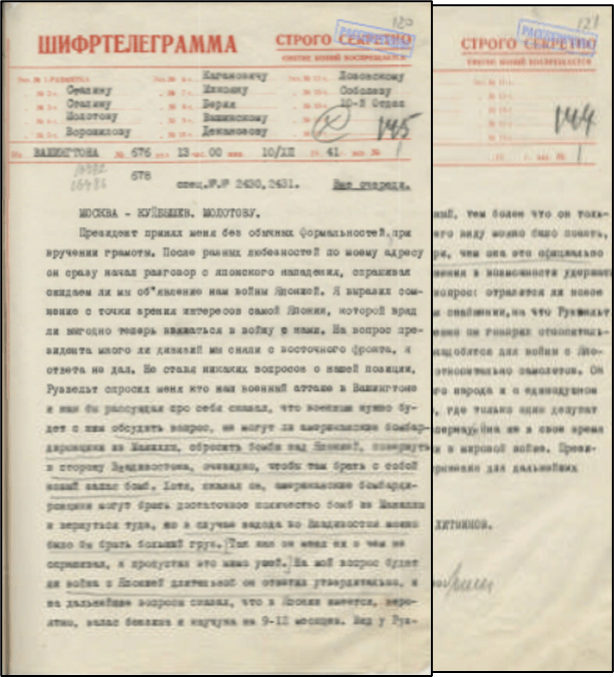
On 8 December 1941, new Soviet Ambassador to the United States Maksim Maksimovich Litvinov met with US President Franklin Roosevelt to present same with his credentials and address the Japanese attack on Pearl Harbor. The following is an English translation of the coded telegram penned by Litvinov that day (sent to Moscow on 10 December). The header information notes that copies of this telegram were sent to Stalin, Molotov, Voroshilov, Kaganovich, Mikoyan, Beria, Vyshinskiy, Dekanozov, Lozovskiy, Sobolev, and the 10th Department.
CODED TELEGRAM – TOP SECRET
From WASHINGTON 13:00 10 XII 1941 Priority
MOSCOW – KUYBYSHEV. TO MOLOTOV.
The President greeted me without the usual formalities when I presented him with my credentials. After several pleasantries addressed to me, he immediately began discussing the Japanese attack, asking if we expect any announcement by Japan regarding war against us. I expressed doubt, from the point of view of the interests of Japan herself, for whom it would scarcely be advantageous to get entangled in a war with us. When asked by the President if we had removed many divisions from the eastern front, I didn’t provide an answer. Without asking any questions regarding our position, Roosevelt asked me who our military attaché was in Washington, and as if talking to himself, said that the military would have to discuss with him the question of whether American bombers from Manila could drop bombs on Japan and turn toward Vladivostok, obviously in order to pick up a fresh load of bombs. Although, he said, the American bombers could carry a sufficient number of bombs from Manila and return there, but in the event of a stopover at Vladivostok, it would be possible to take a larger load. Since he didn’t ask anything of me, I paid it no heed. To my inquiry as to whether the war with Japan would be a lengthy one, he answered in the affirmative, and to my further questions, he stated that Japan most likely has fuel and rubber supplies to last 9 to 12 months. Roosevelt appeared tired and edgy, especially as he had just returned from Congress. From his appearance, it could be understood that America had suffered greater losses than was officially being acknowledged. Roosevelt expressed doubts that it would be possible to hold the Philippines. I asked just one question: will this new turn of events have an impact on the supplies we have been promised, to which Roosevelt replied that it would not. He spoke more confidently about tanks that America won’t need for a war with Japan, but less so in terms of aircraft. He spoke, of course, about the unity of all people and the unanimous vote in the Senate and House, where only one female lawmaker dissented – Grepernau [sic] – when the time came, she voted against America’s participation in a world war. The President said that he is at my disposal for further discussions.
LITVINOV
 Translating History