
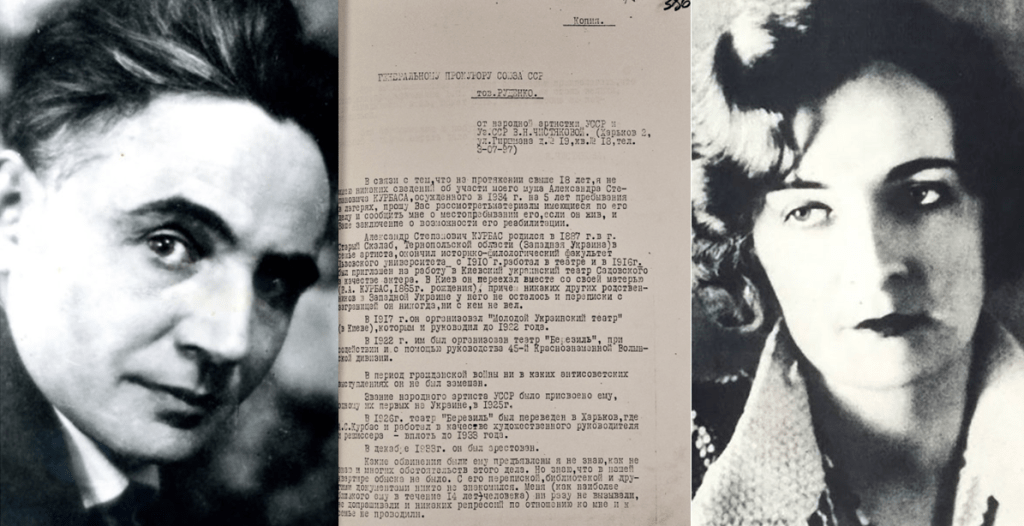
The following is a copy of an undated letter to the Prosecutor General of the USSR Rudenko from People’s Artist of the Ukrainian SSR and UZ SSR Valentina Chistyakova with a request to provide information about her husband Oleksandr Kurbas, who was sentenced in 1934 to 5 years of imprisonment, information about his whereabouts, and the possibility of providing an opinion on rehabilitation. What Chistyakova did not know when writing the letter is that Kurbas was shot on 3 November 1937 with 289 other members of the Ukrainian intelligentsia at the killing field and burial ground of Sandarmokh near Medvezhyegorsk, in Karelia (northwest Russia), a site discovered in 1997 by members of the Memorial Society. This letter first appeared in 2020 on the website of the Digital Archive of the Ukrainian Liberation Movement.
TO THE PROSECUTOR GENERAL OF THE UNION OF THE SOVIET SOCIALIST REPUBLICS comrade RUDENKO.
from People’s Artist of the Uk.SSR and Uz.SSR V.N. CHISTYAKOV (Kharkiv 2, Ulitsa Girshmana No. 19, Apt. 18, tel. 3-07-97)
Because of the fact that, over the course of more than 18 years, I have had no information regarding the fate of my husband, Aleksandr Stepanovich KURBAS, condemned in 1934 to 5 years in camps, I am asking for you to look into available materials regarding his case and let me know his whereabouts, if he is alive, and your opinion on the possibility of his rehabilitation.
Aleksandr Stepanovich KURBAS was born in 1887 in Staryy Skalab, Ternopolskaya Oblast (Western Ukraine) into an artist’s family, graduated from the Faculty of History and Philology of Lviv University, began working in theater in 1910, and in 1916 was invited to work in the Kyiv-based Ukrainian Sadovsky Theater to work as an actor. He moved to Kyiv together with his mother (V.A. KURBAS, birth year 1865), as he had no other living relatives in Western Ukraine, and he never had any correspondence with anyone abroad.
In 1917, he organized the “Young Ukrainian Theater” (in Kyiv), which he managed until 1922.
In 1922, he established the Berezil Theater, with the backing and assistance of the leadership of the 45th Red Banner Volynskaya Division.
During the civil war, he was not involved in any anti-Soviet activities.
He was bestowed the honor of People’s Artist of Ukraine in 1925, one of the first in Ukraine to be honored in this manner.
In 1926, the Berezil Theater was moved to Kharkiv, where A.S. Kurbas also worked as artistic director and stage director up to 1933.
In December, 1993, he was arrested.
I do not know what charges were made against him, just as I do not know many of the circumstances surrounding this case. But I do know that no search was made in our flat. Nobody acquainted themselves with his correspondence, library, or other documents. I, as the person closest to him for 14 years, was never called, never questioned, and no reprisals were carried out against me or the family.
All of this gives me reason to believe that the charges levied against A.S. Kurbas, were not that profound, and today, possibly, they might not be confirmed at all.
This reasoning prompted me to turn to you with the request to reconsider the Aleksandr Stepanovich KUBRAS file.
V. CHISTYAKOVA
 Translating History