
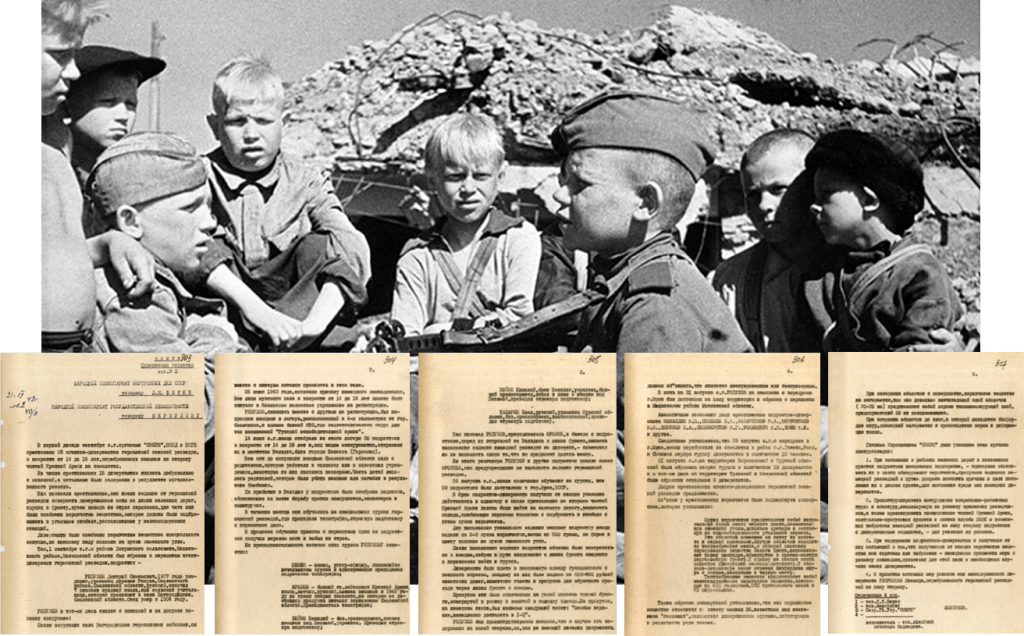
Nine documents were declassified and published on the Russian FSB (Federal Security Service) website on 1 June 2024, the International Day for the Protection of Children. This is the fourth in the series of documents translated. This is an undated five-page TOP SECRET report, probably written in September 1943, providing details of the arrest of 28 saboteurs trained to carry out sabotage missions on behalf of the Russian Liberation Army, and details of their training.
Copy 303
Top Secret
Copy No. 3
PEOPLE’S COMMISSARIAT OF INTERNAL AFFAIRS OF THE USSR
to comrade L.P. BERIA
PEOPLE’S COMMISSARIAT OF STATE SECURITY
to comrade MERKULOV
In the first third of this past September, the organs of SMERSH, NKVD, and NKGB arrested 28 German military reconnaissance saboteur-agents, aged from 14 to 16 years old, having been brought over by the Germans into Red Army territory via airplane.
Of those arrested, 15 of the saboteurs voluntarily gave themselves up, and the others were apprehended as a result of an organized search.
As those arrested testified, they were tasked by the German intelligence service to commit acts of sabotage on railway lines traveling to the front line, by incapacitating the locomotives, for which they were provided with explosives which were to be dropped into coal storage piles located at the railway stations.
The saboteurs were equipped with a special mix of explosives which looked like bituminous coal.
On 1 September, near the Khatunsky village council in the Mikhnevskiy Rayon, Moscow Oblast, an underage German intelligence service agent-saboteur parachuted in –
REPUKHOV Dmitriy Semenovich, born 1927, native of the town of Repukha, Smolenskiy Rayon, Smolensk Oblast, a Russian graduate of 7th grade of secondary school, son of the village teacher who lives in the village of Bogoroditskoye, Smolensk Oblast. Father died in 1934.
That same day, REPUKHOV surrendered and offered the following during his interrogation:
After the German forces’ occupation of Bogoroditskoye, he and his mother stayed to live in this village.
On 25 June 1943, following orders from the German command, all males aged 14 to 16 were to appear in the Kozinskoye Volost administration for registration.
REPUKHOV, appearing with others for registration, was directed by the Germans to a camp located four kilometers from Smolensk, in the building of the former MTS, where personnel underwent training for the so-called “Russian Liberation Army”.
On 14 July, the Germans brought 30 children aged from 14 to 16 years out of the camp, and masquerading as sightseers, brought them to the principality of Waldeck, near the city of Kassel (Germany).
All of the children, prior to the German occupation of Smolensk Oblast, lived with their parents, who worked in collective farms or in Soviet institutions, and several of them were members of the pioneer movement. Some of the children were orphaned, their parents having been killed by the Germans or died as a result of air raids.
Upon arriving at Waldeck, signed testimonies were taken from the children that obliged them to wage war against communists, commissioners, and political officers.
Over the course of a month they were trained in special German intelligence courses, including topography, drilling, and parachuting.
While practicing parachute jumping, one of the children broke a leg and was pulled from the ranks.
From the instructor staff of these courses, REPUKHOV knew the following:
SHIMIK – German, an Unteroffizier, in charge of the courses and simultaneously taught topography to the children’
FROLOV – former Red Army senior lieutenant, purported to be a pilot, Russian, captured by the Germans in 1942 during a mishap with an aircraft he used for delivering provisions to guerillas in Smolensk Oblast. Topography instructor;
BOYKO Vasiliy – former Red Army soldier, captured by the Germans near Vyazma, Ukrainian. Conducted training in drilling;
BOYKO Nikolay, brother of Vasiliy, Ukrainian, former Red Army soldier, taken prisoner near Vyazma, conducted training in drilling;
TABARIN Ivan, Russian, native of Kursk Oblast, former Red Army soldier, prisoner of war, conducted training in drilling.
As REPUKHOV testified, instructor FROLOV, in a conversation with the youths before their departure from Waldeck to the front line, in terms of the German intelligence service’s sabotage assignment, advised them to not blindly carry out what the Germans were asking them to do.
From this conversation, REPUKHOV and the other youths understood FROLOV’s advice as a warning to not perform the German intelligence assignment.
On 25 August, after completing training, all 29 of the youngsters were sent to the city of Orsha, BSSR [Belarussian Soviet Socialist Republic].
In Orsha, the young saboteurs received instructions from the Germans to each operate on their own, and after touching down on the side of the Red Army units, they were to head for the railroad, seek out depots that supply the locomotives with their fuel, and drop into the coal piles the lumps of explosives.
In order to carry out this assignment, the Germanys gave each of the youngsters 2-3 lumps of explosives, each weight 500 grams, in the same color and shape as lumps of bituminous coal.
After seeing the assignment through, the youths were to return to the Germans, having gathered information on troop and cargo transports along the route.
The saboteurs wore threadbare civilian and military clothing, and each of them were given 500-600 Soviet rubles, Soviet newspapers and a pass for their return across the front line to the Germans.
These passes were printed on a narrow strip of thin paper, wrapped in rubber, and sewn into the seams of their clothing. The following text, in German, was written on the pass: “Special assignment, deliver immediately to I-Ts.”
REPUKHOV was instructed by the Germans that, in the event of capture on our side, he, not having any documents, would have to explain that he is an evacuee or abandoned.
On the night of 31 August, REPUKHOV, aboard an airplane from an airfield in Orsha, was delivered to our territory and parachuted into the Minnevskiy Rayon of the Moscow Oblast.
The same instructions were given to the following arrested young saboteurs: KOMALDIN V.N., SEMENOV YE.K., ZAKHARENKOV V.A., MINICHENKOV M.Z., KHORISOV YE.A., SELIVERSTOV I.G., ROMANOVICH I.P., YEZIN F.I., and others.
An investigation established that on 29 August, from an airfield in Orsha, the Germans sent the first group of ten saboteurs to the areas of Gzhatsk, Rzhev, and Sychevka.
On 31 August, the second group of ten was sent to the territories of Voronezh and Kursk Oblasts, and on the same day, the remaining nine saboteurs were sent to the territories of the Tula and Moscow Oblasts.
An interrogation of the arrested young saboteurs for German intelligence continues.
The explosives taken from the arrested were submitted to expert analysis, which established:
“The explosive lump is an irregular shape of a mass, black in color, reminiscent of bituminous coal, quite solid, and consisting of bonded coal powder. This cover is applied to a mesh of twine and copper wire. Inside the cover is a dough-like mass in which a pressed white substance is placed, reminiscent of the shape of a cylinder, wrapped in a red and yellow parchment paper. To one of the ends of this substance is attached a blasting cap. Fastened into the blasting cap is a piece of blasting fuse with the end inserted into the black mass. The dough-like mass is a gelatine explosive, made up of 64% hexogen, 28% trotyl oil, and 8% pyroxylene.
Thus, the expert analysis established that this explosive is related to a class of powerful explosives known as “hexanite,” which is a sabotage weapon that operates in various types of burners.
When the case burns from the surface, the explosive does not light up since the rather significant layer of the case (20-30 mm) serves nicely as a heat insulating layer that protects the explosive from igniting.
When the case burns down to the layer containing the blasting fuse, the latter burns and creates an explosion and a deformation of the burner.
The Main Directorate of SMERSH has issued the following instructions to all counterintelligence bodies:
1. Should there appear suspicious youths near railroads and populated areas, search them thoroughly to find explosives and passes issued by German intelligence, and through interrogation, ascertain the reasons and objectives of their appearance in this area, in order to identify the German saboteurs among them.
2. Thoroughly brief members of intelligence-collection groups and agents assets utilized to search for enemy spies, and acquaint the headquarters of Red Army units, checkpoints, and VNOS [air surveillance, notification, and communication] service posts on possible air drops by German intelligence of youths with sabotage assignments, in order to intensify the search for them.
3. Upon detention of the young saboteurs and receiving statements from them to the effect that the explosives they received from the Germans were hidden or disposed of, immediately take steps to search for the latter, and involve the saboteurs themselves for this purpose whenever necessary.
4. On active search measures taken for the not yet detained saboteur GAVRILOV Leonid, air dropped by German intelligence into our side.
4 copies printed
1 – comrade L.P. Beria
2 – comrade Merkulov
3 – Secr. Main Directorate SMERSH ABAKUMOV
4 – ______________
 Translating History