

Nine documents were declassified and published on the Russian FSB (Federal Security Service) website on 1 June 2024, the International Day for the Protection of Children. This is Part One the first in a series of three separate interrogations conducted of Yu.N. Yevtukhovich. Yevtukhovich, a deserter from the Soviet Red Army as a Lieutenant, details how the children were selected from camps in Poland, how they were “encouraged” with a trip to Germany to participate in acts of sabotage against the Soviet Union. Such encouragement came in the guise of trips to the zoo, motion pictures, and getting the youngsters drunk.
RECORD OF INTERROGATION
1945, 27 January Army in the Field
I, Major ROSHNIKOV or Military Unit 44360, interrogated the prisoner YEVTUKHOVICH YU.N.
YEVTUKHOVICH Yuriy Nikolayevich, year of birth 1913, resident of the city of Tambov, comes from a family of seven military service members, Russian, a non-party man, previously belonged to the VLKSM [All-Union Leninist Young Communist League] from 1930 to 1939, departed automatically, being over-aged, incomplete higher education – completed three courses at the Leningrad Civil Engineering Institute, married, wife YEVTUKHOVICH-SOKOLOVA Galina Vladimirovna, lived in Leningrad, current whereabouts unknown. Served in Red Army from July 1939 until March 1940, and from 25 June 1941 to 31 August 1941, last duty – commander of sapper platoon, rank – Lieutenant.
Question: What were you doing before the war between the USSR and Germany?
Answer: After finishing secondary school in 1929 in Pushkin, Leningrad Oblast, due to my parents moving to Sumy in the Ukrainian SSR, I went to work as an apprentice pattern maker at the Frunze Engineering Works in Sumy, where I worked for a year. In the spring of 1930, I moved with my parents to Tomsk, where I enrolled in the first course of the Siberian Mechanical Institute, but didn’t even finish the first course because my father moved to work in Leningrad as an instructor at the Artillery Academy; I moved to Leningrad and enrolled in the Electromechanical Institute.
In 1933, I moved on to the Leningrad Civil Engineering Institute, where I finished three courses in 1937. I dropped out because of difficult financial circumstances, I went to work at the 9th Spanish orphanage, starting out as a secretary, then as a teacher until July 1939. In July 1939 I was mobilized into the Red Army and participated in battles on the Finnish front until March 1940.
After demobilization from the army, I went to work at trade school No. 9 in Leningrad as a draftsman instructor, where I worked until the Great Patriotic War.
Q: What military units were you with when serving in the Red Army, at what part of the front did you take part in fighting against the German troops?
[Translator note: Seven pages of original interrogation report missing, next page joined in mid-sentence]
…to Germany, rewards and other benefits. When the trained agents came to Lieutenant BUKHHOLZ, he also set up some drinking parties with them, which won them over. When training agents to carry out the assignment, they were given the opportunity to go to the movies, get drunk, have some fun. The training itself for the sabotage mission meant that Sonderführer KRAUSE would discuss the practical application of plastic explosives to blow up a railbed, then give a short exam. The agents got to know the ins and outs of the parachute only at the airfield, right before the jump. They were also told what to do with the parachute once they’d landed.
Q: For how long of a period were the assignments estimated, and what were the methods for returning?
A: No specific time frame was established for the agents to carry out the assignment, although the sooner the better. Upon completion of the assignment, the agents had to return by crossing the front line on foot.
Q: How much time were you active in recruiting and training the agents for dropping behind Red Army lines, and with what specific assignments were the agents were they going over?
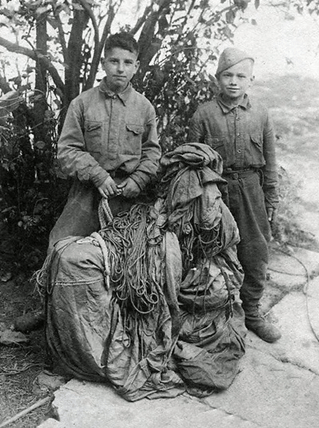
A: I recruited the last four agent-saboteurs, DRUZHKOV, KALASHNIKOV, KOLESNIKOV, and POPET in mid-September 1944. Lieutenant BUCHHOLZ was brought over to recruit agent-saboteurs from a number of 14- and 15-year-olds. All of the agents were dropped behind Soviet lines, only with sabotage assignments.
Q: What did the recruitment and training of agents involve?
A: I’d like to talk about the recruitment and training process in greater detail, since I personally spent a great deal of time on these issues.
It was N.S. FROLOV’s idea to create a group of youngsters. He made the recommendation to BUCHHOLZ in the summer of 1943 in the S-camp, and along with that, both FROLOV and, later on, BUKHHOLZ himself were guided in this matter by the following considerations: the ongoing war in the Soviet Union is leaving behind ruined cities and towns, the population of which partly dies and partly remains behind. Families fall apart, and a lot of the little ones have lost their family home and parents, and just wander from place to place which, in the opinion of both of them, which never arouses the suspicion of the Red Army units, which would sometimes or never bother with the question of trying to find out the identify of these little vagabonds. The psychology of the child during adolescence is such that he is drawn to journeys and adventure, imitating the grownups, and during the war, imitating soldiers. There’s substantial intrigue in forcing a child to actually inspect the demolition supplies and explosives given to him, if not consciously, then out of interest. Having provided the youngster the opportunity to wear this or that uniform, playing “soldiers” with him, then he feels as if he is equal to the grownups, military assignments, a sense of discipline, food, distractions – these all place the youth at a leader’s disposal. Then the grave assignment of the mission to the youth, explaining to him why it must be carried out, promising rewards, and so on, finishing up preparing the youth as a weapon in the hands of the Abwehr. This was the explanation of BUCHHOLZ, FROLOV, and others on the issue of using the youngsters.

At BUCHHOLZ’s order, the group of youngsters was sent to the Tuchingen children’s camp near Łódź, where some 2000 children were kept. The camp belonged to the Łódź “SD” department, subordinate to Berlin. The gathering and screening of the youths took place on a voluntary basis, and before the children were arrayed, it was announced that one of the Russian volunteer units was selecting a group of foster children. During the first gathering, Sonderführer KRAUSE and I brought with us Ivan ZAMOTAYEV, who was already wearing a uniform with belted pistol, which would surely arouse keen interest among the half-starved, poorly dressed children.
More volunteers were found than required for the assignment (24 children). Having formed up the youngsters who stated their willingness, I went down the row and selected the most lively and spirited, based on their appearance. My 9 years of experience working with children before this turned out to be a big help in this endeavor. The group wound up with the liveliest children, some with criminal records.
A group from the same camp, according to BUCHHOLZ, “for after,” was fitted out anew with neat uniforms with a three-color device on the sleeve, new boots, good underwear, and stockings, which proved to be a sharp contrast with the camp uniforms made of dirty gray cloth and wooden “shoes”.
Upon arrival at their encampment, the children were fed beyond all norms, with white bread, butter, sausage, and sweets, and a good deal of attention was further paid to the question of sustenance, which was the responsibility of KRAUSE and Gefreiter NITSCH, who was attached to the group. The presence of the Germans was explained by the lack of their own gear in the Russian volunteer units, and that’s why the need to call on the help of the Germans to obtain food, weapons, money, clothing, and expenditures, and whose use was controlled by the Germans, and to what end KRAUSE and his assistant Gefreiter NITSCH was with us to supply everything needed, even to the provision of amenities. The group was told that, before the classes were to start, everyone would be given a rest, in order to regain their strength. The group was divided into operational units headed by commanders (consisting of children) and Ivan ZAMOTAYEV was the captain in charge of maintaining order.
The group was given an excursion program to the cities of Wrocław and Dresden for a period of 10-12 days.
The group was enlisted on 12 September 1944; before this, the time was spent preparing their uniforms, accommodations, and documents. On 14 September 1944, under my supervision and that of KRAUSE, the group started off on the excursion.
–During the excursion, we drew the children’s attention to the beauty of the locations, the cleanliness and order, the conditions of the roads and buildings, and how it all compared with what they had seen in the Soviet Union. In Dresden, we visited kulak farms, examined farm equipment and houses. We visited zoos and went to movies, set up boat trips to the mountains, visited eateries where the teenagers were introduced to the pleasure of drinking beer. During this time, I was sizing up the liveliest and most spirited of the children. In Dresden, we conducted one-on-one conversations on the children’s biographies, where I discovered that 90% of the youngsters were the children of partisans or those taken by force by the Germans. These children lived through the horrors of concentration camps and prisons, where they watched their mothers die from starvation, where they were separated from their fathers by barbed wire, or where finally, without any reason, they were forcibly separated from their mothers, brothers, and sisters.
End of Part One.
 Translating History