
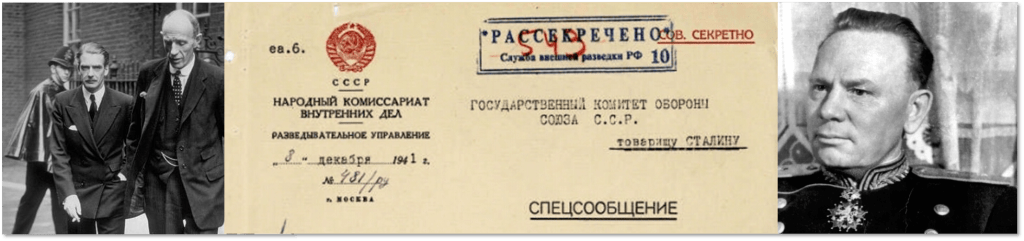
On 8 December 1941, the Head of the Soviet NKVD Intelligence Directorate, Pavel Mikhaylovich Fitin, dispatched a special message to Josef Stalin regarding the contents of an intercepted telegram sent on 24 November 1941 from British Foreign Minister Anthony Eden to Lord Halifax, British Ambassador to the United States, regarding Japanese-American discussions in Washington.
TOP SECRET
STATE DEFENSE COMMITTEE OF THE UNION OF SOVIET SOCIALIST REPUBLICS
To Comrade Stalin
SPECIAL MESSAGE
We are reporting the contents of an immediate-precedence telegram dated 24 November of this year from British Foreign Minister Anthony Eden to Lord Halifax, British Ambassador to the United States.
The contents of the telegram were obtained from London by the NKVD Intelligence Directorate using the agent network.
“Regarding your telegrams on the Japanese-American discussions in Washington:
1. The Japanese proposals are quite typical and confirm the opinion that the objective of the Japanese is the most rapid dismissal of the use of economic pressure against them, but not the swift resolution of other issues. We agree with the comments from Mr. [Cordell] HULL on this proposal and hope to add the following to his remarks:
2. The first paragraph of proposals refers only to an “armed” advance, fully allowing the Japanese to continue their infiltration (which, in any case, is very difficult to regulate) and which they can interpret as ruling out the further strengthening of the Philippines and other forward positions of the democratic powers.
3. Paragraph 3 suggests that the Dutch East Indies should only be viewed as a freight depot and factors little into Holland’s sovereignty.
4. Paragraph 4 strongly accentuates the oil Japan needs primarily for military purposes.
5. Succinctly speaking, the Japanese proposals boil down to the following: measures to freeze Japanese funds will not only be called off, but moreover, Japan will be afforded assistance in obtaining certain goods, including oil, while at the same time aid to China will be cut off. The only specific proposal Japan makes from their side is the transfer of its troops from one part of Indochina to another.
6. Clearly, these proposals are totally unacceptable; in this case, the only choice is to either refuse them (while hinting that coming to a limited agreement is not ruled out) and provide Japan the opportunity to make other proposals, or to make their own counterproposals.
7. We are absolutely certain that it is appropriate that Mr. HULL leads these discussions, that he can best judge which of these two paths is tactically more suitable. We are also absolutely certain in their complete understanding that Japan is attempting to impose a hasty decision by exaggerating the danger of further delay.
8. However, the prediction of Dr. HORNBECK (note: HORNECK is a US State Department advisor on political affairs), as noted in paragraph 4 of your telegram, has made an impression on us. He is wary of the sort of agreement the Japanese are proposing. It is necessary to make sure that such a characterization cannot be applied to any sort of agreement that we eventually reach.
9. We feel that the Japanese proposals must be viewed as an initial step in the “business transaction” process. Japan is hoping to achieve the maximum of their demands at the lowest price. If our counterproposals have to be made, then we feel this process should be carried out the other way around, that our own demands must be satisfied at no great cost to us.
10. Mr. HULL’s counterproposals, as communicated in paragraph 5 of your telegram, in our opinion, cannot justify the softening of economic measures against Japan. The withdrawal of even the “bulk” of Japanese troops from Indochina leaves far too large a loophole. It is improbable that we can justify in any way accepting this wording as satisfactory, or even more improbably, support it. Considering it untoward to reassess out counterproposals, we feel it would be advantageous (from Japan’s point of view) to arrange them in such a way as to prevent the possibility of an insidious attack on Kunming during the term of the interim agreement.
11. On this basis, we would like to propose for consideration to the US government the following proposal: any counterproposals must stipulate the complete withdrawal from Indochina not just the “troops,” as the Japanese themselves are proposing, but also the naval, ground, and air forces with their weapons, and the halt of further military advances into Indochina, not (indistinct…in reference to?) sufficient assurances related to the other areas in Southeast Asia, the southern Pacific Ocean, and Russia.
A partial softening of existing economic measures may be offered as compensation, in so doing, to make it possible to import a limited amount of goods into Japan to support the well-being of the Japanese civilian population, but of course not including goods that would have a direct impact on the country’s military potential, most particularly oil. This softening will be effective only when the advancement of the Japanese armed forces is halted, and we can expect to receive from Japan similar goods, should we have a need for them.
12. Mr. HULL made it absolutely clear to the Japanese that any provisional agreement is merely a first step for a broader resolution to the issues that must be in accordance with the primary principles acceptable for the US. In order to prevent the Japanese distorting the true significance of what is happening, we feel it is necessary to publicly announce that any interim agreement is provisional and will be entered into only to foster dialogue about the final agreement on the fundamental issues acceptable for all interested parties.
13. All of the above represents our immediate edits and is presented without consultation with the governments of the dominions which, like the Dutch and Chinese governments, may have other proposals.
14. All that remains is the question you raised in paragraph 8 of your telegram in terms of the scope of authority that can be brought forward by representatives of the interested powers in Washington. We, of course, would like to use all measures to ease the difficult task of Mr. HULL. But our economic structure is so complex (most notably due to the need to consult with representatives of other subsets of the empire) that we, at present, to not feel it practical to afford unlimited authority to diplomatic representatives. Should the US government approve of the aforementioned proposal, then it will be necessary to identify more specific differences between goods that are essential for the well-being of the Japanese civilian population and important for its military potential, and decide whether or not the easing of economic pressure is to be accomplished using fiscal measures, or by way of barter transactions. Following this, we will be prepared to reconsider the question of rendering assistance.”
CHIEF OF THE INTELLIGENCE DIRECTORATE OF THE USSR NKVD
(FITIN)
Dissemination: Stalin / Molotov / Beria / Merkulov
 Translating History