
On 9 May 1945, the Great Patriotic War came to an end. However, the evolution of relations between the allies indicated that the peace that had come was fragile. The military understood that a new war, if it happened, would be waged using new types of weapons – missiles, jet aircraft, and super-powerful ammunition. But in 1945, the USSR was lagging behind not only German, but also the Soviets’ allies – the USA and Great Britain – in developing these weapons.
Even before the end of military operations in Europe, Soviet leadership knew about Germany’s promising developments of long-range missiles and their successful use to strike the British Isles. After the war, the Soviet military command was tasked with collecting as much information in its occupation zone as possible about the latest types of rocket technology developed by Nazi scientists. Groups of Soviet scientists and engineers were sent to German scientific and production rocket centers, including Peenemünde and Nordhausen. Among these specialists were future academicians S.P. Korolev, B.E. Chertok, N.A. Pilyugin, V.P. Mishin, and other scientists who soon created the USSR’s rocket and space industry.
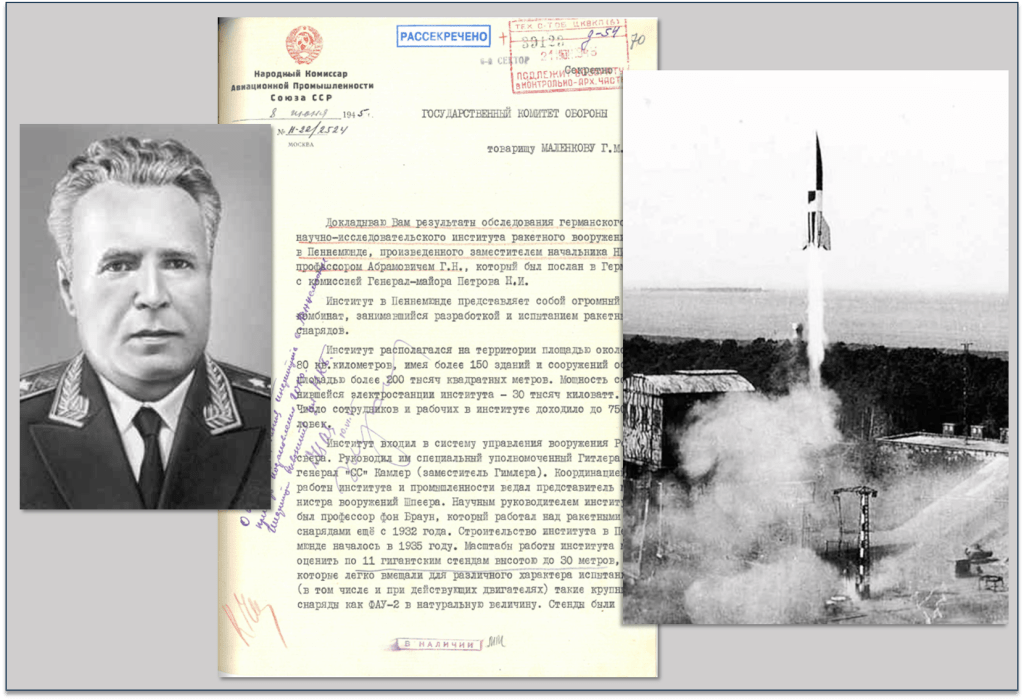
This translated document (dated 8 June 1945) presents the results of a study of the Third Reich’s Peenemünde testing ground and rocket center in northeastern Germany, conducted by G.N. Abramovich, the deputy head of Scientific Research Institute-1 (formerly the RNII of the People’s Commissariat of Heavy Industry of the USSR, which was part of the structure of the People’s Commissariat of the Aviation Industry; currently the M. V. Keldysh Research Center).
Abramovich was a member of a commission of Major General N.I. Petrov, sent to Germany to study work on rocket weapons. The emphasis in the note on the “artillery” nature of the Center’s work subject matter is noteworthy, with the subsequent conclusion on the advisability of assigning work on mastering the FAU-2 (V-2) rocket to the People’s Commissariat of Munitions. This recommendation, supported by the government, limited the opportunity to use aviation technologies and bring in companies and specialists from the aviation industry to develop rocket technology in the USSR.
SECRET
STATE DEFENSE COMMITTEE
To Comrade MALENKOV G.M.
I hereby report to you the results of the examination of the German rocket weapons scientific research institute in Peenemünde, conducted by the head of NII-1 Professor G.N. Abramovich, who was dispatched to Germany with General-Major N.I. Petrov’s commission.
The institute in Peenemünde is an enormous center involved in the development and testing of rocket projectiles. The institute is situated in an area of about 80 square kilometers, with more than 150 buildings and structures of an overall space of greater than 200 thousand square meters. The output of the institute’s remaining power station is 30 thousand kW. The institute boasts up to 7500 employees and laborers.
The institute was part of the Reichswehr weapons control system. It was supervised by SS General Kammler (Himmler’s deputy), specially assigned by Hitler. The institute’s operations and production were coordinated by the deputy to Speer, the Minister of Armaments. The chief research officer of the institute was von Braun, who has been working on rocket projectiles since 1932. Construction began on the institute in Peenemünde in 1935. The scale of the institute’s work can be gauged based on the 11 gigantic test stands, 30 meters tall, that could easily accommodate various types of testing (to include for running engines) for such large projectiles as full-scale V-2s. The stands were equipped with water-cooled walls, dynamometers for measuring the force impacting the projectiles, instruments to measure angular acceleration of a free-hanging projectile, equipment for thermal measurements, etc.
The exclusive single-purposefulness of the work at the institute command’s one’s attention. Here, in spite of the sheer force and large number of employees, all they worked on was rocket artillery – rocket projectiles running only on liquid fuel and liquid oxidizers.
This single-purposefulness is even highlighted by the fact that, according to the former institute employees that have stayed behind in Peenemünde, the test facility for the V-1 buzz bombs located next to the institute had nothing to do with the institute, and in contrast with the institute, it was directly subordinate to the Luftwaffe.
Well before the Red Army arrived, the institute was evacuated to central Germany (to Thuringia), where all of the production equipment was sent, along with all of the main employees, headed by von Braun, and all of the test laboratory gear. Left behind were the large test stands with heavy equipment, tanks with various types of fuel and oxidizers, two large, completely intact oxygen plants, an operational power station, and bits and pieces of various rocket projectiles.
Based on the abandoned structures, recovered projectile pieces, and interrogations of the institute’s remaining (second-level) workers, the following conclusions can be made:
1. The primary focus of the institute’s work was the development of FAU-2 [V-2] long-range rocket (length 14 meters) with a firing range of 300-350 km. These projectiles were developed in 1942 using an alcohol-fueled engine and liquid oxygen as an oxidizer. However, in flight, these rockets tended to detonate prematurely and were poorly controlled by radio, after which they were used when bombing London (the technical name of this projectile is the A-4). Work was being performed to improve precision and increase the range of the FAU-2 rockets to 550-600 km.
2. The institute was engaged in developing radio-control anti-aircraft missiles. The anti-aircraft missile resembles the FAU-2 in shape, but differs in terms of dimensions (length of 8 meters). The engine uses nitric acid as an oxidizer (oxygen is not suitable for anti-aircraft missiles due to its rapid evaporation, since anti-air missiles must be able to endure prolonged storage in full firing readiness).
As a result of the commission’s work, rockets and a number of drawings were discovered that will allow us to study the configuration and operation of the German rocket projectiles, glean the progression of their evolution, and take into account the experience of their development.
It is clear from the inspection materials from the German rocket weapons institute in Peenemünde that the work to create the FAU-2 and other types of rocket projectiles are of an artillery profile, and therefore should be entrusted to the People’s Commissariat of Munitions, including the handover of all remaining equipment from the Peenemünde institute.
A. SHAKHURIN
 Translating History