

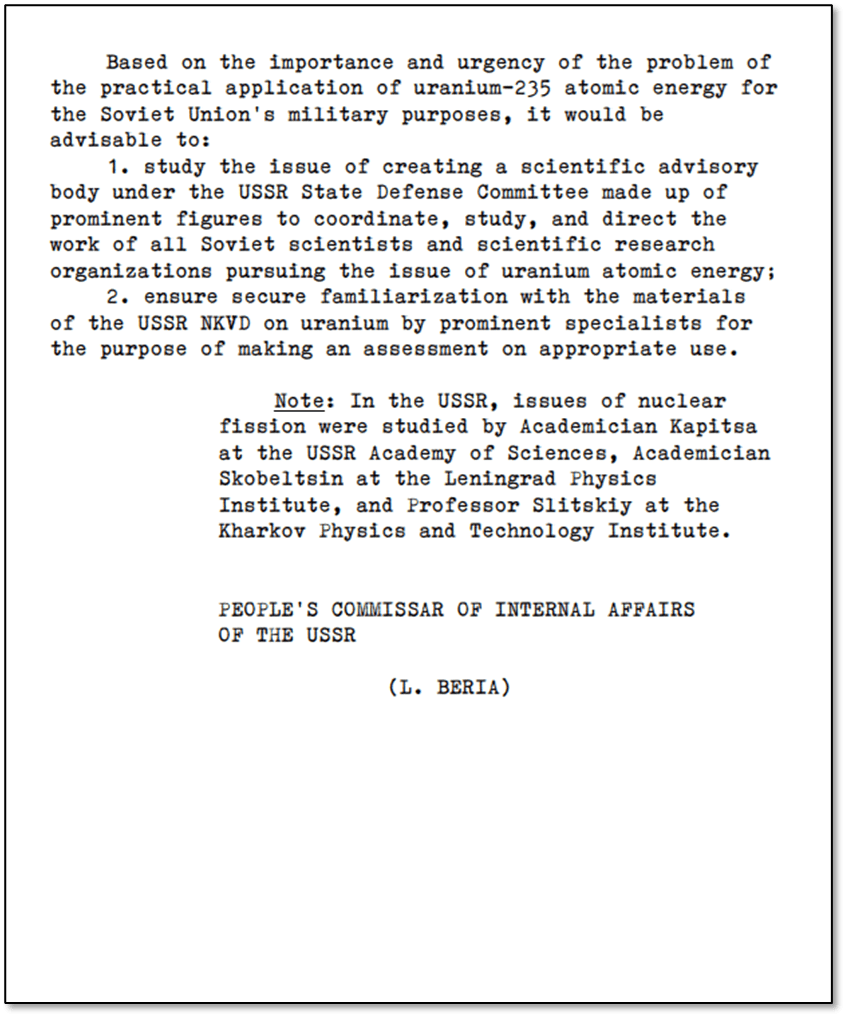
In March 1942, Lavrentiy Beria penned a Top Secret internal report for Josef Stalin regarding recent advances by a number of non-Soviet countries (England, France, Germany, and the US) in trying to achieve nuclear fission as a new power source. These research efforts have, in turn, spawned interest in seeing how this new science could be applied to military use. Beria notes that highly classified materials were obtained by the Soviet NKVD from sources in England, and draws several conclusions regarding the marked urgency of the WW2 Allies to develop a “nuclear “uranium bomb” before the Germans.
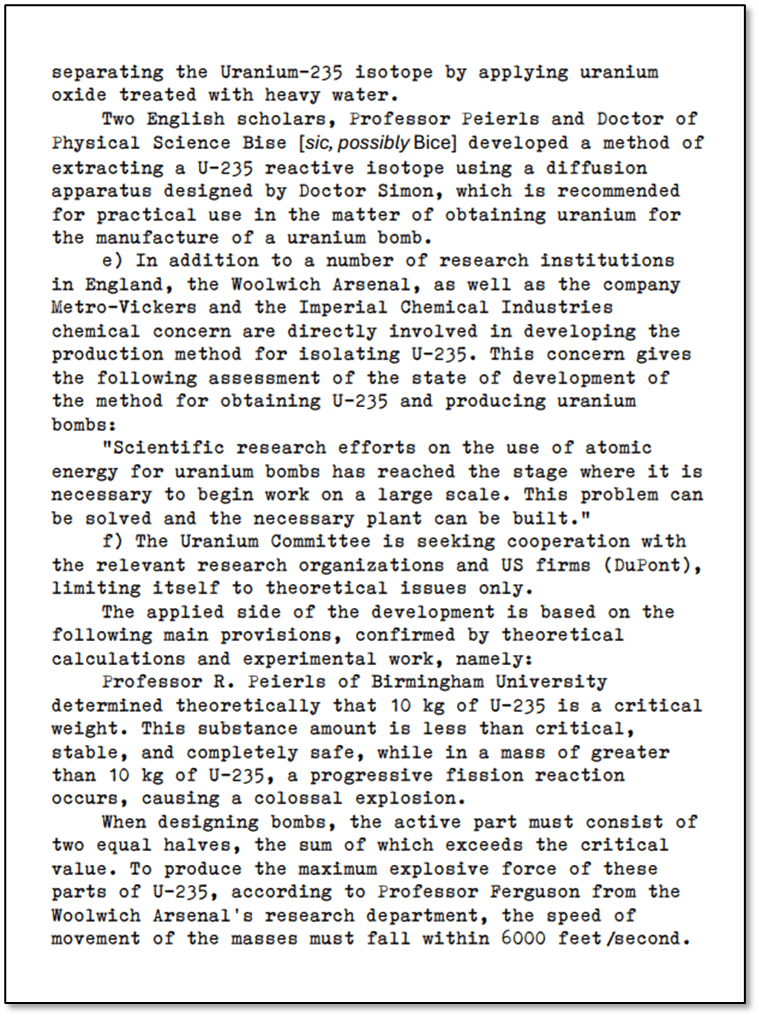
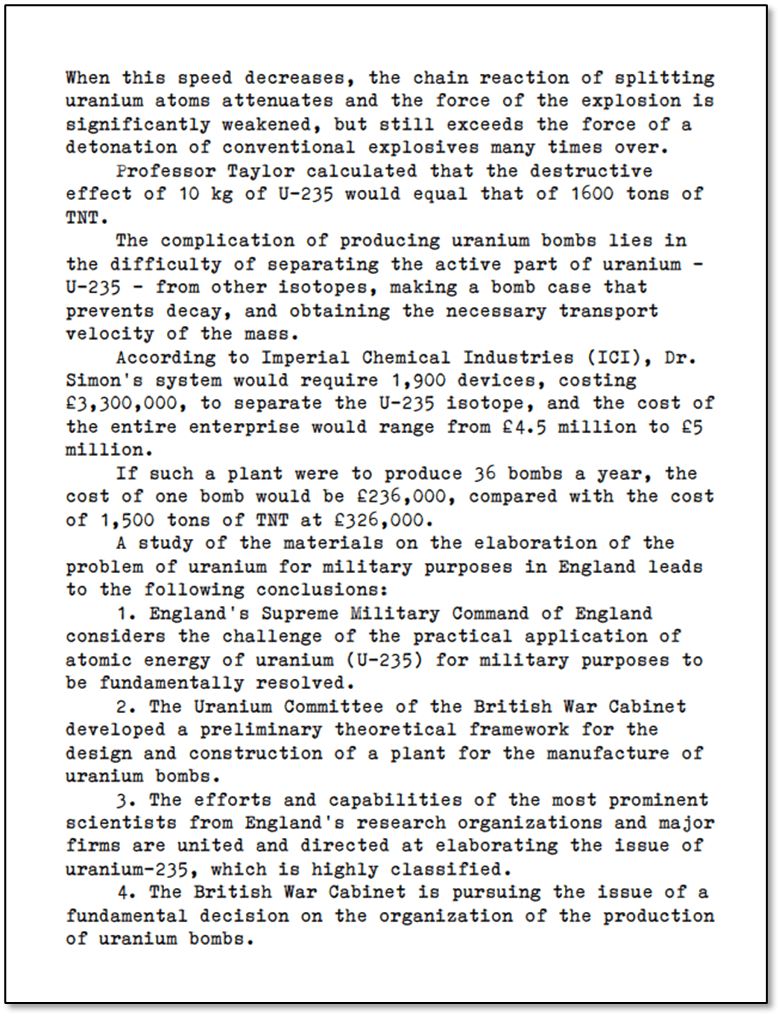
Beria spells out specific areas of research conducted by English and French scientists, and offers that the primary difficulty in producing a viable weapon is three-pronged: tackling the ability to separate the U-235 from other isotopes, fabricating an appropriate bomb casing that prevents the uranium’s decay, and generating the necessary impact velocity for the active ingredients to achieve an adequate chain reaction.
Beria also cites intelligence data that a factory to manufacture the weapons would cost as much as £5 million, and that “if such a plant were to produce 36 bombs a year, the cost of one bomb would be £236,000, compared with the cost of 1,500 tons of TNT at £326,000.”
This is the second in a short series of declassified Russian-language documents reporting on the race to be the first country to possess a nuclear bomb.

 Translating History