

It’s now been four days since the 15 April announcement on the Anonymous France and Anonymous Twitter accounts regarding “10TB of leaked data on all businesses operating in Russia, all Kremlin assets in the West, pro-Russian officials, Donald Trump, and more.” For a website such as ours, it was a compelling call for action.
Prompted by “Translator Monkey,” a frequent co-conspirator and fellow Russian translator, we were able to follow the links to download this historic treasure trove of dirt, and within minutes we had our hands on the goods.
Imagine being promised a chance to hold the Hope Diamond, and instead being tossed a cubic zirconia. Lustrous, yes, but not quite as advertised.

The MediaFire ZIP file, reported on 15 April, is said to have been uploaded from Ukraine on the 18th. So the original 10TB of data may have been swapped with a slightly different package – one that weighs in at a comparatively dinky 18.96GB. Further, if the original package contained data “on all businesses operating in Russia,” the new package contains data on (needless to say) woefully fewer businesses.
However, it must be said that a very large portion of the material provided was of direct interest to people in our line of work – information on Russian defense enterprises, many of them well known in our corners. See if you recognize any names.
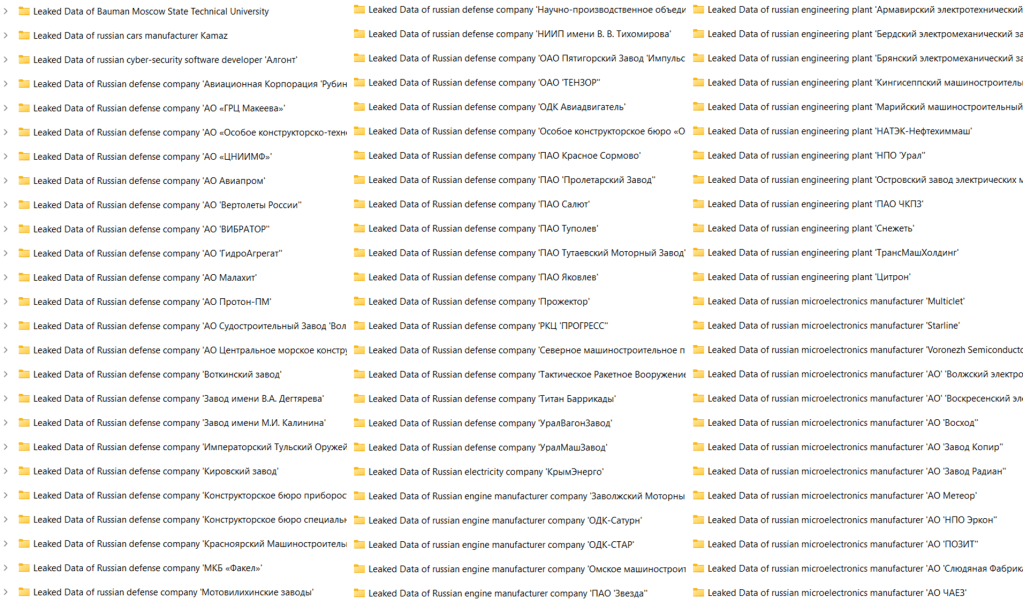
I could provide dozens more screen shots like those above, but you get the picture. There are oil companies, software developers, cyber security organizations, aviation plants, shipyards, chemical plants, sensor developers, engineering plants, and on and on and on. More on these later.
Also included were piles of personal folders and files of people and public organizations, famous and not-so-famous (yet), on all sides of the Atlantic and Pacific, from Domino’s to Donald. Many of these include details of social media accounts, personal webpages, company sites, proxies, passwords, “items of interest,” and vulnerabilities – how to walk right in through the backdoor. As fascinating as this information looks from a distance, we decided that this is not the sort of stuff we’re looking for – there are plenty of people who would love to have access to the information on neo-Nazis, Russian public figures, American politicians, and Russian and American news organizations, to name a few. But that’s not us. We deleted these outright.
Instead, with Translator Monkey’s assistance, we set to work plumbing the depths of the Russian defense-related material noted above. We dove through folders marked “leaked documents,” “leaked videos,” “leaked presentations,” “vulnerabilities,” and on and on. We were anxious to see what types of documents we could grab to begin translating and publishing to help expose the numerous corrupt officials we were supposedly encountering. And we arrived at a rather tragic conclusion: there’s just too many pieces to get our arms around. Like being handed a million-piece jigsaw puzzle, and no picture to guide you on what goes where.

Drowning in data at this point, we can say that what we DID encounter may be of interest to a number of journalists, political junkies, intelligence analysts, and even the casual layperson. The companies we looked into provided massive amounts of information on the names of personnel working at those companies, sometimes their faces, email addresses, company phone numbers, personal mobile numbers, business addresses, home addresses, ad nauseum. There are also scads of financial documents that may be of interest in connecting this or that organization or agency to some nefarious goings-on in Ukraine and elsewhere. Annual reports, certifications, licenses, minutes of stockholder meetings, product catalogs, and so on.
Unfortunately, the OSINT folks we know will be quick to look at this cache and announce (correctly) that almost all of this can be acquired through a general scrape of this or that website. Fair enough, but here we are offered a one-stop shopping opportunity, and that’s not necessarily a bad thing. But is it of any value for our purposes? Probably not.
One gem was found in a folder tied to a well-known ship design bureau; it contained a government document advising company leadership that any documentation containing financial information is considered by the government to be a “state secret,” and should be protected accordingly. In the same folder, there are dozens of documents containing (you guessed it) company financial information. So that’s nice.
Almost all of the material we went over appeared to be something that anyone with a capable machine translation tool and appropriate OCR (optical character recognition) package could grab and easily produce a functional translation. Some of it appears to require the closer scrutiny provided by a human translator in order to catch nuances not often understood by our robot friends.
Sadly, however, we don’t see much value in proceeding with exploitation of the material for publishing on our website. We’re happy to consider any requests for information on documents or folders of interest offline; drop us a note.
 Translating History