
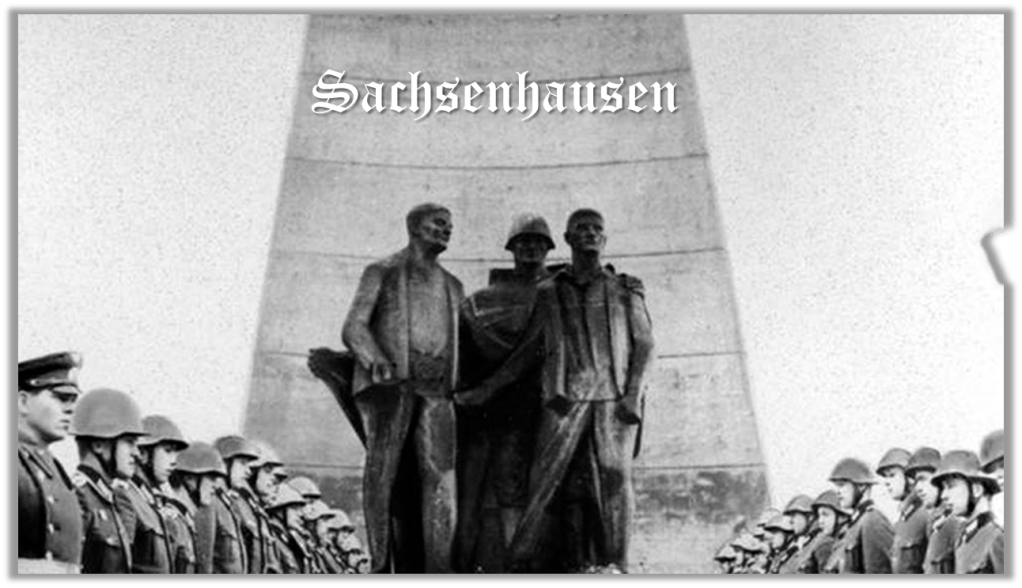
We continue our translation of the Russian-language record of the December 1946 interrogation of SS Standartenführer Anton Kaindl who, at the time of his arrest in May 1945, was the commandant of the infamous Sachsenhausen concentration camp.
Due to its length, the translation is being published bit by bit throughout the week. In Part One Kaindl described his early years and political motivations, his military life and work for the Nazi Party, and his assignment to the SS Concentration Camps Inspectorate and as commandant of the Sachsenhausen camp. In Part Two, Kaindl begins to describe the layout and function of the various segments of Sachsenhausen and the need to construct its gas chamber.
Question: Your new appointment was obviously as a result of your fervent service to the Nazi authorities?
Answer: I’ve already testified that I was loyal to Hitler’s government and was diligent in the fulfilment of my duties. In 1938 I received the Sudetenland and Austria medals, in 1940 I was awarded the Iron Cross Second Class, and in 1941, I was awarded two crosses – the Kriegsverdienstkreuz, First and Second Class. Obergruppenführer POHL was pleased with my work, which is why he appointed me to work in Sachsenhausen.
Q: Having been in the SS Totenkopfverbände starting in 1936, and subsequently having worked in the Concentration Camps Inspectorate, you were well acquainted with the organizational structure and function of Germany’s concentration camps. Provide us with the details.
A: The history of the concentration camps in Germany begins in 1933, when the Nazis came to power. At that time, at the initiative of former chief of police GÖRING, concentration camps were constructed in various regions of Germany. These were subordinate to the local provincial authorities.
In 1934, when HIMMLER ran the German police, and then the German Reichsminister of the Interior, he reorganized the supervision of the camp system and created five large central camps, directly subordinate to the Reichs Ministerium of the Interior. These camps were located in Dachau, Esterwegen, Kolumbia – Berlin, and Frankenburg for the men, and Lichtenburg for the women.
As of 1939, the number of concentration camps in Germany grew to 25, and this refers only to the main camps which, in turn, had a broadly distributed network of branches in various enterprises, construction and earthworks, in at least 800-900 locations.
To maintain each prisoner, the SS concentration camp directorate received less than two marks from the German Ministry of Finance. Prisoners were widely used in military and other factories, for which the SS directorate paid the Ministry of Finance from one and a half to two marks for each workday. If the prisoners worked in a state or private factory, the Ministry of Finance received four marks for unskilled labor, and six marks for qualified specialists.
Thus, the headquarters of the Concentration Camps Inspectorate was interested in employing cheap prison labor at its factories and extracted huge profits from the use of the free labor of the prisoners at their factories.
I have pointed to the number of concentration camps and the work conditions of the prisoners in Germany, touching only on the central SS camps and their branches. Additionally, just as in Germany, there was a large network of Wehrmacht camps in the occupied territories of the European countries, but I have no information on them.
Q: As a senior official in the SS Concentration Camps Inspectorate headquarters, were you not aware of the agreement between HIMMLER and KEITEL resolving the so-called “prisoner of war problem”?
A: In the early days of October 1941, when I arrived from the Totenkopfdivision to work in the camp Inspectorate headquarters, SS camp inspector GLÜCKS informed me about the conversations that took place between HIMMLER and KEITEL. GLÜCKS stated that he learned from HIMMLER that General KEITEL agreed to send from 300 to 400 thousand Soviet prisoners of war to the concentration camps to be used in the munitions industry, as well as in earthworks and other construction work of strategic value. In mid-October of that same year, GLÜCKS received a written order from HIMMLER to perform the preparatory work in the SS concentration camps to receive the aforementioned contingent of Soviet prisoners of war. GLÜCKS dispatched HIMMLER’s order to the camp commanders and, to the best of my knowledge, soon afterwards, large batches of Soviet prisoners of war began to come into our camp system from the Wehrmacht camps.
Q: Is it true that the Soviet prisoners of war were sent to the concentration camps not only for backbreaking labor in the munitions industry and construction, but also to be exterminated?
A: Two or three days before the German military attack on the USSR, the regiment and division commanders of the German Army were made aware of HITLER’s top secret order regarding movement to special locations for holding captured political workers and Soviet communist officers. This category of prisoners of war, as well as individuals from the civilian population of the occupied territories of the Soviet Union and other European countries, transported by SS elements for antifascist activities to the Reich Security Main Office, were sent to the concentration camps to be exterminated.
I know of this not just from my own work in the SS Concentration Camps Inspectorate. While serving as commandant, I was constantly carrying out unlawful orders for the mass extermination of Sachsenhausen camp prisoners.
Q: Thus, would you say the activities you were carrying out in Sachsenhausen were being carried out, without exception, at the other German concentration camps?
A: Yes. The German authorities turned the Sachsenhausen camp into a place to exterminate prisoners of war and civilians forcefully removed to Germany from occupied areas of the Soviet Union, as well as from other European states. By its very character, Sachsenhausen was a death camp, as were the other concentration camps in Germany.
Q: What was the state of the Sachsenhausen camp when you arrived to oversee it in August 1942?
A: In late 1942, Sachsenhausen housed up to 16,000 prisoners, 12,000 of which were brought in from occupied areas of the USSR and other European states. By the end of 1944, the number of prisoners grew to 50-60,000.
Along with the adults, there were as many as 800 Soviet youths between 14 and 17 years old, and Polish children aged 6 to 12, brought in to work in the camp.
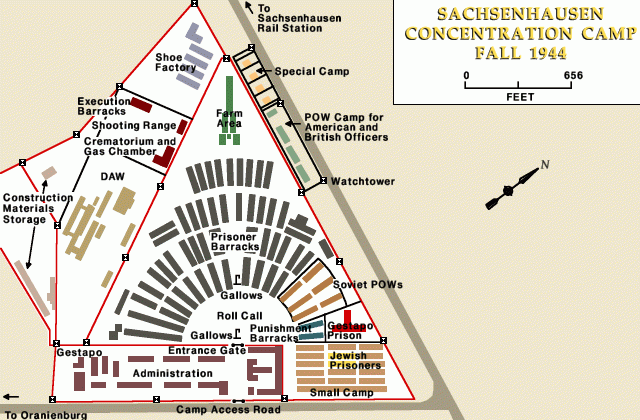
In size, Sachsenhausen covered 160,000 square meters, where there were some 60 barracks for prisoners, a prison with 70 cells, and incidental barracks. Adjoining the camp were a so-called “industrial yard” area with workshops and crematoria, as well as a pre-zone area with administrative buildings.
The camp framework subordinate to me consisted of 180-200 workers, and 18 security squads varying in numerical strength from 1500 to 3000 men.
The camp was arranged as follows: camp commanding officers HÖHN, KOLB, and KÖRNER report to me as commandant, and who, in turn, oversee the Rapportführer, who is responsible for the movement and accounting for prisoners, as well as their movement, the Blockführers, in charge of the condition and operation of prisoner barracks. In addition, I was also in charge of the camp political department, which was involved in investigating prisoners’ cases; chief camp physician BAUMKÖTTER; the manpower distribution section, headed by REHN; a judicial officer; adjutant’s office; and security battalion.
Sachsenhausen was built on HIMMLER’s order in 1936-37 to house political enemies of the Nazi regime, and during the wat, for prisoners of war and persons of all nationalities fighting with the occupying powers of the German armed forces.
Q: Upon being designated commandant of the Sachsenhausen camp, what instructions did you receive in terms of the work?
A: I received no special directives, since during my service with the SS Concentration Camps Inspectorate headquarters, I was well-versed with the role that was intended for the camp commandant. During day-to-day activities, orders from HIMMLER and his assistants were continuously being sent, and I fulfilled them unquestioningly.
Q: Specifically what unlawful orders were sent to you for execution?
A: Even before working as the commandant of Sachsenhausen, as directed by Reich Security Directorate, truckloads of people were being sent to be exterminated.
From the very first day of my service in the camp, that is, from 1942, all the way until its evacuation in April 1945, by order of the Deputy Chief of the Reich Security Main Directorate, Gruppenführer MÜLLER, prisoner transports arrived at Sachsenhausen systematically, once or twice a week, with the standing order that all of those brought to the camp be exterminated.
Transports delivered prisoners to Sachsenhausen from all of the Gestapo and SD camps located in Germany’s northwestern districts and in the Berlin area. The order was usually signed by KALTENBRUNNER’s subordinate, MÜLLER, with the order as to whether the delivered prisoners were to be shot or hung. The number of transports varied at different times, but I can state approximately that, according to the orders of the Reich Security Main Directorate, more than 150 people were sent to use each month, which we exterminated.
So over the period of my work at Sachsenhausen, from 1942 to 1945, on order from the Gestapo and SD alone, we killed more than five thousand people.
Q: Who were these people?
A: Transports coming in at the direction of the Reich Security Main Directorate arrived at Sachsenhausen with people of different nationalities of the European countries occupied by German forces. The majority of these were Soviet civilians – as many as 30% of the total number in the transports arriving from Berlin. Among the Soviet civilians sent for extermination, the majority was made up of non-combatants forcibly brought to Germany to work.
These people were sent to Sachsenhausen camp for extermination without trial or investigation, all based on the single order from MÜLLER. They were killed for resisting German authorities, participating in sabotage activities, refusing to work, or on political grounds.
Q: Provide detail on what methods were used to exterminate those people brought to Sachsenhausen?
A: Before autumn 1943, the extermination of individuals transported to Sachsenhausen from Berlin took place by shooting, in a facility specially equipped for this purpose on camp premises, and by using mechanized gallows located on the camp’s “industrial yard”.
Q: How were the execution yards equipped in Sachsenhausen?
A: The location for shooting prisoners in our camp was located in a separate room at the “industrial yard,” in a room specially equipped for this purpose. It had two doors, one of which was the exit, and the second led to the morgue, designated for piling up the corpses. Outwardly, this room looked like a sanitary facility. Within there was standard equipment used to measure a person’s height, and an alphabet chart to test vision. Along the measuring instrument board, a firing slit approximately two centimeters wide was cut through the wall which led into the adjacent shooter’s chamber.
The condemned stood with his back to the measuring instrument board, supposedly to have his height measured before the medical examination, and at the moment the command “ready” was given, from the adjacent shooter’s chamber, through the firing slit in the measuring instrument board, the prisoner was shot in the back of the head.
Close to the measuring board, on the floor was a built-in grate, through which, after the gunshot, the blood was washed with water from a hose. The corpse was dragged out of the execution chamber into the adjacent room, the so-called “morgue,” and the next person was brought into the execution chamber. And the process was repeated from the beginning.
The gallows, located in the industrial yard’s shooting range, had a block mechanism to accelerate the hanging. Three to four people could simultaneously be hung on these gallows, and after their killing, were dropped to the ground using the block system.
 Translating History
3 thoughts on “Declassified Interrogation of Sachsenhausen Concentration Camp Commander: Part 2”