

We continue our translation of the Russian-language record of the December 1946 interrogation of SS Standartenführer Anton Kaindl who, at the time of his arrest in May 1945, was the commandant of the infamous Sachsenhausen concentration camp.
Due to its length, the translation is being published bit by bit throughout the week. In Part One Kaindl described his early years and political motivations, his military life and work for the Nazi Party, and his assignment to the SS Concentration Camps Inspectorate and as commandant of the Sachsenhausen camp. In Part Two, Kaindl begins to describe the layout and function of the various segments of Sachsenhausen and the need to construct its gas chamber. In Part Three, Kaindl further outlines the various functions of the various sections of the concentration camp.
Part Three:
Question: We know that hangings in Sachsenhausen took place not only on the shooting range gallows, but on the so-called “portable gallows”. What purpose did this serve?
Answer: We practiced public hangings at Sachsenhausen in the presence of the prisoners. During the public hangings, the portable gallows were brought from the industrial yard to the barracks area, and were set up on the square between the bath house and cookhouse.
Public hangings took place without a trial, at HIMMLER’s order, to intimidate the prisoners. Right now I remember 15 incidents of hangings for attempts to escape, and 5 incidents of hanging Russians, French, and Polish patriots brought to work for the German industry and who were convicted of sabotage.
The camp’s political department prepared the files on those scheduled for public hanging, and I submitted them to SS Reichsführer HIMMLER for approval.
Q: Were there not hangings carried out, without HIMMLER’s authorization, on your personal orders?
A: In 1945, I ordered one camp prisoner, a Ukrainian, to be hung on the gates. Later, however, after the fact, I officially registered HIMMLER’s sanction for this hanging.
Q: You testified that the shootings and hangings in Sachsenhausen were carried out on a mass scale until 1943. How were the people in camp exterminated in subsequent years?
A: In 1942, at the order of SS camp inspector GLÜCKS, so-called “gas chambers” began to be used widely in the German camps for exterminating the prisoners. Before I arrived to work as commandant of Sachsenhausen, this extermination method had not been put to use. In 1943, I made the decision to build a gas chamber at the camp for the mass extermination of prisoners.
Q: Therefore, it was your initiative to employ the method of suffocation of the prisoners with poisonous gases at Sachsenhausen?
A: In Sachsenhausen, yes. I decided to ease the suffering of the condemned, since I knew that death comes instantly in the gas chamber.
Q: Do you have special knowledge in the fields of chemistry and medicine?
A: No. I asked the advice of the camp’s chief physician, BAUMKÖTTER, and his assistant, KOLB, with whom I consulted on the issue of the impact of gas on the human organism and the how long until death comes. They both approved of and supported my initiative, after which I made the decision to approach GLÜCKS for authorization to employ the method in Sachsenhausen to exterminate prisoners using suffocation by gas, in addition to shooting and hanging, already being employed. I also discussed this with a chemical engineer of Department 5 of the Reich Security Main Directorate WIDMANN; it was through him that I acquired builders from the SS Command Department, who in the fall of 1943 completed equipment on the camp premises and in the crematorium building and gas chamber.
Q: What were Doctor BAUMKÖTTER’s official functions?
A: BAUMKÖTTER worked in Sachsenhausen as an ordinary physician from August 1942, and from the end of August he was the camp’s chief physician. BAUMKÖTTER would sometimes fill in for LOLLING, the head of the health office of the Concentration Camps Inspectorate, when the latter would take leave of Berlin.
BAUMKÖTTER, or one of his subordinate physicians, would always be present at shootings and hangings of prisoners to certify the death. He also oversaw executions, performed experiments on the prisoners, and on my instructions, he also drew up lists of persons subject to execution for various reasons. His physicians, as far as I know, were always present during the extermination of prisoners in the gas chamber.
Q: Describe the gas chamber at Sachsenhausen.
A: The gas chamber was located in the camp crematorium, and by all appearances it was equipped as a shower room. On the opposite walls of the chamber there were two vents, made airtight when the chamber was filled with gas, and an opening in the wall to pump in the toxic substance.
A pipe from a special mechanism, which contained an ampule of hydrocyanic acid, was fed from the adjoining room to the gas opening. Individuals to be suffocated by the gas were brought into the gas chamber under the guise of undergoing disinfection in the “shower room”. They were locked in tightly by the airtight door, and the gas was released through the tube from the gas device. A physician or one of my assistants, via a window in the chamber, would watch the behavior of those in the gas chamber. After the chamber was aired out, the corpses of the exterminated were brought to the morgue, and new groups of people were brought to the chamber for extermination.
Q: Where did you receive the ampules of hydrocyanic acid?
A: The ampules came to Sachsenhausen from Doctor WIDMANN of the Reich Security Main Directorate. He prepared the ampules in his laboratory in Berlin, not only for Sachsenhausen but for the other SS camps where gas chambers were also installed.
Q: Who directly dealt with the execution of HIMMLER’s orders to exterminate the people brought to Sachsenhausen by special transport from Berlin?
A: All orders from the Reich Security Main Directorate on the extermination of prisoners in Sachsenhausen addressed to the camp commandant, I personally saw that they were carried out. If I was elsewhere on the camp premises when the order came in, then I usually entrusted the organization and execution of the operation to my assistants, HÖHN, KÖRNER, or KOLB. If I wasn’t at the camp, the execution of the orders was overseen by one of my assistants on duty, again, HÖHN, KÖRNER, or KOLB. The order was received with instructions as to whether the prisoner would be shot or hung, so my assistants did not have to select the form of extermination of those delivered.
Depending on the number of people brought in for extermination, a certain number of Blockführers and guards would be involved.
In the fall of 1943, after the gas chamber was constructed in our camp, I and my assistants HÖHN, KÖRNER, and KOLB, on our own initiative and independent of the instruction on method of extermination, sent the arriving parties of prisoners to be killed in the gas chamber.
HÖHN, KÖRNER, and KOLB most often brought in the Blockführers for shootings, hangings, and suffocation in the gas chamber.
As I already testified, BAUMKÖTTER or one of his subordinate physicians would always attend the executions.
The corpses of those exterminated in all cases were burned in the crematorium.
Q: When was the crematorium built in the camp?
A: The crematorium building, with two stoves, was built prior to my arrival at the camp. In autumn 1943 I built two new permanent brick ovens, where all of the corpses of the exterminated were burned in Sachsenhausen up to April 1945.
Q: This is a photograph of the inside of the crematorium with four brick ovens, and not two, as you testify. Do you recognize the Sachsenhausen crematoria?
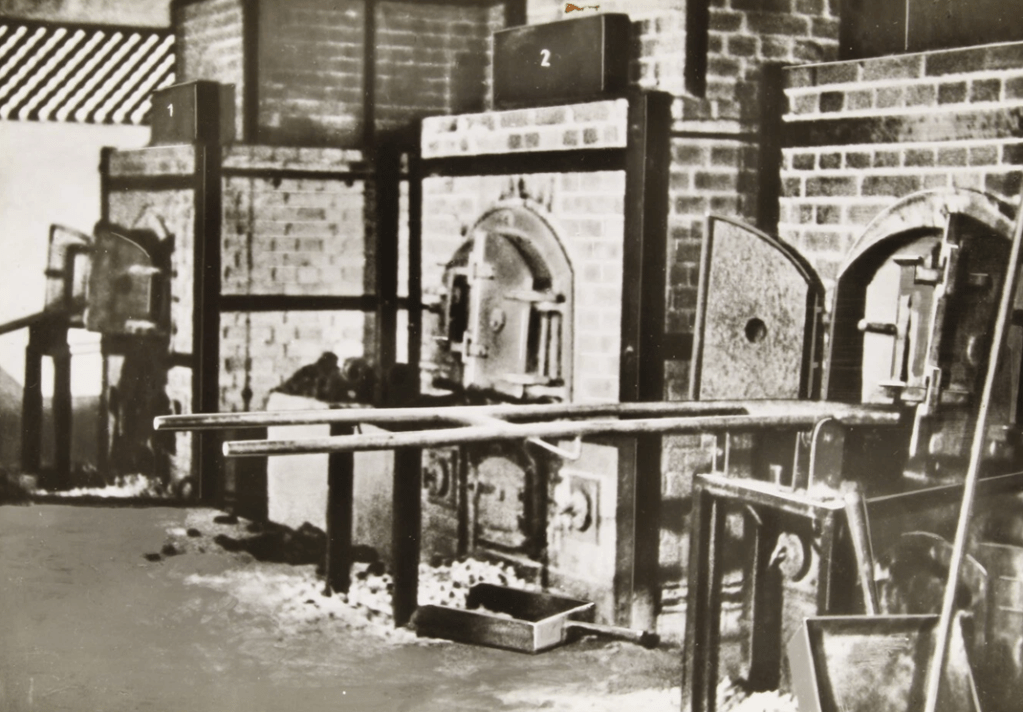
A: Yes, I do. I was mistaken in stating that two additional permanent brick ovens were built in autumn of 1943. In actuality, two double permanent brick ovens were built.
Q: Was remodeling the crematorium associated with theincrease in the number of people slated for extermination in Sachsenhausen?
A: Yes, that was the primary reason for our increase in the crematorium’s capacity.
Q: Who operated the crematorium?
A: Corpses were burned in the oven by German prisoners ZANDER and ZAKOVSKY.
Q: The investigation has information that in autumn 1941, the crematorium at the Sachsenhausen camp was updated for the express purpose of burning corpses of murdered Soviet prisoners of war. Were you aware of this?
A: What I know is that, in 1941, as many as 15,000 Soviet prisoners of war were brought to Sachsenhausen from OKW camps, and all of them were killed on camp premises at HIMMLER’s order, as sanctioned by HITLER. The contingent of those executed was selected in accordance with HITLER’s 1941 order on the special treatment of Red Army political workers and Soviet communist officers.
The selection of Russians for extermination in the Wehrmacht camps was done by specially designated SD workers. I should note, however, that I do not have exact information on the operation to exterminate Soviet prisoners of war at the Sachsenhausen camp in autumn 1941; I only know what was told to me about it by my coworkers in the Concentration Camps Inspectorate of the SS Main Directorate.
In autumn 1941, HÖHN and other subordinates of mine were working at Sachsenhausen. They would be able to speak more in detail about the so-called “Russian action”.
Q: All this time, you are talking about the general supervision of the camp, but when it comes to specific matters, you cite third parties. Tell us, in which operations to exterminate prisoners did you personally partake?
A: Along with those orders that came to the camp from the Reich Security Main Directorate regarding group extermination of prisoners sent by the Gestapo and SD, I received a number of orders on exterminating large groups or individual persons from special categories. These orders usually originated from the Chief of Department 4 of the Secret Police, MÜLLER, and the Chief of the Reich Security Main Directorate KALTENBRUNNER, with instructions that was imperative for me to delegate the extermination of the persons enumerated in the order to the SS officers.
In the summer of 1943, I received an order from MÜLLER to shoot a family consisting of a man, 25-30 years old, three women – 25, 30, and 60 years old, and a child, 3-5 years old. They were all brought to the camp at night in a closed cargo truck, accompanied by two officials from the Reich Security Main Directorate. The family members were killed in the gas chamber at my order and in my attendance. The SS officials witnessed the death and dispatched the corresponding document to Berlin that same night. The gas equipment was operated by my assistant, KOLB.
Q: What do you know about the family that was gassed?
A: The SS officials offered no information about this family. I only know that it was a Polish family.
In August of 1943, a woman (whose surname I cannot recall) was sent from Berlin to the camp, with the instruction that she was to be put to death. My assistant HÖHN voluntarily expressed his desire to shoot the woman, and I entrusted him with carrying out the order. The woman was killed in the crematorium, in a room designed for executions. Along with the woman, an assistant to some professor came to the camp with an instruction from MÜLLER that, after the woman was put to death, he would be permitted to remove her eyes and deliver them to the professor who, as the assistant explained to me, had recently been treating the woman. I gave orders that everything was to be carried out in accordance with the instruction, and the woman was killed by HÖHN, who fired two shots into her back in my presence. Her eyes were removed and thereafter sent to Berlin.
In October 1944, head of the facilities administration LAUER discovered that one of the Sachsenhausen barracks housed prisoners who possessed a homemade receiver, through which they listened to radio transmissions from abroad. Per special order from KALTENBRUNNER, we arrested some 200 prisoners, 27 of whom were executed by HÖHN in my presence, and the others were sent off to the Mauthausen camp for extermination or life imprisonment.
 Translating History
2 thoughts on “Declassified Interrogation of Sachsenhausen Concentration Camp Commander: Part 3”