
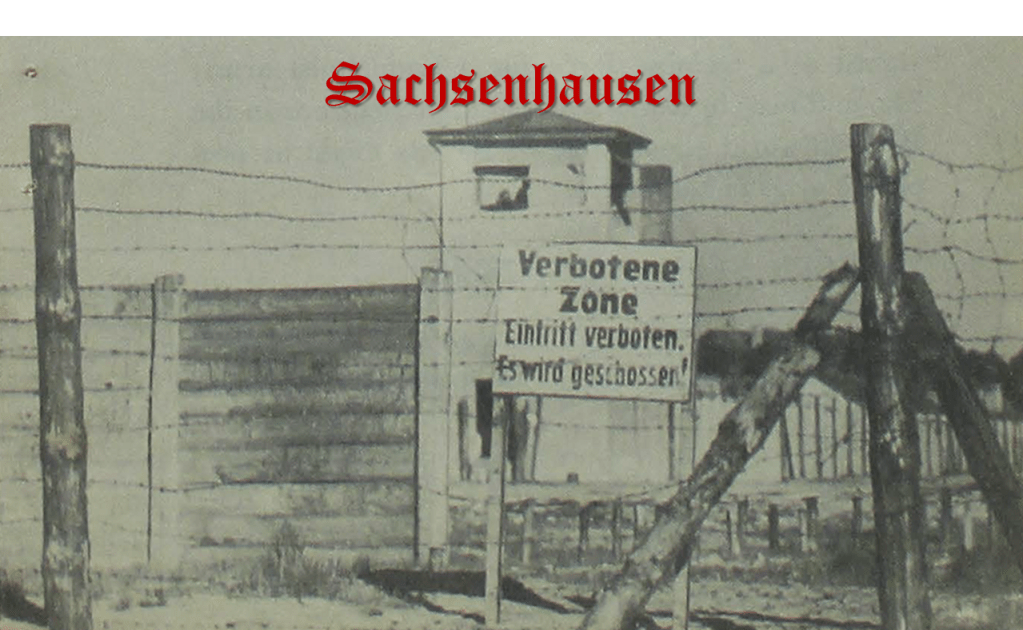
We continue our translation of the Russian-language record of the December 1946 interrogation of SS Standartenführer Anton Kaindl who, at the time of his arrest in May 1945, was the commandant of the infamous Sachsenhausen concentration camp.
Due to its length, the translation is being published bit by bit throughout the week. In Part One Kaindl described his early years and political motivations, his military life and work for the Nazi Party, and his assignment to the SS Concentration Camps Inspectorate and as commandant of the Sachsenhausen camp. In Part Two, Kaindl begins to describe the layout and function of the various segments of Sachsenhausen and the need to construct its gas chamber. In Part Three, Kaindl further outlined the various functions of the various sections of the concentration camp.
In Part Four, Kaindl details the further depths of depravity exhibited by camp staff and other SS personnel – not least of which during experiments on live prisoners. Thirty-kilometer marches, experimental drugs that do not allow the prisoner to sleep, testing poison bullets and new grenades on prisoners, covering prisoners in typhoid-infected lice to test an ointment, and burning prisoners with phosphorous to test the efficacy of another ointment. It’s all heinous, but an important record from the mouth of the man in charge of it all.
Part Four:
Q: The information you’ve provided has not been limited to the extermination of prisoners in Sachsenhausen alone. Tell us about other mass extermination operations.
A: First and foremost, I would like to show the details of the life and labor of the prisoners in Sachsenhausen and its branches, since as a result of the most difficult conditions, the prisoners perished en masse from exhaustion and sickness. This was observed not only in the central camp, but also its branches.
Q: What branches existed under Sachsenhausen?
A: Sachsenhausen had up to 50 branches in different cities in Germany. The largest of those were the branch at the Heinkel factory with 6000 prisoners, the Lieberose branch that performs road construction with 4000 prisoners, the Falkensee branch with its tank factory, with 3000 prisoners, the Klinkerwerk branch with 3000 prisoners, and others.
Prisoners sent to work in the camp branches found themselves in unbearably difficult conditions, at the complete mercy of the owners in the absence of any monitoring or established production standards.
Q: How would you explain HIMMLER’s interest?
A: Back during my work as the head of the facilities administration for the Concentration Camps Inspectorate bureau, I knew of repeated cases in which HIMMLER received bribes from large businesses for providing them with cheap labor – camp prisoners. HIMMLER’s deputy and head of the SS administrative department, POHL, made a large fortune this way. In 1942 or 1943, he spent more than one million marks just for decorating and furnishing his country house. Moreover, businesses were in the practice of handing out bribes to the lower SS officials who directly supervised the prisoner group working in their businesses. All of this led to an inordinate exploitation of the prisoners, who completely lost their ability to work in a very short time. The work day lasted for more than 11 hours, but regardless, the prisoners only received 280 grams of bread a day and thin soup twice a day. In this way, the prisoners who were sent off to work were condemned to death by starvation.
Q: The facts bear out that the German government established a brutal and bloody regime for the purpose of mass extermination, and you were the administrant of the unlawful orders of Hitler’s executioners, supporting and reinforcing the camp regime they established. Do you admit this?
A: I do. On an almost monthly basis, I visited our camp’s branch in the Klinkerwerk brick factory, where prisoners worked in the autumn and winter mining clay, standing knee-dep in water without special boots or clothing. It was especially difficult loading stone onto steamships or working at kilns. The prisoners lived in overcrowded barracks and, as I stated earlier, were not provided with the minimum required nourishment. All of this led to the prisoner mortality rate at Klinkerwerke reaching up to 15% of the total mortality rate in the Sachsenhausen camp.
The same conditions were present in the Lieberose branch. I visited this camp twice and was certain that the mortality rate there was even greater than that at Klinkerwerke.
Q: Along with the prisoner mortality because of the brutal conditions of their exploitation, the Nazi authorities encouraged direct steps for their extermination. Isn’t that so?
A: The Concentration Camp Inspectorate headquarters occasionally issued orders signed by GLÜCKS and his deputy MAUER with instructions on sending those persons who were sick or had lost their ability to work to Dachau and Lublin special death camps to be executed, since they had become a burden. All of the camp commandants received the orders, to include me, as commandant of Sachsenhausen. In connection with this, I provided information to the SS Concentration Camps Inspectorate on Sachsenhausen regarding the number of sick and disabled to be exterminated.
After each order of GLÜCKS that I received, lists were drawn up of those individuals subject to be put to death, then dispatched to the Camps Inspectorate.
Q: Who drew up these lists?
A: BAUMKÖTTER, the chief physician, usually selected the individuals subject to be sent to the death camps, along with his assistants and Chief of Labor Distribution REHN. In this case, if the order for information about the sick and disabled originated from Department 1 of Concentration Camps Inspectorate Group D, as the camp commandant, I would be the one signing the report on the number of those subject to extermination. If the order originated from the Inspectorate’s health office, the lists were usually signed by the Sachsenhausen chief physician BAUMKÖTTER.
Q: Tell us, how many prisoners no longer able to work or sick did you dispatch for extermination, and to which death camps?
A: From 1942 to 1945, more than 5000 were sent from Sachsenhausen to Dachau for extermination. Additionally, more than 500 who developed mental disorders due to severe conditions were sent to the Pernburg camp.
Translator Note: The above reference to “Pernburg” camp is transliterated as found in the original source document.
Q: Those numbers are not consistent with the facts. You are understating them, and substantially so.
A: In fact, significantly more prisoners died. At the time, when our reports indicating the number of disabled were being delivered to the Inspectorate, some of the people on the list had died, and other prisoners not on the list lost the ability to work. Having received the instruction from the Concentration Camps Inspectorate to dispatch those previously indicated in our reports to Dachau to be exterminated, we included new names in the list that corresponded to the number of those who died during this time.
Q: What is the number of prisoners who dies in Sachsenhausen during your work as its commandant?
A: To the best of my knowledge, some 8000 prisoners died in our camp from the hard labor and disease.
Q: Does this figure reflect the number of those who actually died or only those who were listed in your camp reports as dead?
A: That is the number of those who actually died.
Q: The investigation obtained eight death certificates issued by the camp to prisoners’ relatives in August 1943. The certificates indicate that all five men from one family died of a heart attack at 9:15 p.m. on August 10, 1943, and three women from the same family died at 10:25 p.m. on August 11, 1943. How can five men and then three women die of heart attacks at the same time at the same hour?
A: This certificate indicates that the entire family was executed in Sachsenhausen.
Q: Where, according to your “statistics,” were these people classified?
A: Since these individuals were killed in the camp, they are not among the number of 8000 who died a natural death. Thus, you can increase the figure I provided to the group of prisoners exterminated in small groups in Sachsenhausen, but I find it difficult to state right now how it is recorded.
Q: What other camps, other than those you already mentioned, did Sachsenhausen send prisoners to for extermination?
A: From 1941 to 1944, other than to Dachau and Pernburg, I sent over 6000 prisoners from Sachsenhausen to Auschwitz (Oświęcim) and more than 1200 to Lublin (Majdanek).
Q: You testified that the large mortality rate in Sachsenhausen camp was a result not only of the back-breaking labor, but also of the harsh conditions in which the prisoners were held. What are we to make of this?
A: I am referring to the widespread system of prisoner punishments that also accelerates their death.
Q: What types of punishment were employed in Sachsenhausen?
A: Prisoners were usually beaten. Beatings would take place with my personal authorization, at the request of my assistants HÖHN, KOLB, or the Rapportführers.
Beatings took place in the prison yard or in the “industrial yard,” where there was a long table, known as “the goat,” placed there specifically for this purpose. The prisoner was tied to it by his hands and feet. The beating was carried out under the watchful eyes of HÖHN and KOLB, and as mandated, in the presence of a physician. A wooden club was used to beat the prisoner anywhere from 5 to 25 times.
Another punishment used on the prisoners was confinement: simple or strict.
In simple confinement, the prisoner is placed in a cell without bedding for 14 days, and the standard camp food would be brought to him every three days. In strict confinement, the prisoner is placed in the cell for 42 days, with no window or bedding, and having the standard food brought to him every three days. In one of the cells they even used shackles that were chained to the floor in the center of the room to prevent the prisoner not only from sleeping, but also from moving about.
Cell allocation and monitoring of compliance with the harsh conditions of the prisoner detention was carried out by the head of the camp prison ECCARIUS together with my assistant WESSEL.
The harshest punishment was placement into the so-called “penal company”. In each and every case, the Blockführers would report to my assistants HÖHN and KOLB, and sometimes to RENN about incidents or prisoner violations of camp regulations. For the appropriate requests, I never refused to grant permission to place a particular prisoner or even an entire group into the penal company.
Q: What was the penal company like?
A: Those in the penal company were sent to hard labor at the Klinkerwerk factory, the clay mines, the Lieberose branch, or to the so-called “running crew”. This last one, every day, involved prisoners sent to an area in the camp, and over the course of 8 hours, while monitored by its chief BRENSCHEIDT, walked more than 30 kilometers in a circle. The crew was usually made up of 120 men, and if that number was not gathered up from among the prisoners: prisoners from the quarantine unit were sent to the crew, innocent of any wrongdoing.
Q: Why was the number of the “running crew” set at 120?
A: We utilized the “running crew” and “penal company” to perform strength-tests on new types of military boots, based on the concluded agreement between the SS Concentration Camps Inspectorate and the German Ministry of the Economy. The agreement specified the number boot types to be tested, and based on that, the body of the “running crew” was selected.
The shtrafniki, wearing the test boots, had to walk across various types of ground until the boots come apart. The “runners” would walk on a square on a path specially prepared for this purpose with various types of soil.
Per the agreement, boot testing was performed not only through walking, but using other methods. As far as I can recall, it required 10 days of walking in the test boots with a backpack rigging weighing up to 30 pounds, jumping in the boots, crawling on one’s belly, and of course, all of this had a detrimental effect on the health of the prisoners.
I also remember that during their testing of the boots, the “running crew” participants were experimented upon with a drug that caused an inability to fall asleep. The prisoners on whom this experiment was carried out, after walking all day, were brought back to the camp square and continued marching throughout the entire night.
Q: We know that that is not the only experiment conducted in Sachsenhausen, that there were many others. Tell us step-by-step about the experiments on living prisoners.
A: From 1942 to 1944, numerous experiments were carried out on humans in Sachsenhausen, at the order of HIMMLER and the chief physician of the Concentration Camps Inspectorate LOLLING.
As the camp commandant, I received in these cases the corresponding order from the Reich Security Main Directorate of the chief physician of the Concentration Camps Inspectorate LOLLING with instructions to provide individuals for testing a drug or to perform an experiment, having offered the necessary conditions for their work.
In August 1942, the chemical engineer of the Reich Security Main Directorate Doctor WIDMANN arrived at Sachsenhausen with instructions for us to provide him with the opportunity to perform an experiment to test a new type of grenade. I selected appropriate accommodations for WIDMANN on the premises of the “industrial gate,” where two Russian prisoners were brought. They were placed in a room where the grenade test was to be held by WIDMANN’s assistant, who had also arrived at out camp. In my presence, WIDMANN’s assistant threw the grenade into the room where the Russian prisoners of war were located.
In 1943, Doctor WIDMANN arrived at Sachsenhausen for a second time, this time with an order from HIMMLER on a test of a specific type of poison. In carrying out the order, I gave instructions to the chief physician of the camp BAUMKÖTTER to participate in the experiment, giving all possible assistance to WIDMANN. The poison’s effects were tested on two prisoners, Russian or Poles, in the camp hospital.
The poison that had been prepared for testing was given to the prisoners in their coffee or soup.
That same year, at the order of the Reich Security Main Directorate, Doctor WIDMANN conducted an experiment at Sachsenhausen to test the impact of a poisoned bullet on a human body. I was not present for the experiment, and only learned of it upon my return to the camp.
Because of this, I’m unable to tell you who among the camp workers was present for the experiment, and which of the prisoners was used for the experiment. It was after I returned to camp that Doctor WIDMANN himself told me that the new poison bullet brings death upon striking any part of the body.
In late 1942 or early 1932, Doctor LOLLING and Reich Physician GRAWITZ conducted an experiment at Sachsenhausen on ten prisoners. The trial consisted of LOLLING and GRAWITZ testing a newly invented ointment for a body covered with typhus-infected lice. The doctors were testing whether or not this ointment would have a protective effect against the typhus-infected lice.
Along with LOLLING and GRAWITZ, one of the Sachsenhausen physicians participated in the experiment, but it would be difficult to say exactly who that was.
If memory serves me right, this experiment was carried out in the hospital barracks or in the convalescence barracks.
In the spring of 1944, Sachsenhausen camp’s chief physician BAUMKÖTTER received an order to test an ointment against combustion. BAUMKÖTTER, along with a representative of the Reich Physician whose name I can’t recall, conducted a test of the ointment on 5 or 10 prisoners who he burned with phosphorous on various parts of the body, and then used the burns to test the ointment. The results of the experiment are totally unknown to me.
Q: So it should be considered established that mass extermination took place in Sachsenhausen not only from shootings, hangings, and suffocation in the gas chamber, but through various experiments on living humans. Do you confirm this?
A: It’s difficult to admit, but that is the case. I tried to keep the human experiments in strictest secrecy, and so I selected the camp teams painstakingly. Everyone was warned about the extreme secrecy surrounding our activities and the serious consequences they would suffer if anything was disclosed.
 Translating History
One thought on “Part Four: Declassified Interrogation of Sachsenhausen Concentration Camp Commander”