

We continue our translation of the Russian-language record of the December 1946 interrogation of SS Standartenführer Anton Kaindl who, at the time of his arrest in May 1945, was the commandant of the infamous Sachsenhausen concentration camp.
Due to its length, the translation is being published bit by bit throughout the week. In Part One Kaindl described his early years and political motivations, his military life and work for the Nazi Party, and his assignment to the SS Concentration Camps Inspectorate and as commandant of the Sachsenhausen camp. In Part Two, Kaindl begins to describe the layout and function of the various segments of Sachsenhausen and the need to construct its gas chamber. In Part Three, Kaindl further outlined the various functions of the various sections of the concentration camp.
In Part Four, Kaindl details the further depths of depravity exhibited by camp staff and other SS personnel – not least of which during experiments on live prisoners.
We finally come to the final chapter of this 39-page interrogation, when Kaindl tries to offer reasons for trying to illegally cover up the evidence of his war crimes thus far, and we find him describing him the waning days of World War Two. The Red Army is storming toward the gates of Berlin, and HIMMLER recognizes that Sachsenhausen, as a “special” concentration camp, needs to be taken apart piece by piece, leaving no trace of the camp or the prisoners. Kaindl is tasked with the grisly implementation of this order.
Based on this and other testimony he provided, Kaindl was found guilty of war crimes with 11 of the other camp officials. He was sentenced to life in prison with hard labor and sent to the Vorkuta Gulag, where he died in August 1948.
Part Five:
Q: So in doing this, you hoped to cover up your crimes?
A: Of course.
Q: We know that the concealment of the traces of crimes committed in Sachsenhausen was done not just by the removal of non-disclosure agreements, but also through other methods. Isn’t that so?
A: In February 1945 I instructed my adjutant WESSEL to destroy the ashes of the bodies of the prisoners who died in our camp and were burned in the crematorium. WESSEL collected the required number of people from the camp guard and also recruited the head of the Klinkerwerk branch, Obersturmführer FRÖSEMANN; together, they carried out my order. WESSEL and his people loaded up the ashes into two or three trucks with trailers and brought them to the Klinkerwerk site, where they were dumped into the Hohenzollern Canal.
FRÖSEMANN broke up the ice in the canal and threw all of the ashes collected at Sachsenhausen into the ice hole.
Q: Were you acting at the time on orders from above?
A: Yes. In February 1945 I received an order from HEISSMEYER to write off from the camp logbooks all prisoners who had been exterminated in the camp as having died from natural causes. I entrusted the camp’s chief physician BAUMKÖTTER to carry out this order, and he then input the falsified data on prisoners’ cause of death.
Q: Which resulted in the number of executions in Sachsenhausen carried out by you, as recorded in the camp logs, is significantly lower than the actual data?
A: That goes without saying.
Q: What persuaded HEISSMEYER to issue such an order in February 1945?
A: I believe that HEISSMEYER issued the order because of the military situation, which was becoming difficult for Germany, and the Red Army’s advance to Berlin’s outer defenses.
Q: And consequently, the German authorities were concerned to the point of covering up evidence of the atrocities that they had been carrying out in Sachsenhausen?
A: Yes, that is the case. Sachsenhausen was a special camp, the importance of which was not just is territorial proximity to Berlin.
Sachsenhausen held the most serious political enemies of fascism, prominent statesmen from many countries across Europe: France, Czechoslovakia, Yugoslavia, Austria, Holland, and the heads of state and ministers of these countries up until their occupation by the German military.
The most important and highly classified operations for human extermination took place in Sachsenhausen, carried out at the personal instruction of HIMMLER and other top leaders of the German government and German intelligence and penal establishments.
Moreover, special experiments were conducted on prisoners in Sachsenhausen, also at the personal instruction of HIMMLER and his aides: testing the effects of various poisons, inoculations against typhus, burn ointments, asphyxiating grenades, aircraft ejection seats, and so on.
This is why the work at Sachsenhausen was under the directorate oversight of HIMMLER and the central Reich State Security headquarters, and I, as commandant of this camp, regularly received orders from them and acted in accordance with these orders.
When the military situation began to deteriorate for Germany and the fall of Berlin became obvious due to the Red Army’s successful offensive, Nazi leadership and, first and foremost, HIMMER himself, as the leader of all of Germany’s intelligence and penal establishments, and GÖBBELS, as the Reich Defense Commissioner, felt impelled to stamp Sachsenhausen out of existence or, at the very least, destroy all evidence of the numerous crimes committed in the camp.
Because of this, in December 1944, when I was visiting GLÜCKS in his office premises in the Concentration Camps Inspectorate in Oranienburg, he verbally instructed me to take steps to prevent the possibility of Sachsenhausen’s prisoners falling into enemy hands.
On February 1, 1945, I was called by telephone to the Reich Security Main Directorate, to MÜLLER’s office. I arrived in Berlin and met with MÜLLER in his Prinz-Albrecht-Strasse office. MÜLLER, on behalf of HIMMLER and GÖBBELS, handed me an order on the need to destroy the Sachsenhausen camp by artillery fire, air-dropped bombs, or poisoning the entire prisoner contingent.
Q: Did MÜLLER explain what the reasoning was behind the order to destroy the Sachsenhausen camp?
A: He said, in brief: “The situation that has taken hold on the front requires that Sachsenhausen be destroyed, and you are to initiate the implementation of this order, immediately upon returning to the camp.”
Q: Tell us how you carried out MÜLLER’s unlawful order?
A: From MÜLLER’s office, I called my adjutant, WESSEL, suggesting that, to start with, he collected all of those deemed politically risky, and begin having them killed the on the very first night.
Overnight from 1 to 2 February 1945, the so-called “politically risky” were collected in the camp, to the best of my knowledge, numbering up to 150, were shot in the “industrial yard,” then burned in the crematorium. The operation was overseen by HÖHN.
Regarding the rest of the camp, I expressed my opinion to MÜLLER that its destruction by artillery fire or air-dropped bombs would lead to the destruction of the homes adjacent to the camp that belonged to the civilians, and also have, as a consequence, a mass stampede of escaping prisoners. In carrying out such an operation, I believed that we would have to remove the guards, and with such a large amount of prisoners, escapes would be inevitable.
I also objected to poisoning the prisoners, noting that this method would be ineffective. In this case, I based it on the fact that we have not been able to organize in the camp a means to have several thousands of prisoners be fed simultaneously, but could only poison individual groups, based on the output of our kitchens. All of this would slowly lead to the exposure of our plan, since those who had partaken would die in front of the other prisoners, because food is always eaten in the barracks.
MÜLLER agreed with my arguments, and directed me to HEISSMEYER for a final decision to the issue.
Having listened to my arguments, HEISSMEYER recommended we prepare to evacuate the prisoners to Buchenwald and its branches.
I returned to Sachsenhausen that evening, and held a meeting of the camp’s senior staff. Among those present were my assistants – HÖHN, KOLB, primary physician BAUMKÖTTER, WESSEL, RENN, and a number of officers from the guard battalion. I laid out the details of my conversation with MÜLLER and HEISSMEYER, who recommended beginning preparations to evacuate the camp.
Q: Let’s be more precise. Did you give the instruction to exterminate the camp prisoners?
A: I only gave subsequent instructions on the second day.
Q: Specifically what instructions did you give?
A: On the second of February 1945, I once again went to HEISSMEYER and received the order from him to kill all of the wounded and disabled prisoners. Returning to Sachsenhausen from HEISSMEYER’s office, that evening I called a second meeting with a much smaller circle of staff members, with BAUMKÖTTER, KOLB, and as far as I recall, HÖHN. I gave them instructions to draw up lists of individuals to be exterminated throughout the camp.
Q: Who, according to the lists, were subject to extermination?
A: I ordered that all of the sick, disabled, and those unable to march, not just in Sachsenhausen but also in its branches, were to be killed. My previous order was also still in effect, as directed to WESSEL by telephone from MÜLLER’s office, to kill the “politically risky”.
Execution of my order started in the Heinkel branch, as that was where the largest number of sick and disabled were held.
On 3 or 4 February 1945, BAUMKÖTTER, chemist TOMAS, and physicians GABERLE and ADAM came to me with the recommendation of using the poisoning method to exterminate the prisoners in the Heinkel branch. I agreed to their proposal, and the next day BAUMKÖTTER sent physician ADAM to Heinkel to carry out the injections. All of the drugs for this operation were prepared by chemist TOMAS.
Q: How many prisoners were poisoned at the Heinkel branch?
A: As reported to me, the injections were used to kill 45-50 people, but using this extermination method, the operation in Heinkel was taking a prolonged period of time. Because of this, I ordered that we cease using injections, and that all subject to extermination were to be brought to Sachsenhausen and shot. To my knowledge, some 500 from Heinkel were exterminated in Sachsenhausen.
Q: And how was this extermination “operation” carried out in Sachsenhausen?
A: BAUMKÖTTER received my order to collect the people for extermination. Together with his subordinates, as well as HÖHN and RENN, drew up the lists of those individuals across the camp who were subject to extermination.
I entrusted HÖHN with overall supervision of the execution of this operation. He himself, based on the lists received from BAUMKÖTTER, carried out the execution of the prisoners, with the assistance of the Blockführers. Hauptscharführer MOLL carried out the shootings.
Q: How many Sachsenhausen prisoners died this time at the hands of your subordinates, based on your orders?
A: In mid-February 1945, the operation to exterminate the sick and disabled was complete. During this time we killed up to 2000 people in Sachsenhausen, and 1800 prisoners in the Lieberose branch. Additionally, more than 500 died from natural causes.
In February, at MÜLLER’s order, 4 or 5 English sailors were shot in Sachsenhausen. A significantly large number of prisoners were taken away to other camps.
Q: To be more specific, they were taken off to be exterminated?
A: We only sent prisoners off for extermination to one camp – Bergen-Belsen. As far as those transported to other camps, I don’t believe they were killed.
Q: How many prisoners did you send to Bergen-Belsen to be exterminated?
A: We began evacuating prisoners to other camps between 5 and 10 February 1945, and finished by the end of the month. According to our query, for the Sachsenhausen camp, the Berlin Railway Directorate sent the required number of trains to allow us to send up to 11,000 persons to Bergen-Belsen for extermination. We sent up to 6000 prisoners to Buchenwald and its branches, as well as to Flossenbürg.
Q: So let’s sum it up. Clarify what was the number of prisoners that were exterminated, those that were sent for extermination to other camps, or died as a result of the brutal conditions you created at Sachsenhausen during the time of your work as commandant.
A: I worked as Sachsenhausen’s commandant from August 1942 to late April 1945, Over these two years and eight months, based on far from complete data, the number of prisoners who were exterminated, died from the backbreaking work and unbearable conditions, and sent off for extermination to other death camps is over 42,000. I would add that this number does not include those who perished from starvation or were shot on the road during the camp evacuation in April 1945.
Moreover, I’m aware that in the fall of 1941, before my arrival to work at the camp, during just one operation in Sachsenhausen over 15,000 Soviet prisoners of war brought from Wehrmacht camps were executed.
Q: How many prisoners remained in Sachsenhausen and its branches by the time Germany had surrendered?
A: Approximately 35-40,000.
Q: What did you do with these prisoners?
A: On 18 April 1945, I received an order from the inspector, GLÜCKS, to gather up and transport those remaining in Sachsenhausen on barges out to see and drown them.
Q: Where, per GLÜCKS’s order, were you to amass barges to load prisoners from the Sachsenhausen camp?
A: The prisoners were to be loaded onto barges in Oranienburg on the Spree River canal system.
Q: Did you carry out this order?
A: No, since the execution of this order would be tied to insurmountable difficulties, since it would take more than 100 barges for the 45,000 prisoners from Sachsenhausen and its branches, and bringing these barges into Oranienburg would take far too long.
Besides, the Red Army was already in Berlin’s outer lines, and the front ran 30 kilometers from Sachsenhausen. In additional, the military situation in northern Germany made it impossible to transport such a massive caravan of barges, since, the way I see it, even without tugs, they would have stretched to a distance of 5-7 kilometers.
On 20 April, GLÜCKS sent me a new order from HIMMLER, to evacuate Sachsenhausen and its branches to the northwest, to the Wittstock area.
Q: So the Red Army, with its advance into Berlin, stopped the execution of your unlawful plan to kill the remaining 45,000 prisoners in Sachsenhausen by drowning them at sea?
A: That is so. But I must add, that I did not agree with HIMMLER’s order to drown the prisoners, and I reported my disagreement to GLÜCKS.
Q: You didn’t agree with the order, having in mind other methods to kill the prisoners?
A: In the morning of 21 April 1945, the remaining part of the prisoners from Sachsenhausen and its branches, to the order of 27,000 persons, traveled in 500-man columns toward Wittstock, escorted by SS security. I must admit, however, that the camp evacuation route was a “death road”.
Q: More specifically?
A: I gave the order that any prisoners who fell out of the columns were to be shot on site by the SS.
Q: How was feeding the prisoners managed on the travel route?
A: Each prisoner received a loaf of bread and a kilogram of tinned goods.
Q: Was everyone able to receive this standard?
A: About 6-7000 prisoners received no rations at all.
Q: Did you have a final destination point?
A: No. I myself had no idea where to bring the prisoners, I was only given a general direction of travel.
Q: Were there provision shelters for the prisoner columns?
A: There were neither provision shelters nor kitchens for the columns.
Q: Under these conditions, the prisoners were exhausted, fell behind the columns and, per your unlawful order, were shot. Consequently, you had turned the evacuation into one of the methods for the mass extermination of the prisoners?
A: I admit that. And truth be told, I don’t know how many prisoners were shot by the SS men on the travel route, since on 27 April 1945, in the settlement of Below, near Wittstock, I abandoned the camp.
Translator Note: The above reference to “Below” is transliterated and Germanicized as found in the original source document.
Q: As confirmation of the fact that the travel route of the Sachsenhausen camp columns was littered with the bodies of the prisoners, officials from the Swedish Red Cross filed a protest against you for this reason.
A: I never personally received such a protest, but BAUMKÖTTER told me that he, as a physician, did receive a protest from the Red Cross workers, due to which I gave the order that in future, executions would be carried out away from the road, in the forest, and the bodies of those shot would be buried.
Q: How many prisoners in all died along the route?
A: I don’t know, since I departed camp on 27 April, making my way to Lübeck.
Q: Lübeck the port city?
A: Yes, the port of Lübeck.
Q: Why Lübeck?
A: On 27 April 1945, I received an order from GLÜCKS on directing the Sachsenhausen columns to Lübeck, and headed there myself in order to find out the situation on the scene and make arrangements to bring the prisoners together.
Q: Why were you evacuating the Sachsenhausen prisoners specifically to Lübeck?
A: In GLÜCKS’s order, the final objective of the movement of the prisoner columns was not indicated, and it wasn’t really required; it was clear to me that his previous order of 18 April on drowning the Sachsenhausen prisoners at sea was still in force, and GLÜCKS was endeavoring to put it into effect. He just change the method of bringing the prisoners to the sea. Instead of barge transport, it was decided to bring the prisoners to a destination in columns, on foot, for subsequent loading onto ships that, as GLÜCKS explained, are already standing in harbor at Lübeck.
Q: Based on GLÜCKS’s order, what preparations did you undertake for drowning the prisoners upon arriving at Lübeck?
A: I arrived at Lübeck on 2 May, and spent only one day there, after which I departed for Flensburg to meet with HIMMLER and ascertain the fate of the Sachsenhausen prisoners. HIMMLER, however, pretending to be too busy at work, didn’t receive me, and on 4 May 1945 I was taken prisoner.
This record was prepared in Russian and German.
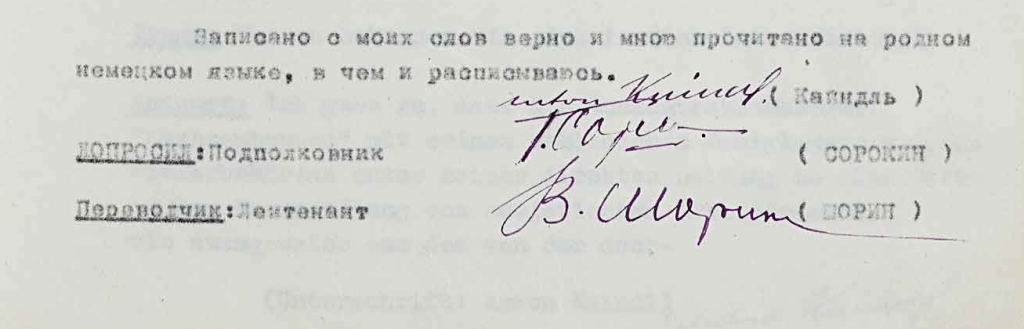
Written down from my words truthfully and read by me in my native German language, which I also hereby sign.
[signed] Anton Kaindl
INTERROGATOR: Lieutenant Colonel [signed] SOROKIN
Interpreter: Lieutenant [signed] SHORIN
 Translating History