
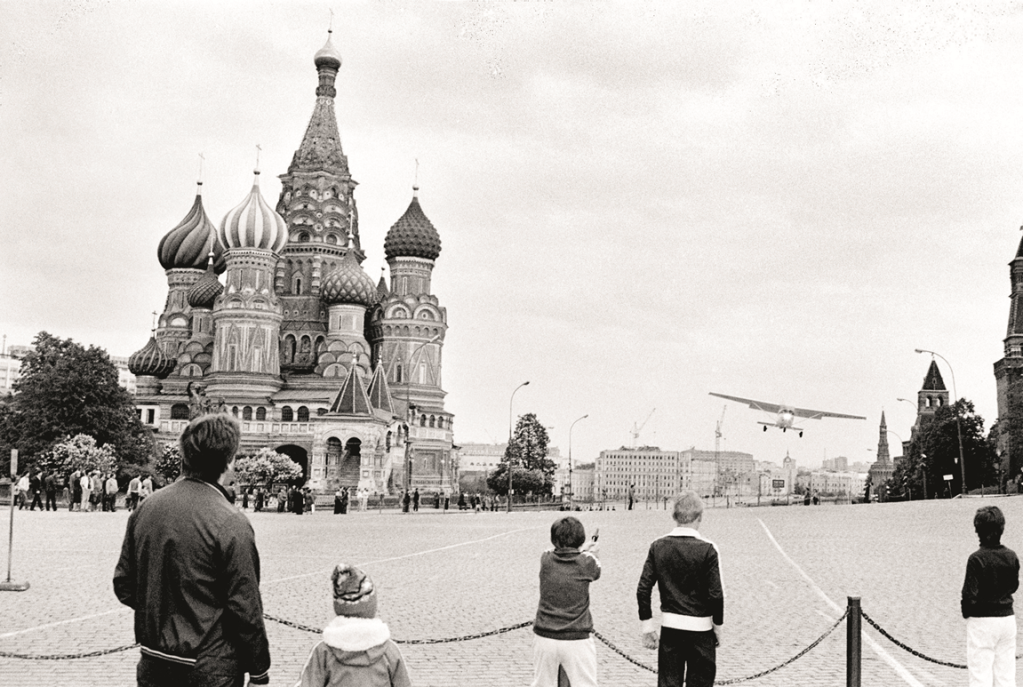
It’s always an interesting exercise to reflect on just what happened to plant an 18-year-old West German lad in the cockpit of a Cessna to attempt to land on Kremlin grounds on this day in 1987, when the Cold War was still at its height. Was it a test of Gorbachev’s will amid a growing season of reforms, Glasnost, and Perestroika? Was it a CIA operation to test the ability of something slow and low to penetrate Moscow’s air defenses? There are thousands of theories, and every year, the Russian Federation media is happy to trot out new ones, or if nothing else, paint a fresh coat of speculation on the overall picture. As if on cue, the following article was published online last week, and we’re delighted to offer the article in English. Whether or not the title lives up to its name – offering “the truth” about the flight – is open to debate.
Enjoy.
The Truth About Matthias Rust’s Flight: How a Pilot from Germany Landed on Red Square
In May 1987, in the late Soviet era, an event occurred that caused wide repercussions and a true shock among the Soviet people. German pilot Matthias Rust, piloting a light aircraft, managed to cross the country’s border and land in the very center of Moscow.
A veteran of the country’s special services, who was a direct witness to the events, shared interesting details about this extraordinary case.
May 28, 1987, Friday. Border Guard Day. It was a warm, sunny day. At 7 p.m., an unknown light aircraft appeared in the sky over the center of Moscow. It made two approaches over the Kremlin, but was unable to land. The wingspan (24 m) did not allow it to fit into the space of the Kremlin’s Cathedral Square. It also did not land on the crowded Red Square. But a third option was prepared, guaranteeing a landing in the Red Square area. The trolley line on the Moskvoretsky Bridge was de-energized, and the wires were pulled from the roadway. It was in this place that the pilot landed the plane and taxied to the back of St. Basil’s Cathedral.
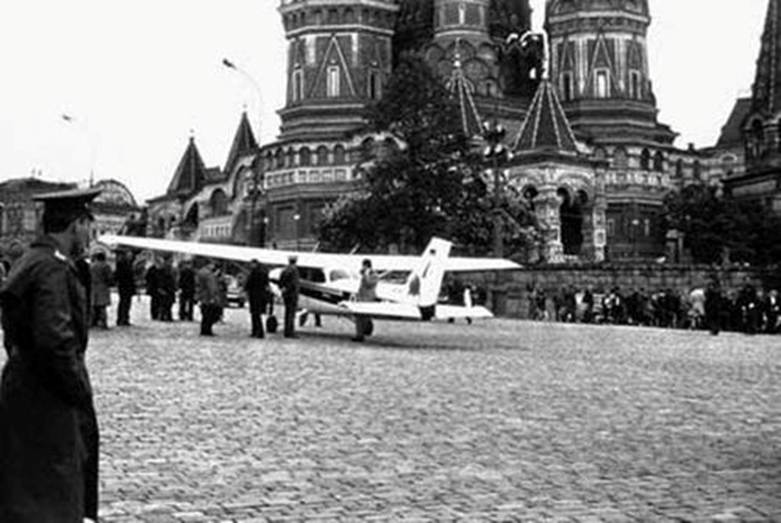
A tall, thin young man got off the plane, smiling. A few minutes later, 25-30 people gathered around him, reacting with great surprise and bewilderment to what was happening. From the first phrases it became clear that he was a foreigner, a German, who was calm and friendly. The people gathered naturally had questions – who was he, where he had flown in from, and for what purpose. The language barrier made communication difficult. After 20-25 minutes, a black Volga drove up, and he was detained by secret service officers. Since he was a foreigner, he was taken to Lefortovo – the USSR’s KGB pre-trial detention center.
How did this start? The 18-year-old highly qualified pilot Mathias Rust from a small West German town rented a light Cessna 172 from a local flying club. Air tourism is quite common in the West; the flying club issues the pilot the necessary permits, agreed upon with the relevant services of the host country. Rust planned to spend the first week of his trip in Sweden, and then a week in Finland. On the second day in Finland, the plane and the pilot disappeared.
On May 28, 1987, an unidentified light aircraft crossed the Soviet state border from Finland at an altitude of 200-300 m and invaded our airspace. Border guards recorded it. In accordance with the current regulations, every violation of the state border, whether by a person or hardware, is reported to the center in Moscow. There, the degree of possible danger is assessed. An aircraft is an object of increased threat, since there may be weapons on board. As soon as the information is received, it is immediately reported to the country’s leadership, which is what was done.
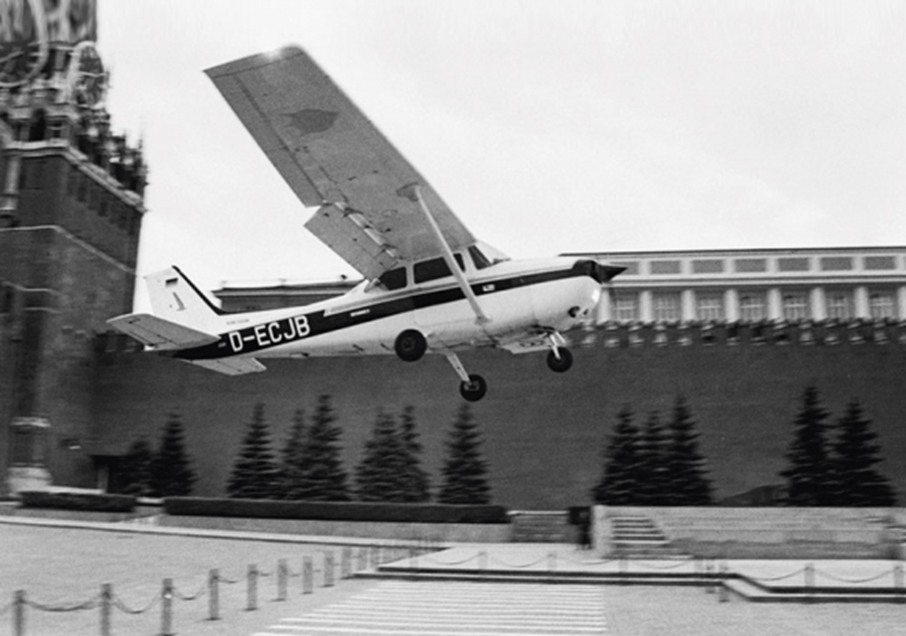
After crossing the state border, the plane flew to the October Railway and over it to Moscow (the shortest route), and then along the Moskva River it flew to the Kremlin. The “cruising” speed of the Cessna 172 is 230 km/h.
Let’s remember when in 1983 the South Korean passenger plane Boeing 777 crossed the state border of our country in the Far East and penetrated deep into our territory, the scrambling fighter-interceptors detected and escorted it. The Boeing 777 crew did not respond to repeated calls and appeals by the fighter pilots, and continued the flight. Then the country’s leadership made the decision and gave the command to destroy the aircraft, which was carried out.
The flight of Matthias Rust lasted about three hours. All this time, the situation was considered and discussed at the level of the country’s leadership, the leadership of the Ministry of Defense and the command of the air defense forces, and a decision was made. In relation to such air targets, the final decision is made only by the country’s leadership. Fighter-interceptors were scrambled, but their altitude and speed were not compatible with the altitude and speed of the Cessna-172. But the command was never given, which allowed Rust to successfully complete the mission and land the plane in the Red Square area.
Overnight from May 28-29, 1987, the plane was transported from Red Square to Sheremetyevo-1 Airport, where it was stored until its return to the West German flying club. At the same time, information about the storage location of the plane was not leaked anywhere. The plane “disappeared.”
On September 4, 1987, the Criminal Division of the Supreme Court of the USSR sentenced Matthias Rust, a citizen of the FRG, to 4 years in prison. He was charged with Article 3 of the Criminal Code – “Illegal crossing of the state border, violation of international flight rules and malicious hooliganism.”
On August 3, 1988, by decree of the President of the USSR, Matthias Rust was pardoned after serving 1 year and 4 months in prison. After his release, he returned to his homeland.
The Cessna-172 aircraft, which was material evidence in the criminal case, was returned to its owner, the West German flying club.
In conclusion, it must be said that this was a well-thought-out and planned operation. 18-year-old Matthias Rust was used in the “dark” as a highly qualified pilot. Apparently, he underwent thorough training, received the necessary instructions and successfully completed the task.
Could this young man develop a flight route into Soviet airspace and prepare the aircraft without assistance? In the cabin of the 4-seater aircraft, 2 seats were dismantled and an additional large-capacity fuel tank was placed in their stead. And the choice of the type of aircraft was not accidental. The Czech-made Cessna was common in our country and its appearance should not have aroused suspicion.
In his cover-story, Rust, a solo pilot and a fan of air travel, stated, “I have long dreamed of visiting the Soviet Union to get to know your wonderful country, and so I chose this option.” His testimony and explanations are contained in the classified materials of the criminal case. It would be very interesting to know who prepared the route and the plane. But most importantly, why did a “simple tourist” want to land at the Kremlin or on Red Square?
Now let’s look at the consequences of this operation. In 1978, Sergei Leonidovich Sokolov was appointed Minister of Defense of the USSR, and was awarded the title of Marshal of the Soviet Union. In 1980, he was awarded the title Hero of the Soviet Union. Sokolov ended the Great Patriotic War as a colonel, commander of the Armored and Mechanized Troops of the 32nd Army of the Karelian Front. He was awarded 32 Soviet awards and 46 foreign ones. He enjoyed great authority and respect in the Armed Forces of the USSR. He was a very strong, strong-willed, talented, and deeply patriotic person. He was the only Soviet marshal who lived to be 100 years old. By the decree of the President of the USSR dated May 30, 1987, he was dismissed from his post. The reason was the flight of Mathias Rust. At the same time, a large number of military leaders were dismissed from their posts, including the leadership of the Air Defense Forces, one of the most important branches of the armed forces for the country’s defenses.
On May 30, 1987, General of the Army Dmitry Matveyevich Yazov, Deputy Minister of Defense for Personnel since January 1987, was appointed Minister of Defense. Dmitry Yazov had been the Commander of the Far Eastern Military District since 1984 – one of 30 district commanders at that time. He had served in the ground forces for more than 40 years.
Why did the President of the USSR perform such a “backflip” in three days? History will provide the answer to this question.
 Translating History