
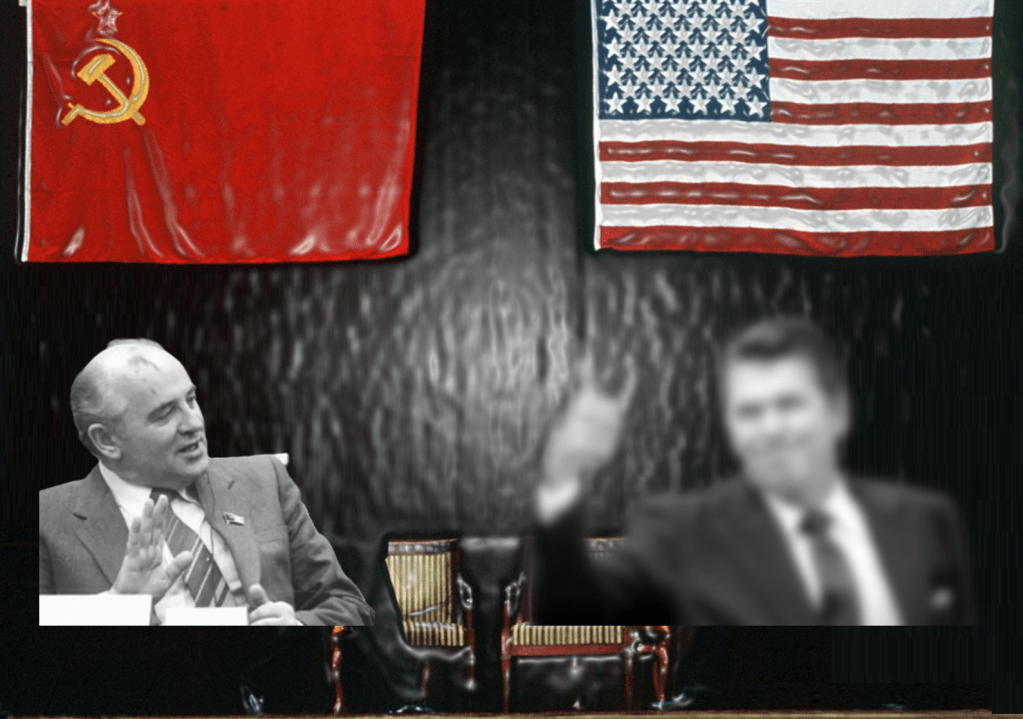
On March 10, 1985, Konstantin Chernenko, the General Secretary of the Communist Party of the Soviet Union (CPSU) passed away after a short stint as the Soviet leader. Less than 24 hours later, Mikhail Gorbachev was elected at the Central Committee session as Chernenko’s successor. And less than 24 hours after that, he found himself being primed by Aleksandr Yakovlev, former Soviet Ambassador to Canada, for what the latter felt was a necessary high-profile meeting with Ronald Reagan.
Reagan at the time was enjoying the third month of his second term as President of the United States, a country that seemed to be losing its economic competitive edge, but was still motivated to extend efforts to reduce Soviet influence around the world. Gorbachev and Reagan would become an odd couple of viable negotiating partners over the coming years.
But before any summits were to be held, Yakovlev had some advice for the newly appointed Gorbachev. His memorandum, titled (in all caps) “ON REAGAN,” offered some savvy insights into the handling of the US President, including the potential propaganda win-win for Reagan should details of a potential meeting emerge.
He loses nothing from refusing to meet (“…you see, I wanted to, but…”), as well as from the failure of the meeting (“…the Russians, as always, are unwilling…”).
Given the events that would play out for the rest of Gorbachev’s political days, this is a remarkable piece of history that we felt was worth translating and presenting.
The translation of this memorandum follows.
12 March 1985
ON REAGAN
The initial positions are complex
1. Everything suggests that Reagan is persistently striving to seize the initiative in international affairs, to create an image of America as a country that is purposefully advocating for improving relations with the Soviet Union and improving the global political climate.
He would like to resolve a number of problems in the context of the dream of a “great peacemaker president” and a “great America,” although the psychological situation is currently not in his favor.
2. Reagan outlined and partially implemented plans for the militarization of America, gave almost everything to the defense industry that he promised, so he can move on to diplomacy at the “highest level,” which in any case is a prestigious matter and raises political equity, which is what Reagan needs now.
3. He is being squeezed by a budget deficit, which threatens economic turmoil. This deficit must either be justified by an external threat or reduced.
4. Despite all the external relative solidarity in NATO and among other allies, there is either no unity, or a unity that is not that strong. The United States is trying to stay on the crest of a centripetal force, and in every way prevent the development of a centrifugal trend. In this context, it is obvious that the invitation to the meeting should also be assessed.
Many things can be seen here: the desire to close our relations with the West in the Soviet-American channel (the United States watches its allies with caution); taking into account the anti-militarist sentiments within and outside of Congress; and the desire to re-test the Soviet position on key international issues.
And there is no doubt that this action, in addition to its political purpose, carries a significant propaganda load. He loses nothing from refusing to meet (“…you see, I wanted to, but…”), as well as from the failure of the meeting (“…the Russians, as always, are unwilling…”).
In other words, from Reagan’s point of view, his proposal is well thought out, accurately calculated, and carries no political risk.
Conclusion. A meeting with Reagan is in the national interests of the USSR. It must be held, but there’s no need to rush. One should not create the impression that only Reagan presses the buttons of world events.
The goals of the meeting: a) get a personal impression of the American leader; b) send a clear signal that the USSR is really ready to negotiate, but on the basis of strict reciprocity; c) convey to Reagan in an unambiguous manner that the USSR will not allow itself to be manipulated, and will not sacrifice its national interests; d) continue to subtly show that the world does not revolve around the USA, but at the same time not to miss real opportunities to improve relations with the USA, because in the next quarter of a century the USA will remain the strongest power in the world.
We can’t expect any unexpected changes in American policy of a fundamental nature. And it is not only Reagan’s anti-communist dogmatism; the tough course of the USA is dictated by the nature of its transition period from absolute dominance in the capitalist world to a dominant partnership, and then to relative equality.
The delicacy of this process, even if we ignore the traditional geopolitical habits of the United States, is obvious; it will continue to affect foreign policy for a long time.
It is this transition period that dictates a certain redirection of foreign policy in terms of the gradual and systematic development of relations with Western Europe, Japan, and China.
But this should not lead to a decrease in attention to the essence of Soviet-American relations, but, on the contrary, should increase this attention.
Time. Perhaps after the [CPSU] Congress. It would be better after some economic reforms, other practical intentions, and achievements demonstrating the dynamism of our country. Americans are convinced by practical actions above all else; they become more accommodating.
Location. Not the US. Somewhere in Europe.
Alternative. As already stated, we need to use all possible factors of political pressure on the US, first and foremost the interest of the Europeans in reducing tensions, which was clearly felt during recent conversations in Moscow, to confirm our proactive position.
This requires a strong countermove.
For example, in connection with the 10th anniversary of the Helsinki Conference (this August 1), we could propose holding a meeting in the Finnish capital of the heads of state and government of those countries whose signatures were placed under the Final Act. In putting forward such an idea, we could focus attention on the need to introduce elements of trust into international relations and revive the process of détente in both the political and military spheres.
Initially, this idea could be mentioned in a personal message from the General Secretary of the Central Committee to the President of the United States, noting that personal contact could be established in Helsinki and opinions could be directly exchanged on the possible dates and general framework of a Soviet-American summit.
Regardless of the American reaction, we could inform our allies of the step taken and coordinate with them on carrying out appropriate work with Western European countries. Political efforts in this area would also enrich the work of the upcoming meeting of the Political Consultative Committee of the Warsaw Pact member states. And most importantly, we would not only significantly confirm our active approach to reviving the détente process, but would also lay the foundation for a Soviet-American summit.
 Translating History