
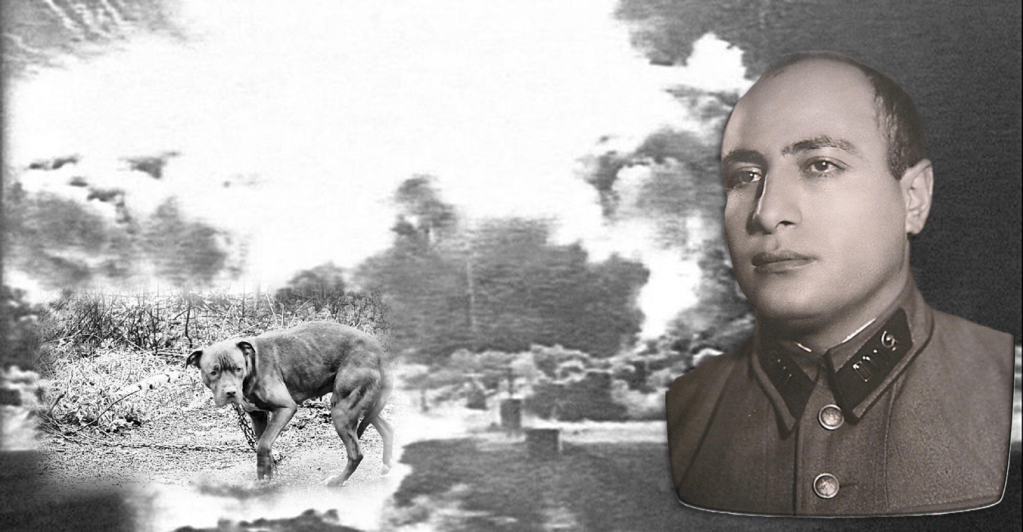
On 30 August 1949, one day after the Soviet Union successfully detonated its first nuclear bomb, Avetik Ignatyevich Burnazyan, Deputy Minister of Health of the USSR, filed a report to Lavrentiy Beria on preliminary findings from data retrieved on more than 1500 animals purposely exposed to the explosion and radiation. As expected, the reading is grim, but includes interesting initial information on placement of the animals, as well as three radioactivity level readings from ground zero to 1000 meters out over the course of 22 hours.
As an aside, Burnazyan would later distinguish himself for his work in the Soviet space program and for creating a medical support system for nuclear industry workers.
The translation of this declassified Top Secret (“highly sensitive”) document follows.
30 August 1949
Top Secret
Highly sensitive
Copy No. 3
Comrade L.P. Beria:
I hereby report:
1. A total of 1,538 animals were brought out into the field. Of these, 122 were removed as dead, and 85 animals were critically ill. 138 animals were left in the 500-meter zone from the center, due to inaccessibility, the vast majority of which can be considered dead. Total losses—345 animals (22%) for 29 August 1949.
2. Clearly fatal effects were noted in 100% of the cases on open ground at a distance of 750-800 m from the center.
3. Burns were observed on animals placed at a distance of up to 1200 m (light and moderate burns in black dogs and sheep).
4. In trenches up to two meters deep, animals at distances of 750-800 m from the center are alive, with no signs of burns.
5. In the basement of a stone building 800 m away, the animals are alive.
6. On the first and third floors of destroyed stone buildings, at distances of 800 and 1200 m, most of the animals were not extracted and probably died as a result of injuries during the destruction of the buildings.
7. In eight of the dead animals, located during the experiment in open areas and in shallow trenches at distances of 500 and 750 m, radioactivity was detected in the blood, bile, and internal organs. For blood and bile, this radioactivity is equal to several hundred pulses per minute per 1 cm3. A decrease in radioactivity can be possibly be explained by the formation of radioactive sodium and, possibly, phosphorus in the body.
8. Radioactivity of wool was detected in animals located at the same distances (500 and 700 m). The radioactivity was in the order of 300-15,000 pulses per minute per 1 gram of wool. The radioactivity was partially eliminated by washing the animals and, therefore, should be attributed to radioactive contamination.
9. All animals retrieved from the field will undergo further comprehensive blood tests, biochemical and physiological reactions, as well as clinical studies in order to identify symptoms of atomic-based illness. Outlined symptoms will appear on the 4th day after the experiment in animals located at a distance of 750-1000 m.
10. On some of the animals (230 heads), the following treatments are being tested: anesthesia, sleeping pills, penicillin, streptomycin, serum injection, and saline solution and blood transfusion.
11. For animals that died in the field during the experiment and in the laboratory after recovery from the field, post-mortem examinations are being performed to establish the cause of death.
12. Radioactivity in the field:
a) at 10:00 on 29 August 1949
in the center of the field 500,000 μR/s (microRoentgens per second)
250 m from the center 100,000 to 150,000 μR/s
500 m 8600 μR/s
750 m 1000 μR/s
1000 m 100 μR/s
b) at 17:00 on 29 August 1949
in the center of the field 150,000 μR/s
200 m 100,000 μR/s
500 m 2500 μR/s
c) at 08:00 on 30 August 1949
in the center of the field greater than 50,000 μR/s
250 m 25,000 to 60,000 μR/s
500 m 400 to 1200 μR/s
 Translating History