
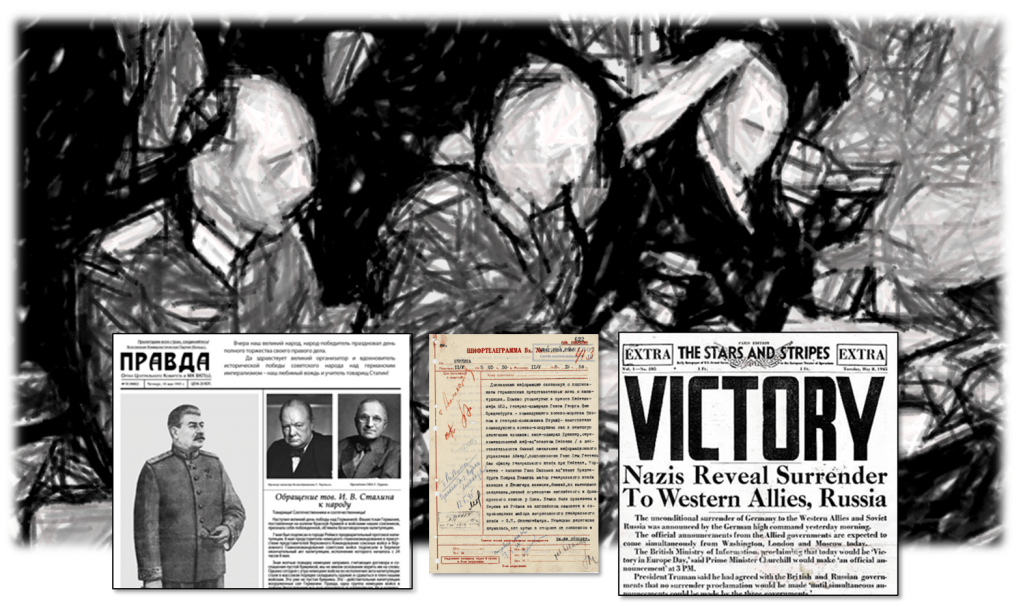
Germany’s capitulation document – or as Bob Hope put it, “The paper so nice, they signed it twice…” – was signed in Reims on 7 May 1945, and again the next day in Berlin, at the insistence of the USSR that Germany bring the war to an end in the same city from which it was initiated.
In spite of some eye-rolling from US and UK authorities at the time, these Allies acceded, and the German signatories were brought to Berlin from Reims on a British aircraft. The details of the signing of the Instrument of Surrender are rather well-documented by all sides. However, the details of the next day’s luncheon of the signatories and other German officials are less well-known. The event was captured in a Top Secret report sent to Moscow on 11 May 1945, with the apologies of the author – a Soviet agent who allowed that he had spent two days without sleep and left at the meeting site with no means to broadcast his report. The Germans chatted with the author, along with Soviet intelligence agent Vadim Kuchin, both of whom felt the Germans were under the impression that the new government they had formed – headed by Admiral Karl Dönitz – would be allowed to continue its existence by the Allies. Keitel had actually rendered a Nazi salute at one point.
The report is mostly anecdotal – nothing truly explosive, not even Keitel’s description of the bomb blast that took place in Hitler’s room the previous July – but it does offer an interesting glance at the early, perhaps naive aspirations the surrendering Germans had for their own future and that of their government. There are also a few interesting examples of Germans trying to butter up the Soviets (“We’re the only ones who really understand what it means to suffer…”) and Soviet angst over American concerns over hurting the Germans’ feelings by asking them to stay put during the welcome ceremony of the arriving British and American dignitaries.
The translation of this Top Secret report is provided below. The author’s assertions of his fatigue in the last paragraph show through in the text of the original Russian report, where numerous names were misspelled or provided incompletely. These have been cleaned up by the translator as well as possible.

TOP SECRET
CODED TELEGRAM No. 6281, 6282, 6286
From BERLIN
Received 11 May 1945 at 02.50 Decoded 11 May 1945 at 15.50
I am reporting information associated with the signing of the act of surrender by German representatives. Along with those already identified in the press – Keitel, Chief of the OKW [Wehrmacht High Command], Admiral of the Fleet Hans-Georg von Friedeburg, commander of the German Navy, and Lieutenant General Hans-Jürgen Stumpff, deputy commander of the Luftwaffe, the German delegation included the following: Vice Admiral Brückner [sic, should read “Bürkner”], recommended by Keitel’s chief adjutant (in actuality, the former head of the Abwehr’s Information Directorate), Lt Colonel Hans Böhm Hötelbach [sic], one of Keitel’s general staff officers; Captain 3rd Rank Hans Zalman, Friedeburg’s adjutant Konrad Stangl, and Leonhard, Bock’s former (per available information) personal English and French interpreter. The Germans were brought to Berlin from Reims on a British aircraft, accompanied by a Major in the US general staff – F.E. Oppenheimer. Throughout, the German delegation was kept away from the allies and did not participate in any of the welcome ceremonies or preliminary discussions. The Germans were only brought into the room where, after answering whether or not they had read and understood the text of the declaration, and prepared to sign it, Marshal Zhukov called them to the desk to sign the document. After this, the German delegation was removed from the room. Herewith, we report our observations of the Germans and highlights from our discussion over lunch, after signing the declaration. Our discussion took place in the accommodations made for the Germans for their overnight stay; the only persons present other than the Germans were comrade Kuchin and I. By the delegation’s appearance, it was evident that they fancied themselves as representatives of a still-prevailing Nazi Germany. Keitel raised his arm in a Nazi salute by way of greeting, and had a gold Nazi decoration on his dress coat, regarding which he proudly explained that it was a personal decoration from Hitler. Other members of the delegation also had medals adorned with the swastika. Moreover, Keitel stressed his allegiance to Hitler, providing an account of the exploding bomb in Hitler’s room on 20 July of the previous year, that Keitel himself was standing one meter from the blast, and arranged for the arrest of the plot’s conspirators.
Additionally, he said that, having left with one of the groups to the north of Berlin, he went precisely to the north, and not to the south, where he had previously intended to go only because he wanted to take all measures to save Hitler from the entrapment, organizing a breakthrough of the ring of our troops around Berlin. Keitel, Friedeburg, and Stumpff presented their credentials, signed by Grand Admiral Dönitz as head of state. It was explained during lunch that Dönitz became Hitler’s successor in accordance with Hitler’s last will and testament. The government that Dönitz put together included Graf Schwerin von Krosigk as Minister of Foreign Affairs, simultaneously occupying the post of Minister of Finance, Franz Seldte as Minister of Labor and Social Affairs, [Herbert] Backe as Minister of Supply, and [Julius] Dorpmüller as Minister of Communications and Ports.
Other government members are still unknown. This so-called government is currently located in Holstein, near the city of Flensburg, where the German headquarters was located. This government staff is clearly an effort by the Germans to maintain, legitimize, and somehow, in full view of the allies, steamroll their leadership that would ensure Germany’s integrity and work on creating the conditions for retaliation. In this connection, as an attempt to obtain support from the Allies for the new government’s undertakings, it is important to note the remark made by Keitel that he had already spoken to Eisenhower about the need to immediately send the demobilized soldiers of the disbanded German army to the farming sector in order to provide a food base for the state. On the other hand, Keitel, Strumpff, and Friedeburg reminisced a great deal during the lunchtime conversation, particularly about the pre-1933 ties between the German and Soviet generals and officers, as well as joint trips on maneuvers.
Moreover, Keitel stressed two times that during this war, only the Russian and German people, showing their strength and ability, endured great suffering, whereas during that time the British and Americans barely suffered from the war at all. All of these facts are a sign of the effort to repeat the history of post-Versailles Germany, obtain support from the West, preach and use the slogan of General von Seeckt on turning east, preserving the core of German (distorted) and the military for restoring Germany’s “splendor.” From other comments by Keitel and the others, it must be considered that, having expressed absolute certainty that Hitler is no longer alive, Keitel cited, as evidence, no more than the unconvincing fact of Hitler’s will entering into force and the subsequent designation of Dönitz after his death. When asked about the location of other Nazi party leaders, Keitel and the others would always answer that they don’t know, and have no communication with them. As relates to von Brauchitsch, Keitel states that he, too, is in Flensburg, but Keitel supposedly has no connection with him.
The following facts deserve attention as an example of the attitude of the Americans to the Germans: In order to prevent the participation of the Germans in the welcoming ceremony of the allies, at the airfield Serov requested that the Americans give the instruction to keep the Germans in the airplane while the reception with honor guard took place. In response, the Americans asked that delaying the Germans be organized by our own officers, since they did not want to spoil the relations with the Germans. Oppenheimer, mentioned above, is fluent in German, worked in Germany as a lawyer, and is currently engaged in Eisenhower’s staff developing appeals and laws for Germany. Another American, an intelligence agent in the general staff, Lieutenant Reinhard [Gehlen], was constantly flitting about near the Germans. He is a German native, and is an excellent German speaker. He tried rather impudently to slip into the staff room when General Malinin was speaking with Keitel about establishing ties between the Soviet and German commands to implement the surrender instrument. I will be providing further information about the American and British teams.
I apologize for the information delay, having gone two days with absolutely no sleep and having been at the meeting point, isolated from my radio set, and with no way to call over HF communications.
 Translating History