
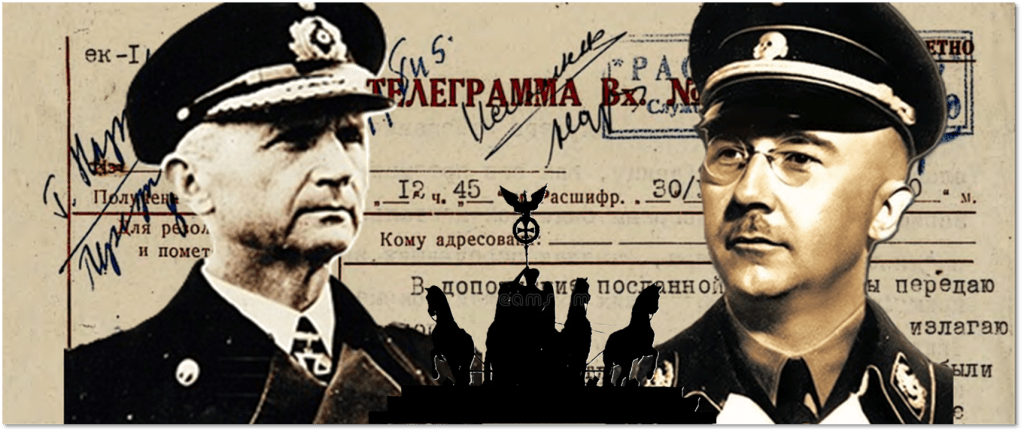
Another Top Secret coded telegram from Berlin to Moscow, this time with the Soviet agent providing information about sweeping into Nazi command and control headquarters to search for, examine, and abscond with the “most “most interesting” documents for Stalin’s eyes. We learn some information about Hitler’s last will, including the appointment of Dönitz as his successor, Hitler’s apparent approval (post-mortem) for German leadership to appeal for a truce, and Dönitz’s insistence that Germany fight on. We also learn of a small bit of a tug of war when it came to acquiring photographs of Himmler’s body.
Curiously, the report itself was written on 28 May, and wasn’t received until two days later. There is no indication as to what time of day (or night) that the report was completed in Berlin, but given the time required to encode it, and the amount of similar classified traffic flowing into Moscow from around the world during these hectic days, a lapse like this is understandable.
As an aside, an excellent account of Himmler’s final days can be found at this Warfare History Network link.
The translation of the Top Secret document follows, with redactions intact.

TOP SECRET
CODED TELEGRAM No. 7363, 7389
From BERLIN
Received 30 May 1945 at 12.45 Decoded 30 May 1945 at 19.20
Further to my last telegram I am submitting a report ██████████ ████████████ which lays out information about Hitler. While materials have appeared in the press regarding Himmler, I am transmitting the following information as an eyewitness account. ███████████████████ ████████████████████████████████████████████████.
1/ On 23 May, after the British apprehension of the Dönitz “government,” ██████████████████████████████████████████ went to the building where the OKW and government offices were located, in order to be present during the search for and analysis of the documentation. Examining the documents, located on tables in separate rooms, we selected a number of the most interesting ones and, having secreted them into the briefcase, we carried them outside and brought them on board the SS Patria ████████████████████████████████████████████████████ █████████. Among the documents were records of telephone messages M. Bormann, the leader of the Party Chancellery on behalf of Admiral Dönitz regarding Hitler’s death, which ensued on 29 April, and about the fact that his last will had come into effect, according to which all authority was transferred to Dönitz as his successor.
The records of these telephone messages were formally documented: they were given entry numbers and carried the surnames of those who transmitted, encoded, received, and decoded them. The documents included the text of the address of order of Dönitz, which stated that as matters stood at the time, there was no way out for Hitler other than suicide, that he [Hitler] wanted to untie the hands of German leadership to allow for a truce to be reached. In his address, Dönitz calls for continuing the fight, in keeping with the spirit of Hitler, whose death he called Hitler’s “ultimate service” to the German people. Both of these documents are in General Trusov’s hands.
2/ On 24 May Colonel [Vasiliy] Gorbushin, Lieutenant Colonel [Ivan] Iyevlev [TN: also rendered as ‘Ievlev’] were in the city of Lüneberg in the British Second Army headquarters, examining the body of Heinrich Himmler. Himmler, according to information from Second Army headquarters, was detained on 21 May in the Bremervörde region, accompanied by two of his adjutants. Himmler and his companions were dressed in civilian attire, and Himmler himself was sporting a bandage on his right eye and had shaved his moustache. All three were placed in an internment camp, and on 22 May were send to prisoner of war camp No. 031 near British Army headquarters.
It was at this camp that Himmler revealed himself to the commandant, and his identify was confirmed based on the registration card of the Supreme Headquarters of the Allied Expeditionary Force. During a doctor’s examination, carried out to check for the presence of any objects or poisons on his person, Himmler bit down on a glass ampule with poison that he had hidden in his mouth. In spite of measures taken, death followed 15 minutes later. The appearance of the corpse matches exactly the final photographs of Himmler: on his face were all of the characteristic signs: his extremely small chin, puffiness of the face, and flat fingernails on quite small hands, all indicative of Himmler. The corpse’s appearance leaves no doubt as to his identity. On the corpse’s crown there were several rather large red spots.
In the evening of 24 May, the chief of the intelligence and counterintelligence department of the Army headquarters, Colonel Murphy, provided to us the following documents:
1/ A copy of the report of the counterintelligence officer who conducted Himmler’s interrogation.
2/ The examining doctor’s report (copy).
3/ A copy of the communique from the Second Army headquarters for the media regarding Himmler’s death. The documents were provided to us in English in two copies.
One copy was with Colonel Gorbushin. Moreover, in response to our requests for photographs of the body, we were given a roll of undeveloped film that contained 8 photos of the body in various positions. Our request to be provided with processed photos of the body was not fulfilled, with the excuse that correspondents’ photos had already been sent out by airplane to London, whereas the official ones had not yet been processed due to the late hour. Colonel Gorbushin regarded the rolls of unprocessed film as sufficiently reasonable to bring to Brussels, where he was headed with Lieutenant Colonel Iyevlev at the instruction of General Major Trusov. Colonel Gorbushin planned to return from Brussels to Flensburg, where he would personally report to General Major Trusov on the documents we had obtained in Lüneburg.
 Translating History