
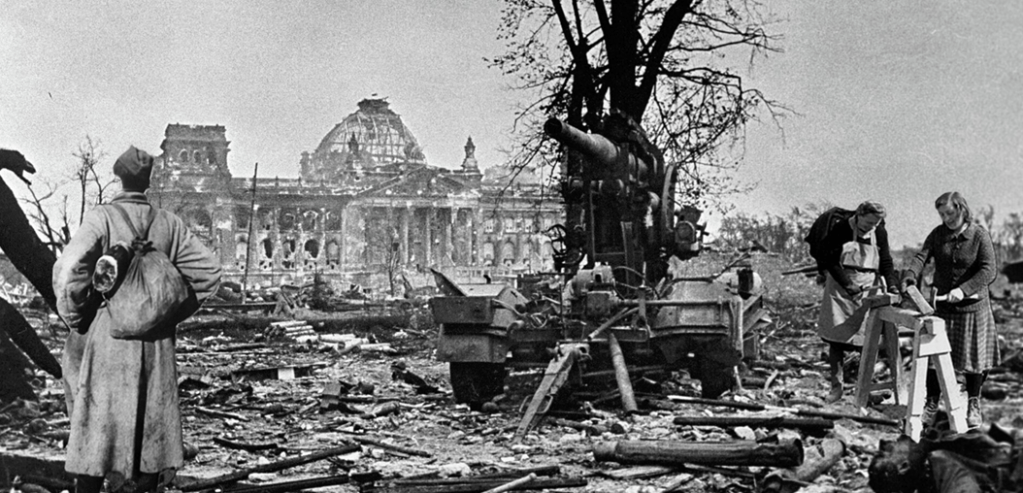
Until we can get our hands on more material, this ends our collection of post-war Berlin reporting from a well-placed Soviet intelligence officer. In this, his final report (which was written almost concurrently with our previous post), he and his unnamed (redacted) colleagues wandered across the German countryside to see how life for the Germans is going in the American and British zones of occupation. In particular, the group visited Nauen, Ludwigslust, Schwerin, Lübeck, Kiel, Hamburg, Hannover, Braunschweig, Magdeburg, Halle, and a number of other unidentified small towns. They observed interactions between the British and Germans and the Americans and Germans. They recorded how the Americans seemed to hit it off with the Soviet officers, while muttering that they would one day have to fight the Soviet Union.
There’s nothing explosive or particularly compelling in this report, just a glimpse into how life was in the war-torn remnants of Germany in May 1945.
One final word on this set of redactions. The paper used in the report is thin enough to be able to read, at times, text from the opposite side. We’ve made attempts to try to isolate those redacted sections from the back of the sheet, but the text on the obverse is always in the way. If the reader is aware of digital forensic tools in use today that can peel away the obverse while maintaining the integrity of the reverse, I’d be interested in hearing from you. I think discovering what the Russians mean to keep classified would be a fascinating exercise.
The following is the translation of this Top Secret report.

TOP SECRET
CODED TELEGRAM No. 7370, 7388
From BERLIN
Received 30 May 1945 at 12.45 Decoded 30 May 1945 at 17.30
█████████ 8th Department. █████████████████████████.
To round out the picture, further to the report ██████████████, I am sending information about the situation in the American and British zones of occupation ███████████████████████████████████████.
On the road to Flensburg █████████████, and █████████ also on the way back, we visited the following cities: Nauen, Ludwigslust, Schwerin, Lübeck, Kiel, Hamburg, Hannover, Braunschweig, Magdeburg, Halle, and a number of other small towns.
Among the aforementioned cities, a number were seriously damaged: Hamburg (about 75 percent destroyed), Hannover and Kiel (more than half destroyed), and in other cities, the damage was insignificant or altogether absent. ███████████████████████████████████████████████ ████████████████████. There were no checkpoints or patrols on the roads. The US Military Police drive around in “Willys” [Jeeps] and on motorcycles, but nowhere did we see the police stopping or checking anyone. Only after the arrest of the Dönitz government did the situation change a bit: returning from Flensburg █████████ saw in Hamburg, Hannover, and other cities squads of military police in the outskirts, checking the documents of civilians.
Overall, the situation in the Hamburg, Hannover, Braunschweig, Magdeburg, and Halle areas has yet to be finally determined, since only advance elements were located there. A redisposition of troops is expected to take place soon, after which occupation forces will be visibly in place.
As previously reported, there are already allies’ commandants in the cities, as well as burgomasters designated by “military government” elements, responsible for registration of the population and distribution of ration cards. City governments have yet to be created.
The cities in the southwest of Germany are overpopulated with German refugees from territories occupied by our troops. The cities are generally full of life. Trams and cinemas are up and running, and stores are doing business. Provisions are issued according to the old standards, and the allies only confiscated those warehouses that belonged to the German army, the rest being left to the Germans.
██████████████████████████████████ can be stated that across the entire territory of the allies, the police that existed under the Hitler regime remain in full force, including police of the SS, with the exception of senior leadership.
In the city, movement of the German population is prohibited from 21.00 until 06.00, and during that time, guards patrol the streets.
No appearances of orchestrated goings on or activities of the political parties that existed prior to 1933 have been observed anywhere.
Along our comrades’ route, we encountered many German prisoner of war camps, especially in the British zone of occupation, but they are very poorly guarded; the prisoners are granted leave to visit the city. Everywhere we observe that the Americans have a far stricter and harsher attitude toward the Germans than the British. Along our travel route there were many camps for our [TN: Soviet] prisoners and forced labor.
German rear guards were removed immediately, they all come and go where they please, and they no longer work anywhere. They go to the camp themselves so they won’t miss out on the promise, made by the allies, to get shipped back home. Some have even been able to get their hands on a bicycle or other gear. Those held in the camps receive 600-700 grams of bread and hot food. My comrades note the exceptionally friendly attitude of the Americans toward out commanders arriving at the occupation territory. All of them return with various gifts.
When establishing official contact between the American troops and the troops of the commander of one of the front armies, General Colonel Tsvetayev, he and his officers coming to the American Army headquarters were given the red-carpet treatment. Despite this appearance, one can hear remarks from the lips of the American officers that it is likely that the US will have to fight the Soviet Union.
[Translator note: This last line is outlined and underlined in red by one of the report’s readers.]
 Translating History