

To mark the 80th anniversary of the 16 July 1945 kick-off of the Potsdam Conference between the leaders of the Soviet Union, United States, and Great Britain, the Russian Federation Federal Security Service (FSB) has published a handful of materials, freshly declassified for the occasion.
The following was translated from information cobbled together from a number of Russian-language news sites as well as the FSB website itself, where its press release and materials can be found. The reports referenced below will be translated and presented here in the coming weeks.

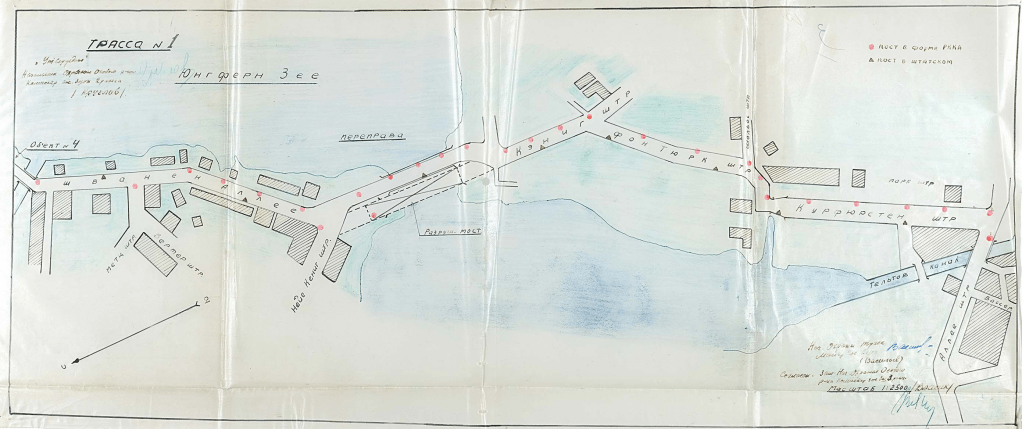
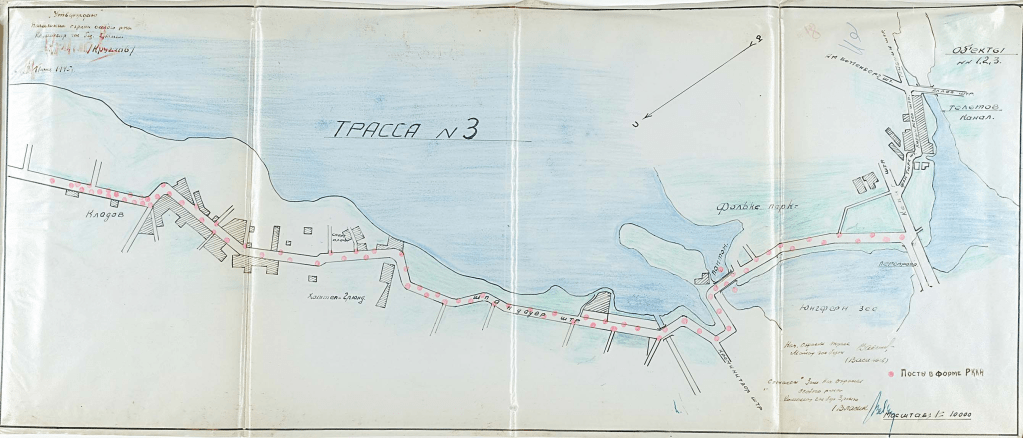
On July 16, 1945, a Soviet delegation headed by Josef Stalin arrived in the Berlin suburb of Potsdam. On July 17, the third and final meeting of the leaders of the “Big Three” – Great Britain, the USSR, and the USA – opened here. This event went down in history as the Berlin (Potsdam) Conference of the leaders of the countries of the Anti-Hitler Coalition. The FSB Public Relations Center published declassified materials on efforts to provide conference security, including Beria’s secret report to Stalin, route security plans, special passes to the conference, armament of special trains, a report on mine-clearing of territories, and other unique documents. For example, of interest is the list of the film crew for special filming of the Cinematography Committee under the Council of People’s Commissars of the USSR for the Berlin Conference. The first on the list is the director, the outstanding Soviet film director and actor Sergei Gerasimov.
Despite the fact that several airfields had been prepared in Berlin to receive the Soviet delegation, Stalin did not change his ways and went to Germany by train. The report of the Soviet NKVD to the State Defense Committee described in detail the measures to ensure the safety of the Soviet delegation’s journey from Moscow to Berlin:
“The total length of the route is 1,923 kilometers, of which: 1,095 kilometers are in USSR territory, 594 kilometers are in Poland, and 234 kilometers are in Germany.
“To ensure security both along the route of the special train and at the stations, 1,515 NKVD-NKGB operational personnel and 17,140 NKVD troops have been sent to the sites, and will be deployed in a timely manner at the following density, per kilometer: USSR – 6 people per kilometer, Poland – 10 people per kilometer, and Germany – 15 people for each kilometer of the route.
“In addition, 8 armored trains of NKVD troops will travel along a special train route, including 2 armored trains in the USSR, 2 in Poland, and 4 in Germany.”
The railway track from the Soviet border to Potsdam was “re-gauged” to the Soviet standard, and special test trains passed along it. Three special trains were formed for Stalin’s trip. The first was a control train with forty operatives of the 6th Directorate of the NKGB. Along with the standard weapons (a revolver, a Mauser, and a knife), they were also armed with machine guns with four loaded drum magazines. In addition, the armored platform of the train had a 37-mm cannon, a quad-mount anti-aircraft machine gun, and two onboard Maxim machine guns. Next came Stalin’s train, which was guarded by 100 employees of the 6th Directorate. In addition to machine guns and pistols, each carried two grenades. The armored platform was armed in the same way as the first train. Also, 17 Red Army soldiers with machine guns and six grenades each were assigned as security. The third train was the cover train, consisting of 10 NKGB officers and 70 Red Army machine gunners.
As for the preparation of the meeting of the three leaders, as noted by the FSB Public Relations Center, the preparation of the meeting itself was carried out thoroughly and clearly – many official and protocol issues were resolved in agreement with representatives of Great Britain and the United States.
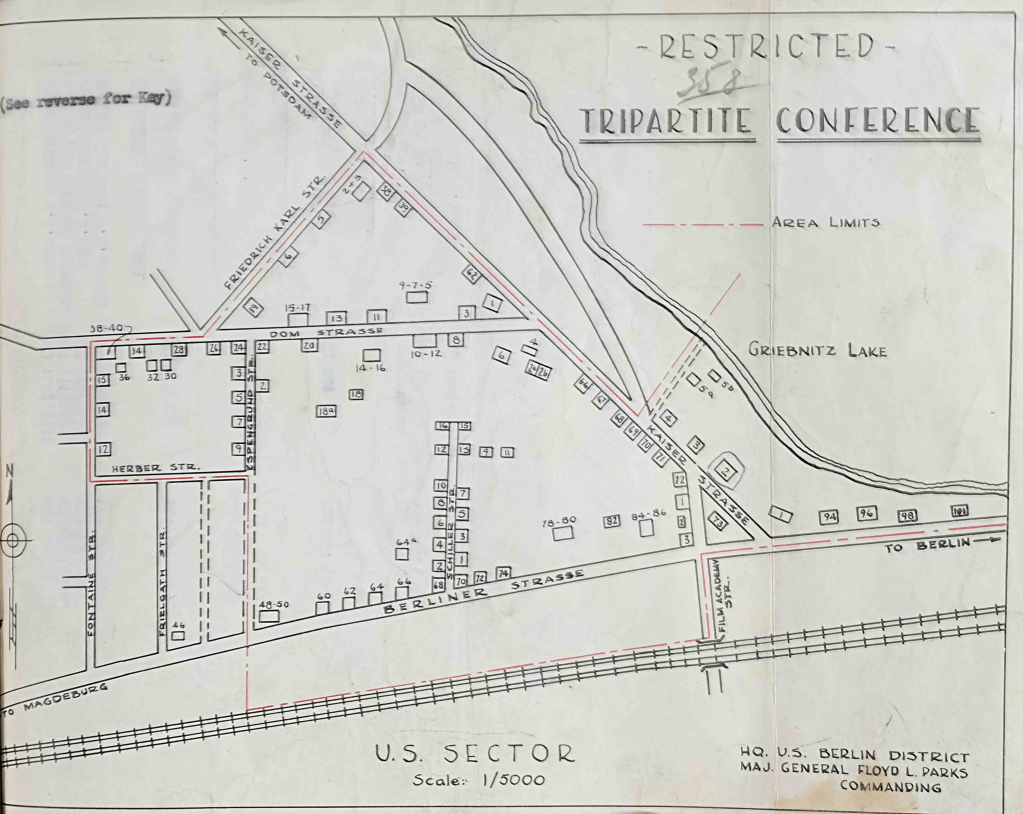
At the same time, the main burden of conducting preparatory events fell on the shoulders of the Soviet special services. The security and protection of the conference was provided by employees of the units of the 6th Directorate of the NKGB of the USSR, “SMERSH” military counterintelligence, intelligence, and other services of the NKGB and NKVD. By early July, the Soviet military administration ensured the implementation of a number of urgent measures: the power plants in Babelsberg and Potsdam were repaired and put into operation, the Dalgow and Kladow airfields were restored. In Cecilienhof Palace, 37 of the 176 rooms in the palace were overhauled, including a conference hall with three separate entrances. By the time of the conference, the Babelsberg area was divided into three occupation zones, in which the troops of the corresponding countries were located.
In a report on the completion of preparatory measures for the reception, accommodation, and protection of the upcoming conference of the three powers in Potsdam (no later than June 30, 1945), Lavrenty Beria informed Stalin and Molotov:
“The location chosen for the conference was the Babelsberg tract, located 4 km east of Potsdam in the area of Lake Griebnitz See and the Teltow Canal […]
“Due to the lack of accommodations in the aforementioned buildings suitable for holding conference meetings, the former palace of the German Crown Prince, located in Potsdam, 4 kilometers from the area where the Soviet delegation was located, was prepared.
“The palace is an old two-story building, suitably equipped, with an area of up to 2,000 square meters; the area of the meeting room is 160 square meters; the kitchen unit and dining room at the palace allow for receptions to be held.”
In the same document, Beria reported on the organization of security for delegations of the allied powers:
“The personal security of the head of the Soviet delegation will be carried out by the operational staff of the NKGB 6th Directorate, and to protect the area where the Soviet delegation is located, security has been organized in 3 rings, numbering 2,041 NKVD troops.
“The security of the former castle of the German Crown Prince is carried out by the operational staff of the NKVD-NKGB, totaling 150 people, and NKVD troops numbering 1,000 people.
“Comrade Vlasik was appointed head of security for the head of the Soviet delegation.
“The personal security of the American and British delegations is provided by the allied forces, and external security by NKVD troops.”
A curfew was in effect from 11 p.m. to 4 a.m.
In addition, in the areas adjacent to the conference site, Soviet sappers carried out large-scale reconnaissance and mine-clearing work on dedicated facilities and routes in Potsdam and Babelsberg.
From June 13 to June 29, 1945, personnel of the Red Banner 8th Guards Special Mining Battalion, with the 2nd Guards Mine Engineering Battalion and a separate company of mine-sniffing dogs carried out an inspection of dedicated facilities and routes in Potsdam and Babelsberg.
The Report of June 29, 1945 stated that a total of 888 Faustpatrones, 1,484 artillery shells, 61 kg of explosives, 726 mortar and 102 anti-tank mines, 20 aerial bombs, etc. were discovered and destroyed. As a result of the reconnaissance and mine-clearing activities, 8.8 square kilometers of territory and 41.8 kilometers of routes were inspected.
The final results of the reconnaissance and mine-clearing of facilities and travel routes of the leaders and members of the delegations were spelled out in the Report of the 8th Guards Special Mining of the Red Banner Battalion of Guards by Colonel Yu. I. Pergament, dated July 13, 1945.
The report noted that reconnaissance and mine-clearing of Route No. 1 was carried out twice. During the initial reconnaissance and mine-clearing on Route No. 1, 482 artillery shells, 298 hand grenades, 28 anti-tank mines, 425 panzerfausts, and a large number of other explosive objects were discovered and destroyed. Similar reports were reported in the same number based on the results of checking Routes No. 2-4. As a result of the re-inspection, four artillery shells, three Faustpatrones, one anti-tank mine, two mortar mines, and dozens of small arms were discovered.


 Translating History