

A report published by the Russian Federation Ministry of Defense in June 2025 provides a look at the latest modifications to its counter-drone measures employed as a response to Ukraine’s propensity to expand combat drone operations deep into Russian territory. The report, unclassified but not intended for broadest distribution, covered a number of different (mostly non-kinetic) angles for counter-drone protection which would appear, even to the layman, as rather rudimentary and of questionable effectiveness.
Translated excerpts from the report are provided below.

Storage facilities, as part of the military infrastructure, are the foundation of bases, combat, logistical, and special technical military support. These facilities were built during the preliminary engineering preparations of national territory in accordance with the current views on military operations, and currently do not meet modern requirements. Trends in the construction of Russian military warehouse infrastructure, represented in recent decades by logistics centers, have leaned toward minimizing construction and operation costs. As a result, they turned out to be very vulnerable to various external threats, such as cruise missiles, multiple launch rocket systems, and unmanned aerial vehicles.
During Ukraine’s special operation to destroy Russian Ministry of Defense storage facilities (depots for missiles, ammunition, explosives, rocket fuel tanks, fuels and lubricants, etc.), Ukraine used large numbers of UAVs. Russian air defense systems intercept some of the Ukrainian drones, but there are examples when drones reach military warehouses located within the Russian Federation, which leads to significant material losses and disruption of combat missions.
The Ukrainian Armed Forces is armed with more than 2000 different types of UAVs, a large percentage of which are either produced by Ukraine or are the results of Ukraine’s conversion program for foreign counterparts. Meanwhile, there is a significant increase in their performance – in terms of range (1000 km and more), accuracy (target detonation accuracy within 5-7 m), warhead yield (30 to 50 kg of various types (thermobaric, shaped-charge, fragmentation, armor-piercing hollow charge or high-explosive)), and the use of artificial intelligence. Due to the relatively low cost of drone production compared to missile production, the Ukrainian Armed Forces are concentrating their main efforts on UAV production.
As of today, and for the foreseeable future, UAVs are the most cost-effective and efficient way to destroy storage facilities. This trend emphasizes the need to develop measures aimed at increasing their security. Warehouse survivability implies the ability of an object to withstand not only man-made impacts in peacetime, but also combat damage, as well as restoring and maintaining the technical condition at a level that allows it to perform functional tasks.
Depending on the nature and significance of the storage facilities, the expected means and methods of enemy action, and other specific conditions, all of these measures are carried out in one or another appropriate combination, as we will see.
Currently, protective screens are used to ensure anti-drone protection of storage facilities. The screens consist of a frame, located at a safe (calculated) distance from the facility, and the screen itself. Various meshes (usually chain-link mesh) are used as screen material. Experience in using mesh screens shows that, during their installation, it is advisable to make maximum use of existing engineering structures and constructions (Figure 1) and select screens (lattices) with a mesh size of no more than 35×35 mm (since the diameter of the VOG-25 is 40 mm) and a wire thickness of at least 3 mm (Figure 2).
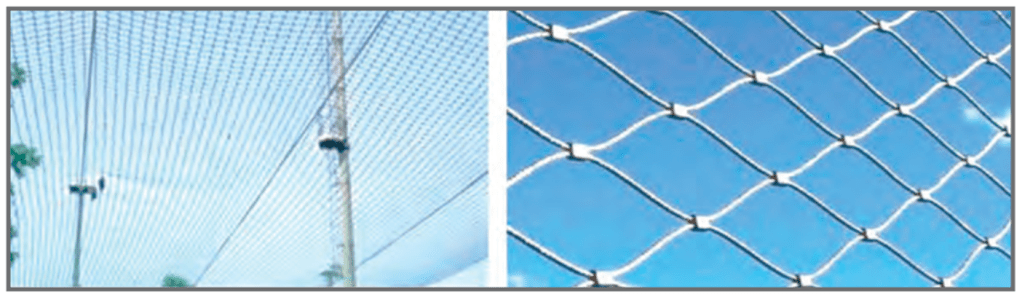
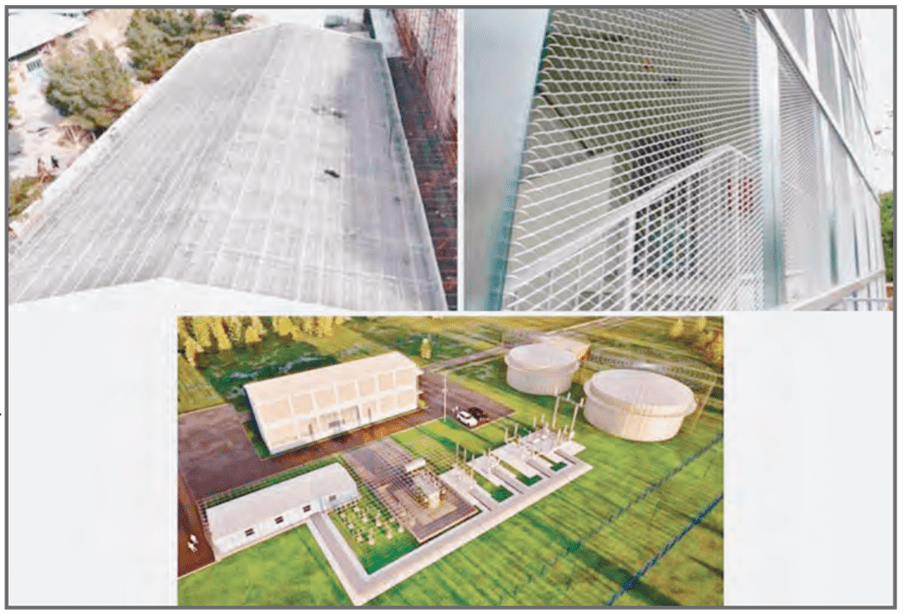
Anti-drone protection of a depot prevents fixed-wing UAVs from entering a secure installation. Protection of fixed upright tanks can be organized both in the upper hemisphere (a canopy installed additionally between the tank roof fence and the upper point of the extension of the central pillar), and along the entire perimeter (installed without support on the structural elements of the support equipment and tank farms).
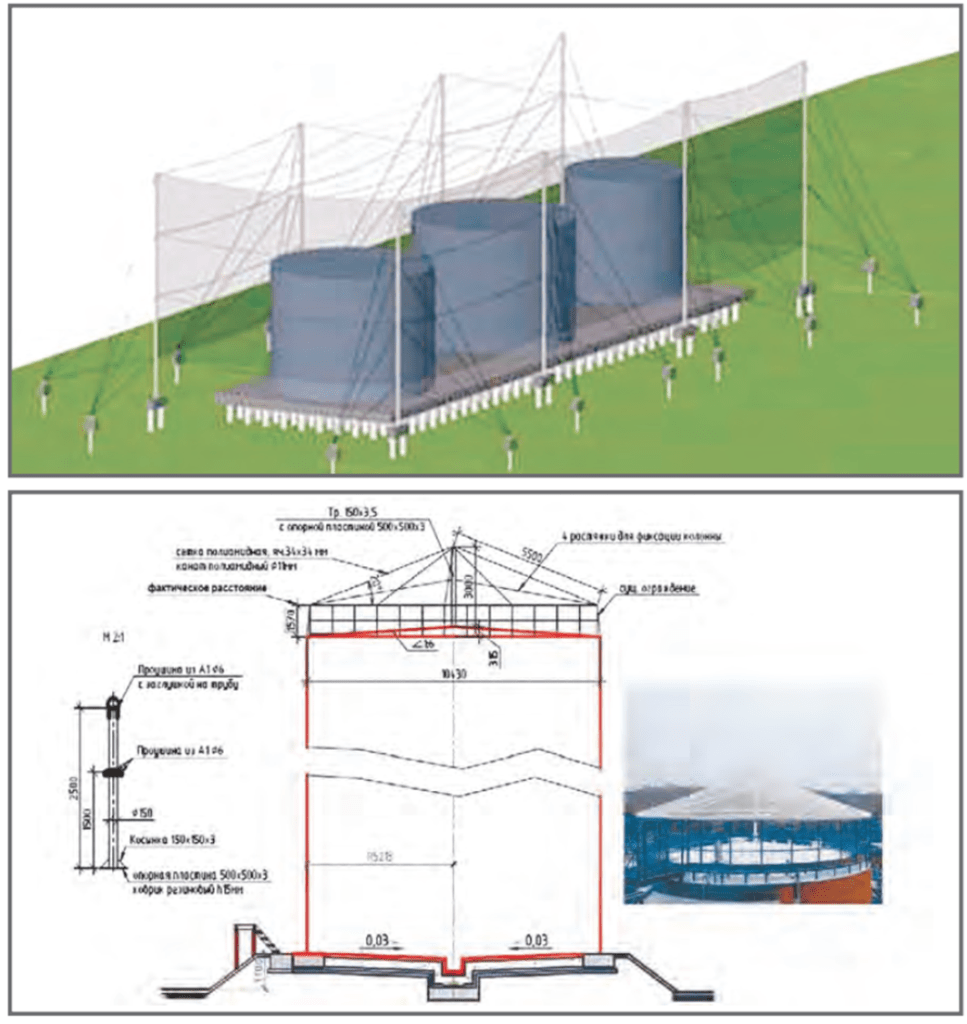
Protection of fixed upright tanks is provided by installing canopies with the space between the supporting elements filled with nylon netting (or chain-link mesh) with mesh grids no larger than 35×35 mm (Figure 4). The simplicity of the canopy design allows them to be created from previously used materials (decommissioned pipelines, etc.).
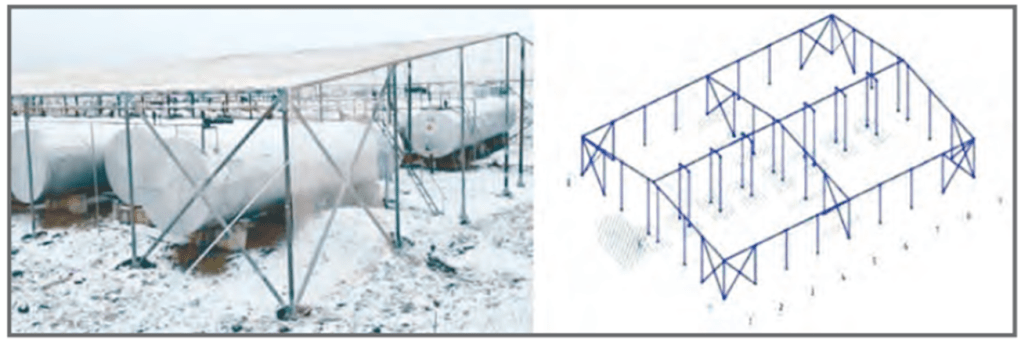
An intermediate solution between dispersion and structural protection is the use of embankment-type gabion structures, which are actively used in modern armed conflicts. They can serve as reliable protection against combat UAVs of any type, as well as the aftermath of an explosion (fire) at a storage facility. Fast and reliable connection of individual sections allows one to build fortifications of almost any length and height in several tiers (Figure 5).

Underground storage facilities. The greatest protection of storage facilities from the damaging effects of UAVs can be provided by the protective layer of soil when they are located underground. Currently, storage facilities are located in different types of structures: above-ground embanked; pit; mine; and underground (Figure 6).

Active protection. To increase the effectiveness of protecting storage facilities from being hit by enemy UAVs, it is necessary to use electronic warfare systems, anti-drone guns, and well-proven hunting guns. To increase the effectiveness of using active protection systems, a system of trenches, covered slits, shelters, etc. is created (Figure 7).

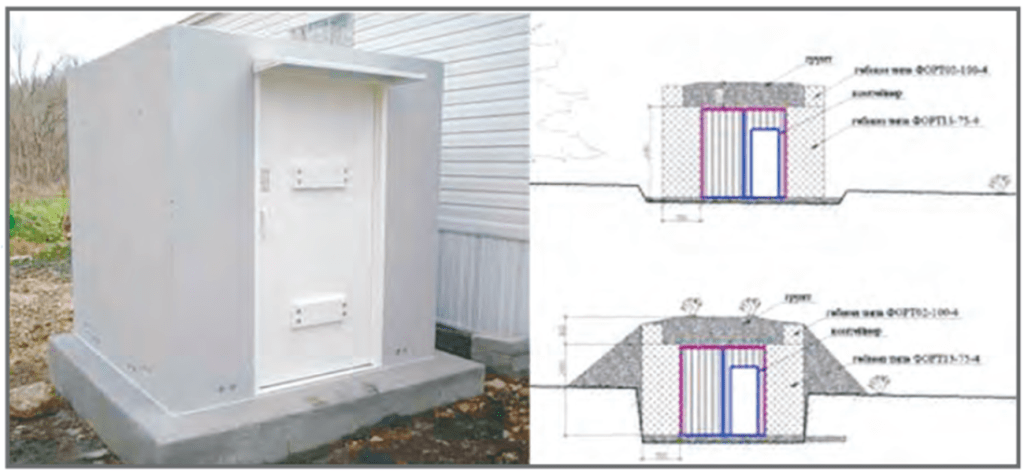
To protect personnel from surprise attacks by enemy UAVs, it is important to install reinforced concrete modular shelters, developed and produced by industrial enterprises, where required.
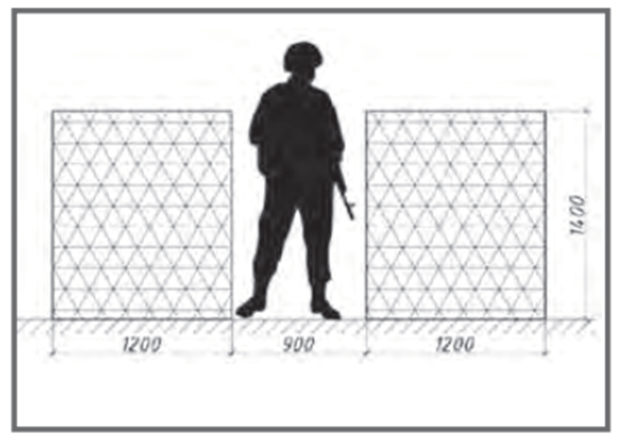
To protect personnel from surprise attacks by enemy UAVs, it is important to install reinforced concrete modular shelters, developed and produced by industrial enterprises, where required.
Camouflage. These days, the enemy uses drones that fly based on collected coordinates, but an AI-based guidance system is under active development, which allows for selective and high-precision strikes.
Camouflage plays a special role in ensuring security. Its main goal is to ensure the invisibility of actions, resulting from the main task – preserving the storage object, which can be solved in several ways: concealment, imitation, demonstrative actions. Military-technical camouflage measures are based on the use of standard means of concealment, decoy, and electronic warfare tools.
Concealment from enemy intelligence collection is carried out using all known technical methods and means of camouflage, including optical camouflage, artificial blinds (Figure 9), camouflage paint, the use of mock-ups of dummy installations, including radar, thermal, smoke, aerosol, and light camouflage.

 Translating History