
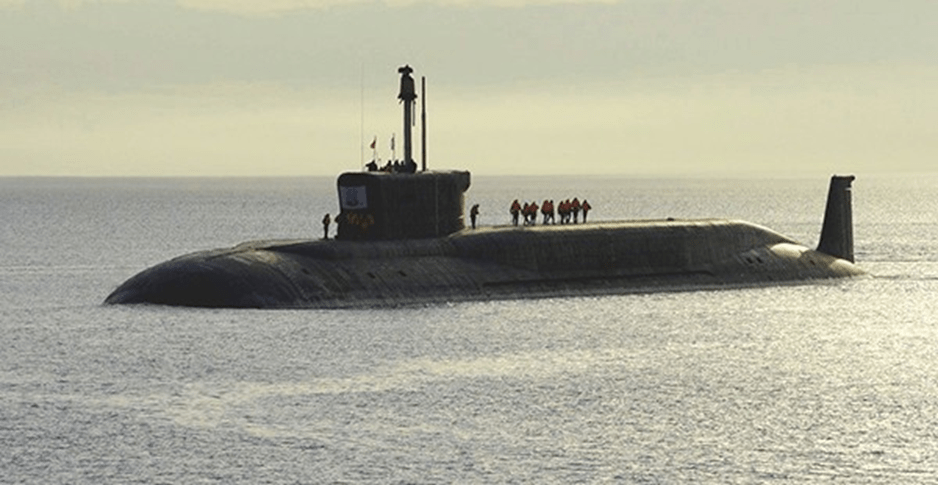
A press release issued today, 4 August 2025, from Russia’s Northern Shipyard – Sevmash – celebrated the 40th anniversary of the world’s depth record (1027 meters) being set in 1985 by the Project 685 nuclear submarine Komsomolets, built at the Sevmash facility. To date, this record has not been surpassed by any fleet in the world. The dive took place in the Norwegian Sea and was exploited as a demonstration of the Soviet Union’s superiority in nuclear submarine shipbuilding. Less than four years later, the submarine would find herself lying on the bottom of the Barents Sea, leaking plutonium, after a fire on board.
The nuclear submarine was laid down at Sevmash in 1978. The person in charge of the delivery was Vladimir Chuvakin. The submarine was a product of the Rubin design bureau, and was designed for searching, detecting, long-term tracking, and destroying enemy submarines, defended aircraft carriers, large warships, and transports. According to the technical performance characteristics drawn up by the Soviet Navy, the maximum diving depth of the Project 685 submarine was to be 2.5 times greater than any other products of submarine shipbuilding.
Advanced technologies were used in building the nuclear submarine; three dock chambers were specially built at the plant to test the submarine’s compartments under external pressure. Shipbuilders and officers referred to the sub a kind of “hydrospace orbital station.”
Vladimir Chuvakin recalled: “Up to eight hundred meters, the dive was carried out in steps of 50 meters, then to the maximum depth in steps of 25 meters. From seven hundred meters, the compression of the pressure hull began to have an effect. With a snap and crash, the bolts in the deck expansion joints were sheared off. Reports from the combat posts and compartments were clear, thorough, and calm.”
Over the decades, international efforts have been made to in a bid to determine whether the wreck presents threats to the undersea environment. At the time she sank, the Komsomolets was carrying two plutonium warheads. Those now lie at a depth of 1,680 meters with the rest of the sub’s wreckage and pose ongoing worries about radioactive leakage at the bottom of the Norwegian Sea. But plutonium isn’t the only concern. The submarine’s reactor, loaded with nuclear fuel, produces other radioactive isotopes like cesium 137 and strontium 90.
Leakage from the wreck – though deeply submerged and unlikely to contaminate fish stocks – has been detected on previous missions Russia and Norway have undertaken since the Komsomolets went down. In 2019, a joint expedition launched by the two countries discovered the leakage directly around the submarine’s hull had increased slightly over levels measured in 1998 and 2007.
© 2025 by Michael Estes and TranslatingHistory.org
 Translating History