
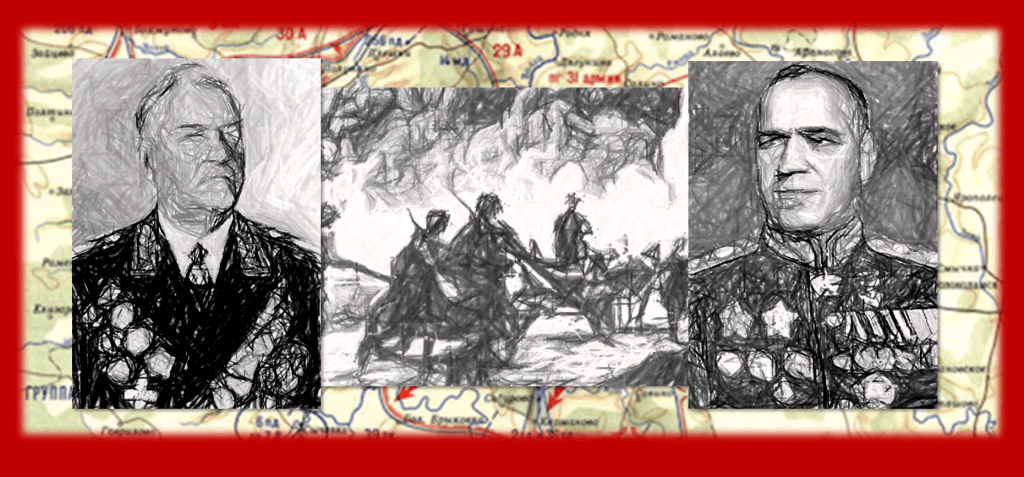
The summer 1942 Battle of Rzhev was one of a number of fierce and bloody battles that began the previous January, and would not let up until the following March. There is still heated debate regarding the entire campaign’s toll to the Red Army and the Wehrmacht – many suggest the numbers of Red Army deaths reached or surpassed one million – but what is not in doubt is the brutality of the fighting. The campaign has come to be known to its veterans as “Ржевская мясорубка” (the Rzhev meat-grinder).
On 7 August 1942, General Zhukov, who was commanding the Western Front at the time, and Nikolai Bulganin, chief political commissar on the Western Front, sent a report (presumably to Josef Stalin) outlining what was initially viewed as a successfully penetration of the German front lines. Their objective, as spelled out by Stalin’s Stavka, was to destroy German formations along the Zubtsov-Karamanov line and provide assistance to Russian forces in retaking Rzhev.
Up to this point, Stalin had real concerns about the will of his soldiers putting forth a solid effort in the Western Front, and some of his countermeasures to Red Army hesitancy can be found in a single chilling sentence in this report – reading between the lines, the suggestion is that commanders were embedded on tanks following the units into battle that would deal with cowards, fear-mongers, or other challenges that led to delays. One can imagine what authority the commanders were afforded in order to keep the lines pushing forward. How many Soviet losses were from Soviet pistols?
It’s a bit of a lengthy report, but fascinating regardless. The translation follows.

REPORT
on organizing a penetration of the enemy front line by forces of the 31st and 20th Armies of the Western Front
Objective of the operation
The Supreme High Command Stavka issued an order to the Western Front that forces of the 31st and 20th Armies penetrate the enemy front line and advance to the VAZUZA River.
The operation’s objective: destroy the enemy ZUBTSOV-KARMANOV group and assist the KALININ Front in capturing RZHEV.
Selection of the penetration site
After painstaking study of the enemy’s defenses, the ALESHEVO – IVANOVSKOYE segment (20 km) was selected as the breakthrough site by the Military Council. The breakthrough site was the weakest in the enemy’s overall defense and, in addition, given a successful penetration, allowed our troops access to favorable areas – ZUBTSOV, RZHEV, KARMANOVO-GZHATSK, and SYCHEVKA-VYAZMA.
The Enemy
The western bank of the river DERZHA, according to intelligence, was being defended by units of the 161 and 162 infantry divisions and the 36 mechanized division. The closest enemy reserves were located in the KARMANOBO, GZHATSK, ZUBTSOV, and RZHEV areas. During his lengthy time spent on the line, the enemy has established a strong defense, layered to a depth of up to 8 km with a well-developed fire plan, earth and timber bunkers, and different types of formidable obstacles (3-4 rows of barbed wire, mines).
The enemy’s defenses are fortified by:
a) the presence of fortified areas in a number of places on our bank of the river DERZHA;
b) wooded and marshy areas in the defensive belt.
OUR FORCES
At the beginning of the operation, the 31st and 20th Armies had the following:
14 rifle divisions
4 rifle brigades
1 cyclist/motorcycle brigade
11 armored brigades
25 artillery reinforcement regiments
13 rocket battalions (M-13)
18 rocket battalions (M-30)
This mix of weapons and forces made it possible to create a density of fire in the penetration site per 1 km of the front in the 31st Army – 54 guns, and in the 20th Army – 74 guns. The air order of battle consists of 480 aircraft – 200 fighters, 176 ground attack aircraft, and 104 bombers.
Two mechanized corps – the 6th and 8th, along with the 2nd Guards Cavalry Corps, made up the immediate reserve for the front as exploiting forces.
OPERATION PREPARATION
No written documentation on preparing for the operation was drafted. All instructions were given orally, directly to the Army Commanders themselves. The necessary documents on the operation plan were handwritten. Cipher telegrams were not used.
The success of the operation hinged on surreptitiously concentrating the troops. Thus, all movements took place, as a rule, at night. Debarkation of troops occurred on a wide front and far from the concentration areas. Enemy aircraft would monitor the railways and tracks adjacent to the stations on a daily basis, but did not detect the troop concentration. The debarkation of troops, as well as armor, took place without a single enemy air attack.
The reception of the arriving units was supported by the presence of representatives from the headquarters of the Front and Armies, who had on hand the most convenient routes. Independent of the measures for the surreptitious concentration of troops, a strong air defense was provided.
In order to maintain concealment of the troops, opening fire against single aircraft was prohibited.
By the start of the operation, despite the difficult delivery conditions, they managed to create reserves in the field of 2 ammunition loads, 4 to 5 days’ worth of food rations, and 3 to 5 fuel refills.
In order to support the movement and maneuvers of troops and the arrival of supplies, old roads were repaired and new roads were laid down in advance. From all across the front, 31 engineering battalions were brought in from other armies.
In order to cross the river DERZHA, they managed to build 14 bridges hidden from the enemy.
To support the advance, engineering troops were assigned, one sapper company per armor brigade, and one engineering battalion for each armor and cavalry corps, tasked with mine clearance and putting up crossings to negotiate obstacles (streams, swamps).
Taking into account the lack of roads, in order to accompany the artillery, each division artillery group (division artillery and RGK [General Headquarters Reserve] regiments assigned to the divisions) was provided with one escort detachment consisting of a sapper company and rifle battalion. This helped ensure the rapid deployment of artillery. Behind the advancing units, to secure the captured strongholds, each army had fortification detachments consisting of a sapper company with barrier equipment, and infantry – from company- to battalion-size, and 2 to 3 repaired captured tanks each.
For reconnaissance of the enemy’s defensive positions, continuous photography operations were conducted; data from the photo reconnaissance was plotted on maps, replicated, and distributed to battalion commanders and artillery battalions.
The Front commanders and a Member of the Military Council of the Front, with a group of staff commanders, in an advance trip to the field, carried out a readiness check of the armies for the execution of their tasks. The armies’ plans were inspected on location, and all of the commanders and commissars of the divisions and brigades underwent personal instruction. Command staff training involved special assignments with the performance of tasks for the advance. The assignments were conducted in the field, where particular attention was paid to the challenges of interaction and speed of movement of the combat formations and the depth of the enemy defense.
Execution of the operation
Initial positions were occupied a day before the start of the advance in order to provide the troops sufficient time to study the locale, the enemy, and the targets of the attack. The arrival of the troops to the initial position was accompanied by persistent combat reconnaissance, forcing the enemy to draw out his reserves to the forward edge. As a result, prisoners testified that the enemy reserves moving to the forward edge were destroyed by our artillery fire at the same time as the first line troops.
Artillery shelling of enemy defenses was organized as follows:
With no warning, at 6.15 in the morning, the bulk of artillery and mortar fire, as well as rockets (with the exception of the M-30), was carried out in a ten-minute strike against the enemy’s communication centers, observation posts, artillery and mortar positions, and forward line. This surprise concentrated artillery strike was carried out to destroy the enemy’s combat communications, deprive him of his “eyes,” and inflict as many losses as possible to hardware and personnel caught off guard. After this ten-minute fire, artillery began to strike forward perimeter fortifications using continuous targeted fire lasting 45 minutes. In order to attack direct-fire bunkers, various guns were used, from 45 to 152 mm, which was placed 500-1000 meters from the forward edge and dug in with shrapnel cover. After having worked over the forward edge in this manner, in order to deceive the enemy and perform follow-up reconnaissance of the surviving elements of his fire group, a dummy shift of massive fire was conducted into the depth of the defense. During this time, in select sections, aircraft-dropped smoke screens were deployed. This forced the enemy to come out of his shelter in order to prepare to repel the attack. After this shift, artillery fire once again returned to the forward perimeter, with increased force. At the end of the artillery fire and immediately before the attack, a salvo from the 18 M-30 battalions was launched. This powerful artillery fire inflicted massive damage to the enemy and destroyed his entire fire group, allowing the infantry and armor to move in for the attack, swiftly and without significant losses. Artillery was adjusted not just from the ground, but also by airborne spotters, observation balloons, and tank-mounted artillery commanders armed with transmitters.
Enemy defense was attacked not only by artillery fire, but also by bomber and ground attack aviation assets. The air attack was carried out as follows: Bomber aircraft carried out a concentrated strike against the forward perimeter, headquarters, and communication centers and lines. Ground attack aircraft chiefly conducted strikes against artillery and mortar batteries. During the hour and a half artillery attack, aircraft fired in waves on the depth of defense, and once the infantry entered the attack, provided continuous support, carrying out the main strike on surviving artillery pieces, tactical reserves, and mortars. Fighter aviation throughout the entire period provided cover for the infantry formations. The tightest cover was provided from the moment the infantry started their attack.
Two brigades from the armor brigades assigned to the armies directly interacted with the first echelon divisions. The brigades operated in full forces, never conceding a split in their forces. Moreover, each army of three armor brigades had mobile deep penetration groups. These armor groups were reinforced with infantry, antitank artillery, aviation, and signals assets.
To ensure that the advance was not halted during the night, detachments reinforced with guns and rifles were assigned from the second echelon divisions. The detachments were tasked with constantly pressing the enemy and not allowing him to become organized for defense.
In order to prevent individual units from delays and to deal with cowardice and fear-mongering, commanders specially designated by the Military Council of the armies followed each first echelon battalion on tanks.
As a result of all measures taken, the troops of the 31st and 20th Armies successfully penetrated the enemy’s defense.
ZHUKOV BULGANIN
7 August 1942
© 2025 by Michael Estes and TranslatingHistory.org
 Translating History