
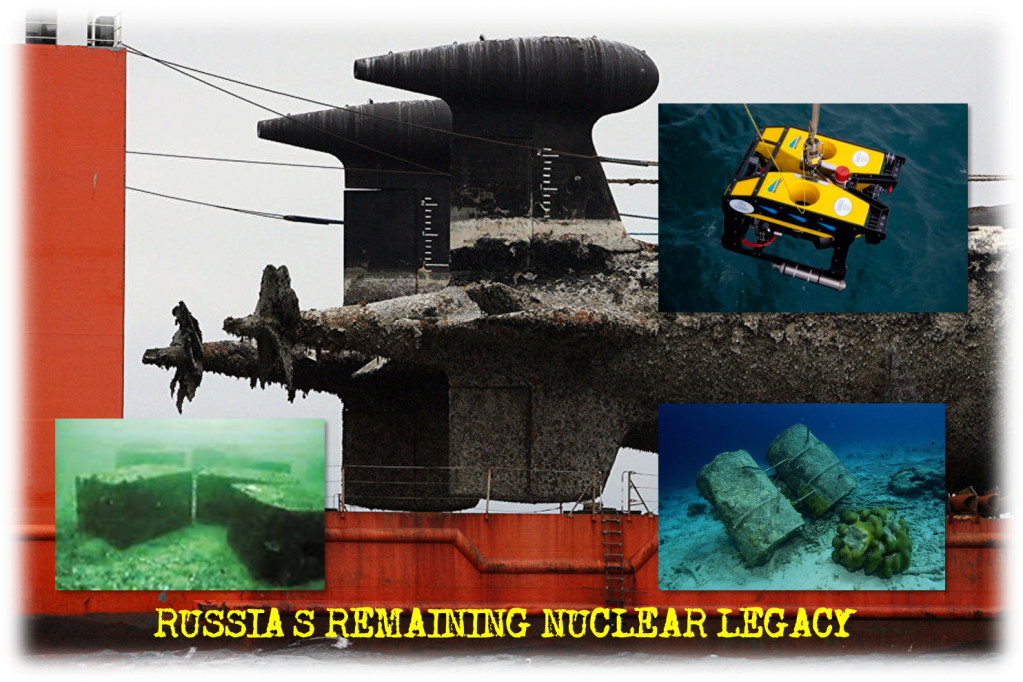
The Russian Academy of Science and the Russian Federation Ministry of Science and Higher Education hosted the three-day conference “Modern Methods and Means of Oceanological Research” from 13 to 15 May 2025 in Moscow and the Shirshov Institute of Oceanology. The conference is held every two years, and is devoted to a number of disciplines related to the ocean environment. This year one of the conferences of interest revealed a great deal of information of the condition of submerged nuclear submarines and nuclear waste scattered across the Arctic and Far East.
The following information is provided from our translation of the salient points of the briefing, as well as the accompanying report submitted to the official conference materials.
The briefing was authored by A. Yu. Kazennov, O. Ye. Kiknadze, and N. Ya. Knivel of the Kurchatovskiy Institute National Research Center. The title of the briefing is “The Current State of Submerged Nuclear- and Radiation-Hazardous Objects in the Arctic.”
The information provided represents the latest experimental data obtained during expedition efforts from 2021 to 2024. Along with the Kurchatovskiy Institute, the data was obtained and processed by the Shirshov Institute and the Russian Geographic Society.

Slide 2 is titled “Objects with spent nuclear fuel, submerged/sunken in the Arctic zone of the Russian Federation”. The slide provides the names of the objects in the Norwegian, Barents, and Kara Seas, date sunk, and units of radioactivity evident at the site; radioactivity data provided for each of the objects is based on assessments from 2024.
1 – Nuclear submarine K-278 Komsomolets. Sunk in 1989, 2.6 PBq [petabecquerels] (70.5 kCi [kilocuries])
2 – Nuclear submarine B-159. Sunk in 2003, 4.038 PBq (109.1 kCi)
3 – Nuclear submarine K-27. Sunk in 1981, 478.8 TBq (13 kCi)
4 – Nuclear submarine K-11. Sunk in 1966, 361.3 TBq (9.8 kCi)
5 – Radioactive waste from nuclear submarine K-19. Sunk in 1965, 436.6 TBq (11 kCi)
6 – Barge with reactor from nuclear submarine K-140. Sunk in 1972, 144.6 TBq (3.9 kCi)
7 – Special cask assembly from nuclear icebreaker Lenin. Sunk in 1967, 909.7 TBq (3.9 kCi)
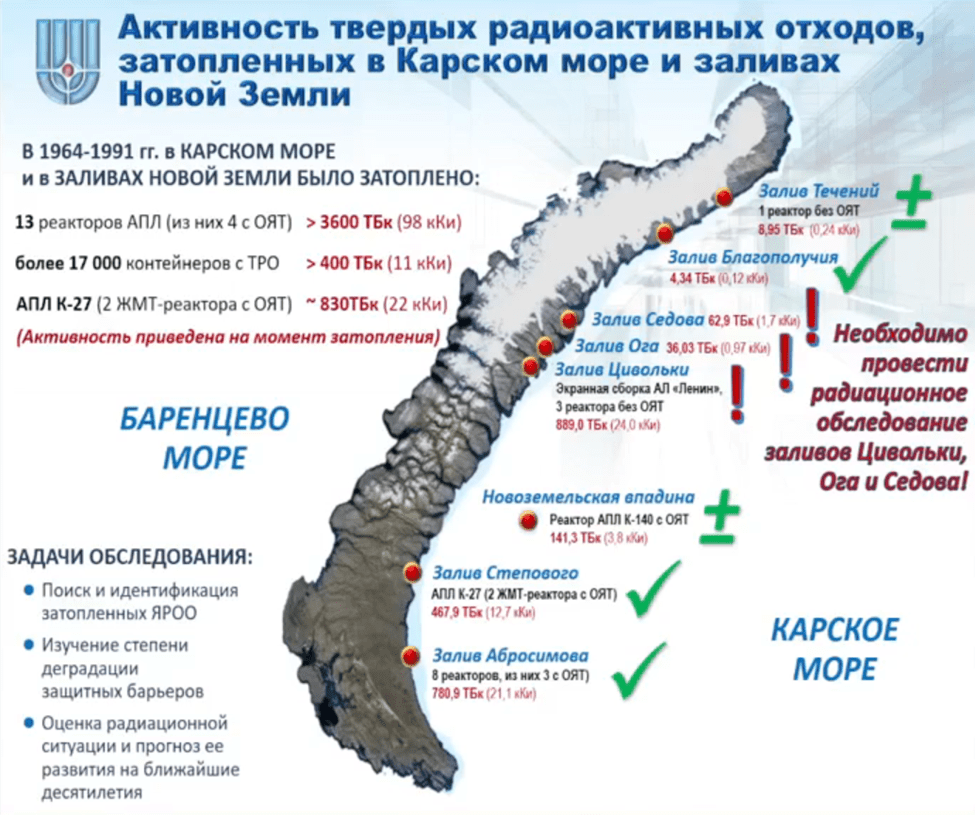
Slide 3 is titled “Activity of solid radioactive waste submerged in the Kara Sea and the bays of Novaya Zemlya.” It identifies that from 1964 to 1991 in these areas, the following were sunk: 13 nuclear submarine reactors (4 of which contained spent nuclear fuel) > 3600 TBq (98 kCi), more than 17,000 containers of solid radioactive waste > 400 TBq (11 kCi), and the nuclear submarine K-27 (2 liquid metal cooled reactors with solid radioactive waste) ~ 830 TBq (22 kCi).
The slide states that the objectives of the survey were to search for and identify the submerged hazardous objects, study the level of degradation of the protective barriers, and assess the radiation situation and project its development over the coming decades.
On the right of the slide, the authors have listed the Novaya Zemlya bays of interest. From north to south, those locations are (with accompanying data):
– Zaliv Techeniy – 1 reactor with no solid radioactive waste. 8.95 TBq (0.24 kCi)
– Zaliv Blagopoluchiya – 4.34 TBq (0.12 kCi)
– Zaliv Sedova – 62.9 TBq (1.7 kCi)
– Zaliv Oga – 36.03 TBq (0.97 kCi)
– Zaliv Tsivalki – Special cask assembly from nuclear icebreaker Lenin, 3 reactors with no solid radioactive waste. 889.0 TBq (24.0 kCi)
– Novaya Zemlya Trench – Reactor from nuclear submarine K-140 with solid radioactive waste. 141.3 TBq (3.8 kCi)
– Zaliv Stepovogo – Nuclear submarine K-27 (2 liquid metal cooled reactors with solid radioactive waste). 467.9 TBq (17.7 kCi)
– Zaliv Abrosimova – 8 reactors, three of which contain solid radioactive waste. 780.9 TBq (21.1 kCi)
The slide offers a warning in bold red letters stating it is imperative that a radiation survey be conducted for Zaliv Tsivalki, Oga, and Sedova. The authors state in their accompanying paper that these areas have not been surveyed for over five years, as access thereto has been prohibited throughout that period by the Russian Ministry of Defense. Thus the current condition of those objects is unknown.
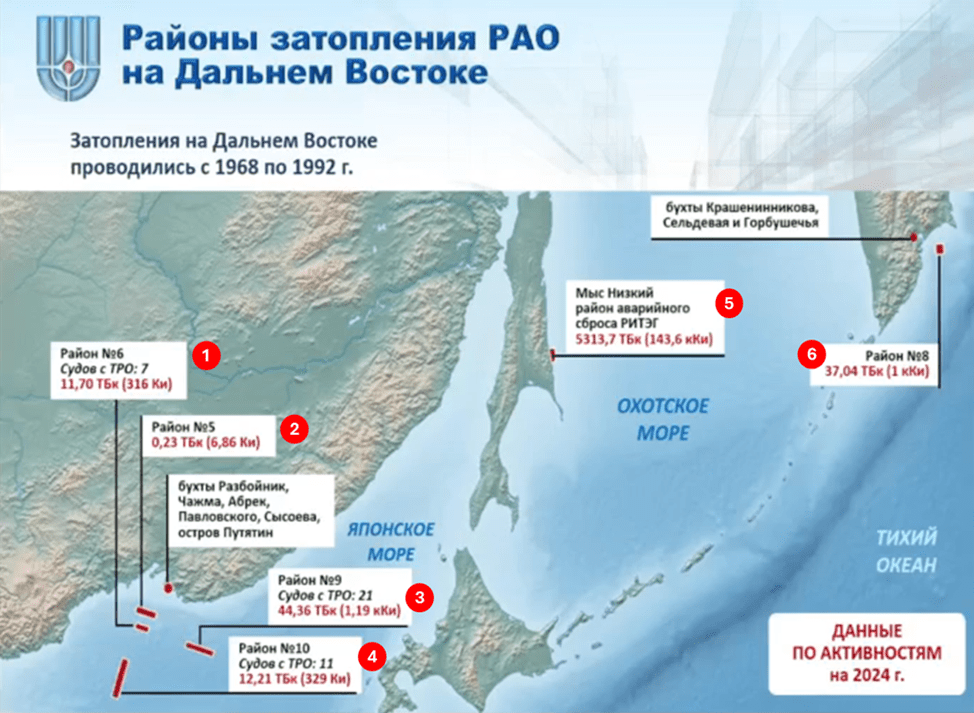
Slide 4 is titled “Areas of submergence of radioactive waste in the Far East,” showing the objects that have sunk from 1968 to 1992 in the Sea of Japan and Sea of Okhotsk. Radioactivity data provided from 2024.
1 – Area No. 6 – Vessels with solid radioactive waste: 7. 11.7 TBq (316 Ci)
2 – Area No. 5 – 0.23 TBq (6,86 Ci)
3 – Area No. 9 – Vessels with solid radioactive waste: 21. 44.36 TBq (1.19 kCi)
4 – Area No. 10 – Vessels with solid radioactive waste: 11. 12.21 TBq (329 Ci)
5 – Mys Nizkiy, site of emergency release of RITEG [radioisotope thermoelectric generator]. 5313 TBq (143.6 kCi)
6 – Area No. 8 – 37.04 TBq (1 kCi)
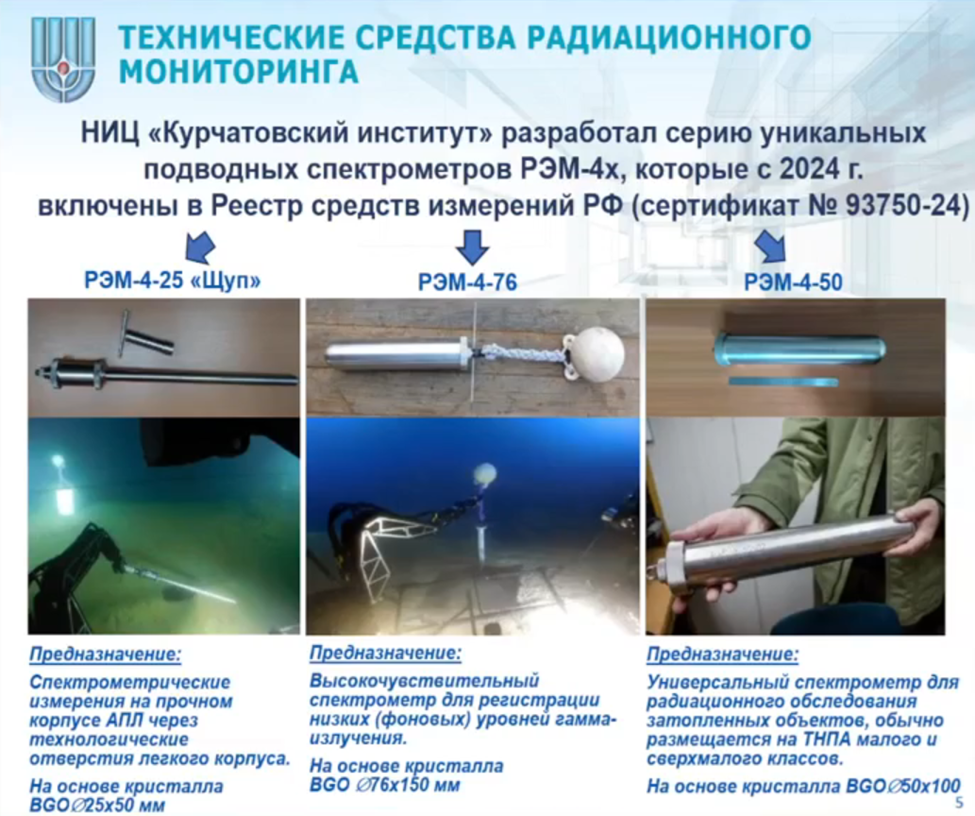
Slide 5 is titled “Radiation monitoring equipment.” The Kurchatovskiy Institute developed a series of unique underwater REM-4x spectrometers, which have been included in the RF Register of Measuring Equipment since 2024 (certificate No. 93750-24).
From left to right:
REM-4-25 Shchup. Designed for spectrometric measurements on the pressure hull of the nuclear submarine via the access holes in the outer hull. BGO [bismuth germanate] crystal based, ⌀ 25×50 mm.
REM-4-76. Designed as a high-sensitivity spectrometer for recording low (background) gamma ray levels. BGO crystal based, ⌀ 25×50 mm.
REM-4-50. Used as an all-purpose spectrometer for radiation surveys of sunken objects, normally housed on mini- and micro-class ROVs [remotely-operated underwater vehicles].

Slide 6 is titled “Methodology and means of surveying the bays.”
– Search for submerged objects using a side-scan sonar, coordinate referencing the location sites à Sidescan sonar Mezoskan-T
– Acoustic imaging of objects using multibeam echo sounder à Acoustic portrait of sunken vessel with solid radioactive waste, obtained using the Reson SeaBat T50R multibeam echo sounder
– Photo and video imaging of submerged objects using TOVs; radiation survey of objects using ROV-mounted underwater spectrometer à REM-4-50 underwater spectrometer mounted on the ROV Argus
– Selection of seabed soil, sea water, and biota samples à Sampling tube (Neymisto tube)
– Study of hydrophysical parameters of the sea environment à CTD 90M standalone hydrographic probe.

Slide 7 is titled “Zaliv Stepovogo.” The authors state that, when surveying the central section of the bay, two containers were detected. A radiation survey of the containers indicated the presence of isotopes 137Cs (Caesium-137) and 60Co (Cobalt-60). In the bottom right, an image of the two containers with solid radioactive waste, obtained using the SeaBat T50R.
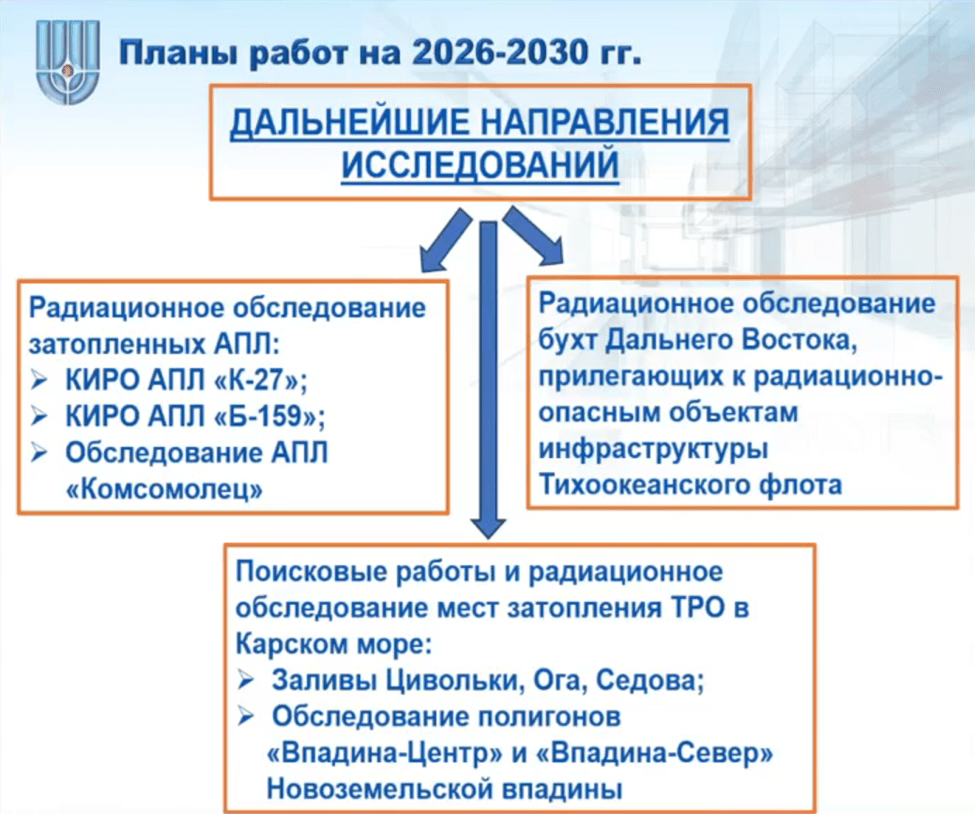
Slide 8 is the final slide in the presentation, and is titled “Plans of operations from 2026-2030.” According to the slide, future research areas include
– radiation surveys of sunken nuclear submarines: comprehensive engineering and radiation surveys of the K-27 and B-159, and a survey of the Komsomolets;
– a radiation survey of the coves [бухты] of the Far East adjacent to radiation-hazardous objects of the [Russian] Pacific Fleet infrastructure
– search operations and radiation survey of the radioactive waste dumping sites in the Kara Sea: Zaliv Tsivolki, Oga, and Sedova; and survey of the Vpadina-Tsentr [“Trench Center”] and Vpadina-Sever [“Trench North”] ranges of the Novaya Zemlya Trench.
In their paper, the authors state that 3D images were taken for the large objects in Zaliv Abrosimova, Stepovogo, and Blagopulichiya (vessels, reactor compartments, large clusters of solid radioactive waste containers. According to the authors, these bays exhibited a stable radiation environment, and the objects had no significant level of radionuclide discharge from the objects.
Because of the complex seabed conditions created by glacier meltdown, there were difficulties encountered in detecting solid radioactive waste sites in the northern bays – Sedova and Techeniy. The recommendation was made to continue search and survey efforts in these locations.
A critical result of the work carried out is the establishment of the precise location of all of the submerged objects with solid radioactive waste. The last such object (the reactor from the nuclear submarine K-140, which sank on a barge together with the steam generators at a depth of approximately 350 meters) was located in 2021 in the Novaya Zemlya Trench. A radiation survey of this object will require special hardware – a workclass ROV deployed from a platform vessel, equipped with a dynamic station-keeping system. Also located in the trench, in a several-hundred square kilometer area, in the submerged object locations in the archives, an additional three vessels were located.
Surveys of the K-27, B-159, and Komsomolets nuclear submarines involved the use of divers and/or manned submersibles to study the radiation environment and investigate the retained strength of the submarine radiation shields. An analysis of gamma-spectrometer measurements indicated that neither the K-27 nor the B-158 submarines continued negatively to the radiation environment in the areas in which they sank.
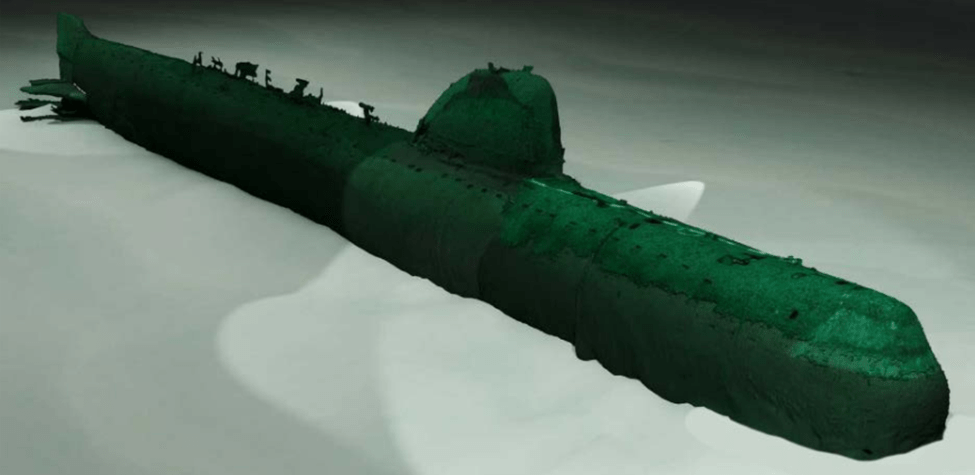
Videos taken during the 2021-2024 period allowed 3D models of the submarine to be constructed, which will be used to draw up projects for further treatment of these objects. The image below shows a 3D model of the K-27, prepared using data from the ROV ARGUS.
A work cycle was performed on the Komsomolets to study the release of radioactivity into the sea environment. The source of the radioactivity release is an opening in the ventilation pipe of the reactor compartment, located at the aft end of the conning tower. The acoustic portrait of the Komsomolets is below.

Measurements taken in 2023-2024 confirmed the shifting nature of the release of radionuclides from the Komsomolets, which the authors associate with the change in speed and direction of the bottom currents. The authors were quick to point out that over the last 15 years that have passed since measurements were taken in 2007, the release rate of 137Cs from the Komsomolets has not decreased. The average 137Cs concentration in the water inside the reactor compartment pipe is 17 Bq/l [becquerels per liter], which nearly approximates the value of 14 Bq/l taken in 2022, and is more than three times the value recorded in 2007 – 5 Bq/l.
The authors assert that the submarine Komsomolets is the only object in the Arctic from which radioactivity has been proven to leak, and call on efforts to provide constant, or at the very least, long-term monitoring. The close by stating that the most preferable option is to place a special spectrometric system and a flow meter for water passing through the section of the pipe in the reactor compartment for a period of at least one year.
© 2025 by Michael Estes and TranslatingHistory.org
 Translating History