
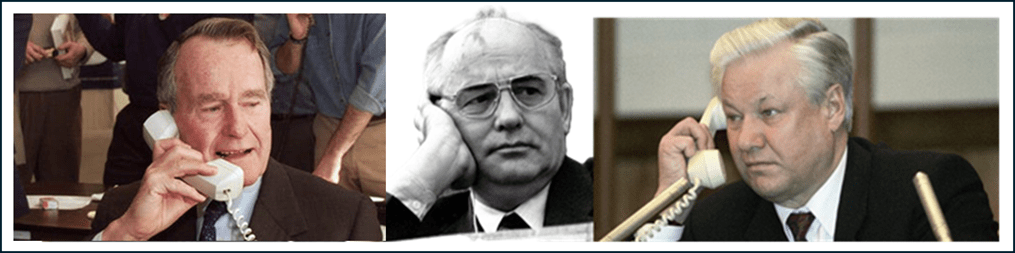
On December 26, 1991, the Council of the Republics of the Supreme Soviet of the USSR adopted a declaration ending 69 years of the existence of the Soviet Union. This was the result of the Belovezh Accords of December 8, when the leaders of the RSFSR, the Ukrainian SSR, and the Belarus SSR signed a package of documents ending the USSR and establishing the Commonwealth of Independent States, CIS. Many in the West felt that this was simply another name for a confederation of countries over which Russia would wield a hammer and sickle. Many former Republics also felt this might be the case, not least of which was Ukraine.
By the late 1980s, the USSR was in a state of economic crisis, and communist ideology had lost popularity. During Perestroika, which began in 1985, it was broadly felt that General Secretary of the CPSU Central Committee (the highest party position) Mikhail Gorbachev weakened the supranational role of the party.
Decentralization of power led to an aggravation of interethnic relations. In 1987, the long-standing Karabakh conflict was revived, as a result of which the Nagorno-Karabakh Autonomous Region, populated mainly by Armenians, left the Azerbaijani SSR in September 1991. In the summer of 1990, bloody clashes between Kyrgyz and Uzbeks took place in the Osh Region of Kyrgyzstan.
The independence movement in the Baltics took on a renewed vigor: in 1988, the Estonian SSR adopted a declaration of state sovereignty, which allowed the suspension of the laws of the USSR on its territory. Lithuania and Latvia followed in 1989. In 1989, the law on sovereignty was also adopted in the Azerbaijan SSR, and in 1990, the other union republics did the same. In June 1990, the powers of the RSFSR were expanded, and on March 17, 1991, the post of President of the RSFSR was introduced, to which Boris Yeltsin was elected.
Soviet President Mikhail Gorbachev insisted on signing a new Union Treaty, in which each republic would receive the status of a sovereign state, and the center would retain a narrow scope of powers, including the organization of defense. In March 1991, a referendum was held on preserving the USSR as a federation of “equal republics.” Georgia, Armenia, Latvia, Moldova, Lithuania, and Estonia boycotted it, but in the nine republics that took part, more than 70% of the population voted in favor. Based on the results of the plebiscite, a new draft of the Union Treaty was developed, which would preserve the USSR, but limit the power of the center.
In August 1991, a group of Soviet leaders attempted a coup. They formed the State Emergency Committee (SECC) and removed Gorbachev from power for health reasons in order to prevent the signing of the Union Treaty, which they believed would mean the collapse of the USSR. The conspirators were opposed by RSFSR President Yeltsin, who cancelled the SECC orders. After this, the union republics declared their independence, and the signing of a new Union Treaty scheduled for late August fell through. Further discussions on preparing a new agreement reached a dead end.
On December 1, 1991, a referendum on independence was held in Ukraine, in which more than 90.32% of the votes were in favor. On December 3, President Yeltsin announced his recognition of this decision. On December 8, the leaders of Russia (Boris Yeltsin), Ukraine (Leonid Kravchuk), and Belarus (Stanislav Shushkevich), the founding states of the Soviet Union, signed an Agreement on the Dissolution of the USSR and the Creation of the Commonwealth of Independent States at the Viskuli residence in Belovezhskaya Pushcha. On December 25, 1991, at seven in the evening Moscow time, Gorbachev announced the end of his activities as President of the USSR.
A number of phone conversations held in 1991 between US President George H.W. Bush, Mikhail Gorbachev, and Boris Yeltsin were recently declassified and released. Bush discussed with Gorbachev and Yeltsin how Russia would be officially responding to the Ukrainian independence referendum, how the USSR’s successor organization would be configured, and the resignation of Gorbachev.
The translations below are taken from the Russian version of the conversations. We are relying on their ability to authentically translate the English portion of the conversation; with that in mind, Bush’s part of the discussions may not cleanly match the official White House transcripts. We will continue the thread tomorrow, when we publish additional translated conversations after Ukraine’s independence referendum passed.

November 30, 1991 9:01 – 9:37 AM
BUSH: Hello.
GORBACHEV: Hello, George. I’m glad to hear your voice on the phone.
BUSH: I am calling to share my concerns about Ukraine. I have read Soviet statements that have troubled me. I am sure you are concerned, too.
GORBACHEV: George, it’s good that you are the one initiating this conversation. I see this as a continuation of our discussion in Madrid [Madrid Conference on Finding a Path to Reconciliation between Israel and the Palestinians, October 30-November 1].
BUSH: I’d like to share some of the positions that I’ve worked out with [State Department Secretary] Jim Baker and [National Security Advisor] Brent Scowcroft and get your reaction.
GORBACHEV: Okay, I’m ready to listen and take notes.
BUSH: First of all, I want to say that I applaud your mediation in the dispute between Azerbaijan and Armenia. This is very good, and we applaud your actions.
GORBACHEV: We will try to use exactly this approach to end the conflict. But it is difficult to expect immediate results. Their differences are very large.
BUSH: I know. Now, about Ukraine. Everything indicates that the overwhelming majority will vote for independence. This will be a powerful signal to the world, a real celebration of the new atmosphere created after the suppression of the coup. You know the traditions of America as a democratic nation. We must support the Ukrainian people. But we want to do this in a way that encourages a peaceful transition to a new order built on productive relations with the center and friendly relations between Ukraine and Russia. We do not want to inadvertently create difficulties for you or [Boris] Yeltsin.
But if the referendum result meets expectations, the only question is when and how we and other countries will recognize Ukrainian independence.
It seems to us that recognition of Ukrainian independence could bring them back to the table of negotiations on a union treaty. If any questions about recognition of their sovereignty are removed, they will be able to participate without fear that by doing so their independence could be called into question.
Look, if we are moving towards recognition, I need to clearly understand that agreements will be reached on the following points:
— collective, centralized control over nuclear weapons;
— a non-nuclear Ukraine that will sign the non-proliferation treaty [of nuclear weapons];
— respect for human rights, with equal rights for minorities; and
— compliance with existing treaties (the Strategic Arms Reduction Treaty and the Conventional Armed Forces in Europe Treaty).
We will also continue to insist that the Ukrainian government implement market reforms and accept responsibility for its share of the USSR’s debts.
I’ll ask Jim Baker to send a special envoy to Kyiv to begin discussions on these and other points. We want to work with Ukraine. The outcome of these discussions will determine our next steps.
We will be making a statement immediately after the referendum that will clarify our approach. It will also note our desire to work closely with you and President Yeltsin. It goes without saying that we will not announce recognition of Ukraine until these issues are resolved.
I have not yet spoken to Yeltsin. Obviously I intend to do so. I am also consulting with NATO allies about our approach to the new situation.
These are the main positions. I would like to hear your reaction. Ambassador [to Russia Robert] Strauss has already informed us of [Soviet Foreign Minister] Shevardnadze’s concerns. I hope that what I’ve said allays those concerns.
GORBACHEV: Well, George. Let me try to say something. We are discussing a question of great importance – not only for our relations, but for the future of the union. It is of interest not only to our people, but to Europe and the whole world. Above all, the fate of the union depends on it.
I’m not about to hide the fact that the leak from the White House, in the sense that the issue of recognizing Ukraine is being seriously considered by the United States, especially in connection with the fact that the leak occurred on the eve of the referendum, was perceived negatively [Trans.: At a meeting in the White House with Americans of Ukrainian descent on November 27, Bush announced that in the event of a positive outcome of the referendum, he would take steps to recognize the independence of Ukraine]. It looks like the United States is not only trying to influence events, but also to interfere.
Secondly, most of the republics have declared independence. This does not prevent them from participating in the creation of a new Union of Sovereign States. In fact, sovereignty gives them the freedom to participate.
Thus, the referendum does not automatically mean that Ukraine has left the Soviet Union, that this is a break in relations between Ukraine and the Union.
We really want there to be no rush in this delicate and important matter. Let’s recall the situation in Yugoslavia, which led to the current state of affairs [Trans.: From 1991 to 2001, armed conflicts took place in the territory of the former Yugoslavia during the disintegration of the country]. But George, the current situation is even more complicated than it was in Yugoslavia. If someone in Ukraine declares withdrawal from the Union and someone speaks out in support of this, then this will mean that 12 million Russians and representatives of other peoples become citizens of a foreign state. Crimea has already announced that if Ukraine moves away from the Union, Crimea will reconsider the status of Crimea in Ukraine. The question of Donetsk will also arise.
We all have to act – and I hope you understand this, because it is important what position the President of the United States takes – to act in a way that does not push events in the wrong direction. Keep in mind the advice of those who want processes to follow their natural course. This takes time.
There are forces around Yeltsin that advocate for the independence of Russia and the return of all Russian lands, including those that are now in Kazakhstan, Ukraine, and the other [republics]. If this process begins to unfold, it will be a catastrophe for Russia, Ukraine, and the rest of the world.
That is why I would like to recall our last conversation in Madrid, where we discussed the common interest of the United States and Europe in preserving a reformed, democratizing Union.
These are the thoughts I wanted to express to you. I just spoke with Yeltsin. We will be closely tracking the referendum in Ukraine. Perhaps after the referendum I will organize a meeting between the presidents of Russia and Ukraine. Therefore, I urge you to be very careful and balanced, to act slowly and to cooperate.
BUSH: First of all, I want to cooperate. Our recognition of independence will be directed against radical elements in Russia and Ukraine. I want to support the reasoned position you outlined to work with [all involved] parties.
Mikhail, if the referendum takes place, what are you and Yeltsin expected to say about independence? Not about recognition, but about independence?
GORBACHEV: We’ll say what I have already said. I hope Yeltsin says the same. Independence strengthens Ukraine’s sovereignty and gives it the opportunity to conduct a free dialogue with other republics on further cooperation, including political and economic union – a political union, including defense.
We cannot agree with separatists who want to use the vote on independence as a vote for separation, for breaking with the union. Each state of the United States is sovereign, but we do business with the United States as a strong nation.
BUSH: Absolutely. By recognizing the Ukrainians’ desire for independence, we will pave the way for resolving the thorny issues that stand in the way of political and economic reform.
Mikhail, believe me, I am not trying to create difficulties for you or Yeltsin, and I have no intention of interfering in your internal affairs. I want to emphasize once again: I do not want to inadvertently play into the hands of the radicals in Russia or Ukraine.
I will listen carefully to you and the Russian Republic. Jim Baker is in close contact with Eduard. We will work hand in hand on borders, nuclear weapons, and relations between the center and the republics. I just wanted to discuss this with you personally.
GORBACHEV: Yesterday I had a meeting of the Political Advisory Council. [Aleksander] Yakovlev, Shevardnadze, [Gavriil] Popov, [Sergei] Sobchak, [Grigory] Yavlinsky, [Nikolai] Petrakov, [Vadim] Bakatin and Yegor Yakovlev are a proven team of people focused on reforms, who are well aware of the suffering and hardships.
The main thing we discussed was a political union. Everyone had their say. We sat from three to nine in the evening. Everyone said that a political union was vital. Without it, the result could be catastrophic for the Soviet Union, for you, and for the entire world.
All members of the council agreed to do everything possible to speed up this process, to encourage politicians to sign the treaty. I am telling you about this so that you understand what we are discussing, how we all think.
BUSH: I don’t need to tell you that we have great respect for everyone you just named. They are tried and true and that impresses us.
GORBACHEV: George, I appreciate this call and our frank, friendly conversation. I deeply believe that our cooperation and engagement with the US administration – which is only possible with a renewed alliance – is vital. It is very important for the entire world.
BUSH: We are following events closely. I am always available, as is Jim Baker, at any time. And now I will try to get through to Yeltsin.
GORBACHEV: Well done, George. I shake your hand. My colleagues and I wish you and your staff all the best. Warm regards from Raisa [Gorbacheva] to you and Barbara [Bush].
BUSH: I’m not in the same stressful situation as you are, of course. I can’t understand everything you’ve been through, but I have a lot of pressure on me too, so to some small extent I understand what you’re going through. Well, good luck.
GORBACHEV: Thank you. Goodbye.
BUSH: Bye.

November 30, 1991 9:42 – 10:19 am
YELTSIN: Hello?
BUSH: Boris? Can you hear me?
YELTSIN: I can hear you, Mister President. Happy to hear your voice.
BUSH: First of all, I want to greet you personally. Then I want to give my comments on Ukraine so that we do not have disagreements on this issue.
YELTSIN: First, Mr. President, I want to ask whether you have seen Kozyrev and whether he gave you my letter?
BUSH: We had a very good visit. I have studied the letter in which you set out in detail your views on the future of Russia. I appreciate it very much.
YELTSIN: I would like to reiterate that we have finally decided to take major steps towards reform, starting December 16. We will decisively begin the reform with the liberalization of most prices.
BUSH: That’s a very brave step. I also noted that you are ready to create an economic community with equal rights for Ukraine and other republics, and a political union…
YELTSIN: Okay, let’s talk about Ukraine.
BUSH: Let’s run through my points, and then I would be glad to hear your response and comments.
YELTSIN: Go ahead.
BUSH: First, regarding your reaction to Sunday’s referendum. We think a large majority will vote for independence. That would be a powerful signal from the people of Ukraine and a real triumph for the new atmosphere you created when you led the forces that crushed the coup.
I hope you understand that, as a democratic nation, we must support the will of the Ukrainian people. But we want to do so in a way that encourages a peaceful transition to a new order built on strong, friendly Ukrainian-Russian relations.
We had a very good conversation with [Russian Foreign Minister Andrei] Kozyrev. I assured him that we do not want to support interactions that will play into the hands of radical forces in Russia or Ukraine.
We think it would be a mistake to take actions that look like resistance or some kind of punishment through economic sanctions for voting for independence. We feel that Ukrainian independence is inevitable and we see it as a tribute to the victory over the coup, in which you played a key role. We also think that priority should be given to measures to ensure that independence advances the cause of peace, freedom, and democracy in Ukraine and in Russia.
As we move towards recognition, I want to ensure that steps are taken to ensure:
— collective, centralized control over nuclear weapons;
— a nuclear-free Ukraine that will sign the non-proliferation treaty;
— respect for human rights, with equal rights for minorities; and
— compliance with existing treaties (the Strategic Arms Reduction Treaty and the Conventional Armed Forces in Europe Treaty).
I’ve asked Jim Baker to send a special envoy to Kyiv to begin discussions with the Ukrainian leadership.
I have called you and Gorbachev, I just finished talking to Gorbachev. He says you intend to meet with the elected leadership [of Ukraine] soon.
But after the referendum, we will issue a statement that explains our approach. The statement will also note our commitment to work closely with you and President Gorbachev. This will not be recognition, but rather a statement of independence.
We are also consulting with NATO allies to coordinate our approach to this new situation.
We believe that the ties between Russia and Ukraine are strong. Their declaration of independence will not change that.
These are the main points. I am eager to hear your frank opinion on the US position, but mainly on how things will develop.
YELTSIN: I understand, Mr. President, your concern about the current situation with our union. Right now, only seven states are ready to sign the draft union treaty – five Islamic and two Slavic (Belarus and Russia). This worries me very much.
I will speak to you with all frankness, as always. I believe that the Union without Ukraine will be a rather weak union. I told Gorbachev today and said in my newspaper interview yesterday that if Ukraine does not join the Union, then this is a problem for Russia.
Gorbachev keeps saying that he will come to an agreement with the Ukrainian leaders and they will sign the agreement. But if the referendum shows that the majority of the Ukrainian people are in favor of independence, then this means that the Ukrainians will not sign the treaty that is now being prepared for the Union of Sovereign States.
This will lead to a dramatic change in the balance in the Union between the Slavic and Muslim nations. We cannot allow a situation in which two Slavic states, Russia and Belarus, have two votes against five votes of the Muslim nations.
Moreover, after Russia, Ukraine is the largest state, and we have good relations. We do not want to lose these good relations; we want to develop them.
I told Gorbachev that I cannot imagine the union without Ukraine. Of course, it is too early to draw conclusions until the referendum results are available.
I agree that the United States, which has always supported human rights, the right to self-determination, and democracy, that the United States cannot simply ignore the aspirations of a large population for independence. The process that took place in the case of the Baltic countries, when Russia and then the United States recognized their independence after the countries asked the United States for support for very logical reasons, supported democratic processes.
I think that the new Ukrainian president will not negotiate with Gorbachev, but will negotiate with Russia.
As for nuclear weapons, I agree that this is a really necessary condition. All four conditions – I will not list them all, but I remember them – are important. But at the same time, Russia cannot make similar demands on Ukraine in the current context.
If Russia does not recognize Ukraine’s independence after the referendum (if it has a positive outcome), this will complicate relations with Ukraine. This will also create new pretexts for pressure from extremists – if we do not recognize [independence].
Therefore, we believe it is more correct – if, say, 70% of voters vote for independence – for Russia to recognize Ukraine’s independence, regardless of whether it signs an agreement on political union or not.
BUSH: Just like that?
YELTSIN: Yes, we’d have to do this immediately. Otherwise, our position will be unnecessarily ambiguous, especially as we approach the new year and new reforms. Gorbachev does not know about this. He still thinks that Ukraine will sign.
We will meet with the new President of Ukraine in early December to discuss the principles of relations between Russia and Ukraine. We need to discuss:
— centralized control over strategic nuclear weapons; and
— removal of nuclear warheads from Ukrainian territory, even if it costs 25 billion rubles and takes several years.
They have very modern installations there — large launch silos.
Of course, we will talk about Ukraine accepting all international agreements on nuclear weapons. We also want to agree with each other on the number of members of the armed forces or the national guard.
When I was in Germany, I spoke with Kohl about the possibility that, say, the US, Germany, and France, together with the rest of the G7, could persuade Ukraine to conclude an agreement that would take these demands into account. But now I think that this is completely useless. It will only strengthen extremist groups.
If we do not recognize Ukraine’s independence, even with conditions – and the conditions you listed are necessary – this will be a very strong blow to democracy. It could cause a revolt of extremist forces, especially since Ukraine is ready to recognize all international agreements on human rights.
But you are right. We cannot lose the ties between Russia and Ukraine. Together with a very small circle of key advisers, I am now thinking about how to preserve the union, and also how not to lose relations with Ukraine. Our relations with Ukraine are more important than with the Central Asian republics, which we feed all the time. On the other hand, we cannot forget about the factor of Islamic fundamentalism.
In this difficult situation, it is not easy to find an optimal solution. In any case, we need to wait for the results of the referendum. We must recognize the independence of Ukraine.
I ask you, Mr. President, not to disclose the content of this conversation until the results of the referendum are made public.
BUSH: You have my word.
YELTSIN: Okay. Are you satisfied with my explanation of Russia’s position?
BUSH: Yes. I assure you that we do not want to play into the hands of extremists in Russia or anywhere else.
YELTSIN: Of course.
BUSH: I appreciate it. We need to stay in close contact.
YELTSIN: Mr. President, I am pleased to be in telephone contact. I assure you that we are about to begin a serious reform that will radicalize Russia and turn Russia into the engine that will pull other republics along the path to democracy. The reform will begin on December 16 and will be very difficult. There will be critical moments when people may take to the streets. I hope we can count on the support of the G7 at these critical moments.
I also want to say that I met with Gorbachev and the leaders of the Union government on the budget issue, because the budget is on the verge of collapse. The Union has no money for the military, science, culture, or anything else. Russia, on the other hand, has a budget surplus. So only Russia can save the whole country.
We agreed to create a consolidated Union-Russian budget. All the republics agreed to provide guarantees for the loan that Russia alone will provide to the Union. In this way, we can support the Soviet Union so as not to go bankrupt on our obligations to the rest of the world. So Russia is ready to transfer 60 billion rubles to the Union budget. But everyone must fully understand that we cannot always be so altruistic.
Therefore, beginning in 1992, all the republics must take responsibility for their own affairs. The transition to reform will be very tough and realistic. We cannot allow a budget deficit of more than 4-5%.
I was glad to talk to you about this. We will continue this practice of mutual consultations.
BUSH: We will definitely continue, and thank you. Goodbye, Boris.
YELTSIN: Thank you. Please extend my good wishes to the American people.
Translation © 2025 by Michael Estes and TranslatingHistory.org
 Translating History