
Today marks the 25th anniversary of the tragic sinking of the K-141 Kursk, the Northern Fleet’s Project 949A nuclear submarine. The general picture is still clear in the minds of those who were “around “in the trade” when it took place – the first major Russian Navy exercise in a decade, while sailing submerged in the Barents Sea, the Kursk prepared to fire a practice torpedo when an explosion brought her down to the seabed, some 108 meters from the surface.
Some of the best reporting on the accident, from almost the very beginning, was produced by the bold investigative newspaper Novaya Gazeta. We’ve gathered some of the most pertinent and valuable of the NG staff’s Kursk reporting over the years and are offering the translation here, to not only pay tribute to the Kursk’s fallen crew, but also to highlight NG’s efforts to ensure the truth behind the submarine’s loss is not obscured by the cloak of persistent lies that political and military figures don for self-protection.
The post below is lengthy, and at times the writing style shifts tones based on the different authors of the material. We’ve tried to maintain the voice of the original in our translation.

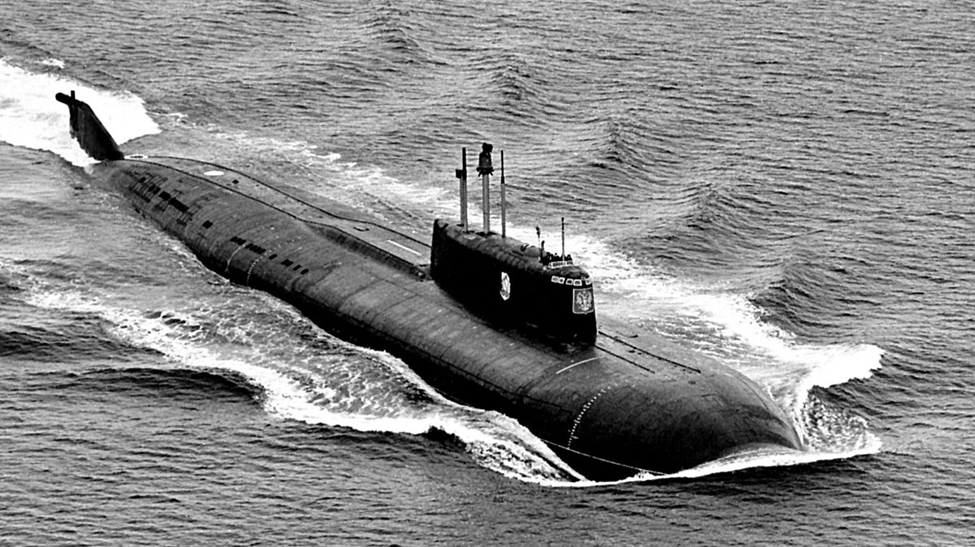
In July 2002, the investigation into the Kursk case was stopped. On July 26, 2002, the Prosecutor General of the Russian Federation Vladimir Ustinov called a press conference and informed journalists about this. Ustinov began his speech by telling them that he had met with President Putin, to whom he presented a 100-page report on the circumstances of the loss of the nuclear-powered missile submarine Kursk and its crew. The journalists were given a short two-page press release. And nothing more. Explaining this fact, Prosecutor General Ustinov said: the case contains information that constitutes state secrets, and therefore “it is not possible to transfer the information in full either to society or even to the relatives [recognized as the injured party in the criminal case].”
But Vladimir Ustinov failed to hide the materials of the criminal case back then, in 2002. The Supreme Court went against the prosecutor’s office, granted the petition of Boris Kuznetsov, the lawyer for the relatives of the deceased submariners, and issued a ruling to declassify all investigation materials.
The investigators were forced to provide them to the lawyer. All except one document, which they kept silent about at the time, and carefully concealed information about its existence for many years. In this document, the investigation completely disavows its own dubious conclusions and finally gives exhaustive answers to all questions about the circumstances of the death of the boat and the crew.
On August 12, 2000, during a comprehensive combat training exercise for the Northern Fleet ships in the Barents Sea, a disaster occurred on the nuclear submarine Kursk.
The first explosion occurred at 11:28 a.m., at the very moment when the submarine was preparing to fire a practice (without a warhead) hydrogen peroxide torpedo 65-76 “KIT”. The hydrogen peroxide in the torpedo’s engine exploded. The explosion, equivalent to about 200 kg of TNT, killed the crew members of the Kursk in the first (torpedo) and second (command) compartments. The submarine lost control, and 75 seconds later hit the bottom with its nose at a speed of about 7 knots (13 km per hour). At 11:30 a.m., a second explosion was heard – at least 10 operational torpedoes exploded one after another (according to the official version – from a large fire in the torpedo compartment, and according to Vice-Admiral Valery Ryazantsev, a member of the government commission to clarify the circumstances of the sinking of the nuclear-powered missile submarine Kursk – as a result of the submarine hitting the ground, the torpedo tubes were deformed and the operational torpedoes in them detonated).
The second explosion, equivalent to 5,000 tons of TNT, caused a shock wave of terrifying force, which was recorded by seismic stations in Norway.
The hydrodynamic wave even covered the submarine Karelia, which was 80 kilometers away from the Kursk and was preparing to fire a practice missile, targeting the range in Kamchatka. After firing a missile and surfacing, the Karelia’s commander Andrei Korablev reported to the Northern Fleet command post about the supposed underwater explosion and transmitted its coordinates, which corresponded to the coordinates of the Kursk’s sinking.
The Northern Fleet flagship, the heavy nuclear missile cruiser Petr Velikiy, was much closer to the site of the disaster than the submarine Karelia. It was at this cruiser that the Kursk practice torpedo was supposed to be fired. But instead of firing, the sonar operators on the Petr Velikiy recorded two explosions, and Petr Velikiy itself shook as if it were a rowboat rather than a huge ship with a displacement of 26 thousand tons. The crew members’ knees “buckled” from the hydrodynamic shock. At that moment, Admiral Vyacheslav Popov, commander of the Northern Fleet and head of the exercise, was on Petr Velikiy. However, unlike the commander of the Karelia, he was not interested in either the cause of the “shaking” or the sonar operators’ report.
From the testimony of the sonar operator of the Petr Velikiy, Lavrinyuk: “…I reported to the combat information center, to the captain’s bridge, and to the central command post. Immediately, at the moment of the flash and the pop from the speaker, I felt that a hydrodynamic shock had passed through the ship, which was expressed in the trembling of the hull of the Petr Velikiy. In my opinion, such an effect in the form of a trembling of the hull from the activation of any equipment aboard the Petr Velikiy could not have happened. It was an external dynamic shock…”
During questioning at the prosecutor’s office, Northern Fleet Commander Vyacheslav Popov will deny the fact that sonar operators reported explosions recorded on the Kursk, and will explain the hydrodynamic shock that shook the ship’s hull as “the deployment of a radar antenna.”
95 of the 118 people on board the Kursk died as a result of the explosions. The blast wave destroyed the bow of the submarine all the way to the reactor compartments – 5 and 5-bis.
But Kursk crew members in the 6th, 7th and 8th compartments survived. A total of 23 people. They decided to move to the 9th compartment, the so-called “survivability compartment,” brought food and water, personal rescue gear, and air regeneration equipment with them, and sealed the bulkhead between the 8th and 9th compartments to reduce the water inflow. They did everything to survive on the sunken Kursk as long as possible while waiting for rescue.
The disaster happened during an exercise, in shallow water, in a clearly defined area of the Barents Sea with a large number of Russian ships. So the submariners in the 9th compartment were constantly sending out SOS signals. They were certain that they would soon be found and heard.
Here’s why. During torpedo firing, the submarine must make contact three times. The first time it must report the firing was either successful or not successful. The second time is when the practice torpedoes are found and raised. The third time, the submarine makes contact to report surfacing and clearing the area. According to the “Rules for the Use of the Firing Range” (a classified naval document regulating combat training rules), until the submarine makes contact, the warship detachment is not authorized to leave the training area. According to the training plan, the maximum time for torpedo firing for the Kursk is 14:30. At 14:31 (the latest time if the submarine fails to make contact), it was to be declared an emergency and a search and rescue operation was to begin. But the warship detachment, led by the flagship Petr Velikiy, without waiting for the torpedo launch, left the area of the Kursk’s sinking at 14:12, and Admiral Popov flew by helicopter to Severomorsk, where he gave a press conference.
He tells journalists that the exercise was carried out according to plan, and all combat missions were carried out by the fleet perfectly. At the very moment the press conference was taking place, the fleet already knew that an emergency has happened aboard the Kursk.
At 13:50, the following entry appears in the logbook of the Northern Fleet command post: “Begin to act according to the worst-case scenario.” But officially, the submarine will not be declared in distress and the combat alert raised until 23:30, 12 hours after the explosions. The official investigation into the Kursk disaster will “reduce” the time of the unlawful delay by three hours: “Due to Admiral V.A. Popov and his subordinates’ ignorance of the specific situation, failure to comply with the requirements of the Navy’s governing documents in the event of the submarine not surfacing at the appointed time, as well as due to the adoption of erroneous decisions while waiting for the submarine to surface, it was declared in distress with a delay of 9 hours.”
The rescue vessel Mikhail Rudnitsky with two underwater vehicles on board – the search AS-32 and the search and rescue AS-34 Priz – would leave the base only at 1:04 a.m. on August 13. It would take the vessel almost 9 hours to reach the site of the Kursk’s sinking.
Meanwhile, the Kursk compartments that were not damaged by the explosions were gradually filling with water, and the pressure within them was increasing. The 9th “survivability compartment”, designed for only three people at normal times, was overfilled almost 8 times over. There was not enough oxygen. The submariners used regeneration units (RDU) to generate oxygen. They had 3 units and 25 V-64 cans with 25 regeneration plates in each. If all three RDUs were charged simultaneously (one can for each), there would be enough oxygen for 23 people for almost a day. They opened and used 9 cans.
Two of the surviving submariners, Lieutenant Commander Dmitry Kolesnikov and Lieutenant Commander Sergei Sadilenko, were taking notes, recording the situation. They made notes on two sheets of paper, apparently torn from the logbook.
In addition, Dmitry Kolesnikov and Senior Warrant Officer Andrei Borisov wrote personal messages to their families. All the entries, it is quite obvious, were made at different times and in different conditions. And, we believe, on different days. The first entry was made on August 12 at 13:34 by Captain-Lieutenant Dmitry Kolesnikov. “List of personnel 6, 7, 8, 9 detachments located in the 9th compartment after the accident on 12.08.2000.” And below are the 23 names of survivors. The second entry, made at 13:58, indicates an increase in pressure in the 7th compartment. From the third entry, made by Captain-Lieutenant Sergei Sadilenko, it follows that the situation in the “survivability compartment” has significantly deteriorated. “13:15. All personnel from compartments 6, 7 and 8 have moved to compartment 9. There are 23 of us here. Feeling poorly. Weakened by the effects of carbon monoxide. Pressure is rising. We are running out of regenerative cartridges. We will not survive decompression upon reaching the surface. There are not enough belts on the individual breathing gear. There are no carabiners on the stoppers. We will not last more than another day.”
This entry directly indicates that the submariners used part of the regenerative plates, i.e. spent a long time in the 9th compartment. I am almost certain that this and all subsequent entries were made on August 13; possibly the 14th.
The fourth entry, marked with the time period “15.15”, was made by Captain-Lieutenant Dmitry Kolesnikov and is of a personal nature to his wife Olga. Senior warrant officer Andrei Borisov also wrote to his wife Natasha and son Alexander.
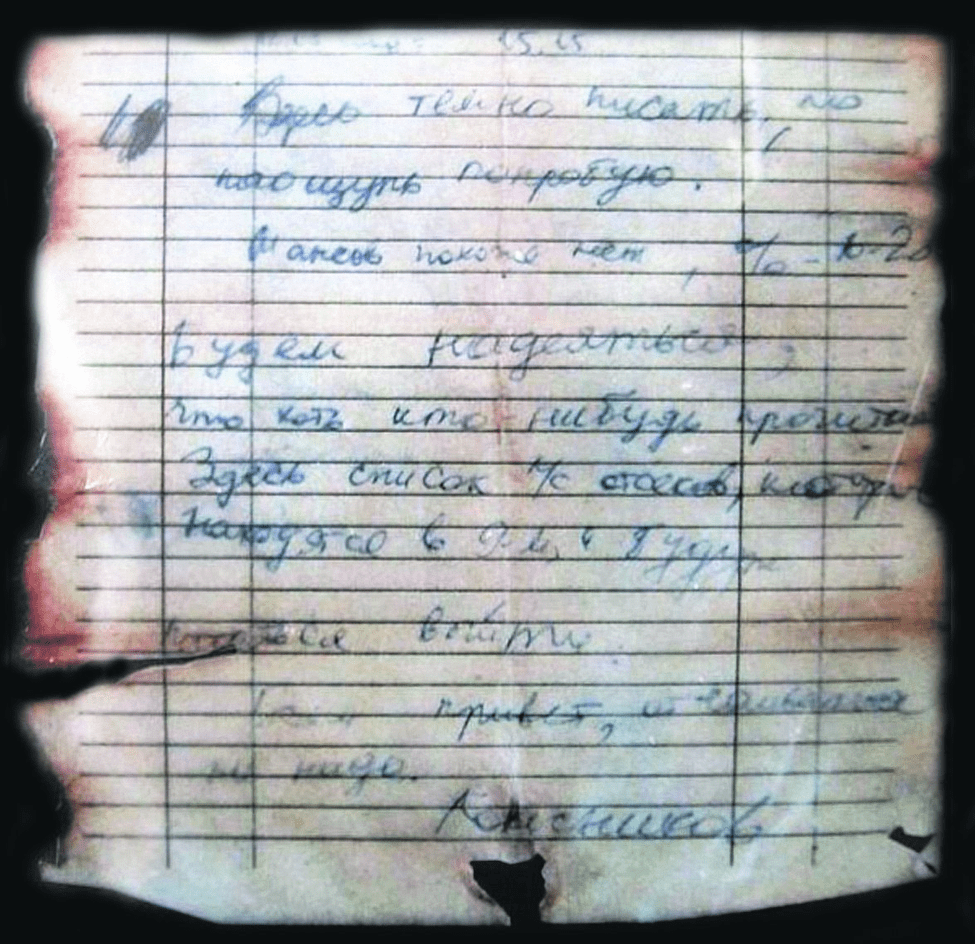
And finally, the most well-known part of these notes, made by Captain-Lieutenant Andrei Kolesnikov. It is not marked with any time period. The handwriting changes. The lines are sweeping and “dance” across the entire page, the letters are sometimes very large, sometimes very small. “It’s dark to write here, but I’ll try by touch. There seems to be no chance: 10–20 percent. Let’s hope that at least someone will read it. Here is a list of the personnel of the compartments that are in the 9th and will try to leave. Regards to everyone, no need to despair. Kolesnikov.”
Then Kolesnikov folds and hides in his breast pocket the two precious fragile sheets of A4 paper so that no element can destroy this evidence.
They could not save themselves. Even the “wet method” of exiting a sunken submarine (when the submariners themselves exit the “survivability compartment” and rise to the surface) requires outside help – deep-sea divers and a rescue vessel that will take the submariners on board and decompress them.
Lieutenant Commander Sergei Sadilenko wrote in the note he left behind: “We won’t survive decompression.” This phrase says a lot: the submariners assessed the situation sensibly and understood that if they tried to leave the compartment without help, they would face a painful death from the pressure difference (in the compartment of the sunken submarine it is much higher than on the surface).
And all this time they continued to knock. The SOS knocks or, in the language of the investigation, “emergency signals produced by a person striking a metal object against metal” will be heard above.
On August 21, 2000, in an interview with the Vremya program, Defense Minister Marshal Igor Sergeyev said: “You know, there were knocks on the thirteenth and fourteenth. A special interpretive map was even compiled, on which we received a short and succinct answer: ‘SOS, water.’ This was already an assessment of the condition of the people who were still alive, who were in the compartments. Obviously, water was already entering or seeping into the compartments.”
Journalist: When did the knocking stop?
Sergeyev: Pretty much after the 14th.
The knocks would come to be recorded on an audio device. An expert examination was conducted on them. The examination would prove that people were knocking on the intercompartment bulkhead of the sunken submarine. And then, when these SOS knocks turn out to be politically and legally disadvantageous evidence against the government and those guilty of this catastrophe, they were officially reinterpreted as “technical noises.” Later it would be asserted that unidentified people from a ship not identified by the investigation were knocking.
President Putin, who flew to Sochi on August 12 for a vacation, did not learn about the emergency during the exercise until August 13 at 7 a.m. from Defense Minister Igor Sergeyev.
“The Defense Minister called and said that we had lost the boat, but had already found it, and were starting work now. It was unclear that something tragic was happening,” Putin recalled.
It was Sergeyev who recommended that the president remain in Sochi, assuring that the search and rescue operation was proceeding even more quickly than the naval instructions prescribed, and that the resources at the Navy’s disposal were sufficient to conduct an effective search and rescue operation.
The country learned about the Kursk only on August 14. At 10:45, the head of the Navy press service, Igor Dygalo, told journalists: “The Kursk has sunk to the bottom at 69 degrees 40 minutes north latitude and 37 degrees 35 minutes east longitude, the crew is alive, air and electricity are being supplied, communication with the crew is being maintained, and the nuclear reactor has been shut down.”
On August 14, as soon as the emergency situation with the Kursk was officially announced, England, Norway and the United States offered Russia their assistance in the rescue operation.
But Navy Commander-in-Chief Vladimir Kuroyedov refuses foreign assistance, and for the first time he is the one who launches the completely false, but incredibly tenacious version of the collision of the Kursk with a foreign submarine. According to him, there are “signs of a major and serious collision” on the hull of the submarine missile carrier. Kuroyedov does not rate the chances of a successful outcome of the rescue operation very high.
On the evening of August 14, Deputy Prime Minister Ilya Klebanov, appointed by RF Government Order No. 112-rs as head of the Government Commission for the Investigation of the Causes of the Kursk Nuclear Missile Accident, makes a statement. He says that Russia does not need help from other countries, and that the fleet’s “technical capabilities are no worse than those of the Americans.” Unlike the commander-in-chief, he assesses the chances of saving the crew as good.
Meanwhile, rescue operations continue in the disaster area. Deep-sea rescue vehicles (DSVs) constantly break down, putting the lives of rescuers at risk.
And when they manage to dive, they cannot dock with the hatch of the coaming platform of the 9th compartment. On August 15, the SGA dives are halted due to a storm. The only work that is carried out effectively and does not stop even due to the storm is the inspection of the Kursk lying on the bottom and the wreckage of the bow. The operation is carried out by the secret nuclear deep-sea station Project 1910 Kashalot (Losharik, or AS-12, which became infamous in 2019 due to an accident with a battery, is a more modern modification of the Kashalot). The Kashalot records extensive damage to the Kursk.
“The bow compartment is completely destroyed,” reports the commander of the Kashalot, Egorov.
On August 15, France, Italy, Germany and Great Britain offer Russia assistance in rescuing the Kursk crew.
On August 16, attempts to dock with the coaming platform of the 9th compartment are resumed. Still with no result.
In total, between August 13 and August 19, the AS-32, AS-34, and AS-36 made 8 dives and 13 landings on the coaming platform of the emergency rescue hatch of the 9th compartment of the Kursk. They failed to dock even once.
The reason was a design flaw: the support ring of the coaming platform was sunk into the deck of the superstructure. But it should have protruded by 5-10 mm. This became known much later. As, incidentally, it was also found out that during the sea trials and state tests of the submarine, no one checked the possibility of docking the rescue apparatus with the coaming platform on the Kursk. Both the designer of the submarine (the Rubin Central Design Bureau) and the Navy bear equal responsibility for this.
On the afternoon of August 16, President Putin speaks on the phone with US President Bill Clinton. At 4:00 p.m., it becomes known that Russia has accepted aid from Great Britain and Norway. Early in the morning of August 17, the Normand Pioneer rescue ship with the British LR-5 rescue vehicle (which participated in the 2005 rescue of the Russian crew of the AS-28 autonomous station that sank in Kamchatka) and the Seaway Eagle rescue ship, equipped with a deep-sea diving complex (DSDC), leave the Norwegian port of Trondheim. There are 12 deep-sea divers on board the Seaway Eagle. On August 19, the Northern Fleet Chief of Staff, Vice Admiral Mikhail Motsak, says that SOS signals were received from the Kursk up until August 15. According to Motsak, the submariners asked for oxygen and reported that water was entering the compartment. On August 15, the knocking stopped. “We will most likely have to accept the worst possible expectations. But the operation to penetrate the submarine will continue. Its main task is to find the crew members, alive or dead.”
On August 19, all of the Russian rescue vehicles fail. They are replaced by the British LR-5, and on the night of August 20, the Seaway Eagle approaches the Kursk site. Just 13 and a half hours later, Norwegian deep-sea divers descend to the Kursk and try to open the hatch of the 9th compartment. It turns out that this requires a special tool, the manufacture of which takes the rest of the day and the night from August 20 to 21. At 7:20 on August 21, Norwegian divers dive and 16 minutes later open the hatch of the 9th compartment of the Kursk. The airlock of the compartment is filled with water. This means that the 9th compartment is completely flooded and there is no one to save.
On August 23, Putin addresses the country. He says that contact with the submarine was lost at 23:30 on August 12, and that rescue operations began four hours after the tragedy. This is a lie. Contact with the Kursk was lost at 11:28 on August 12, rescue operations began 29 and a half hours later, and the first attempt to dock with the coaming platform of the hatch of the 9th compartment was made only 43 and a half hours after the explosions.
Putin says that the fleet had all the necessary rescue equipment and that it was fully operational. This is also untrue. The Northern Fleet had only one outdated rescue vessel, the Mikhail Rudnitsky, and three rescue vehicles, all of which broke down repeatedly during the rescue operation. None of the vehicles were able to dock with the hatch of the 9th compartment.
Putin says that foreign aid was accepted by the sailors as soon as it was offered. This is not true.
The Navy leadership was against accepting foreign aid and, insisting on its own, lost precious time. The decision to involve foreign rescuers was made by the Russian President, and only when it became clear to him that the situation was critical and the rescue operation was an absolute failure.
Putin said that the delay in this matter was not fatal, since the Norwegian divers managed to open the hatch of the 9th compartment only on the 6th day from the moment Russia accepted foreign aid. This was a falsehood. The Norwegian divers managed to open the hatch in less than a day on the second attempt and in just 16 minutes from the moment of submersion (for comparison: the Russian AS-34 Priz needed more than two hours from the moment of submersion to the landing on the coaming platform of the 9th compartment).
Putin considered the main problem to be the lack of deep-sea divers in the navy. But he was lied to about this too. There were deep-sea divers in Russia — the Russian Navy Expeditionary Emergency Rescue Detachment is based in Lomonosov near St. Petersburg. The 12 divers from this detachment take part in raising 12 of the bodies of the submariners from the 9th compartment two months later (in October 2000). Only they will work together with Norwegian colleagues, and their work will be supported by a Norwegian rescue vessel with a deep-sea diving complex (DSC). It was the absence of marine rescuers with a DSC that would become a critical circumstance in the failure to save the surviving crew of the Kursk in August 2000.
After 20 years and a huge amount of money that the state allocated to create a maritime rescue service, the Northern Fleet still does not have a single modern rescue vessel with a DSC.
Russian submariners, like their dead comrades from the Kursk, continue to sail without any hope of rescue.
On August 23, 2000, President Putin promised the country: “The day before yesterday, Defense Minister Igor Dmitriyevich Sergeyev, and yesterday the Commander-in-Chief of the Navy and the Commander-in-Chief of the Northern Fleet submitted their resignation reports to me. These reports will not be accepted. They will not be accepted, I repeat, until there is a full understanding of what happened, what the reasons were, and who is to blame. Whether there are guilty individuals, or if this was just a tragic confluence of events. There will be no indiscriminate reprisals under the influence of emotional outbursts or under the influence of a confluence of events. I will be with the army, I will be with the fleet, and I will be with the people. And together we will restore the army, the navy, and the country.”
On November 25, 2001, Prosecutor General Ustinov placed on Putin’s desk an expert opinion by Vice Admiral Valery Ryazantsev, a member of the government commission investigating the causes and circumstances of the Kursk submarine disaster. The opinion stated that the cause was the explosion of a practice hydrogen peroxide torpedo.
During his work, studying naval documents on the readiness of the submarine and crew for combat duty, Admiral Ryazantsev discovered a number of official documents with forged signatures. In particular, he found forged signatures on the “Certificate on the inspection and degreasing of the utility air pipelines of the K-141 Kursk.”
“The document was allegedly issued in December 1999, signed by the commander’s executive officer and the torpedomen of the Kursk, and approved by the submarine commander (Gennady Lyachin). I have spent a lot of time painstakingly comparing the signatures on this document with the signatures of the same persons on other documents of an earlier period and have come to the conclusion that all the signatures are forged.”
Why did this become catastrophic?
Admiral Ryazantsev explains:
“The watch documentation found on board the sunken submarine Kursk contains a handwritten entry by the commander of the combat mine-torpedo unit with the following content: “August 11, 2000, 15:50. We measured the pressure (growth) in the oxidizer tank over 12 hours. The pressure increased to 1 kg/cm2. We added high-pressure air (HPA) to the air tank to 200 kg/cm2.”
This short entry tells a lot to a submarine specialist.
- First, this information pertains to the 65-76 PV peroxide practice torpedo.
- Second, the condition of the oxidizer of this torpedo was normal for a long time, from August 3 to August 11, 2000, and did not cause any concerns among the personnel.
- Third, in the peroxide practice torpedo there were microleaks of high-pressure air (HPA) through leaks in the air line. This is not an emergency situation. In torpedoes (operational and practice), replenishment of HPA is a normal technological operation.
But replenishing air in torpedoes with strong oxidizers requires special care and specially degreased tools and systems. The instructions for handling hydrogen peroxide state that when organic oils, metal shavings and filings, copper and lead parts, dirt, dust and other objects get into it, a violent process of decomposition of the peroxide begins, which is accompanied by a large release of heat and ends in an explosion.
“<Therefore> the degreasing of torpedo tools, air hoses, and utility air systems is carried out annually under the supervision of the ship’s commission and is formalized by the “Certificate of inspection and degreasing of technical air pipelines”. In the existing “Certificate of inspection and degreasing of technical air pipelines” for the submarine Kursk dated December 15, 1999, the signatures of the members of the ship’s commission and the submarine commander are forged. From this it follows that the utility air systems on the Kursk were not used for a long time and were not degreased. During this time, dust particles and organic oils accumulated inside the utility air pipelines, and the smallest particles of dirt, grease, and rag fibers could get into the portable air hoses. Thus, the high-pressure air replenishment of the air reservoir of the hydrogen peroxide torpedo on August 11, 2000 was performed with untreated air, and all the dirt from the air pipelines and hoses that had accumulated over many years of their inactivity got into the air reservoir of the practice torpedo.
“On August 11, 2000, after replenishing the high-pressure air through dirty pipelines and hoses, the non-defatted air from the torpedo’s air reservoir could not get into the oxidizer reservoir. When the 65-76 PV practice torpedo was on the rack, its air shut-off valve was closed, and safety devices were installed on the air trigger valve. That is why the “fat” torpedo behaved quietly until August 12, 2000, when preparations for torpedo firing began. It was after being loaded into the torpedo tube and air valve being opened that an uncontrolled reaction of hydrogen peroxide decomposition began inside the torpedo…”
In addition to Vice-Admiral Ryazantsev’s conclusion, Ustinov reported to Putin on numerous violations committed by the leadership of the Northern Fleet and the Russian Navy in preparation for the exercises. During the work of the investigation and the government commission, a number of design flaws were identified that contributed to the fact that the explosion in the torpedo compartment led to the death of the entire command staff of the Kursk and the loss of control of the submarine. All of these violations were in a direct cause-and-effect relationship with the loss of the sub and her crew members. As for the search and rescue operation, its chronology, cross-referenced by the investigation with the governing documents of the Russian Navy, quite clearly proved that in August 2000, the military did not tell the president a word of truth, and he broadcast their lies to the entire country.
The elements of the crime were obvious. Also obvious were those guilty of the death of the 118 members of the Kursk crew. But Vladimir Putin decided not to bring the case of the Kursk disaster to court.
He summoned the Commander-in-Chief of the Russian Navy Vladimir Kuroyedov and showed him the preliminary findings of the investigation. After this, Kuroyedov personally compiled a “hit list” of 14 senior officers (including five admirals) of the Northern Fleet and the Main Staff of the Russian Navy. It was those on the list that Putin dismissed on December 4, 2006 “for serious omissions in organizing the fleet’s daily and combat training activities.” The word Kursk did not appear in Putin’s order.
However, the main culprits of the disaster have settled in well: former commander of the Northern Fleet Vyacheslav Popov became a senator, and former chief of staff of the Northern Fleet Mikhail Motsak became the first deputy of the presidential envoy to the Northwestern Federal District.
On June 28, 2002, investigator Artur Yegiyev issued the ruling refusing to initiate a criminal case “due to the lack of a cause-and-effect relationship between the actions of Russian Navy officials and the loss of the nuclear-powered missile submarine Kursk and her crew.” The ruling was based on two falsified expert examinations carried out a month before the end of the investigation. The forensic medical commission examination claimed that 23 submariners had lived in the 9th compartment for only 4.5-8 hours, and even if the search and rescue operation had begun on time, no one would have been saved. The second examination, conducted by the chief navigator of the Russian Navy Sergei Kozlov, came to the conclusion that the SOS signals recorded on August 13 and 14 were sent by unidentified persons from a surface ship not identified by the investigation, located outside the training area in which the Kursk perished.
At the same time, 5 out of 14 audio cassettes, which recorded all the noises and knocks from the Kursk during the search and rescue operation, disappeared without a trace from the list of material evidence. In particular, three audio cassettes recorded by the acoustics of the Petr Velikiy and two recorded by the sonar of the rescue ship Mikhail Rudnitsky were not handed over to the experts. It is quite possible that these cassettes contain the knocks “SOS. Water,” which both Defense Minister Sergeyev and Vice-Admiral Motsak spoke about. And it is quite possible that the knocks recorded on these five missing cassettes indicate that the submariners were alive in the 9th compartment until August 15.
For a long time, they did not want to recognize the relatives of the deceased submariners as victims and were recognized only when they personally appealed to Putin.
But the investigators did not want them to acquaint themselves with the criminal case, and therefore, as soon as the relatives were recognized as victims, the Kursk case was classified. The victims’ lawyer Boris Kuznetsov managed to declassify it only through the Supreme Court of the Russian Federation. In 2002, the victims’ lawyer appealed the decision to refuse to initiate a criminal case. But the Kursk topic was no longer of interest to Russian society: there was not a single journalist at the trial, except for a Novaya Gazeta correspondent.
All Russian courts refused the relatives of the victims, and then lawyer Boris Kuznetsov appealed to the Strasbourg Court on behalf of the father of Lieutenant Commander Dmitry Kolesnikov.
In 2009, the European Court of Human Rights [ECHR] communicated the complaint “Kolesnikov v. Russia” and tried to contact the applicant’s lawyer. Unsuccessfully – a trumped-up criminal case for disclosure of state secrets was opened against lawyer Kuznetsov, as a result of which he was forced to flee Russia and seek political asylum in the USA. The lawyer lost contact with his claimants on the Kursk. Therefore, the ECHR contacted the claimant himself – Roman Dmitriyevich Kolesnikov, a retired naval officer (Dmitry Kolesnikov continued the family dynasty).
Roman Dmitrievich withdrew his complaint on the Kursk case and explained it to me this way: “Nobody is fighting this lie, corruption, theft here, although the president and prime minister make very beautiful statements. And now I will go and fight this? So that they will point a finger at me, like, Don Quixote has appeared?
“Of course, everyone understands that it was a lie, that they didn’t rescue anyone, that everything in the fleet had long ago been sold and squandered… And all of this is described in the criminal case.
“And at the same time, a decision is made: close the case. The reason is the hopelessness of our system. On the other hand, Putin could have made sure that a trial took place and there would have been an objective investigation. The fact that they lied to him when they reported that everyone was being rescued there, and he listened to all of this, and believed it, and stayed in Sochi… That’s what they reported to him. But he had nothing to do with the collapse of the fleet! And he could have sorted out the Kursk case at the beginning of his presidential career. But he made a different decision. He apparently had completely different plans for the future of Russia and his own personal future.”
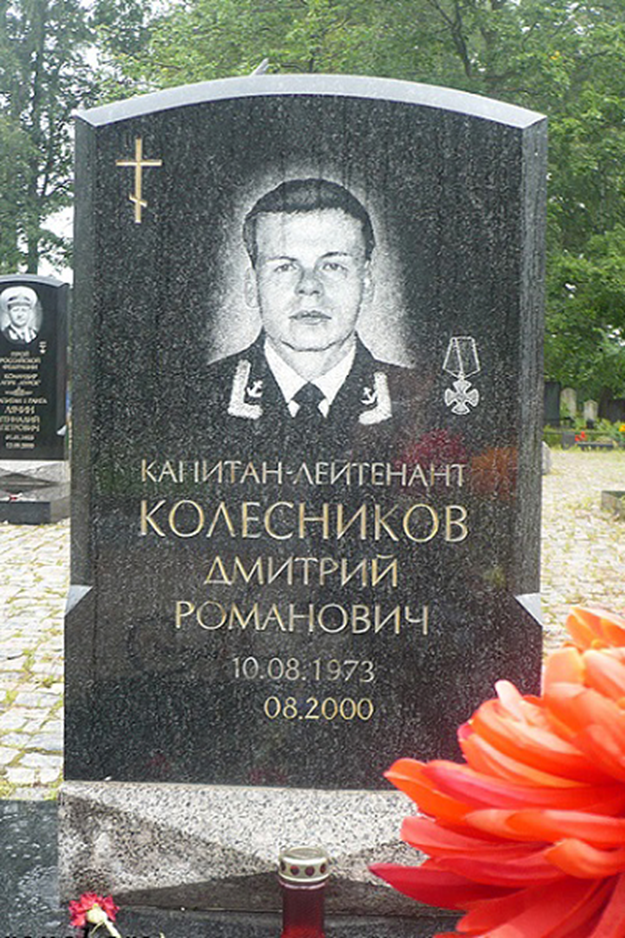
Captain-Lieutenant Dmitry Kolesnikov is buried in the famous Serafimovskoye Cemetery in St. Petersburg, where entire generations of naval sailors are buried. But Kolesnikov’s grave is different from all the graves in this cemetery. Roman Kolesnikov forbade the day on which the investigation buried 23 submariners who survived the explosions to be carved on his son’s tombstone. His son was still alive on August 12! But the investigation did not establish when he died for political reasons. Therefore, the captain-lieutenant’s grave simply reads: “August 2000.”
Translation © 2025 by Michael Estes and TranslatingHistory.org
 Translating History