
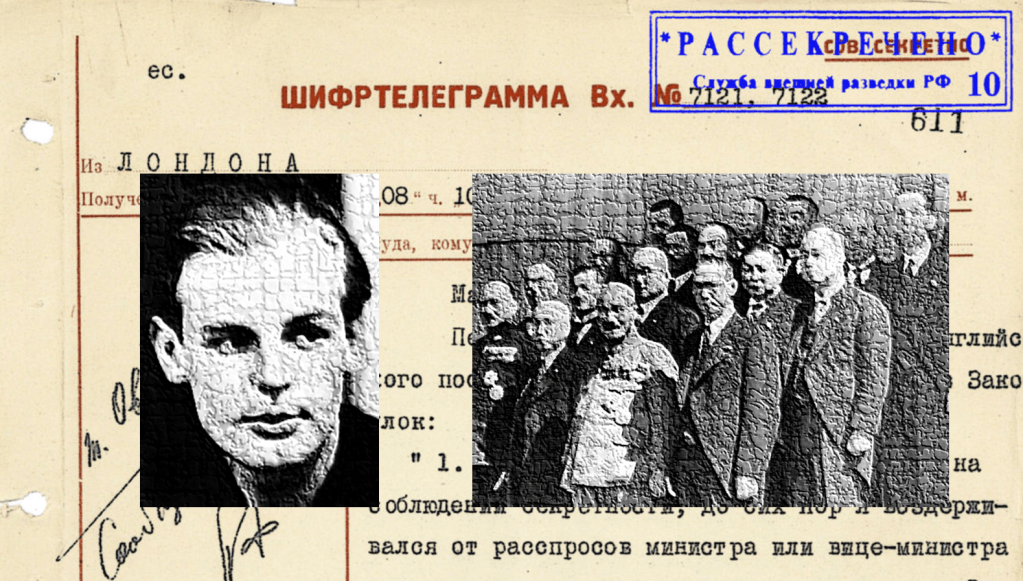
The following translation is that of an enciphered telegram dated 6 October 1941 from Soviet agent Vadim in London, citing information from source “Stuart” on the possibility of the conclusion of an agreement between the Americans and the Japanese, which would ensure the safety of American, English and Dutch interests in the Far East, and would give Japan the green light to attack the USSR.
Regular readers of this website will recognize Vadim as Anatoly Gorsky, a highly successful resident in both London and Washington DC. The source “Stuart” was none other than Donald Maclean, one of the infamous Cambridge Five spy ring.

TOP SECRET
CIPHER TELEGRAM No. 7121, 7122
From LONDON
Received 7 October 1941 at 08:10. Decrypted 7 October 1941 at 17:15.
Material from Stuart.
We are transmitting the contents of telegram No. 1834, from the British ambassador in Tokyo, dated 27 September, to the British Foreign Office [Закоулок]:
“1. Because of the insistence of the Americans to maintain secrecy, until now I have refrained from asking questions of the Foreign Minister or his deputy regarding negotiations in Washington. Yesterday, however, after I casually mentioned these negotiations, the Deputy Foreign Minister, clearly under the impression that I am already well in the know, was quite open with me and reported the following:
“a) The possibility of a meeting between President Roosevelt and Prince Konoe is currently being discussed. The Japanese government very much desires that this take place as quickly as possible in order to strengthen Prince Konoe’s position against extremists, whose attacks on him continue to intensify. The Japanese feel it sufficient to first, before the meeting, to discuss the general principles of settling the situation in the Far East, leaving the details for subsequent elaboration through the usual diplomatic channels. However, the American government for its part is working on hammering out the details of the proposed agreement before the meeting. The Americans also stated that they must first consult with the other Pacific powers – that is, Great Britain, the Netherlands, China, etc. The Japanese government believes that a detailed consultation with his Highness’s government completely normal and necessary, but is concerned that any such consultations with other countries will lead to delays, which could prove fatal to the entire scheme.
“b) The phrasing has already been drafted that defines Japan’s position in regard to the ‘Tripartite Pact,’ and its relations and intentions toward the USSR. The American government clearly feel that this phrasing is up to the mark.
“c) Japan has also been giving like commitments to refrain from any expansion in the southern axis, although for now it is unclear if these commitments have been found to be satisfactory.
“d) A bit of difficulty was encountered when trying to identify a period during which, after peace is reached, Japanese forces must be pulled out of China. The Japanese are insisting that in the event of any sort of unforeseen changes in the situation, they must maintain a number of SAFEGUARDS in place.
[Translator Note: Here and elsewhere, Vadim has indicated certain words or phrases in the original English telegram, in anticipation of vexsome translations. These words are indicated in the text in bold capital letters.]
“e) No special difficulties have been encountered in terms of economic issues, at least when defining general principles.
“3. Having given me the above information, the Deputy Foreign Minister noted that it will be a tragedy if all of the opportunities currently available will not be taken advantage of because of pointless delays or because of the inability to understand the current situation in Japan.
“In sending his message to President Roosevelt, Prince Konoe has established the precedent for Japanes prime ministers, taking responsibility upon himself for the initiative in foreign affairs. The abortive publication of the message has increased the hostility toward Konoe from the Axis powers and pro-German elements in Japan. By his actions and the far-reaching assumptions of the US government, Prince Konoe has in essence severed ties (CUT THE PAINTER) with the Axis powers. I was left with the impression that if the negotiations collapse or drag on too long, the current Japanese government is unlikely to survive it.
“The negotiations currently underway are a sincere attempt by those who have always objected to a coalition with the Axis powers. The German government is using all available means to exert the most colossal pressure on Japan, hoping to disrupt Prince Konoe’s plans.
“4. Deputy Minister Ya. [sic] is certain that the delays and indecisiveness are explained away by misconceptions about the current political situation in Japan and the belief that the Japanese government is too weak to carry out the commitments it has taken on. He refuses to believe, for example, that Colonel MABUCHI’s announcement can make much of an impression on the US government, since it supposedly diminishes the significance of Prince Konoe’s message.
[Translator Note: Colonel Hayto Mabuchi is identified in contemporary media reports as the chief of the Japanese Army press section of Imperial Headquarters.]
One cannot compare these two things, for if Konoe’s message is a state document of utmost importance, then Mabuchi’s announcement is, all in all, a statement from an officer with no authority, although representing a certain school of thought. The only factors that can hamper the Japanese government currently power would be unnecessary delays or a collapse of the entire project addressed above in paragraph A.
“Stuart” points out the serious danger to us that are hiding behind these Japanese-American discussions. Foreign Office circles are openly saying that the Americans can conclude an agreement with the Japanese that will ensure the preservation of American, British, and Dutch interests in the Far East and give Japan the green light for an attack on the USSR.
In addition, the British are exhibiting a certain nervousness in general, related to the discussions.
The Americans are quite sparing and reluctant with the information they are providing the British regarding their progress. This is motivated by the possibility of the Germans intercepting the British coded messages.
CORDELL HULL specifically requested that coded telegrams with information on this topic not be sent to British Ambassador Craigie in Tokyo (he insisted quite persistently).
6 October 1941. No. 1107. Vadim
 Translating History