
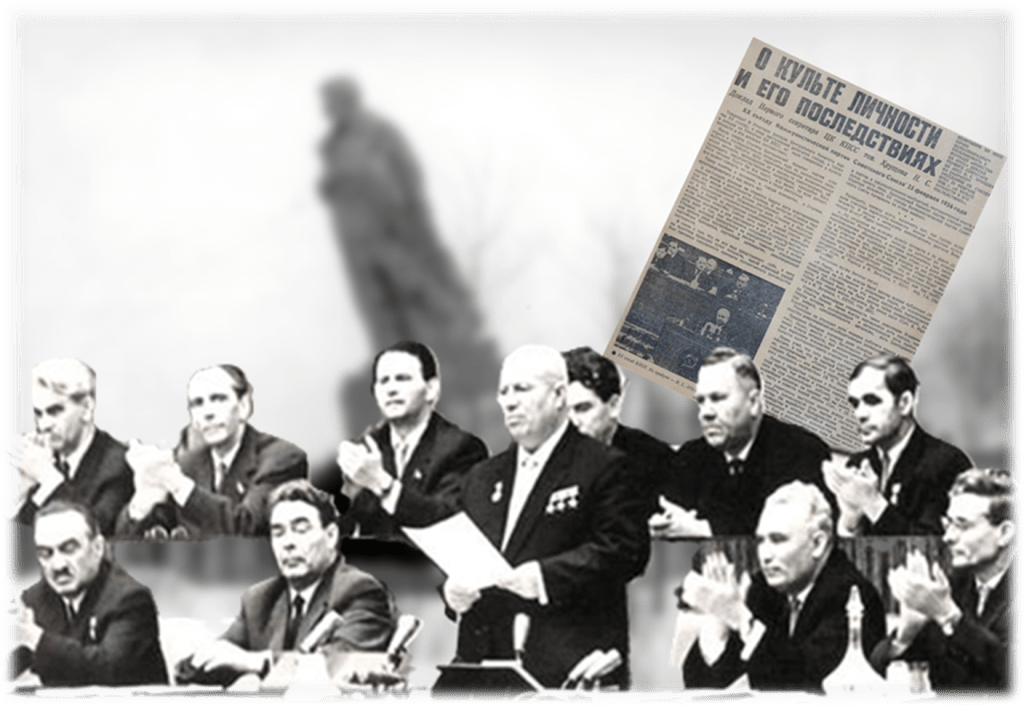
Shortly after midnight on 25 February 1956, Nikita Khrushchev was yielded the floor at a closed session of the 20th Congress of the Communist Party of the Soviet Union, and he had a few things he wanted to get off his chest. For the next four hours, Khrushchev described and denounced the harsh repressions and cruel atrocities committed by his predecessor, Josef Stalin, methodically dismantling his reputation in a report titled “On the Cult of Personality and Its Consequences,” which would come to be known as the “secret speech”.
While the session was closed, it was clear that the information conveyed would have to make its way to the eyes and ears of the Soviet people. District Party leaders were called upon to spread the word throughout the land that the previous guy was not much more than a thug, one for whom the country’s reverence should rightly be ratcheted down a few notches.
The local Party leaders were to provide a brief summary of how things were going in their areas of operation as they went from oblast to oblast on their “Denounce Stalin” tour. One area in particular being paid close scrutiny was the Soviet Republic of Georgia, given that the name now being dragged through the mud was one of their own kinsmen. Less than two months after Khrushchev’s speech was given, the Director of Communist Party Organs of the Central Committee of the Communist Party of Georgia dispatched an eight-page paper to the Central Committee outlining how the Georgian population had been responding to the news.
The following is a translation of that report.

To the bureau members of the Central Committee of the Communist Party of Georgia
Information
Status report on familiarization with the report of the 20th Congress of the Central Committee of the Communist Party of the Soviet Union “On the Cult of Personality and Its Consequences” in the Party chapters of Georgia
After district and city meetings of the active party members, in conjunction with meetings of the Party chapters following the results of the 20th Congress of the CPSU, familiarization of Communists everywhere has been organized with the Central Committee CPSU report “On the Cult of Personality and Its Consequences,” given by First Secretary of the CC CPSU Comrade Khrushchev at the 20th Party Congress.
Carrying out this work was preceded by the appropriate preparatory measures. District and city committees selected and provided instruction to Party committee members and other senior officials, who are now performing the work in the party chapters on familiarizing others with the report.
First and foremost, the report is being shared with Communists from large industrial enterprises, construction sites, collective farms, state farms, MTS [machinery and tractor stations], universities, and workers of the ideological and cultural front.
From 26 through 31 March, in the city of Tbilisi alone, more than 20 thousand Communists learned of the report, almost half of the city’s entire party organization. Similar familiarization is being carried out in other cities and areas of the Republic.
District and city Party committees are reporting in their information that during and after becoming acquainted with the text of Comrade Khrushchev’s report “On the Cult of Personality and Its Consequences,” Communists in many of the party organizations are speaking out and reacting differently to the report.
At the Kokhora state farm in the Gali District, after reading the report, Nestor Gegechkori, a Party member since 1928, said that he approves of Khrushchev’s report and believes that the Party took steps in a timely manner to eliminate [the cult of personality].
There were many questions and statements during the reading of the report in the Party organization of the “Mugudzirkhva” collective farm in the settlement of the same name of the Gudauta District, where the superintendent of the Department of Propaganda and Agitation of the Abkhazia Party regional committee, Comrade A. Styrba, was present. The Communists talked about the atrocities and lawlessness that were taking place in Abkhazia in 1937. It was noted that, in 1937, some 80 collective farmers in the settlement were repressed, some of which have now been rehabilitated posthumously. Because of this, Communists Dzhikirba, Agrba, and Gubaz, who themselves were arrested in 1937, asked the question, “Do we really need portraits and monuments of such a person who was so mercilessly killing people? Because through his own actions, he himself was actually an enemy of the people, just not exposed as such until now.”
Party member V. Agrba noted that the placement of Stalin, who had carried out so much evil, in the mausoleum will blacken the memory and name of the great Lenin.
In addition, many Communists asked questions on the spot such as “Why did you not recommend us to remove the shrines to the life and work of Stalin before we read this? Since you knew everything in advance? What is the need for such a shrine dedicated to such a man who savagely killed people? Why are you not taking harsh measures against the agitators and accusers who were used to destroy so many brave people? Why didn’t the members of the Politburo expose all of these atrocities earlier?”
As we can see from incoming information, some of the Communists correctly grasp the importance of the question raised by the Party regarding the cult of personality for both the present and the future of our Party, and believe that the excessive exaltation of the cult of Stalin helped give rise to many failures in our efforts.
Another segment of Communists, clearly still not having recognized the entire importance of the issue in question, are expressing – through their silence or submitting of questions of different content – their disagreement and dissatisfaction, or even a strange sort of protest with the conclusions from Comrade Khrushchev’s report.
By analyzing the questions posed, we can conclude that some of the Communists perceive quite poorly those parts of the report that talk about Stalin’s role in the Great Patriotic War, Stalin’s denigration of Lenin’s role, and the fate of Comrades Ordzhonikidze and Kirov.
Some of the Communists were dissatisfied because it was only after Stalin’s death that it became possible to bring to light the deleterious consequences of the cult of personality, but while he was still alive, all of this was covered up, reinterpreted.
In most cases, the Communists ask: What is the purpose of the report “On the Cult of Personality and Its Consequences”? Why were the report’s contents declassified and made known to non-Party members? Why are we limited to only reading Comrade Khrushchev’s report and not discussing it, and why was there no discussion of this report at the Party Congress?
The following are individual moments that characterize the reaction of a number of individuals and groups of Communists to Comrade Khrushchev’s report.
Of the 94 Party chapters of the Ambrolauri district, Communists from 52 of the organizations were already familiar with the report. After reading the report, the Communists exchanged their opinions. The Communists mostly spoke of Comrade Stalin’s service in creating and strengthening our socialist state, that he actively fought to implement Lenin’s instructions against all enemies.
At the same time, Communists noted that until now, they only knew Stalin as the recognized leader of the working class and all workers of the world, and that nobody up to now had suspected him of atrocities. Learning of the report aroused discontent among the Communists; they demanded to know how the Party was unaware all this time if the report was true. Some Communists spoke of organizing discussions of the report in the Party chapters.
In some of the organizations in the Chokhatauri district, the report was heard with great agitation. During the reading, shouts were heard and many questions were asked.
In the Samtredia district, in a number of Party organizations the reading of the report was met with bitterness and silence.
When the report was disclosed to the 67 Party chapters of the Ordzhonikidzevskiy (rural) district, more than 200 questions were raised. In a number of organizations, a particular passage from the report – that “in Georgia” a thousand innocent Soviet people were victims of the abuse of power and lawlessness, all taking place under the “genial leadership” of Stalin – “the great son of the Georgian people,” as the “Georgians like to refer to their fellow countryman” – was met with anger and considered offensive to the Georgian people.
In some of the Party organizations from this same district, there were shouts of “Not true!” when the report mentioned that Stalin never went anywhere, never met with the workers or collective farmers, and never knew of the situation on the ground, that he only knew the country and its agriculture through film clips, and that he had been intending to increase the agricultural tax to 40 billion rubles.
In the Party chapters of the Kachreti district, the Communists responded with approval at those parts of the report that mentioned Stalin’s service, but those parts that spoke of Stalin’s serious missteps, his undeserved authority, etc., disturbed and angered most of the Communists. In a number of the Party organizations, there were collective cries of “This is a slander against Stalin,” “Stalin is the leader of the people,” “The people will never forget Stalin’s name,” “If these actions were known, why weren’t they mentioned when he was alive,” “Stalin doesn’t deserve this,” “The accusations against Stalin are untrue,” “Comrade, what you are reading, is it really written there or are you making it up,” etc. In several of the organizations, the Communists whispered fearfully that submitting questions on favor could lead to consequences.
After reading Comrade Khrushchev’s report, Communist S. Tavadze, a teacher at the first secondary school in Poti stated: “I don’t believe it, but even if the documents that you are reading right now are true, the question still remains (submitted on paper), would it be possible to govern this state without touching the immortal name of Stalin after his death? After all, Stalin died, and he would not have been able to allow ‘these mistakes’ to be repeated. On 9 March in Tbilisi, like on ‘bloody Sunday,’ unarmed people were massacred – who is to blame for this? Comrade Stalin?! Is it justified (academically speaking) when the new blood begins to increase its authority by insulting, as if criticizing, the extremely authoritative old guard? Are good results achieved using this method? … No, no, and no.”
Before the reading of the report, a member of the CPSU from the Party chapter of the Stalin collective farm in the village of Bolnisi in the Bolnisi district, D. Rekhviashvili asked whether or not there would be discussion periods after the reading of the report. When he heard that there would not be, he did not want to hear the report and left the meeting.
In the Party chapter of the Georgian “Glavneftesbyt” [Main Directorate for Marketing and Transportation of Oil and Petroleum Products] branch, upon hearing the report, Communist Chkhenkeli raised his hand to indicate he wanted to ask a question, but the representative from the Molotov District Party Committee, Comrade Khvtisiashvili, insisted that any questions would have to be submitted on paper and, in effect, suppressed questions from being asked, since Comrade Chkhenkeli and other Communists refrained from asking questions.
In a number of Bogdanovskiy district Party chapters, where members were predominantly of Armenian nationality and did not understand the Russian language, had to resort to reading the text while it was interpreted in Armenian. The possibility of inaccuracies in the translation of the report’s contents cannot be ruled out.
It must be noted that the secretaries of a number of District Party Committees, such as the Sachkhere district – Comrade Kosakhidze, Chkhorotsku district – Comrade Tsanava, and Dedopls-Tskaro district – Comrade Berdzeni, along with others, approached the compilation of information on the progress of the familiarization of the report for the Central Committee of the CPSU insincerely and irresponsibly. Their information contains several lines with data errors and do not accurately reflect the circumstances, the mood of the Communists, and the atmosphere in which the reading of the report “On the Cult of Personality and Its Consequences” took place.
Readings of the CPSU Central Committee report “On the Cult of Personality and Its Consequences” continues in the Republic’s Party chapters.
Director of Communist Party Organs of the Central Committee of the Communist Party of Georgia M. Megrelishvili
April 1956
Translation © 2025 by Michael Estes and TranslatingHistory.org
 Translating History