
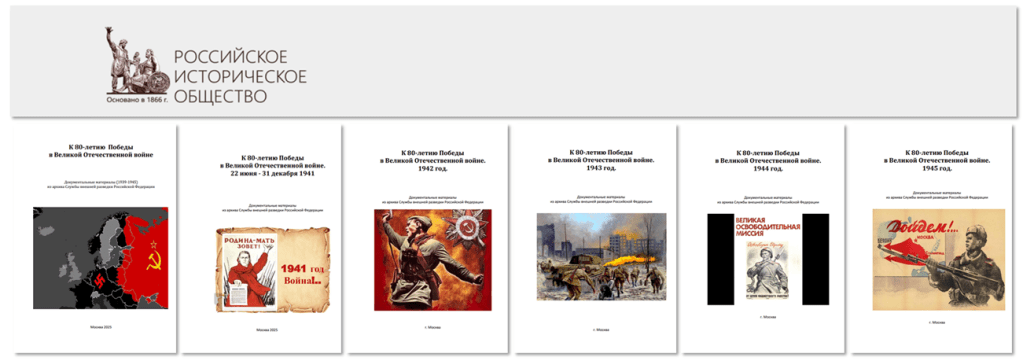
On 17 September 2025, to commemorate the 80th anniversary of the Great Patriotic War, the Russian Historical Society has published a six-volume collection of over 800 archival documents, declassified by the Russian Foreign Intelligence Service (SVR), covering the entire period of World War II — from Nazi Germany’s invasion of Poland to the defeat of Japan. An online version of the collection has been published on the website of the Russian Historical Society, and copies of all six volumes (in PDF form) are free.
These documents provide an excellent look at the Soviet-eye view of how events unfolded. Their agents were peppered across the globe, and through a number of means – human contact, sifting through trash, thievery, rudimentary electronic surveillance, etc. – they gained valuable information on what the thoughts were of not only the adversary, but also neutral countries and allies. Not all of the information turned out to be true, whereas some was particularly invaluable to carrying on the fight on the field and knowing how to handle the US and UK government representatives to the Soviets’ advantage.
The following is a translation of the Russian news agency RIA announcement of the publication. Note the rather anti-West tone of some of the information they happened upon in the collection. Also, beneath the translation is a set of links to the PDFs of the six volumes.

Among these documents was a 16-page report, “Information on Great Britain’s Policy Toward the USSR,” based on classified British documents obtained by Soviet foreign agents. The overview outlined the British leadership’s plans for the Soviet Union. The document, dated 29 October 1945, was prepared by the 8th (Information) Department of the First Directorate (Foreign Intelligence) of the People’s Commissariat for State Security of the USSR and was intended for the People’s Commissariat of Foreign Affairs of the USSR.
The report reads “World War II has radically altered the balance of power. The Soviet Union became the decisive force in Europe” — according to Soviet intelligence, the British elite acknowledged this. “In response to the growing influence of the Soviet Union in European countries, plans have emerged among the British ruling circles to create federations of European states as a ‘cordon sanitaire’ against the USSR, and later, a plan to create a Western European bloc for the same purpose.”
It was also pointed out that the successes of the Red Army and the growing sympathy for the USSR on the part of the population of countries liberated from Nazi occupation “caused great alarm in the ruling circles of Great Britain,” and that British diplomacy had decided to wage a vigorous struggle against the influence of the USSR in the countries of Western and South-Eastern Europe, and in the Near and Far East.
“Britain’s ruling circles view the USSR as Britain’s most likely adversary in a future world war. This, in their opinion, should determine Britain’s policy toward the USSR,” Soviet intelligence emphasized.
Moscow had access to the contents of a memorandum from the British Chiefs of Staff’s Postwar Planning Staff, dated June 29, 1945. According to the memorandum, London’s strategic objective was to create a Western European bloc, initially under the guise of organizing control over postwar Germany. This alliance was planned to include Great Britain, France, Ireland, Belgium, the Netherlands, Norway, Denmark, Iceland, Portugal, and, if possible, Spain and Italy.
These plans were later implemented with the creation of NATO. In 1948, Great Britain, France, Belgium, the Netherlands, and Luxembourg signed the Brussels Treaty to counter the USSR. This move is considered the beginning of the formation of the North Atlantic Alliance.
The memorandum also spoke of the need to maintain Britain’s dominant position in the Middle East. “The question of maintaining a significant reserve of highly mobile military units there is being raised,” noted a Soviet foreign intelligence review. London also planned “a number of events in India and Afghanistan.”
In addition, there was talk of creating military bases in the Far East.
“Particular emphasis is placed on the need to prevent the USSR from gaining greater influence in China than the United States and England, and to ensure that China’s potential manpower reserves are made available, if necessary, to England and the United States, not to the USSR,” the report stated. London also considered it necessary to “prevent the resurgence of a Germany hostile to England and friendly to the USSR.” Another objective was “to engage the United States in active participation in ensuring Anglo-American interests in those areas where these interests do not diverge.”

Please note that the six volumes are all in the original Russian. We’ve already begun cherry picking our favorite documents and will begin dropping them into our website shortly. If you know enough Russian to get a feeling for the subject matter of individual reports and would like to see something in particular translated and published here, leave a comment and we’ll get to it as quickly as possible.
Information on the individual volumes, hyperlinked to the Russian Historical Society’s website to download:
Volume 1: 1939-1941 – 125 MB, 549 pages, 175 documents
Volume 2: 1941 – 65 MB, 359 pages, 110 documents
Volume 3: 1942 – 105 MB, 510 pages, 143 documents
Volume 4: 1943 – 96 MB, 440 pages, 127 documents
Volume 5: 1944 – 78 MB, 396 pages, 126 documents
Volume 6: 1945 – 107 MB, 528 pages, 135 documents
© 2025 by Michael Estes and TranslatingHistory.org
 Translating History