
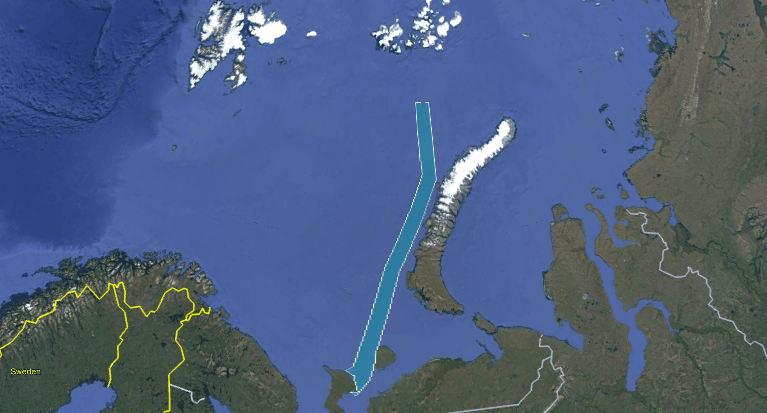
On 7 October 2025, the Russian Federation Ministry of Defense filed a maritime closure area in the Arctic portion of the Barents Sea to ensure safe lanes for Russian Navy missile launches from 12 to 14 October. The activities are to be conducted in a range extending from the eastern coastline of Kanin Peninsula northward along the central Novaya Zemlya coastline to a point some 200 kilometers from the southernmost point of the Franz Josef Land archipelago in the Arctic Ocean.
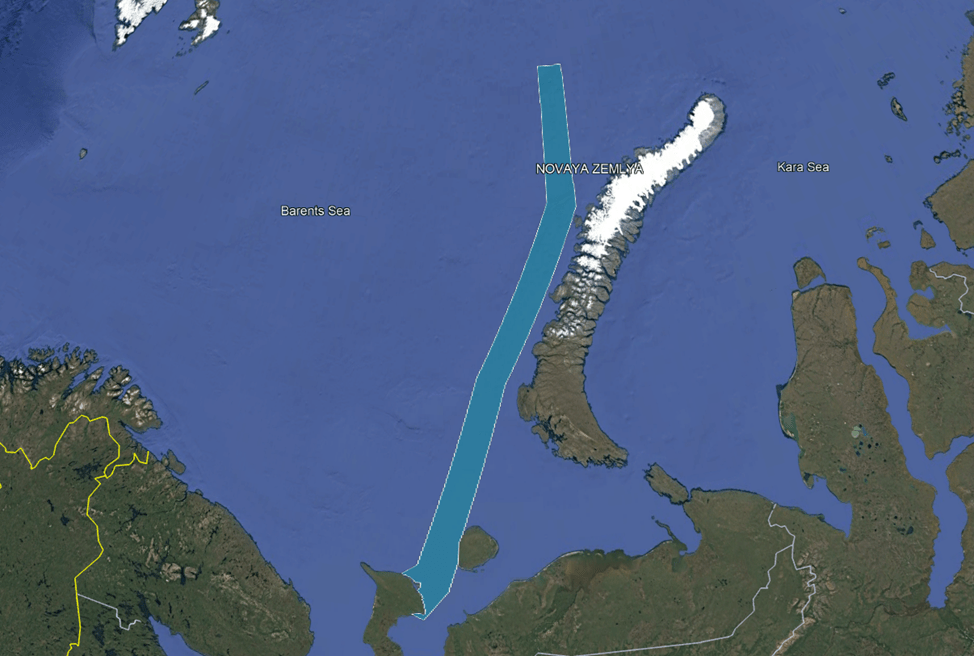

As an aside, we’ve been asked a few times how we come across these maritime closure and navigational warning areas and the associated images. The notifications are published (in Russian) periodically by the Russian Federation Ministry of Defense on a small handful of sites, some easy to access, some not so much. We collect the data, translate it into English, reformat the coordinates, and run them through Google Earth Pro to provide a visual snapshot of the locations. It’s a fairly straightforward process.
It’s worth noting that these are almost always used to identify locations where the Russian Navy or other maritime elements of the Russian Federation will be conducting exercises, carrying out research and development efforts, testing new weapons or platforms, and routine crew certification activities. The notifications are almost always vague in their content, and sometimes contain outright false information. The bottom line is supposed to reflect efforts to prevent civilian shipping and fishing vessels from being in harm’s way, but in the case of the Russian Federation, areas are also created to prevent hostile elements from gaining easy line-of-sight access.
Keep those cards and letters coming!
Translation © 2025 by Michael Estes and TranslatingHistory.org
 Translating History