

On 8 October 2025, the Russian Federation Ministry of Defense published notification of “the suspension of right of innocent passage through the territorial waters of the Russian Federation” in the southeastern Baltic Sea “for foreign military ships and other state vessels operated for non-commercial purposes.” This declaration, which is in effect through 31 December 2025, effectively seals off the Kaliningrad coast from unwanted or potentially hostile shipping activities.

Dr. Pierre Thevenin, a researcher with SIPRI’s European Security Program and well-renowned international expert on maritime security and the law of the sea, recently wrote about the potential challenges that could arise following Russia’s 18 June 2025 adoption of new maritime ‘baselines’ in the Baltic Sea which would dictate where foreign ships could and could not sail near Russia’s coast.
The question of exactly where Russia’s various maritime zones lie in the Baltic — and thus what rights Russian and foreign ships have in different parts of the sea — has become particularly salient since Russia’s full-scale invasion of Ukraine in 2022. After Finland and Sweden joined the alliance, the Baltic is now entirely surrounded by NATO member states, except for Russia’s small coastlines. There are strong suspicions in Europe and elsewhere that Russia is operating a ‘shadow fleet’ of oil tankers to evade international sanctions, including in the Gulf of Finland, some of which may also be involved in espionage and acts of sabotage. NATO’s military exercises and its new naval mission to protect critical infrastructure, Baltic Sentry, have only added to the militarization of the Baltic region—and with it, the risk of naval incidents with a potential for dangerous escalation.
This is a significant change from a draft law that briefly appeared on the government website in May 2024, which set straight baselines, including across the Strait of Baltiysk linking the Vistula Lagoon to the Baltic. This would have meant that Polish ships would have had to ask permission to sail through Russian internal waters to reach Polish ports in the southern end of the lagoon, which would arguably have contravened UNCLOS.
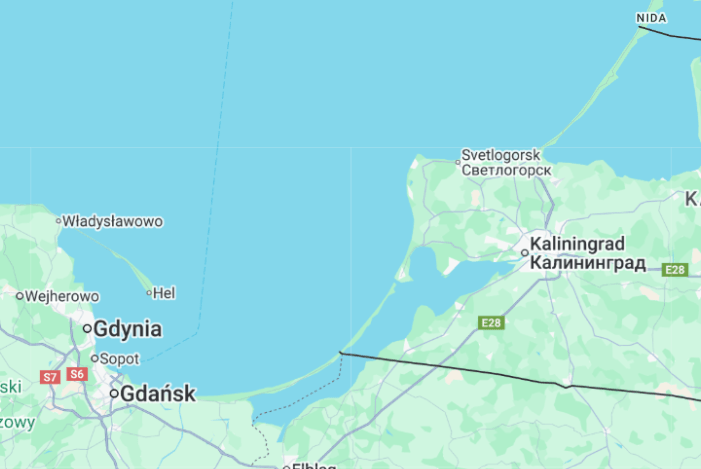
A brief look at the maps above shows that Poland’s concerns following the new suspension of the right of innocent passage could be well-founded when trying to gain access to its easternmost ports. It’s clear that, without expanding and dredging the Vistula Spit Canal, or the construction of new canals further east, this could cause significant challenges. Further to the northeast, Lithuania appears equally impacted for the same reasons. It will be interesting to see where the situation lies on 1 January 2026.
Translation © 2025 by Michael Estes and TranslatingHistory.org
 Translating History