
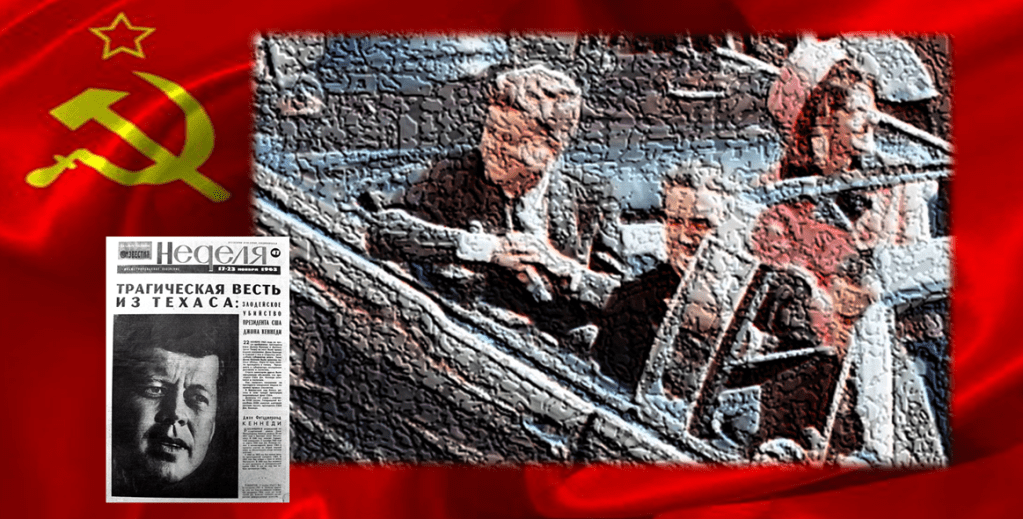
On November 22, 1963, US President John F. Kennedy was assassinated in Dallas, Texas. The event shocked the entire world and elicited waves of sympathy on both sides of the Iron Curtain. The generally positive attitude in the USSR towards the young American president was finally solidified after the publication in Pravda on June 11, 1963, of his keynote speech “Reconsidering Our Attitude Towards Peace.” His openly expressed sympathies for the Russian nation and culture, and his firm conviction that it was possible and necessary to reach an agreement with the Communists on peace and cooperation, despite the ideological divide – all this seemed to open a new page in world history.
KGB reports sent to the Central Committee after the tragedy indicated that Soviet citizens throughout the USSR sincerely grieved Kennedy’s death and expressed hope for just retribution. The Soviet leader was utterly devastated by what had happened: according to his son’s memoirs, Nikita Khrushchev, upon learning of the American president’s assassination, fell to his knees and wept.
That same evening, a meeting of the Presidium of the Central Committee of the CPSU was held, during which plans for official mourning ceremonies were meticulously worked out. After that, Khrushchev rushed to send official messages of condolence to the new US President Lyndon B. Johnson and Kennedy’s widow. The wife of the First Secretary, Nina Petrovna Khrushchev, also sent an official message to Jacqueline Kennedy – a unique case in Soviet history. It was decided that the oldest member of the Presidium of the Central Committee, A.I. Mikoyan, would fly to the United States for the funeral, accompanied by the head of the US Department of the USSR Ministry of Foreign Affairs, M.N. Smirnovsky, Mikoyan’s assistant V.V. Smolyachenko, and interpreter V.M. Sukhodrev.
Based on the recommendation of US Presidential advisor L.E. Thompson, the Soviet delegation did not stay in Washington for long for security reasons. But over the course of three days, from November 25 to 27, Mikoyan managed to meet with the new US president, the British prime minister, and members of the Kennedy family. The meeting with Kennedy’s widow made a particularly strong impression. According to the memoirs of Soviet Ambassador A.F. Dobrynin, at the reception the widow, with tears in her eyes, said:
“The morning of the day my husband was killed, he unexpectedly told me in the hotel before breakfast that we need to do everything we can to establish good relations with Russia. I don’t know what prompted these words at that particular moment, but they sounded like the result of some deep reflection. I am sure that Premier Khrushchev and my husband could have succeeded in the search for peace, and they truly strived for it. Now both governments must continue this work and bring it to fruition.”
John F. Kennedy’s “political testament” was never realized: Lyndon Johnson’s planned visit to the USSR in 1965 – the first official trip by a US president since Franklin D. Roosevelt – did not take place due to the outbreak of the Vietnam War.
The following is a collection of eight recently released and declassified documents, including US to USSR diplomatic traffic, correspondence between the Khrushchevs and Jacqueline Kennedy, and official Top Secret message traffic from the Soviets in Washington to Communist Party leaders to keep them apprised of the situation in the downcast US capitol.
Source: RGANI, F. 3, Op. 64, D. 471.

N1. Note from US Ambassador F.D. Kohler to Soviet Foreign Minister A.A. Gromyko
23 November 1963
Dear Mr. Gromyko,
I consider it my sad duty to inform you of the death of the President of the United States of America, John F. Kennedy, which occurred on November 22, 1963, in Dallas, Texas. I would also like to inform you that Vice President Lyndon B. Johnson was sworn in as President of the United States of America at 3:39 PM Eastern Time on November 22, 1963.
In accordance with our national customs, the Embassy will observe a 30-day period of mourning.
The book of condolences will be open at my residence on November 23, 24, and 25 between 12:00 and 13:00 and 15:00 and 17:00.
I am deeply grateful to you for the condolences you expressed to me yesterday evening by telephone, which I have, of course, conveyed to my government.
Sincerely yours,
Foy D. KOHLER
To His Excellency A.A. Gromyko
Minister of Foreign Affairs, Moscow
Translator: Makarov

N2. Encrypted telegram from Soviet Ambassador A.F. Dobrynin to the Central Committee of the CPSU
23 November 1963
Top Secret
Reproduction prohibited
Copy N12
To Brezhnev, Voronov, Kirilenko, Kozlov, Kosygin, Kuusinen, Mikoyan, Podgorny, Polyansky, Suslov, Khrushchev, Shvernik, Grishin, Yefremov, Mazurov, Mzhavanadze, Rashidov, Ponomarev, Gromyko, Kuznetsov
Special N 1969 Priority
In light of Kennedy’s death, the following would be considered appropriate:
1. Send condolences on behalf of N.S. Khrushchev and L.I. Brezhnev to the new president Johnson and Kennedy’s widow, and also on behalf of A.A. Gromyko to Rusk.
2. One of the members of the government, for example A.A. Gromyko, should visit Kohler and express condolences.
3. It may be possible to send a member of the government to the United States for John F. Kennedy’s funeral, but this matter can be decided somewhat later, when the funeral arrangements become clear, about which we will provide further information.
I personally sent my condolences to the president’s wife, Rusk, and Robert Kennedy.

N3. Message from N.S. Khrushchev to Jacqueline Kennedy
23 November 1963
To Mrs. Jacqueline Kennedy
Washington
The White House
It is with a feeling of deep personal sorrow that I learned of the tragic death of your husband, President of the United States John F. Kennedy.
He commanded great respect from everyone who knew him. And my encounters with him will forever remain in my memory..
Please accept my deepest condolences and heartfelt sympathy during this time of profound grief.
N. Khrushchev

N4. Message from Nina Khrushchev to Jacqueline Kennedy
23 November 1963
To Mrs. Jacqueline Kennedy
Deeply shocked by the tragic death of your husband, President of the United States of America John F. Kennedy, I ask you to accept my sincere condolences and sympathy to you and your entire family in this sorrowful hour.
Nina Petrovna Khrushchev

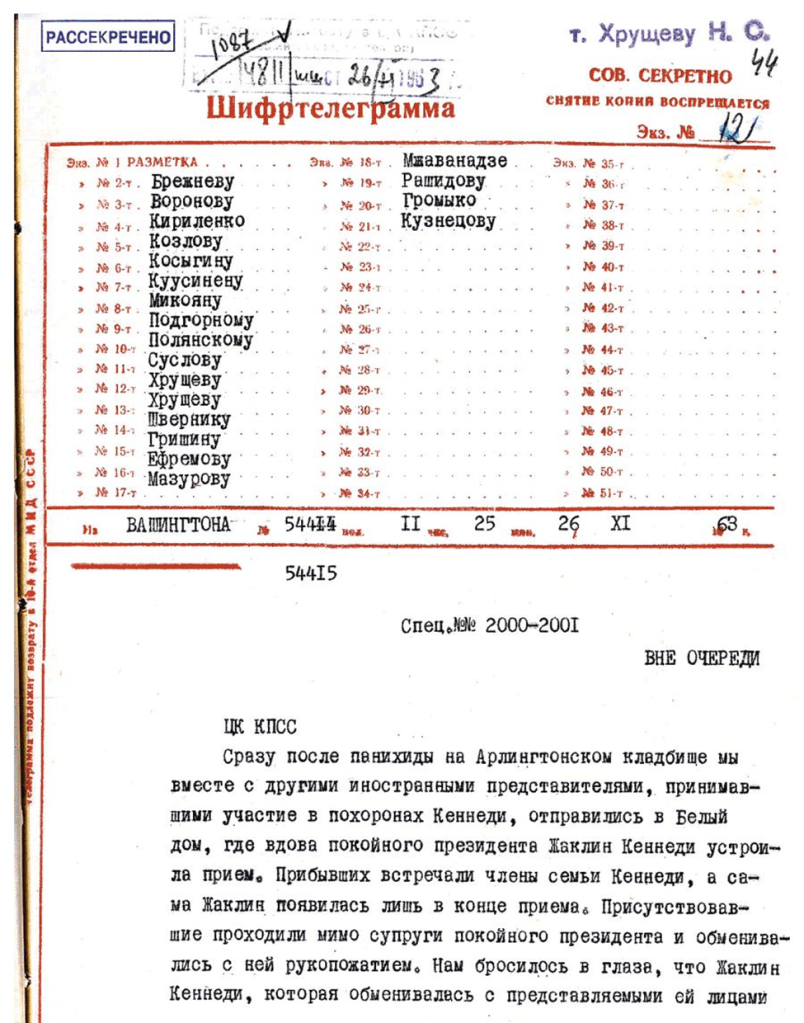
N5. Encrypted telegram from A.I. Mikoyan, member of the Presidium of the Central Committee of the CPSU, to the Central Committee of the CPSU
26 November 1963
Top Secret
Reproduction prohibited
Copy N12
To Brezhnev, Voronov, Kirilenko, Kozlov, Kosygin, Kuusinen, Mikoyan, Podgorny, Polyansky, Suslov, Khrushchev, Shvernik, Grishin, Yefremov, Mazurov, Mzhavanadze, Rashidov, Gromyko, Kuznetsov
From Washington
11:25 26.XI.63
Special Numbers 2000, 2001 Priority
CC CPSU
Immediately after the memorial service at Arlington Cemetery, along with other foreign representatives who had participated in Kennedy’s funeral, we went to the White House, where the late president’s widow, Jacqueline Kennedy, hosted a reception. Members of the Kennedy family greeted those arriving, and Jacqueline herself only appeared at the end of the reception. Those present passed by the late president’s wife and shook hands with her. We noticed that Jacqueline Kennedy, who exchanged only two or three words with those introduced to her, seemed very calm and even appeared to be smiling. However, when we were introduced to her and conveyed our most sincere condolences on behalf of Nina Petrovna [Khrushchev], Nikita Khrushchev, Rada [daughter of the Khrushchevs] and Alesha Adzhubei, as well as on behalf of the Soviet government and people, and on our own behalf, Jacqueline Kennedy, with great emotion and barely holding back tears, said:
“I am confident that Chairman Khrushchev and my husband could have succeeded in their efforts to find peace, and they truly strived for it. Now you must continue this work and bring it to completion.”
We replied that we fully share her opinion and agree that both sides should continue to strive to develop friendly relations between our countries for the benefit of world peace. We emphasized that we grieve with her over the tragedy that has befallen her.
In conclusion, Jacqueline Kennedy expressed her heartfelt gratitude to N.S. Khrushchev and to us for our warm support and for the fact that we had specially traveled to the USA to attend her husband’s funeral.
She expressed all of this with inspiration and emotion, and throughout the entire conversation she held my hand with both of hers, trying to convey as convincingly as possible her feelings and thoughts regarding the cause of peace, to which her husband dedicated his efforts, and her desire for our countries to complete the work they had begun.
Her composure is most impressive.
A. Mikoyan

N6. Encrypted telegram from A.I. Mikoyan, member of the Presidium of the Central Committee of the CPSU, to the Central Committee of the CPSU
26 November 1963
Top Secret
Reproduction prohibited
Copy N12
To Brezhnev, Voronov, Kirilenko, Kozlov, Kosygin, Kuusinen, Mikoyan, Podgorny, Polyansky, Suslov, Khrushchev, Shvernik, Grishin, Efremov, Mazurov, Mzhavanadze, Rashidov, Gromyko, Kuznetsov
From Washington
11:30 26.XI.63
Special Numbers 2002-2004 Priority
CC CPSU
Today, during the reception hosted by the president, I had a number of brief conversations with US officials.
Two points from the statements of these individuals deserve attention:
1. Every one of them (Rusk, Thompson, the director of the Arms Control and Disarmament Agency [William Chapman] Foster, and State Department officials), in addition to expressing great gratitude for the Soviet government’s decision to send its special representative to Kennedy’s funeral, emphasized with their very first words their confidence that President Kennedy’s line in the field of Soviet-American relations, as well as US foreign policy in general, would be preserved under the new president, Lyndon Johnson.
2. Thompson specifically raised with me the issue he had discussed yesterday with Comrade Dobrynin – concerning comments in the Soviet press regarding the assassination of President Kennedy, and especially regarding the circumstances surrounding the investigation of the entire affair.
The gist of Thompson’s statements was that the Soviet press’s emphasis on the involvement of far-right circles in the assassination of Kennedy (and subsequently in the murder of Lee [Harvey] Oswald) complicates the position of those in the US who advocate for improved Soviet-American relations, since such statements are immediately countered in the American press by claims about Oswald’s “Communist and Cuban connections.”
I told Thompson that it was not our intention to introduce any complications, but we also could not ignore a situation where the US government had not yet investigated all the circumstances of the assassination, and yet senseless accusations against us and against Cuba were already being made in the press in connection with Kennedy’s murder.
Thompson replied that he understood this, but asked us to also understand what he had said. The government is currently investigating all of the circumstances of the case, Thompson said, and it is in our common interest to ensure that until the investigation is completed, the Soviet press limits itself to stating the facts and refrains from “premature conclusions,” as this only plays into the hands of the right-wing, who are using this to fuel anti-Soviet and anti-Cuban hysteria.
It’s clear that the US government doesn’t want to embroil us in this matter, but it also doesn’t want to get into a fight with the far right; it clearly prefers to quickly consign the whole affair to oblivion. Our reaction to these murders has already played its part. The president publicly stated today that a thorough investigation will be conducted.
I believe that this point should be taken into account in future publications in our press. This will help to weaken attempts to fuel the anti-Soviet and anti-Cuban campaign.
A. Mikoyan

N7. Encrypted telegram from A.I. Mikoyan, member of the Presidium of the Central Committee of the CPSU, to the Central Committee of the CPSU
28 November 1963
Top Secret
Reproduction prohibited
Copy N12
To Brezhnev, Voronov, Kirilenko, Kozlov, Kosygin, Kuusinen, Mikoyan, Podgorny, Polyansky, Suslov, Khrushchev, Shvernik, Grishin, Yefremov, Mazurov, Mzhavanadze, Rashidov, Gromyko, Kuznetsov
From Washington
6:15 28.XI.63
Special N 2034
CC CPSU
On November 26th, at the White House, before we were escorted to the President’s office, White House Press Secretary Salinger approached Comrade Sukharev and informally asked him to convey to Comrade N.S. Khrushchev the most sincere gratitude on behalf of all White House staff and friends of the President for Comrade N.S. Khrushchev’s visit to the US Embassy in Moscow to personally pay tribute to the deceased President. He emphasized that this gesture made a great and very positive impression on all White House staff who knew Kennedy well and worked closely with him. Salinger also thanked us for the telegrams of condolence and for our special trip to the US to attend Kennedy’s funeral. He said all this with great sincerity and emotion.
A. Mikoyan

N8. Encrypted telegram from Soviet Ambassador A.F. Dobrynin to the Central Committee of the CPSU
5 December 1963
Top Secret
Reproduction prohibited
Copy N2
To Khrushchev, Gromyko
From Washington
5.XII.63.
Special N 2086-2088 Urgent
Today I met with Thompson at his invitation. Thompson said that Jacqueline Kennedy, the wife of the late president, had asked him to pass on a personal letter from her to Nikita Khrushchev through me.
Thompson noted that she had given him this letter through Bundy. No one else knows about her letter, although President Johnson is apparently aware of the fact that the letter was handed over (but not its contents). Rusk is “not yet aware of this matter.” Thompson also said that he is personally unfamiliar with the contents of the letter itself.
The envelope was slightly sealed in one place. This letter is not typewritten, but written from beginning to end in Jacqueline Kennedy’s own hand, which is usually considered here a sign of special respect for the recipient. She also wrote the address on the envelope herself. The letter is written on small sheets of paper on “White House” letterhead.
The text of the letter is as follows:
“White House, 1 December 1963
“ Dear Mr. Chairman-President,
“I would like to thank you for sending Mr. Mikoyan as your representative to my husband’s funeral.
“He looked so upset when he came up to me, and I was very touched by it.
“I tried to tell you something through him that same day, but it was such a terrible day for me that I don’t know if my words came out the way I wanted them to.
“Therefore, now, on one of the last nights I will spend in the White House, in one of the last letters I will write on this White House stationery, I would like to write this message to you.
“I am sending this only because I know how deeply my husband cared about peace and how central the relationship between you and him was in his mind in that regard. He repeatedly quoted your words in his speeches: ‘In a future war, the survivors will envy the dead.’
“You and he were adversaries, but you were also allies in your determination to prevent the world from erupting.
“You respected each other, and you were able to deal with each other. I know that President Johnson will make every effort to establish the same kind of relationship with you.
“The danger that worried my husband was that a war might be started not so much by large nations, but by small ones.
[Translator note: The translator that prepared the text for its Russian reader mistakenly offered the Russian word for ‘people’ rather than ‘nations,’ which literally indicated ‘small people’. This becomes more understandable in the text of the following paragraph.]
“While great men understand the need for self-control and restraint, smaller men are sometimes driven more by fear and pride. If only in the future great men could still manage to get the smaller men to sit down and negotiate before they start fighting!
“I know that President Johnson will continue the policies in which my husband so deeply believed – policies of control and restraint – and he will need your help.
“I am sending this letter because I am so deeply aware of the importance of the relationship that existed between you and my husband, and also because you and Mrs. Khrushchev were so kind in Vienna.
“I read that there were tears in her eyes when she left the American embassy in Moscow after signing the book of condolences.
“Please thank her for that.
“Sincerely,
“Jacqueline Kennedy”.
In our opinion, it would be good if Nikita Sergeevich, and perhaps Nina Petrovna separately, responded to her with a personal letter. It might also be advisable to consider the possibility of inviting, on an unofficial basis, perhaps on behalf of Nina Petrovna and Rada, Jacqueline Kennedy and her children to come and visit us, say, next summer and relax on the Black Sea.
Such a step on our part would make a very good impression on American public opinion, as well as on those in US government circles. Furthermore, maintaining ties with the Kennedy family would also be beneficial.
A. Dobrynin
Translation © 2025 by Michael Estes and TranslatingHistory.org
 Translating History