
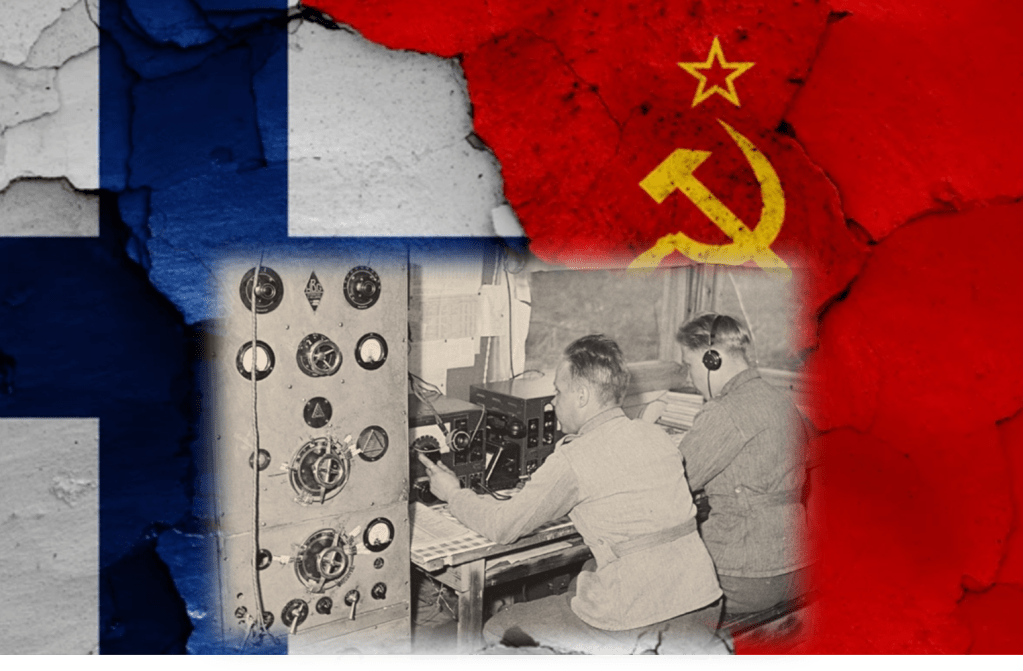
In 2020, the official periodical of the Russian FSB [Federal Security Service] carried a lengthy but interesting breakdown of the history and successes enjoyed by the Finnish Radio Intelligence Service (Radiotiedustelukeskus, or RTK) during the Winter War between Finland and the USSR (1939-1940), as Germany’s ally during World War II (1941-1944), and during the Lapland War (1944-1945) against Germany. The article also details Finland’s collaboration with Sweden via Operation Stella Polaris and its unlikely partnership with their former enemy, the Soviets. The following is a translation of the FSB article, which is uncharacteristic in its apparent respect for Finland’s wartime intelligence efforts, regardless of which side of the fight they were on.

FROM WINTER TO LAPLAND – Confrontation between Soviet and Finnish cryptographers in the air, at sea, and on land
Communications intelligence in action
Drawing on their own cryptographic experience and interactions with the Swedish cryptographic service during the Winter War, the Finns appreciated the potential of obtaining Soviet information through radio interception and cryptanalysis.
In the early 1940s, the Finns intercepted Soviet communications, both military and NKVD. According to some reports, the Finnish Army High Command received over 40,000 intercepted messages from its radio reconnaissance service.
In addition, in the early 1940s, Finnish intelligence services actively collaborated with the Baltic states and even with distant Japan. For example, information obtained from radio intercepts of conversations between Khabarovsk and Vladivostok was forwarded to Japanese intelligence services.
Here are a few examples of the successful work of Finnish cryptographic service specialists against the USSR: On June 27, 1942, Convoy PQ-17 departed for the USSR, carrying weapons and military equipment. Finnish radio intelligence specialists intercepted and decoded messages from a Soviet airbase near Murmansk, encrypted using a simple code. The Finns passed the information about the convoy to Germany. As a result of attacks by German submarines, bombers, and torpedo bombers, 24 of the 36 ships in the convoy were sunk. Many people were killed, and a large number of aircraft, tanks, vehicles, and other military equipment were irretrievably lost. According to Finnish radio reconnaissance, the Germans also attacked the next convoy that was bound for the USSR.
Finnish specialists paid special attention to Soviet Air Force radio traffic. As early as the summer of 1943, the Finns succeeded in breaking the codes used by Soviet pilots and ground controllers. As a result, the Finnish Air Force established radio interception units that monitored all radio communications of the 7th and 13th Air Armies, as well as the radio traffic of the Baltic Fleet Air Force, which was operating against the Finns.
Soon, the Finnish radio interception service detected a new Soviet aviation signals network. After decoding the intercepted data, it became clear that the Long Range Aviation (LRA) assets would be operating against them. This branch of the armed forces was created in March 1942, when several units of the Red Army Air Forces were merged into a single entity and placed directly under the Supreme Commander-in-Chief’s Headquarters.
In several cases, the successes of Finnish specialists were underestimated by their military command. For example, in early February 1944, Finnish specialists intercepted and decoded a message indicating that Air Defense Commander Air Marshal Aleksandr Golovanov had arrived in Leningrad to prepare for a major operation—a series of airstrikes against Helsinki. Despite this information, the Finns were unprepared to repel the airstrikes on their capital.
The Finns also obtained cryptographic materials via human intelligence assets. During the Soviet-Finnish War of 1939–1940, the Finns captured NKGB cipher pads on the battlefield, and in November 1944, they sold them to the Americans. According to another version, in June 1941, at the Soviet consulate in Petsamo (then part of Finland, now the village of Pechenga, Russia), the Finns seized a half-burnt diplomatic code, which they handed over to the Germans. At the end of the war, the Americans found it in German archives. Having copied the pads, the Americans returned the originals to the Soviet Union. Although the ciphers were changed in May 1945, the notebooks nonetheless helped the Americans crack Soviet encrypted messages intercepted before May 1945 during Operation Venona (the code name for the secret US counterintelligence program to decrypt Soviet encrypted messages, which lasted from February 1, 1943, through October 1, 1980).
In October 1942, the Finnish submarine Vesihiisi sank the Soviet submarine S-7 in the Baltic Sea, and on November 5, another Finnish submarine, Vetehinen, rammed the Soviet Shch-305 in the same area. In total, the Baltic Fleet lost 11 submarines to German and Finnish antisubmarine forces in 1942. This was more than in any other year of the war. These losses led the Baltic Fleet command to suspect that the enemy had knowledge of the fleet’s codes. These suspicions were confirmed by the testimony of prisoners, including former Soviet servicemen sent by the Germans behind Soviet lines for sabotage operations. In particular, one of them stated that while in captivity, he spoke with the commander of the submarine S-7, who had survived the submarine’s sinking and was captured by the crew of the Vesihiisi. The S-7 commander [Sergey Lisin] claimed that the Finnish submarine’s commander told him that he was waiting for the S-7 because he knew the coordinates of the Soviet submarine’s combat position and the time of its departure from Kronstadt. Particular concern was also raised by the disappearance of a U-2 messenger aircraft on May 22, 1942, flying from Novaya Ladoga to Leningrad. On board this aircraft was a cryptographer carrying a set of classified documents necessary for encrypted communications. After an unsuccessful search for the aircraft, the Baltic Fleet headquarters decided to change the fleet’s codes, which was completed within three days. In 1945, after returning from captivity, the missing cryptographer testified to counterintelligence officers that he and the U-2 pilot managed to tear up and bury the encrypted documents in the snow before they were captured by Finnish ski patrols. However, this fact confirms the capture of Soviet cryptographers, which may have meant that the Germans and Finns were able to obtain or crack the Baltic Fleet’s active codes.
Operation Stella Polaris
Toward the end of the war, Finnish radio intelligence specialists began to consider preserving their secrets in the event of a Soviet invasion and possible occupation of Finland. Using their knowledge, they had already considered this possibility as early as 1943. The Finns considered the best, indeed the only, option was to evacuate the personnel and equipment of their radio intelligence and cryptanalysis service (RTK) to Sweden. Thus, the idea for a joint Finnish-Swedish operation, Stella Polaris, was born.
Preliminary negotiations for this began in the summer of 1943. The head of Finnish military intelligence, Colonel Aladar Paasonen, and his deputy, Lieutenant Colonel Reino Hallamaa, who had founded RTK in 1927, approached their Swedish colleagues for assistance. Hallamaa was a leading cryptography expert in Finland.
In early 1944, the RTK leadership realized that the threat of Red Army units crossing the Soviet-Finnish border and advancing deep into Finnish territory was more than real, and work on Operation Stella Polaris intensified. Negotiations with the Swedes intensified. The Finns offered the Swedish authorities the opportunity to receive Finnish specialists and specialized equipment. The plans for delivering the equipment were as follows: first by rail, then by truck to the piers of several ports for shipment by sea to Sweden.
The Swedes were extremely interested in such an operation, considering it very useful to become familiar with Finnish cryptographic experience and utilize the Finnish personnel and equipment. The main efforts of the Swedish cryptographic service, FRA, were focused on the Germans, whose attack on Sweden was highly likely, and monitoring the potential enemy was the primary task of the Swedish specialists. Their primary targets were the German T52 and SZ-40/42 cipher machines. Therefore, the assistance of Finnish specialists in this area was very welcome.
Negotiations for the operation were conducted in the strictest secrecy. On the Swedish side, they were overseen by General Carl-August Ehrensvärd, commander of the kingdom’s defense forces. He had always been sympathetic to Finland and maintained close contact with Marshal Mannerheim. He also understood perfectly well the benefits that the intelligence materials and equipment being exported from Finland would bring to Sweden.
With Ehrensvärd’s consent, Operation Stella Polaris began to move into the practical implementation phase. However, its leaders were troubled by one very significant circumstance: no formal agreement had been signed between the two governments regarding the details of the operation; everything was based solely on an agreement between Hallamaa and his Swedish counterpart, Petersen. But in the current situation, there was no time for formalities.
At this time, a third party unexpectedly entered the game related to Operation Stella Polaris: Japan, which had been closely collaborating with the Swedish and especially Finnish intelligence services, including in the field of cryptography. The Finns readily shared the results of their activities with the Japanese, who used them in their work against the USSR. Naturally, the Japanese did not want these materials and the personnel of the Finnish cryptographic service to fall into the hands of the Soviet intelligence services. On the Japanese side, the military attachés in Sweden and Finland, Generals Makoto Onodera and Onouchi Hiroshi, joined the operation.
Let’s digress briefly and briefly discuss Japanese-Finnish cryptographic cooperation. General Toshio Nishimura, who served as military attaché in Sweden before Onodera, achieved significant success in this area. He established close contacts with Hallamaa in late 1939 and consulted with him intensively. As a result, the Japanese offered the Finns the opportunity to second one or more officers to Finnish cryptanalysts to study their methods. In exchange, the Japanese promised to pay well. General Hiroshi, who served as Japanese military attaché in Helsinki from 1940 to 1944, also played a major role in cryptographic contacts.
Of course, cryptographic issues were also handled by the Japanese military attaché in Stockholm, Onodera, who effectively coordinated Japanese intelligence operations in the region and, after a colossal effort, managed to convince the Japanese General Staff to allocate several million yen for the Finnish-Swedish Operation Stella Polaris. All the aforementioned high-ranking military officers did not work alone; they had assistants. One of them was Lieutenant Colonel Hirose Eiichi, who was associated with representatives of the Finnish cryptographic service in Sweden from 1941 to 1944.
As for Onodera himself, in September 1944, he personally paid Erkki Pale, head of the Finnish cryptanalytic department, 300,000 Swedish kronor for Operation Stella Polaris. It’s possible that, in gratitude for this, in September 1944, after Finland’s withdrawal from the war, Colonel Aladar Paasonen, head of Finnish radio intelligence, handed over to General Onodera the archives of the Finnish codebreaking service, which specialized in breaking Soviet codes.
On June 10, 1944, the situation at the front changed dramatically. Soviet troops launched the Vyborg-Petrozavodsk offensive. As a result of fierce fighting, Red Army troops managed to break through the Mannerheim Line and effectively defeat the main forces of the Finnish army. An armistice was signed on September 19, and Finland withdrew from the war.
Despite the fact that hostilities had ceased and Red Army units had halted their offensive, the USSR’s future intentions regarding Finland remained unclear to Finnish leadership. It was decided to continue Operation Stella Polaris.
The Swedish steamship Mainiki arrived at the port of Nempnes for the evacuation the very next day after the signing of the armistice, followed by two more ships, the Osmo and the Georg, the following day. Meanwhile, from September 21 to 24, RTK specialists and their family members — a total of about 500 people — arrived by train at the nearby Finby station. They traveled by bus to the port, where Swedish ships were waiting. Special equipment and documentation from the Finnish cryptographic service were also delivered. On September 24, the ships departed for Sweden. Soon, having successfully passed through the German and Soviet submarine lines in the Gulf of Bothnia, the ships arrived at the Swedish port of Hörnlsand.
Another group of Finnish specialists and their families (250 people in total), along with some cargo, were evacuated from the port of Nystad (50 km northwest of Turku). A total of 750 people (according to other sources, the number was closer to 800) and 350 cargo containers were sent to Sweden. The RTK specialists themselves numbered approximately 250, and the rest were their relatives.
To maintain the secrecy of the operation, the piers at the ports where the ships from Finland arrived were cordoned off by Swedish troops. Materials and equipment were transported to Stockholm, where some were stored in the basements of the Hotel Aston, where they were sorted and microfilmed. The bulk of the documents and equipment — more than 120 boxes — were transported to Fortress Nurningholmen. The Finns received 252,875 Swedish kronor for the technical equipment and documentation.
This concluded the technical phase of Operation Stella Polaris. However, things did not go as planned by RTK’s leaders and their Japanese allies, who had hoped that the Finnish specialists would continue their work against the USSR in Sweden. It soon became clear that the USSR had no intention of occupying Finland, and most of the Finnish specialists returned home. Only 15 Finnish cryptanalysts and radio interception specialists remained in the Swedish cryptographic service, while another six cryptanalysts joined the French.
All of the RTK equipment and most of the documents remained with the Swedes. A large number of publications on Operation Stella Polaris appeared in the Western press, primarily in the Finnish press.
A number of Finnish experts assessed the results of Operation Stella Polaris as a disaster. Not only were the Finns’ expectations of continuing their intelligence activities dashed, but Finland’s cryptographic service was effectively destroyed.
After the war (and according to some sources, even during it), the Finns and Swedes began selling off Finnish cryptographic secrets. Among the buyers were countries such as the UK, the US, France, and Japan.
From confrontation to information exchange
A story about RTK’s activities would be incomplete without a comparison, albeit brief, with the work of Soviet communications intelligence service and cryptographers against the Finnish side during the Great Patriotic War.
As is well known, Finnish troops fought against the USSR in the Leningrad region and in Karelia. The primary focus was, of course, Leningrad, as Finnish troops were directly involved in the siege of the city on the Neva.
Soviet specialists achieved their first success on the night of June 24, 1941, when they determined the coordinates of airfields in Finland where German aircraft were based, as well as the number of enemy aircraft at each. The most important information was that enemy aircraft were expected to launch a massive attack on Leningrad on June 25. Based on this information, the Soviet Air Force launched a preemptive strike, which resulted in heavy losses for the enemy and the disruption of their plans.
In late 1943 and on the eve of the January 1944 offensive, the Leningrad Front’s radio reconnaissance troops focused efforts on uncovering the disposition of enemy units, their firing patterns, and fortifications (Soviet specialists were primarily interested in the Finnish Mannerheim Line, which the Finns reoccupied in 1941 and where they had begun actively restoring its defensive fortifications). Previously, the Leningrad Front‘s radio reconnaissance unit had primarily monitored enemy air and artillery operations, but now the specialists were required to intensify their search for and monitoring of the radio stations of German and Finnish ground forces. The mission of uncovering the Finnish grouping before the decisive offensive was accomplished.
Soviet specialists continued their active work during the Vyborg-Petrozavodsk offensive. Per the combat report of the 21st Army of the Leningrad Front’s headquarters for the period from June to September 1944: “The 623rd Independent Radio Battalion provided valuable data to the army headquarters during the entire operation on the Karelian Isthmus and significantly helped to uncover the Finnish grouping during the offensive.” The front command received information about the group of Finnish forces, regroupings, and the location of enemy headquarters. Signals intercept personnel also continued to inform the command of upcoming enemy air sorties.
During the two-week offensive, Soviet troops advanced 30–90 km and completely liberated Leningrad from the siege. However, despite this, the city was still threatened by Finnish troops looming from the north. Their positions were only 25 km from Leningrad.
To protect the city from a northern attack, the front command conducted an operation in June–July 1944 to defeat enemy forces in Karelia and on the Karelian Isthmus. The 623rd and 398th OSNAZ [special purpose] Battalions participated in the operation. During two years of opposition, radio reconnaissance troops had studied the enemy well, but at that moment, everything was in motion, and the command needed information on the evolving situation. The 623rd Battalion managed to establish that only Finnish units were ahead of the Soviet front line. No German formations were detected.
Cryptographers from the Baltic Fleet also worked aggressively against the Finns. They managed to crack a number of Finnish ciphers and codes. By reading Finnish correspondence, they were able to obtain invaluable information, in particular about the sea channels open for navigation, the mine, hydrographic, and meteorological conditions in the eastern Baltic Sea, the intensity of ship traffic, and so on. This information was of interest to the naval command when planning the combat operations of submarines and naval aviation.
As a result of decisive actions by Soviet troops, Finland withdrew from the war in September 1944. Soviet radio reconnaissance troops and cryptographers also played a role in this.
After Finland’s withdrawal from the war, the country’s leadership demanded the withdrawal of German troops from its territory. The Germans refused, leading to the outbreak of hostilities between Finnish and German forces. In Finland, these events became known as the Lapland War. Soviet communications intelligence provided data support to their former enemy. For example, in September 1944, Baltic Fleet radio reconnaissance officers detected intense radio traffic between German ships in the Gulf of Finland. Using radio intercepts and cryptanalysis, they discovered a concentration of enemy ships near the Estonian town of Kunda. It was also established that the radio traffic intercepted concerned preparations for a German landing on the island of Gogland, which was then under Finnish control. This island played a vital role in the German defense, holding back Baltic Fleet forces in the Gulf of Finland. It was the central link in a system of minefields and anti-submarine nets. During the war, several Soviet submarines were lost on this line.
The Finnish side was warned 2.5 hours before the expected landing, which allowed the Finns to prepare to repel the attack.
On the night of September 15, the Germans landed a 1,500-strong force on Gogland, but encountered fierce resistance from the Finns, who were aided by Soviet bombers from the Baltic Fleet. Some of the German force was destroyed, while the rest surrendered to their former allies.
Subsequently, Soviet specialists continued to exchange information with the Finns, which contributed to joint successful operations against German troops.

Translation © 2025 by Michael Estes and TranslatingHistory.org
 Translating History