
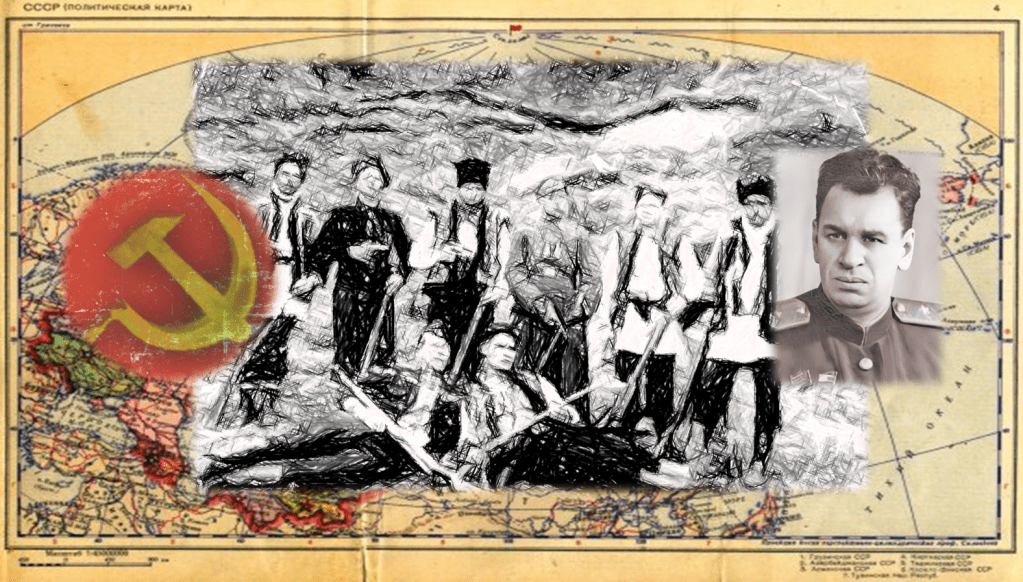
On 22 August 1948, the Minister of State Security (MGB) of the Ukrainian SSR, General-Lieutenant Sergey Savchenko wrote a lengthy report to his USSR counterpart, General-Colonel Viktor Abakumov regarding efforts to entrap two young men of Jewish ancestry believed to have arrived in the Soviet Union from China attempting to gain entry into the Ukrainian resistance organization OUN (Organization of Ukrainian Nationalists) in order to wage battle against Soviet authorities. Savchenko writes that while it has yet been fully verified, there is good reason to believe the two have close ties with Chinese and US intelligence circles, and uses the report to describe an elaborate scheme devised to make the new arrivals believe they have established contact with the Ukrainian underground, but in fact are conversing with MGB agents. The plan calls for the MGB agents, a number of whom have been recruited from the actual rank and file of the OUN they pretend to be members of, to gain the trust of the two men and eventually convince them to reveal their list of contacts and other knowledge of Ukrainian resistance activities.
The older of the two men, Aleksandr Borisovich Shornik, was the son of Boris Abramovich Shornik, who fled the newly-created USSR upon finding himself on the losing side of Russia’s Civil War. While in China, Shornik Sr. visited America, Iran, England, and Palestine in the 1920s. In 1937, when working with the KBZhD [Circum-Baikal Railway] as a railroader, he came to the Soviet Union, leaving his family behind in China. By 1947, his son left China and wound up in Ukraine together with his roommate, Bernard Solomonovich Vitenson.
According to the JDOC website, China was considered a safe-haven for Eastern European Jews fleeing Nazi persecution, with the largest diaspora being in Shanghai: 20,000 strong. While most of the diaspora was made up of refugees from Germany, Austria, and Poland, according to various sources, the share of Jews coming from the the Soviet Union was estimated at 25% to 33%.
Not surprisingly, Chinese repatriates returning to the Soviet Union were placed under surveillance of the secret services. Particular attention was directed at those who had any connections with American entities in China. According to official statistics, as of June 1948, 6,067 persons had been repatriated to the USSR from China, and a large proportion of them were Jews.
There was no legal way to leave the USSR again. So, some re-emigrants had to find illegal ways to escape. Upon the return of Shornik and Vitenson from China to the USSR, they were, according to JDOC, deeply shocked by what they saw, resulting in their complete rejection of the Soviet regime. That is why Shornik Jr. and Vitenzon decided to join the OUN. However, their intentions were uncovered by the security organs, who set up a stunt simulating “recruitment into the OUN.” This resulted in Shornik and Vitenson’s arrest and conviction as American spies. According to unconfirmed accounts, Bernard Vitenson survived and later settled in Be’er Sheva, Israel.
The following translation of the report from the Ukrainian SSR MGB is the first of three reports we are aware of at this time. The other two are being processed and will be published as soon as possible.
A note from the translator: There are moments when the abbreviation OUN is bracketed with quotation marks; this is intended to distinguish when the author is writing of the dupe organization created as part of the plan to deceive the would-be resistance members. In addition, Shornik and Vitenson are referred to in the original Russian as the объекты – translated directly, “objects” – objects of the investigation; we have opted to use the direct translation throughout.

22 August 1948
Top Secret
TO THE MINISTER OF STATE SECURITY OF THE USSR
GENERAL-COLONEL V.S. ABAKUMOV
(handwritten) and PITOBRANOV
SPECIAL REPORT
Concerning agent dossier GASTROLERY (American espionage)
[Translator note: Gastrolery can be translated in a number of ways; in the given context, the closest translations would be “visitors” or “guest-workers”]
The MGB Directorate of the Chernivtsi Oblast for the GASTROLERY dossier has opened an investigation on the following, suspected of being agents for American intelligence:
Boris Abramovich Shornik, born in 1884, native of the city of Kozhavgorodok, Pinsk district, Minsk Oblast, Jewish, non-Party, citizen of the USSR, living in Chernivtsi in No. 7 Storozhinetskaya Ulitsa.
Aleksandr Borisovich Shornik, born in 1920, native of Qiqihar (China), Jewish, university educated, specialized as an instructor, accountant, driver, professional basketball player, works as a basketball trainer for the DINAMO sports club, lives in Chernivtsi in No. 7 Storozhinetskaya Ulitsa.
Bernard Solomonovich Vitenson, born in 1924, native of Irkutsk, Jewish, no fixed employment, lives in Shornik’s apartment.
During the Civil War, B.A. Shornik was in ataman SEMENOV’s gang, with whom he fled to China.
While in China, Shornik visited America, Iran, England, and Palestine in the 1920s. In 1937, when working with the KBZhD [Circum-Baikal Railway] as a railroader, he came to the Soviet Union, leaving his family behind in China.
In 1947, Shornik established communication with his first wife and daughter who were living in the US, as well as his sons Vladimir and Aleksandr, who were in Shanghai at the time, and began corresponding with them, systematically receiving material assistance from them.
Also in 1947, his son A.B. Shornik and his son’s friend, Vitenson, arrived in Chernivtsi from China, via Omsk.
During our investigation of A.B. Shornik we obtained information that during his time in China, he received his education in San-Luis College in Tianjin, and afterwords worked as a reporter for Chili Press and Shanghai Evening News, worked for the shipping company Berbom and Tolsen [sic], and was engaged in trade.
Devoting much time to sport, Shornik was allegedly a player and training for China’s best basketball teams, traveling with them to play in countries across the Far East.
In 1945, Shornik served in the US military, initially as a driver, and then as the head of a warehouse for the US Navy.
Agent “ROMASHKA,” having successfully enlisted in the investigation, was able to establish a trusting relationship with Shornik the son and Vitenson, who began to manipulate her in an anti-Soviet vein and tried to persuade her to illegally abandon her post.
At the same time, the objects of the case began searching for a way to establish communications with representatives of the OUN underground.
We have informed the MGB of the UkSSR on the opening of the opening of the GASTROLERY case and the materials received.
Based on the above, we have made the decision to set Shornik and Vitenson up with an agent boyovka that posed as an element for participants of an OUN criminal gang.
[Translator note: By itself, a boyovka was a low-level tactical unit in various Ukrainian armed rebel formations from the first half to the middle of the 20th century. In this case, the Russian word for “agent” indicates that this is a dummy organization used to lure in the objects of the investigation.]
To achieve this subterfuge, we enlisted agent-insurgents OGON and VESELYY, former participants in the nationalist underground, as well as the department head of the 2-N division of the UMGB of the Chernivtsi Oblast, Captain KULAGIN, who is fluent in the Bukin dialect of Ukrainian.
On the evening of 20 June, agent ROMASHKA, who was selected to set up the meeting between the objects and our agent-insurgent, reported to Shornik that OUN members had agreed to meet with him and Vitenson on the coming night, in the forest on the outskirts of Chernivtsi.
Shornik and Vitenson, together with ROMASHKA, headed to their apartment where they changed clothes and gathered up their personal documents to bring along.
Agent ROMASHKA accompanied the objects to the location agreed upon (an abandoned forester’s cottage), where they were met by the agent-insurgent VESELYY.
Together with Shornik and Vitenson, VESELYY walked deep into the forest to the location of the boyovka, where the “commandant” of the SB boyovka OREL (agent OGON) awaited, with SB participant BYSTRYY (Captain KULAGIN).
During the meeting, Shornik and Vitenson were told that they were to talk about their reasons for wanting to meet with the OUN representatives and the circumstances surrounding their arrival in Ukraine’s western oblasts.
Shornik and Vitenson told the agent-insurgent that they had just recently arrived in the USSR from abroad, and the objective for establishing contact with the Ukrainian nationalists was their desire to conduct active combat with the Soviet authorities, for whom they felt great enmity.
At this point, Shornik and Vitenson handed OGON English-language documents for subsequent report to the “Leadership.” They brought the documents to presumably confirm their identities, and as confirmation of their anti-Soviet convictions, they expressed their readiness to carry out any act of sabotage or terrorism required by the OUN.
At OGON’s statement that he was surprised by Shornik’s and Vitenson’s desire to cooperate with the Ukrainian nationalists, which are hostile to Jewish individuals, Shornik replied that while he may be of Jewish nationality, he “doesn’t know a word of Hebrew, and that he spent his youth in the conditions of the Chinese reality in Shanghai.”
He and Vitenson departed China in a large group of citizens (as many as 3000) who had accepted Soviet citizenship.
Shornik justified his desire to come to the Soviet Union by his unwillingness to serve in the Chinese military, since he was subject to conscription, and by his inability to secure passage to America.
In addition, as Shornik stated, at the time he was hearing a great deal about the Soviet Union and thus, at the first opportunity, he expressed his desire to come to the USSR to his father, who had been living there since 1937.
When agent OGON inquired as to the sources from whom they learned of the existence of the OUN underground in western Ukraine, Shornik answered that he first learned of the OUN’s activities and missions when staying in Omsk, where he had met with families of Ukrainian nationalists who had been sent there.
These individuals, having picked up on the hostile attitudes toward the USSR that Shornik and Vitenson displayed, recommended they get in contact with the OUN, which required them to come to one of the oblasts in western Ukraine.
After discussing the matter with Vitenson, Shornik chose Chernivtsi, where his father was living, and on whom they could rely for help in the first days of their stay in western Ukraine.
Shornik further stated that upon their arrival in Chernivtsi, having established certain connections among the local Ukrainian population, he began taking a cautious interest in the activities of the underground, and through a girl he knew (our agent ROMASHKA), he ascertained that there was also an OUN underground resistance movement in Chernivtsi Oblast.
Thanks to the girl’s manipulation, Shornik and his colleague were given the opportunity to meet with our “OUN” members.
When asked by agent OGON if the two knew anything of underground work, Shornik replied that he had “encountered sensitive operations in China during the war, when he was assigned by a Chinese general to carry some documents across the front line.” Vitenson, in turn, noted that although he had never carried out similar work, he is “also familiar with it, as the OUN representatives will see for themselves, when they entrust him with the execution of any task.”
Turning to Shornik, BYSTRYY (with visible permission from OGON) inquired as to what they were engaged in while in Chernivtsi.
Shornik stated that he is working as a basketball trainer in the DINAMO sports club in order to protect himself against unnecessary suspicion from MGB elements. Vitenson in turn stated that he isn’t working anywhere yet, but is engaged in black marketing penicillin. Shornik elaborated on this statement, stating that they receive packages from relatives in China and America containing penicillin hidden in cocoa jars and canned goods; their weight is chosen to match that of the canned provisions.
Meanwhile, Shornik offered his efforts in providing the OUN with acute deficiency medications, to include penicillin, which they can expect in large volume in three to four months.
BYSTRYY asked Shornik if he made efforts to contact foreign intelligence elements within the Soviet Union, to which the latter replied that “they tried to contact any intelligence agents, just to fight the Soviet Union or, at best, leave it.”
During the conversation, Shornik pointed out that he would be more satisfied if he had the opportunity to talk with someone even slightly fluent in English, since – due to his weak knowledge of Ukrainian – he is unable to fully respond to all of the questions of interest to his interlocutors.
In concluding the conversation, agent OGON noted that Shornik’s wish would be relayed to the “Leadership”.
At the same time as this, it was recommended to the objects, prior to receiving a special assignment, to not carry out any active anti-Soviet activities, since “all of the underground’s work is subject to strict discipline and all actions are first sanctioned by the Leadership.”
The objects were also instructed that, after their questions were resolved, the underground itself would find ways to contact them.
Shornik’s and Vitenson’s personal documents, received by the secret boyovka, were collected by us in the MGB UkSSR, translated from English, and the most interesting of them were photographed.
Sharing their impressions with agent ROMASHKA of the meeting that took place, Shornik and Vitenson noted that they were satisfied that they were able to contact the OUN underground and expressed hope for a follow-on meeting, although they spoke negatively about the individuals with whom they met, referring to them as “simple Hutsuls,” with whom it was difficult to discuss the essence of a question, since they didn’t even speak Russian.
[Translator note: Hutsuls are an ethnographic group of Ukrainians inhabiting the Carpathian region]
Because of this, the decision was made to carry out a repeat meeting with the agent boyovka in which qualified agent YUZHNYY can be implanted, as a raider from Lviv who speaks English and knows the specifics of OUN work.
Actions to carry out this effort were drawn up on the spot, and carried out by a team from the 2nd Directorate of the UkSSR MGB located in Chernivtsi to render practical assistance to the UMGB in stepping up efforts on the Anglo-American line.
In keeping with the deception, agent YUZHNYY, acting in the role of a representative of the OUN “Leadership” during the meeting with Shornik and Vitenson, should state that he was told of the results of their first meeting with the OUN members, as well as of the personal documents they handed over.
Next, YUZHNYY will say that their offers cannot be accepted until they have been sufficiently vetted, and the nature of their assistance, on which the “Leadership” can count on, has been ascertained.
In so doing, YUZHNYY is to stress that in the first meeting with the OUN representatives, Shornik and Vitenson were not frank, and instead of handing over to the OUN materials that would have been of interest, they only offered personal documents of little value, and in English. These documents, which YUZHNYY didn’t examine, were meaningless to the “Leadership.”
Because of the above, YUZHNYY will require a detailed explanation of the circumstances of their stay in China, service in the US military and American outposts, the reasons that prompted them to come to the Soviet Union in the western oblasts of Ukraine and seek out ties with members of the nationalist underground. Upon receiving detailed explanations on all of the issues raised, YUZHNYY will ask Shornik which of his contacts in the Soviet Union would be able to verify his statements. If Shornik names his anti-Soviet contacts, then he will request particulars.
Taking into account the statements made previously by the objects on their experience in underground efforts, agent YUZHNYY will suggest that this factor will play a significant role for the “OUN,” and under this pretext, he will ask them when and under what conditions did they engage in underground operations, and what functions they performed therein.
Immediately afterwards, YUZHNYY will ask in what manner will Shornik and Vitenson plan on assisting the “OUN” in their work against Soviet authorities.
If the objects confirm the statements they made earlier regarding their consent to start carrying out terrorism and sabotage, YUZHNYY will suggest to them that they categorically refrain from carrying out these tasks in order to prevent their premature discovery.
Meanwhile, if Shornik acknowledges his current association with intelligence services during his conversation, YUZHNYY will state that it is extremely valuable for ties between the “OUN” and intelligence services to be established, and in this case, Shornik’s role would include putting the “Leadership’s” representatives in touch with foreign intelligence assets. If Shornik himself does not raise the topic, agent YUZHNYY will offer that he is particularly uninterested in simple performers of acts of sabotage, especially those who don’t know the local conditions, and suggests that the objects tell him what capabilities they have in establishing ties with the underground abroad, which would be of particular value for the “OUN”.
Depending on how the conversation proceeds, agent YUZHNYY has been afforded the opportunity after consulting with the field officer located at the boyovka operating under the cover name BYSTRYY to come up with new questions directed at the establishment of espionage activities of the objects and the channels of their communication with foreign intelligence and abroad.
Carrying out this subterfuge allows for the reduction of the number of agent insurgents under the protection of the “Leadership’s representative” (in this case, YUZHNYY) and the use of additional operational assets, thereby guaranteeing the security of the execution of the activities noted above in Chernivtsi, where an inadvertent encounter between our intelligence group and the OUN bandits cannot be ruled out.
Moreover, the presence of the operational assets in YUZHNYY’s circle makes it possible for us to monitor the behavior of the objects and make the appropriate adjustments, based on the progress of our subterfuge.
Before YUZHNYY was sent to the forest for his meeting with the objects, he was appropriately equipped [to resemble] an actual member of an OUN boyovka.
In keeping with the deception, in the evening of 10 August, ROMASHKA visited the objects and provided them “Leadership’s” instructions to appear at a meeting in a location that they would be led to.
Accepting ROMASHKA’s proposal, from whom up to this point they had repeatedly tried to organize their second meeting with the OUN representatives, Shornik and Vitenson arrived in the forest at nightfall, at the location of the mock residence of the representative of the “OUN” “Leadership” – BOGDAN (agent YUZHNYY) and his guard.
The skillful behavior, assertiveness, and agent’s knowledge of the English language in the given situation during the meeting made an impression on the objects, who in their responses stressed their insights and desire to assist the “OUN” in every possible way in its fight against Soviet authorities.
Shornik expressed his readiness to begin carrying out terrorist acts and named one of the candidates – Senior Lieutenant KONYAYEV, a worker in MGB elements who participated in work in the DINAMO sports club and was supposedly shadowing Shornik. Vitenson also confirmed his desire to partake in killing KONYAYEV.
Responding to YUZHNYY’s questions, Shornik stated that ever since his childhood, when living in Shanghai, he had fallen under the influence of Americans who held powerful economic and political positions in China.
Shornik studied in an American college, worked as a journalist for Chili Press, and conducted commercial operations with American businessmen.
During the years when military operations between Chinese and Japanese forces intensified, particularly after the British and American armed forces entered the fray in the Far East, Shornik became a businessman himself, acquired a modest metallurgic plant, supplying it with Japanese products. At the same time, using Japanese licenses, he produced explosives for the Chinese, some of which were used to blow up one of the bridges in the Shanghai region.
Shornik maintains close ties with prominent Chinese General DAN-BAI-DIN [sic] who, holding to the American attitude, is an enemy of Communism.
Since 1942, Shornik has received assignments from DAN-BAI-DIN to conduct military espionage and communicate with various representatives of the Chinese military.
By this time, Shornik (through DAN-BAI-DIN) had been in communication with American military intelligence officers from the “strategic information bureau” who came to China via submarines, and used the pseudonym “BOB SHRO [sic]” to conduct espionage in China for the Americans.
Shornik informed YUZHNYY that he knew many American intelligence agents, in whose company he spent his spare time, although he supposedly didn’t know their surnames, which were kept secret.
American intelligence agents operated under code names during that time.
It is significant that Shornik, during his conversation with YUZHNYY, stressed on a number of occasions that since the “OUN” is associated with the Americans, it would not be difficult for the underground to confirm that he had been cooperating with American intelligence.
After traveling to the USSR, according to Shornik, he has supposedly had no contact with American intelligence agents or diplomatic workers from the US Embassy, although he would like to establish this connection.
Shornik also repeated to YUZHNYY the assertion previously made that he first learned of the existence of the OUN underground from family members of OUN political prisoners who were sent to Omsk, and [Shornik] had decided to go to his father in western Ukraine to communicate with the OUN to fight the Soviet authorities, towards whom he maintained a hostile attitude.
Shornik and Vitenson expressed their desire to become part of the resistance to wage armed combat against the Soviet authorities, and admitted they intended to simultaneously put their affairs in order, send Shornik’s father abroad with the assistance of the “OUN,” and establish unlawful correspondence with relatives in America.
In a free-spoken manner, Shornik also stated that a connection with the “OUN” would guarantee him a dominant position in the event of an American victory in the coming war.
Shornik also told YUZHNYY that his desire to get his father across the border was motivated by the fact that it would untie his hands for active anti-Soviet efforts.
Shornik wanted to know if YUZHNYY would remain a citizen of an “independent Ukraine” in the event of a war between the USSR and America, and stated that if it weren’t for his father, he would have fled the USSR via Leningrad or Odessa for the US long ago.
Speaking of his wife, from whom he has parted, Shornik said that she is living under her maiden name of KIMSTACH, is living in Omsk, and works with her sisters as dancers in a musical comedy.
Shornik is concerned that his wife might betray him, since he plans to take their son away from her and send him abroad.
Agent YUZHNYY characterizes Vitenson as a man entirely under Shornik’s influence and is his inferior in terms of personal intellectual qualities.
A record of the conversation, put together by YUZHNYY, that took place in the forest lit by firelight and flashlights, was signed willingly by Shornik and Vitenson, and they pledged to keep their communication with the “OUN” secret and to safeguard [the existence of] their contact (agent ROMASHKA).
YUZHNYY concluded the conversation by telling the objects that the opinion of “Leadership” on all issues raised during the meeting will be provided to them in short order through the capabilities available to the “OUN”.
After meeting with our secret boyovka, Shornik and Vitenson paid a visit to ROMASHKA and expressed to her their complete satisfaction with the meeting with YUZHNYY. They also stated that they will hold off making any decisions until receiving a reply from the “OUN”. However, they again stressed that for a number of reasons, they are not able to wait for a response very long.
In accordance with the results of the deception carried out in the GASTROLERY case, and with attention on the lack of information on the objects’ ties with foreign intelligence elements, as well as their sharp anti-Soviet activities and intention to begin a campaign of terror and sabotage, for which there are no guarantees that our agents can prevent them, we have made a decision on the swift disposition of the case.
For this reason, we are designing a scheme to arrest Shornik and Vitenson on the border during their attempt to bring Shornik’s father abroad, during which the latter will be given the secret location of our agent in the border zone, and using the appropriate means, an operations group has been prepared that will act as a border patrol.
With this measure, we expect that, upon the detention of Shornik’s father, we will seize documents of interest being sent abroad by the objects.
Should the objects refuse to immediately carry out their intentions to move Shornik’s father across the border, a new meeting will be arranged for them in the forest with our agent boyovka, where Shornik and Vitenson will be detained during a crackdown on the “OUN gang,” as a result of which we will have the ability to put to use compromising “OUN documents” which will incriminate them in connections with American intelligence elements and anti-Soviet activities.
Any discovered family ties of Shornik will be directed to the MGB.
We will provide further information on the progress of the implementation of the GASTROLERY case.
MINISTER OF STATE SECURITY OF THE UkSSR
GENERAL LIEUTENANT SAVCHENKO

Translation © 2025 by Michael Estes and TranslatingHistory.org
 Translating History