
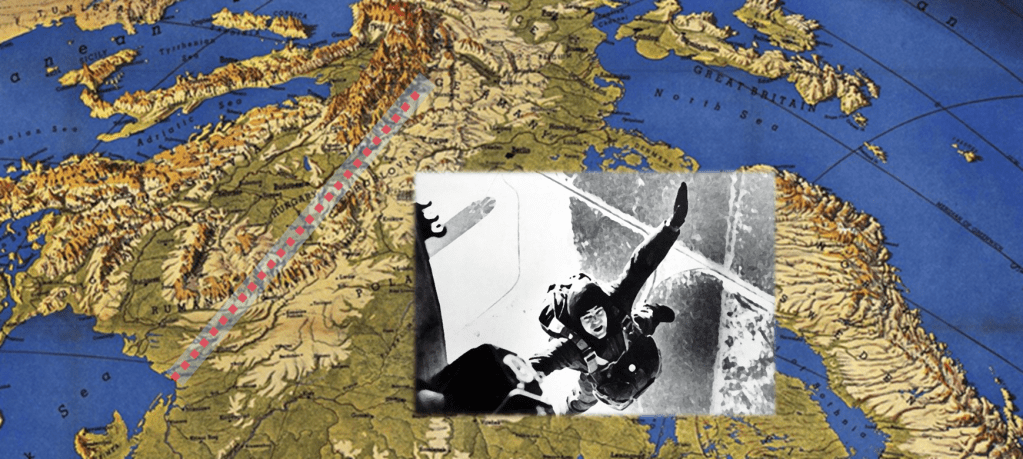
An earlier article from TranslatingHistory offered some details from a brief interrogation of Aleksandr Lakhno, who was trained in West Germany in the early 1950s along with several other émigrés from the Soviet Union to carry out, at best, an anti-Soviet propaganda campaign. Lakhno spent months learning tradecraft from US and British intelligence specialists in the Bavarian countryside, with the objective of eventually being air-dropped into Soviet territory to conduct subversion, sabotage, and intelligence collection activities. Bringing with them an arsenal of equipment, gold, and folding money, Lakhno and his partner had to split up the gear into immediate essentials and stuff they would bury and come back for once they had settled. Then, after what must be assumed to be one of the most stressful days of their lives, they took a local train to their final destination, where they were promptly arrested by Soviet Ministry of Internal Affairs (MID) agents.
What’s still unclear, even with the 50 or so pages of documents released this month by the FSB, is who among Lakhno’s associates was the undercover operator who revealed the plans, which led to Lakhno’s arrest.
Lakhno’s second interrogation was not quite a marathon, but it still lasted from shortly after noon on 3 May until 0100 on 4 May, including a modest break. The resulting 20-page record of the interrogation, recently released by the Russian Federation FSB, has been translated and is published here, in English, for the first time anywhere.

RECORD OF THE INTERROGATION
of the detainee Aleksandr Vasilyevich LAKHNO, also known as Vasiliy Vasilyevich VASILCHENKO
dated 3 May 1953
A.V. LAKHNO, also known as V.V. VASILCHENKO, born 1925, native of Lysychansk, Voroshilovgrad [Luhansk] Oblast, Russian, citizen of the USSR, no party affiliation.
Question: When you were detained on 27 April of this year, as well as during subsequent interrogations, when faced with the evidence, you admitted to being an American intelligence agent and a participant in the foreign anti-Soviet organization, the so-called National Alliance of Russian Solidarists [NTS] and that you came to the USSR to carry out subversive work. Do you confirm this testimony?
Reply: I do. I and my partner, who I knew through his nickname ‘Pete,’ were actually American intelligence agents and members of the anti-Soviet organization National Alliance of Russian Solidarists.
Overnight from 25 to 26 April, we parachuted from an American plane southwest of the village of Kurilovka, Vinnytsia Oblast, tasked with finding our way to Odesa to carry out espionage operations, as well as to print and distribute among the Soviet population NTS leaflets. At the same time, two other American agents, ‘Dick’ and ‘John,’ were with us on the same plane, but jumped out about an hour earlier than we did.
We were unable to carry out our American intelligence assignment because Pete and I were stopped and arrested on the morning of 27 Aprile at the Kalinovka railway station.
Question: While you were detained, fictitious documents were found on your persons: passports, military identification papers, authorization documentation from the Moscow MGB Directorate, a service record booklet, birth certificate, and certificate of employment for a Vasiliy Vasilyevich VASILCHENKO. Who do these papers belong to?
Reply: The papers found and taken from me in the name of VASILCHENKO, yes, are fictitious. These documents were created and handed to me by the Americans about a week before finishing intelligence school in Bad Wiessee (West Germany), where I underwent training from December 1952 to 23 April of this year.
I needed these counterfeit documents as cover for the subversive activities that I was to carry out in the USSR.
In actuality, my name is Aleksandr Vasilyevich LAKHNO, born in 1925, a native of Lysychansk, Voroshilovgrad Oblast.
As the investigators are already aware, in 1941, being mobilized into the ranks of the Red Army, I was sent by headquarters to Millerovo to train at the school for radio operators and intel agents, and upon graduation, I would leave for my homeland with the assignment of settling there and, should the Germans approach, report to the comms center any information I might have on the movement of German troops.
After the Germans occupied Lysychansk, they arrested me and, under interrogation, I truthfully gave them the reasons for my stay in Lysychansk.
Afterwards, all the way to the end of the war, I collaborated with the Germans.
Question: Tell us about your acts of treachery with the Germans.
Reply: During interrogation by the Germans, I gave them five or six names of Soviet intelligence agents and radio operators who studied with me in Millerovo, and in the fall of 1943, I was sent to serve in the special counterintelligence group known as “Sondergruppe Peter,” where I actively participated in uncovering and arresting partisans in the Dnipropetrovsk Oblast.
During the German retreat, together with the Sondergruppe I fled to Mykolaiv, then on to Romania, and then to Yugoslavia, where he served as a private in the Russian Protective Corps until December 1944. In 1945, because of the offensive by the Soviet Troops, the Russian Protective Corps fled to Austria, where it was interned by British forces.
In Austria, I was initially held in a prisoner of war camp, and then was relocated to a so-called camp for displaced persons.
Being afraid to take responsibility for the crimes I committed against the Soviet government, I took every means necessary to avoid repatriation to my homeland, and when recruited in November 1947, I voluntarily left for England, where I resided until May 1952.
Question: What did you do in England?
Reply: At first I worked in coal mines, then I was a machinist at the textile mill ‘Cortwolds’ [sic] in Wolverhampton.
While in England, I joined the anti-Soviet organization National Alliance of Russian Solidarists (NTS), of which I was a member until recently, and it was at their behest that I carried out hostile activities.
Question: When and by whom were you recruited into NTS?
Reply: I was recruited into the NTS in January 1952 by the head of the NTS organization in England, Lev Aleksandrovich RAR. In May 1952, RAR sent me to West Germany to study in the propaganda school in Bad Homburg, No. 57a Promenade Street. After the training was completed, as I testified previously, I was assigned by the deputy chief of the NTS sensitive sector Yevgeniy Yevgenyevich POZDEYEV to distribute anti-Soviet NTS leaflets among the Soviet occupation forces in Germany.
In late October or early November 1952, the head of the NTS sensitive sector Georgiy Sergeyevich OKOLOVICH sent me to the American intelligence school located in the Munich area, between the villages of Gmund and Bad Wiessee on the shore of the Tegernsee.
Question: Who else studied with you in the American intelligence school?
Reply: There were eight others studying with me in the intelligence school, but as I already testified, for reasons of security, we only knew each other by nicknames. Each agent was categorically prohibited from giving his true name.
I was known as Alec, and the other agents were known as Pete, Dick, John, Bob, Paul, Ike, and Joe.
All of these agents, along with me, were members of the NTS anti-Soviet organization, and were sent to the American intelligence school by OKOLOVICH.
As for myself, I studied in the American intelligence school for a total of five months, whereas the other agents studied there for nine months, from August 1952 to April 1953.
During that time, we chiefly studied radio techniques, topography, cover methods, the use of secret writing techniques, and parachute operations. For physical training, we partook in calisthenics for at least 15 minutes a day, with particular emphasis on running.
On 19 April of this year, lessons at the intelligence school ended, and we began preparing to be dropped into Soviet territory, where we would be carrying out our subversive activities. It was back in January of 1953, when we were creating our cover stories, that I was told I would be inserted into the Soviet Union with the agent called Pete, and we would be carrying out our subversive activities in Odesa.
Question: What about the other agents?
Reply: The other American agents were also paired up: Dick with John, Bob with Paul, and Ike with Joe.
Question: What did you know about your partner Pete?
Reply: I got to know Pete back in May or June of 1952 during our joint training period in the Bad Homburg NTS school, where he called himself Aleksandr MAKOV. I don’t know whether that was his real name or another alias.
By talking with Pete, I learned that during the war he lived in the USSR, and that he is very familiar with the cities of Odesa and Kherson, as well as Crimea, where he and the Germans fled from to Germany. Pete served with the Germans as a telephone operator or lineman in some German military unit. The first time he was in Germany, he resided in one of the camps for displaced persons; after the war ended, he married a Russian girl and went to Belgium to work in coal mines; he spent 3 or 4 years there, then went back to Germany. His wife and two kids are in Germany, in Frankfurt am Main.
Question: When did they start inserting the American agents who studied with you into the Soviet Union?
Reply: The first ones to leave the intelligence school to be air-dropped, on 20 April, were Bob and Paul.
Question: Where were they inserted, and what was their assignment?
Reply: Specifically where Bob and Paul were inserted, and in what city they were to carry out their subversive activities, I do not know.
In terms of their assignments, they were the same for all of us. Upon our arrival in the Soviet Union, we were to set up a place to settle down in this or that city and begin preparing and distributing the NTS leaflets among the Soviet population. I don’t know if there were given any other assignments.
Question: What do you know of the anti-Soviet activities of Paul and Bob?
Reply: I got to know agent Paul in May of last year in the NTS propaganda school in Bad Homburg, where he called himself Nikolai – I don’t recall his surname. After finishing this school, Paul went to the American intelligence school in Wiessee,
Paul was an émigré from the Soviet Union, from somewhere in Siberia. He was called up for active duty in the Red Army before the war started. When he was taken prisoner by the Germans, and what he did during the war, I don’t know. After the war, according to Paul, he lived in French Morocco with Bob and Joe.
I first got to know American agent Bob at the propaganda school in Bad Homburg in May 1952, where he was known as Mikhail DADONOV. As far as I know, he comes from the Soviet Union, but I don’t know from what specific area. During the war, he served in the Vlasov Army [Russian Liberation Army], and was taken prisoner by the Americans. But he was able to escape from the POW camp and worked for a German farmer. If I’m not mistaken, in 1947 he was able to go to French Morocco with a group of other former citizens of the Soviet Union, including those nicknamed Paul and Joe. He worked there in construction firms, building houses, bridges, and so on. In 1952, Bob returned to Germany where I met him at the NTS propaganda school in Bad Homburg. After finishing his studies at this school, he went to the American intelligence school in Wiessee.
On 24 April of this year, along with Pete and me, Dick and John left school and were sent by plane to Soviet territory.
I first met agents Dick and John in 1952 during our training in the NTS propaganda school in Bad Homburg, and we later studied together at the American intelligence school in Wiessee. In both schools, agent John was called Ivan Ivanovich and Bender.
John is an émigré from the Soviet Union, and from our conversations, I know that after the war he resided in England and Belgium, where he worked in coal mines, and at one time he served with the Americans, guarding military installations.
Agent Dick at the NTS propaganda school was known as Dmitriy, a Ukrainian by nationality. While living in Germany, he worked at a farm for a German farmer, and in the postwar period he went to work in the coal mines in Belgium.
Question: When and specifically where were the American agents Joe and Ike to be dropped?
Reply: Agents Joe and Ike were to parachute into the Soviet Union right after us, but I don’t know exactly when and where.
Based on our discussions, agent Ike is a native of Orlovskaya Oblast. I’m not sure how he came to be in Germany. At one point after the war, he lived in France and worked there in some sort of factory. In the Bad Homburg school, he was known as Viktor.
Agent Joe is also a Soviet émigré, a Belarusian by nationality. After the war, he lived in French Morocco along with Bob and Paul, where he worked constructing bridges, homes, et cetera.
He was known as Adam in the NTS propaganda school.
Question: When you were parachuted into the Soviet Union, what was your assignment?
Reply: Other than the general assignment that all of the agents received – that is, to prepare and distribute NTS leaflets among the Soviet population, for which we were given the appropriate templates – the head of the American intelligence school MARTINO instructed me to collect espionage information, specifically, to identify locations of airfields, along with the number and types of aircraft at these airfields. MARTINO specifically emphasized MiG-15 jet aircraft, charging me to discover specifically which airfields housed them, and in what quantities.
He also told me to find out of these MiG-15 jet aircraft were equipped with radar.
MARTINO also instructed me to spend time on the southern coast of Crimea as a vacationer to learn which were the most suitable locations on the Black Sea coast to insert our people, as he put it, from submarines and torpedo boats. I understood this to mean NTS members.
Additionally, MARTINO assigned me the task of finding several suitable locations for possible air insertions of people or cargo, for which I was provided a radio beacon.
Question: What other assignments did you receive from the American intelligence agents?
Reply: For two to three weeks before being sent to the Soviet Union, I was instructed, along with two or three of the other agents – I don’t know specifically who – by the head of the school, MARTINO, who said, almost verbatim: If you meet a man in the Soviet Union who, in some form or other, will try to interfere with your work – whether he’s an MVD worker, with the police, an activist, or a party member, and if you need to get rid of him, then find out his surname, address, and other details about this individual, and radio this information to us. From our position here, with this data in hand, we will be able to fabricate a compromising letter against this person and send it to his address, knowing that Soviet censors will read the letter and send it to the appropriate agency, thereby undermining this person’s authority in the eyes of the Soviet authorities, and it is possible he will even be arrested.
Question: Other than that, did you also have terrorism assignments?
Reply: No, nothing of a terrorist nature.
Question: Why were you and the other agents brought in right before May 1st?
Reply: Nobody told me anything about that.
Question: It’s well known that NTS is a terrorist organization and, without a doubt, OKOLOVICH and the other ringleaders of this organization ordered you to engage in terrorist activities. This investigation demands that you testify truthfully.
Reply: I repeat: nobody gave me any assignments of a terrorist nature.
Question: You know very well that the leaflets and other documents distributed by NTS directly speak to the use of terror, sabotage, and other harsh means in the battle against Soviet authorities, and you, as an active member of the NTS organization, could not act contrary to these guidelines.
Reply: I can confirm that, actually, NTS leadership calls on its members to fight Soviet authorities by employing terror and other harsh members.
As a member of this organization, I of course shared the views on terror, and arrived in the USSR to fight against Soviet authority, seeking its overthrow, but I assure the investigators that I had no terror assignments.
Question: What was the purpose of providing you with weapons?
Reply: The weapon, a Browning pistol with 50 cartridges, was given to me in order to defend myself in the event that I was being pursued on Soviet territory.
Question: Tell it like it is, was it for killing Soviet people?
Reply: Yes.
Question: Were you instructed as to how you would carry out hostile activities in the USSR?
Reply: Yes. I was to collect undercover information for American intelligence through personal observation.
NTS work is to be performed as follows: using the templates, I would make copies of a 60-page brochure and leaflets that would then be sent through the mail or delivered through some other means to individuals dissatisfied with Soviet authorities. But I was not to open up to these individuals, stating that I am carrying out hostile activities at the order of NTS. And only in exceptional cases, only well-vetted individuals and, of course, those who were hostile to Soviet authorities could I open up and initiate them in the nature of my activities, using them afterwards as my assistants. Any espionage information I collected, as well as information on my NTS work, I would transmit via radio to the American intel center using the radio transmitter provided to me, or report using secret writing in letters sent to Norway and France.
Radio communications with the American comms center were to be maintained based on a so-called signal plan using cipher and decipher pads.
If we were exposed, that is, if our work was being monitored by state security organs, American intelligence developed the appropriate authentication codes.
Question: Let’s hear them.
Reply: For example, if I’m under observation, then during the first contact, and this method should only be used once, the authentication codes are to be rearranged, with the first ones replacing the second, and vice versa.
If our work is being monitored, then the codes are used according to their proper order.
Afterwards, if I am being monitored, then in each of my radiograms I must replace the letter “E” with an “X”.
If I’m decrypting a radiogram from the American comms center, and in the text I see the phrase “radio club,” this indicates a query from the Americans to determine whether or not I’m working independently or being monitored, then in my response to the radiogram I have to provide the answer prepared by the state security organs, but if I am operating independently – that is, unmonitored, then my response should not be in line with the query, and be illogical in content.
Coded terms were also discussed for written communications, specifically: in letters abroad written in hidden text, if I am not being monitored, then in the first phrase of each letter there must be a word that starts with the letters “KO”.
Question: Do you have any safe houses in the Soviet Union?
Reply: I wasn’t given any safe house addresses. At the same time, MARTINO warned me that a man might possibly come up to me with a pass phrase.
Question: What was the phrase?
Reply: He would ask “Did you study at the Kharkiv training college?” My response would be “No, but I had friends there.”
Question: Who is it that is supposed to come up to you to establish pass-phrase communications?
Reply: I don’t know. MARTINO told me that it would be a man who knows me.
Question: Tell us about how were you equipped.
Reply: Two weeks before we finished school, all of the agents, in pairs – since that is how they would be dropped into Soviet territory – went to Munich (to a permanent military camp), where two Americans – a lieutenant and a sergeant named Patrick – selected for us, and specifically for me and Pete, an American radio transmitter, spare parts for it, and a backup receiver, a device for charging batteries, a radio beacon, 50 rounds for the Browning pistol, a folding knife, a flashlight, a package with a set of tools to manufacture false documents, an entrenching shovel, a sleeping bag, 40 gold coins embedded in cellulose, 10 in each pack, 10 topographic maps of the Black Sea coast, a cloth topographic map of Vinnytsia Oblast, a ruler, compass, stopwatch, a bottle of liquid to put dogs off of the pursuit, a flask of water, provisions, a uniform, and a raincoat and shoes, all packed into special bags.
According to POZDEYEV, these bags were also loaded with the templates for making the NTS brochures and leaflets, as well as batteries.
We weren’t handed these bags until we were airborne over Soviet territory, right before parachuting out.
Fictitious documents were handed to each agent individually. About a week before entering the USSR, an American named Bill gave me a passport, military identification papers, authorization documentation from the Moscow MGB Directorate, a service record booklet, birth certificate, and certificate of employment for a Vasiliy Vasilyevich VASILCHENKO. Everyone was given 45,000 rubles, signal plans with quartz crystals for the radio transmitter, and cipher and decipher pads for radio communication and correspondence were fastened in our belts; we received this from MARTINO, the head of the intelligence school on the day we departed for the airfield.
Question: How did your entry into the Soviet Union take place?
Reply: On Friday, 24 April of this year, at 5:00 in the morning, agents Pete, Dick, John, and I departed in a lightweight vehicle with US Army Captain WILLIAM HOLIDAY to the military airfield near the village of Furstenbruck [sic, probably Fürstenfeldbruck], 12 to 15 kilometers west of Munich, where we were seated in a four-engine American army aviation airplane. The plane had identification markings – on one wing, there were three white stripes over a background with a blue circle, which had a five-pointed star in it, and the other wing was imprinted with the letters “USAF,” which stands for ‘United States Air Force’. The four-man crew consisted of two American military officers and two sergeants.
At 7:30 in the morning, we took off and flew south, and landed at 1:00 in the afternoon at an airfield in a large city, unfamiliar to me, on the sea coast. We were brought from the airfield through the city in an enclosed vehicle, and when we tried to learn from our escort, the American officer WILLIAM HOLIDAY, what city this was, he told us in Russian: “It would be better for both you and us if you don’t know this.”
About 30 to 40 minutes later, we approached a small hut on the outskirts of the city, where we stayed for 24 hours. We were not permitted to leave the yard of the hut. The next day, 25 April, at about 3:00 in the afternoon, the same enclosed vehicle delivered us to another airfield, where we boarded another four-engine transport aircraft, but this one without the identification markings. This is the aircraft that brought us to the Soviet Union.
Seating in the aircraft was organized by the Americans, the aforementioned Captain WILLIAM HOLIDAY and a civilian named Waldo, who served as the liaison between the school and the American intelligence center while we were trained at the intelligence school in Wiessee. Once we were on board, Waldo himself sewed a poison capsule into the shirt collar of each of us, telling us in doing so that if we found ourselves detained in the USSR by MVD elements, we must take this poison, thereby committing suicide.
Question: Tell us about the crew of the second airplane.
Reply: There were six or seven crew members, civilians, who spoke Polish to each other. I concluded that these were Poles rather than Americans. The crew members never entered into any conversations with us, and for almost the entire time, they were located in the pilot’s cockpit.
Question: What route did you take?
Reply: I find it difficult to answer that question, since none of the crew said anything to us about the route. It was impossible to observe from the aircraft itself, since the windows were covered by black cloth.
Question: What speed did the plane fly at over Soviet territory?
Reply: I don’t know, but I believe it was no more than 300 kilometers per hour. In the drop area, the aircraft flew at a speed of 216 kilometers per hour; the American named Waldo told us that when we boarded the plane.
At around 1:00 in the morning on 26 April, in an unknown area, agent Dick, and then John, parachuted from the plane. After about an hour, in an area southwest of the town of Kurilovka in the Vinnytsia Oblast, Pete parachuted out, and immediately afterwards, I did the same.
After touching down, we hid some of our gear in one general location; I buried the radio transmitter, some of the money, gold, the cipher and decipher pads, and the signal plans with the quartz crystals separately in three holes, the coordinates of which I’ve already provided earlier to the investigators.
Pete and I headed to the way station in Kurilovka, bringing with me my counterfeit documents in the name of VASILCHENKO, a topographical map of the drop area, and 6000 rubles. However, we learned from two men we encountered that trains don’t make stops at the Kurilovka station, so we headed to the station in Uladivka, and from there to Kholonivska station. We finally arrived from Kholonivska at Kalinovka where, as the investigators know, on 27 April we were detained.
Question: Did you communicate with the American comms center?
Reply: No, I did not.
Question: But when were you supposed to radio the Americans?
Reply: On the night before our drop, the American known as Bob said that it would be best if we made contact with the American comms center immediately after we landed. The first radiogram was to contain information on where and how we landed, what we did with the gear, and what our plans are, moving forward. However, that was just something they wanted, and nobody imposed any kind of deadline on me.
Question: Was part of your assignment to return to West Germany?
Reply: No, no such task was given. As I understand it, that issue would have been resolved when radioing the Americans.
The record of my interrogation was recorded from my own words accurately and read by me. /LYAKHOV/
Start of interrogation: 12:20
End of interrogation: 01:00 4 May
Adjourned from 17:00 to 22:25
INTERROGATOR: CHIEF OF SPECIAL DEPARTMENT 1 OF THE MAIN DIRECTORATE OF THE MVD OF THE USSR Colonel RUBLEV

Translation © 2025 by Michael Estes and TranslatingHistory.org
 Translating History