
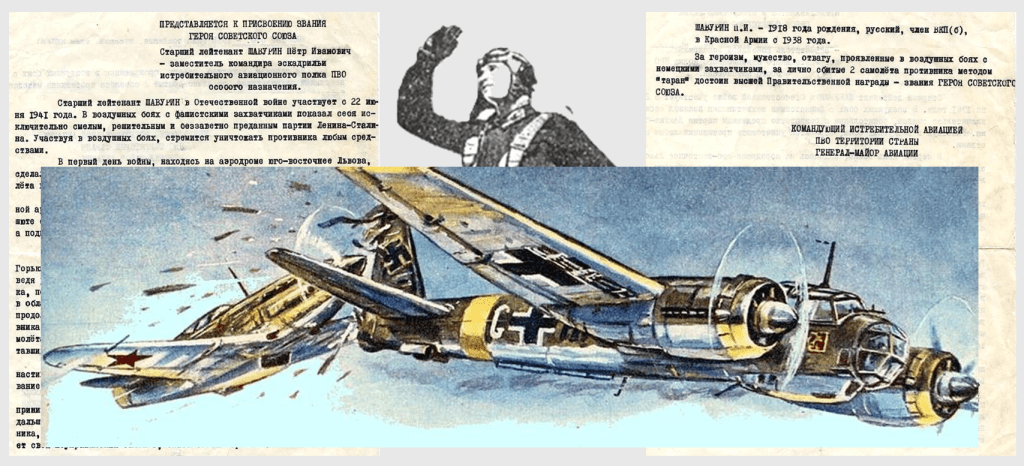
On 27 December 1942, Soviet pilot Petr Shavurin downed an enemy aircraft by ramming it at an altitude of 6000 meters.
It was a frosty December of 1942. The winter days were short. A blizzard raged with only brief interruptions. On December 27th, exactly five months after his ramming attack in the skies over Gorky, Senior Lieutenant Petr Shavurin, deputy squadron commander with the 910th Fighter Air Regiment (101st Fighter Air Division), scrambled in his Yak-7B, paired with Captain Nikolai Kozlov, to intercept a Junkers Ju 88 enemy reconnaissance aircraft flying from the Stalingrad area towards Povorino at an altitude of 6000 meters. He was in a joyful mood: six fascist divisions, which had been trying to break through from the Kotelnikovo area to the encircled group near Stalingrad, had been utterly defeated, the Russian offensive on the Middle Don continued, and the encirclement ring was tightening daily. These thoughts even made him feel warmer in the cold cockpit of the aircraft.
To protect himself, the German pilot climbed to an altitude of 7500 meters, but he was still spotted by Shavurin’s keen eye. Shavurin raised his fighter plane to 7800 meters and approached from the direction of the sun, trying to remain undetected.
After adjusting his course, Petr went into a dive, firing his machine gun. The enemy returned fire, but the bullets missed. Suddenly, the Junkers made a turn and began to disappear into the clouds. A little more and it would be impossible to find it. Petr Ivanovich made a decision – to ram it. It was a proven method. Without interrupting the dive, before hitting the Junkers, he made a small reverse roll to reduce his enormous speed and avoid crashing himself. The maneuver was successful. His fighter’s propeller struck the Junkers’ stabilizer and rudder, and its wing hit the left wing. The enemy plane flipped over and crashed.
Shavurin’s fighter, with a bent propeller and a torn-off wing, became uncontrollable and went into an inverse dive. After several attempts, Petr managed to bail out and parachute to the ground. The documents found in the wreckage of the enemy aircraft were of great value to the Soviet command .
After the defeat of the fascists at Stalingrad, Senior Lieutenant Shavurin, the fighter air squadron deputy commander, was summoned to Moscow. In the Kremlin, M. I. Kalinin presented him with the Gold Star of Hero of the Soviet Union and two Orders of Lenin.
But the war continued, and Petr Ivanovich kept fighting. His combat performance report from August 10, 1944, noted: “He loves to fly, and flies boldly and confidently day and night. Total flight time: 1080 hours and 47 minutes, of which 374 hours were at night. During his time in the 910th Fighter Aviation Regiment, he completed 91 combat sorties. He participated in 15 aerial battles. In a short period of time, he trained 7 night pilots.”
He certainly didn’t lack courage. He skillfully commanded his squadron, which, during the period from September 1942 to September 1944, “carried out 1486 combat sorties and engaged in more than 100 aerial battles. 18 enemy aircraft were shot down, with the squadron’s own losses amounting to 4 aircraft and 1 pilot.”
Petr Shavurin continued to fight until the end of the war. He commanded a squadron, then a regiment. In total, he carried out 350 combat sorties, attacking enemy troops, escorting bombers and ground attack aircraft, providing air cover for ground forces, and conducting reconnaissance. In 100 air battles, he was able to bring down 17 enemy aircraft, ramming not only the Junkers mentioned above, but also a German bomber earlier that same year.

Translation © 2025 by Michael Estes and TranslatingHistory.org
 Translating History