
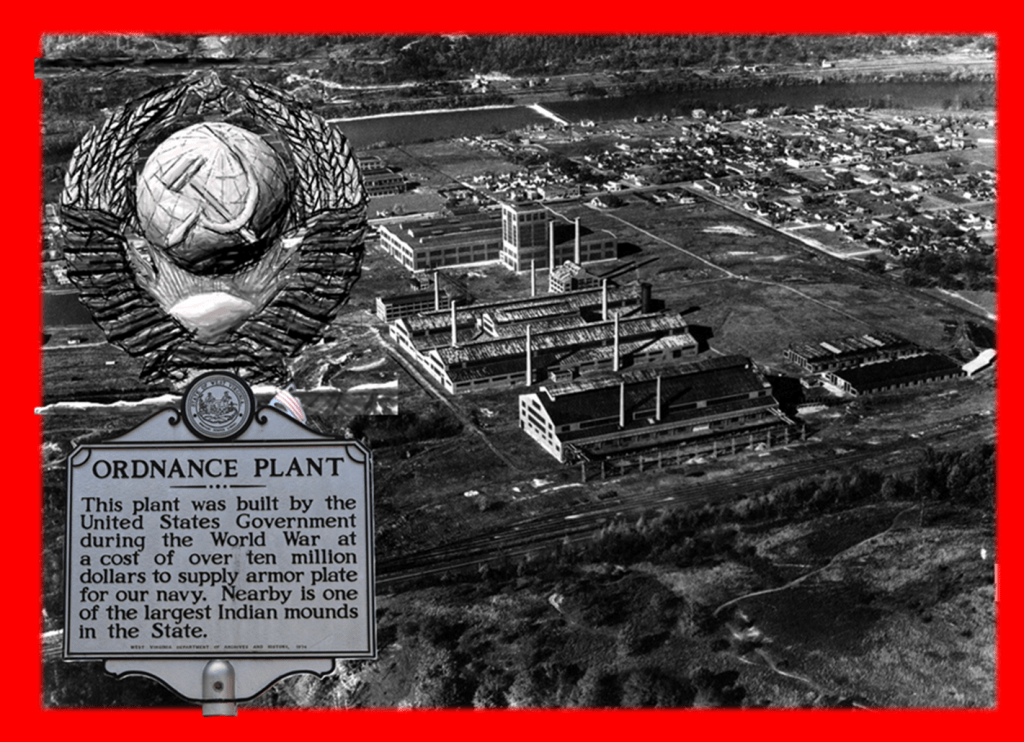
Throughout the 1930s, the Soviet Union expressed tremendous interest in procuring advanced weapons (and the means to produce the same) from a number of countries, not least of which was the United States. We’ve uncovered a small stack of documents that outline one specific line of inquiry: the attempted purchase of the US Naval Ordnance Plant in South Charleston, West Virginia.
According to a 1920 article in the US Naval Institute’s Naval Proceedings, the Navy Department brought before Congress, as early as 1900, the need for a government armor plant. While most agreed in principle that an armor plant was necessary, hashing out the details amidst financial hemming and hawing went on for nearly two decades. It wasn’t until 1916 – midway through World War I – that the 64th Congress finally passed an act providing for the construction of a government-owned armor and projectile plant. Once the bill was enacted, West Virginia’s Charleston Chamber of Commerce acted quickly to donate a 205-acre site for the cause. The site was chosen due to proximity to railroads, safe distance from the coast, and ample access to water, power and gas.
The act itself provided for some $11,000,000 for the construction of a “Plant for the manufacture of armor for ships of the navy,” and $700,611 for the construction of a projectile plant. This amount was further augmented when the 65th Congress appropriated $1,375,345, thus making the total appropriation $2,080,956 for the plant for the manufacture of projectiles. In August 1918, President Woodrow Wilson allotted $4,121,000 from the appropriation for an “increase of the navy armor and armament” for the construction of a gun forging plant. This extra allotment allowed the projectile plant to be increased in size and equipped with the necessary machinery for the production of minor caliber guns.
Ground was broken on Aug. 30, 1917, but despite producing some naval gun components in summer of 1918, most of the plant’s major facilities were not operational until February 1921, well after the First World War had ended. Operations were suspended in February 1922, when the United States became a signatory of the Washington Naval Treaty, limiting production of new large warships such as battleships and aircraft carriers. Between the wars, a skeleton crew was retained to keep the plant in working order, but its usefulness was often treated skeptically. A 1931 New York Sun article blasted the Plant as a mere “lump of steel,” and a gross mismanagement of taxpayer money. At some point in our story, an unknown person – a concerned American official, an undercover illegal Soviet operative, or a joint effort of the two – approached Soviet leadership with news of the abandoned complex.
From the very beginning, Josef Stalin was kept abreast of the issue of the interest in the abandoned equipment lying dormant in South Charleston’s plant. The People’s Commissars of Defense and Heavy Industry of the USSR began a campaign to spread the word to no less than Josef Stalin himself in underscoring the once-in-a-lifetime opportunity before them. Over the course of the next three years, with American and Soviet representatives pushing to take advantage, the offer changed from equipment to ownership of the ordnance plant outright. At some point during the negotiations, Stalin himself chimed in by writing on one of the documents that his government would not be spending that kind of money on the project. But the conversation went on, until finally in November 1938, the American rep backed down, stating that the US government’s War Department had issued a ban on exporting equipment from this plant.
We have come across eleven declassified reports that document the little-known history of this procurement effort. We have translated them and provide them here, in chronological order. It’s an interesting look at a piece of history that you were never meant to see.

Document 1: A note from K.E. Voroshilov and G.K. Ordzhonikidze to Josef Stalin regarding the purchase of equipment from an artillery factory in Charleston.
No. 664 9 July 1935
Secret
To the Central Committee of the All-Union Communist Party (Bolsheviks)
Comrade Stalin
Amtorg has received a proposal to purchase equipment from an ordnance factory located in Charleston This factory, which belongs to the US Naval Institute, can support an annual output of 40-50 with 16-18 inch internal diameter; while the factory is not currently in operation, its equipment is in excellent condition. Of greatest interest of us is that the plant’s main equipment can be likely procured for 2-2.5 million dollars, with an initial worth greater than 22 million dollars.
The question now is the manufacture of large-caliber guns for the fleet and coastal defense. The production base in the industry for manufacturing these types of guns is very weak, with no equipment currently available whatsoever for the 14-18 inch calibers.
Because of this, we feel it necessary to procure the main equipment from the aforementioned factory, to which end a group of engineers from the NKTP [People’s Commissariat of Heavy Industry] and NKO [People’s Commissariat of Defense], seven or eight in all, would be sent to the US for a technical inspection of the equipment and to conduct procurement negotiations.
Such a procurement activity will very seriously assist our creation of a large-caliber artillery production effort. Obviously, other smaller caliber artillery systems can be accommodated on this equipment.
People’s Commissar of Defense of the USSR
K. Voroshilov
People’s Commissar of Heavy Industry
S. Ordzhonikidze
AP RF. F. 3 Op. 66. D. 343. L. 168-169. (America).

Document 2: A note from A.P. Rozenholtz to J. Stalin, V.M. Molotov, and G.K. Ordzhonikidze regarding the possibility of acquiring equipment for a heavy naval artillery plant from the United States.
No. 337 10 July 1936
Secret
To the Central Committee of the All-Union Communist Party (Bolsheviks)
Comrade Stalin
Comrade Molotov
Comrade Ordzhonikidze
According to Amtorg, the opportunity exists to purchase an artillery plant in America for the production of heavy naval guns (16-inch and 18-inch caliber), with the possibility of producing even larger ones.
This factory, belonging to the Department of the Navy, was finally completed during the period 1918-1921, operated for only about 3 months, and was then mothballed.
The plant’s production capacity for artillery pieces is estimated at approximately 40-50 guns per year for the specified calibers.
According to the reports from engineer Shestopalov, a representative of the People’s Commissariat of Heavy Industry, who had the opportunity to visit the plant, the equipment is well-preserved and in perfectly usable technical condition.
The plant consists of a steelmaking shop, a press and heat treatment shop, a mechanical workshop designed for machining the gun bodies, breechblocks, and armor plates, a shell manufacturing shop, a shell heat treatment shop, and auxiliary workshops.
According to Comrade Shestopalov, this same factory also produced shells for heavy naval guns and armor plates for shell testing at proving grounds.
The initial cost of this plant, per accounting documents (according to engineer Shestopalov, who reviewed these documents), was 22 million gold dollars.
At present, if they manage to buy this factory, according to Amtorg, it might be possible to limit the cost to a sum of 2-2.5 million paper dollars.
Our acquisition of this factory may encounter difficulties only from the Navy Department, as there is a law in America prohibiting the sale of military factory equipment to foreign countries. However, according to the people offering to sell this factory, they may be able to circumvent this law.
According to Amtorg, it is also possible that through these same individuals we will be able to obtain the blueprints and manufacturing technology for modern models of naval artillery when purchasing the factory.
Given that acquiring this plant is of interest to us in terms of saving time, since we would be getting a ready-made factory, and also considering the low purchase price, I believe it would be advisable, if possible, to buy this plant at a low price.
I am herewith attaching a draft of the order.
A. Rosengold
AP RF. F. 3 Op. 66. D. 344. L. 23-24.
Attachment
Draft resolution of the Politburo of the TsK VKP(b) on negotiations regarding the purchase of equipment from an artillery factory in the United States.
10 July 1936
Secret
1. Authorize the NKVT [People’s Commissariat of Foreign Trade] to enter into negotiations in America regarding the possibility of purchasing a complete set of equipment from the heavy naval gun factory in Charleston, which belongs to the Department of the Navy.
2. Instruct Comrade Ordzhonikidze to immediately allocate 2-3 specialists to the NKVT for dispatch to America to inspect the factory and assist Amtorg in negotiations.
3. In the event of successful negotiations, authorize the NKVT to purchase the aforementioned set of equipment from the Charleston artillery plant, with payment not exceeding $2 million.
AP RF. F. 3 Op. 66. D. 344. L. 25.

Document 3: Memorandum from the Deputy People’s Commissar of Foreign Trade of the USSR, V.I. Kusharov, regarding the refusal of the US War Department to sell equipment from the factory in Charleston.
No. 1800 4 November 1938
Top Secret
The purchase did not take place due to a ban imposed by the US Department of War on the export of equipment from this factory.
Deputy People’s Commissar of Foreign Trade V. Kusharov
AP RF. F. 3 Op. 66. D. 344. L. 208.

Document 4: Memorandum from the People’s Commissar of the Defense Industry of the USSR, M.L. Rukhimovich, to I.V. Stalin and V.M. Molotov regarding the proposal to purchase an artillery factory in Charleston.
28 December 1936
Secret
To the TsK VKP(b) Politburo Comrade J. Stalin and Chairman of the SNK Comrade V.M. Molotov
I have received, through the People’s Commissariat of Foreign Trade, an offer to sell us an armor and artillery factory in Charleston (United States of America) for 1.5 million dollars.
An examination of all available material on this issue reveals that, although the plant offered to us is not complete in terms of the equipment it contains, neither for the production of armor nor for the production of large-caliber weapons, we will be able to use the equipment located at this plant as a valuable addition to the planned expansion of our armor and large-caliber weapons factories.
It is likely that the structural metal of a significant portion of the buildings of this plant can also be used.
The purchase of the plant offered to us will significantly reduce the time required for enlarging the armor and gun factories, thereby alleviating one of the most critical bottlenecks in the construction of our battleship fleet.
The asking price for the factory – one and a half million dollars – is exceptionally low, provided the equipment is in good condition and there are no major structural defects.
Based on the foregoing, I request permission for the People’s Commissariat of the Defense Industry to purchase the aforementioned factory in Charleston, allocating one and a half million dollars for this purpose.
In order to expedite this purchase, I request permission to send a group of experienced specialists to America, including experts in the fields of artillery and armor. This group is to thoroughly examine the condition of the equipment at the factory we are purchasing and assess its suitability for expanding our own factories before the deal is finalized.
Attachment: Draft of the order
People’s Commissar of the Defense Industry Rukhimovich
AP RF. F. 3 Op. 66. D. 344. L.115-116.
Attachment
Draft resolution
of the Council of Labor and Defense No.
[No later than 28 December 1936]
Moscow, Kremlin
Secret
The Council of Labor and Defense decrees:
1. To authorize the People’s Commissariat of the Defense Industry to purchase the arms and armor factory in Charleston (United States of America).
2. To allocate one and a half million US dollars from the reserve fund of the Council of People’s Commissars for this purpose.
3. To expedite the implementation of this order, the People’s Commissariat of the Defense Industry (Comrade Rukhimovich) is instructed to send a commission of experienced specialists to America, with the required inclusion of specialists in armor and artillery.
4. To instruct the commission sent to America to thoroughly examine the condition of the factory’s equipment and the possibility of using it to expand our armor and artillery factories before the final completion of the factory purchase.
AP RF. F. 3 Op. 66. D. 344. L.115-117.

Document 5: Telegram from D.A. Rozov to V.M. Molotov and M.L. Rukhimovich regarding the equipment for the factory in Charleston.
No. 3485 17 April 1937
New York
Top Secret
To Molotov, Rukhimovich
Copy to Rozengolts
After inspecting the Charleston plant, the commission determined that the plant has the following equipment:
1) Forging presses: one 14,000-ton press, one 6,500-ton press, two 3,000-ton presses, and two 500-ton presses. The presses are suitable for upgraded armor factories, but require a boiler or hydraulic system, since the Charleston plant does not have a hydraulic system for the presses.
2) There are 6 large gun lathes, including a turning and facing lathe, two turning and boring lathes, a drilling and boring lathe, a double-sided turning and boring lathe, and a screw-cutting lathe. The machines are quite suitable for machining large barrels up to 16-18 inches. The year of manufacture of these machines is 1920, and the machines are almost new.
3) There are 12 armor plate machines, including two double-column planing machines, two disc milling machines, two horizontal single-column planing machines, two drilling and milling machines, two grinding machines, and two double-column drilling machines. The machines can be used for machining 9 by 4 meter plates. The year of manufacture of the machines is 1920, also almost new.
4) There are 20 medium-sized gun lathes, including 6 turning and drilling lathes, 7 screw-cutting lathes, 4 turning and boring lathes, and 3 disc lathes; however, this group of machines does not constitute a complete set, and they were in operation at the plant for about 2 years. The year of manufacture is 1918, and they can be used for machining barrels up to 6 inches.
5) There are 18 shell lathes that can be used for rough machining of shells up to 12 inches; they were in operation for about three years.
6) The factory has 31 cranes, including hydraulic cranes for the 14,000-ton press, two with a lifting capacity of 250 tons, and the rest are electric cranes with a lifting capacity of 15 to 250 tons. The cranes were manufactured in 1918-20, and exhibit insignificant wear. All cranes can be used, provided the spans are widened or the bridges are shortened.
7) There are two electric furnaces of 30 tons each and three of 6 tons each, with transformers and substations. The total weight of the equipment is 17,400 tons, with an approximate value of $7 million according to inventory data. According to the company’s offer of October 20, 1936, the price of this equipment, including dismantling, packaging, and delivery to an Atlantic port, is $1,550,000, payable 60% in cash and 40% in a five-year loan at 4.5% annual interest. I am sending a detailed report by mail on the 21st.
Please telegraph whether we can begin negotiations immediately, or if you will provide instructions after receiving the report.
Rozov
AP RF. F. 3 Op. 66. D. 345. L. 44-45.

Document 6: Telegram from A.P. Rozengolts to D.A. Rozov regarding negotiations for the purchase of equipment from an artillery factory in Charleston.
19 April 1937
Top Secret
To Rozov
You can begin negotiations for the purchase of the plant equipment in Charleston based on the company’s offer of October 20, 1936, i.e., a payment of $1,550,000, 60% in cash and 40% on a five-year loan at 4.5% annual interest. Try to negotiate the best possible terms regarding price and other conditions.
A. Rozengolts
[Handwritten] Resolution: In favor – Molotov
AP RF. F. 3 Op. 66. D. 345. L. 43.

Document 7: Excerpt from Protocol No. 49 of the meeting of the TsK VKP(b) from May 4, 1937, Section 117.
No. P49/117 4 May 1937
Top Secret
From the “Special Folder”
117. Approve the following text of the telegram to Comrade Rozov in New York regarding negotiations for the purchase of equipment from the plant in Charleston:
“You may begin negotiations for the purchase of the equipment from the Charleston plant based on the company’s offer of October 20, 1936, i.e., payment of 1,550,000 dollars, 60% in cash and 40% as a five-year loan at 4.5% annual interest. Try to negotiate the best possible price and other terms.”
Secretary of the Central Committee
AP RF. F. 3 Op. 66. D. 345. L. 41.

Document 8: Telegram from D.A. Rozov to A.P. Rozengolts regarding conditions for the purchase of the factory in Charleston.
No. 4872 2 June 1937
New York
Top Secret
To Rozengolts
During follow-on negotiations regarding the purchase of the plant in Charleston, we managed to reduce the price based on the offer sent to you on October 20th to $1,350,000 with financing and $1,250,000 for a full cash payment. Based on this, we can proceed with drafting the contract. After signing the contract, the company will finalize its purchase from the government with the right to resell it to us. Please telegraph your instructions.
Rozov
AP RF. F. 3 Op. 66. D. 345. L. 77.

Document 9: Note from S.K. Sudyin to I.V. Stalin and V.M. Molotov regarding the postponement of the purchase of equipment from the artillery plant in Charleston.
No. 663 2 July 1937
Secret
Comrade Stalin
Comrade Molotov
On June 10th of this year, the Central Committee made a decision to purchase equipment from the Charleston plant in the USA. The chairman of Amtorg, Comrade Rozov, reports that he has agreed with the plant owner on all the terms of the purchase, but the latter has not yet signed the agreement, as permission from the American government is required for the signing, for which the plant owner has requested 60 days..
I am informing you of this for your information.
S. Sudyin
AP RF. F. 3 Op. 66. D. 345. L. 99.

Document 10: Excerpt from Protocol No. 49 of the meeting of the TsK VKP(b) from June 10, 1937, Section 485.
No. P49/485 10 June 1937
Top Secret
From the “Special Folder”
485. Authorize the People’s Commissariat of Foreign Trade to sign (through Comrade Rozov) a contract for the purchase of equipment from the Charleston plant for $1,250,000 in cash.
Secretary of the Central Committee
AP RF. F. 3 Op. 66. D. 345. L. 74.

Document 11: Memorandum from the Deputy People’s Commissar of Foreign Trade of the USSR, V.I. Kusharov, regarding the refusal of the US War Department to sell equipment from the factory in Charleston.
No. 1800 4 November 1938
Top Secret
The purchase did not take place due to a ban imposed by the US Department of War on the export of equipment from this factory.
Deputy People’s Commissar of Foreign Trade V. Kusharov
AP RF. F. 3 Op. 66. D. 345. L. 208.

Translation © 2026 by Michael Estes and TranslatingHistory.org
 Translating History