
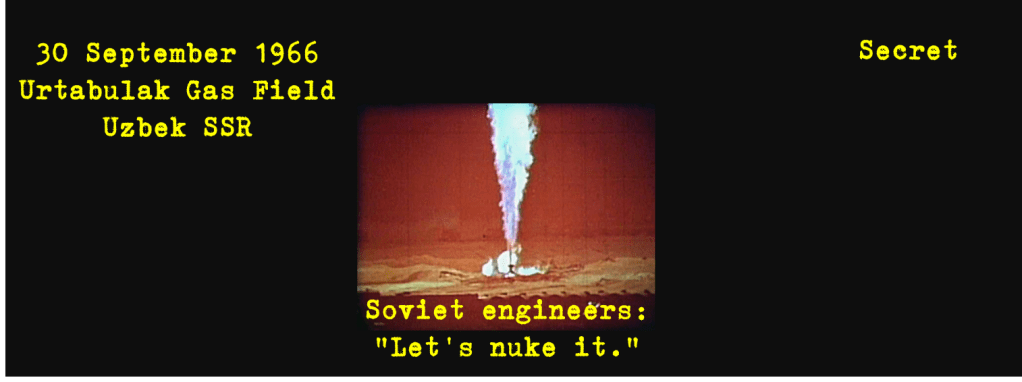
On December 1, 1963, Well No. 11 at the Urtabulak Gas Field in the Bukhara Oblast of the Uzbek SSR hit a high-pressure (300 atmospheres) gas formation, destroying the wellhead and igniting a massive, seemingly unquenchable fire. Unquenchable, that is, using traditional methods. The fire would go on to burn for nearly three years, after countless backfired attempts to cap or extinguish the burn. The Council of Ministers issued Instruction No. 1344rs, dated 14 June 1966, instructing the Ministry of Medium Machine Building and the Ministry of Geology of the USSR to come up with a realistic plan that would put an end to the nightmare.
While the aforementioned classified Instruction remains securely locked away to this day, one single declassified piece of material has made its way out from under its security handling restrictions: a 27 December 1966 paper from the Ministers of Medium Machine Building and Geology of the USSR, outlining for the Communist Party’s Central Committee some details in how the two ministries contrived to seal off the leak and, consequently, extinguish the fire using a 30-kiloton nuclear charge. It also gave the two ministers an opportunity to request permission to honor those who participated in dousing the conflagration with state medals.
We’ve chased down the declassified document, translated it, and present it here in English for what we believe is the first and only time anywhere.

27 December 1966
Secret
TsK KPSS
In accordance with Instruction No. 1344rs of the Council of Ministers of the USSR, dated 14 June 1966, the Ministry of Medium Machine Building and Ministry of Geology of the USSR, at short notice, developed measures and carried out work to extinguish the burning gas blowout at the Urtabulak Gas Field in the Bukhara Oblast of the Uzbek SSR using a deep underground nuclear detonation.
The detonation was carried out on 30 September 1966, and the powerful gas flare, that had been burning for approximately three years, was extinguished. An inspection of the blowout well, immediately after the detonation and during subsequent observations, revealed no further gas leaks nor the appearance of radioactive products.
Carrying out the detonation required a large number of engineering and administrative controls, as well as a significant amount of work to drill an emplacement hole, the construction of temporary buildings and instrumentation facilities, and the assembly of special communication cable lines.
Most important of all was the need to drill a large-diameter (445 mm) incline hole to a depth of 1600 meters, in spite of the lack of data on the spatial attitude of the blowout well. This was a complex technical challenge. Drilling such a hole required an understanding of the attitude of the damaged well within the earth’s interior, and the structural development and fabrication of a special drilling tool with 445 mm rock-bit reamers.
It also required the development of a special minimal-diameter nuclear charge with a cooling mechanism that would ensure the reliable operation of the charge in high temperature conditions at the aforementioned detonation depth (up to 70 degrees C).
The working conditions for the specialists and drilling crew workers in the desert region of the Urtabulak Gas Field were extremely difficult, given the complete lack of roads, water supplies, normal communications, and household utilities. At the worksites located 350 meters from the mouth of the burning well, heightened temperatures of up to 60-70 degrees C could be felt, as well as the ground vibrating and a constant loud hum. The work was performed with great physical exertion, hazardous to the health and life of all directly involved in extinguishing the gas flare.
Yet the workers and engineers from the Ministry of Medium Machine Building and Ministry of Geology of the USSR overcame all of these difficulties and successfully dealt with the Party’s and Government’s assignment.
For those workers and engineers who especially distinguished themselves in the creation and employment of the special charge, and in the execution of the preparatory construction, assembly, and drilling operations to eliminate the gas flare at the Urtabulak Gas Field, the Ministry of Medium Machine Building and Ministry of Geology of the USSR request authorization to bestow upon them the following government awards:
– for the Ministry of Medium Machine Building, 10 government awards: 2 Orders of Lenin, 4 Orders of the Red Banner of Labor, 2 Orders of the Badge of Honor, and 2 Distinguished Labor medals;
– for the Ministry of Geology of the USSR, 10 government awards: 1 Order of Lenin, 3 Orders of the Red Banner of Labor, 3 Orders of the Badge of Honor, and 3 Distinguished Labor and Labor Valor medals.
Minister of Medium Machine Building Ye. Slavskiy
Minister of Geology of the USSR A. Sidorenko

Translation © 2026 by Michael Estes and TranslatingHistory.org
 Translating History