
Knowledge of the morale and physical state of the enemy army has always been of significant interest in planning defensive and offensive operations. In this regard, intelligence services constantly focused on obtaining information of this kind. The defeat of the German-fascist troops at Stalingrad would have been impossible without the persistent, deadly work of Soviet intelligence and counterintelligence officers. During the defense of Stalingrad, employees of the NKVD Directorate for the Stalingrad region collected information on the deployment, strength, and armament of enemy units and formations, as well as the political and economic activities of the German command and occupation administration.
The complex military situation along the Stalingrad axis demanded much from the Soviet special services. August 1942 saw the creation of the 4th Department within the NKVD Directorate for the Stalingrad region, tasked with leading partisan detachments and sabotage groups, and establishing reliable communication with military intelligence.
The information obtained by the intelligence and sabotage groups of the 4th Department of the NKVD Directorate and partisan detachments was sent to the 4th Directorate (behind-the-lines operations) of the USSR NKVD, from where, after reporting to the leadership of the People’s Commissariat, it was forwarded to the State Defense Committee and the Stavka (Supreme High Command).
On November 18, 1942, on the eve of the Red Army’s counteroffensive at Stalingrad (Operation Uranus), the head of the 4th Directorate of the NKVD, State Security Senior Major Pavel Sudoplatov, reported to the Deputy People’s Commissar of Internal Affairs of the USSR, State Security Commissar 2nd Rank Vsevolod Merkulov, an intelligence report “On the situation in enemy-occupied areas of the Stalingrad and Rostov Oblasts, the North Caucasus, and the Kalmyk ASSR.” The intelligence report noted that the occupiers had established a “strict regime” in the Stalingrad area, prohibiting movement on the streets.
Of particular interest in the intelligence report is the final section – “The Mood of Enemy Soldiers in the South,” which characterizes the moral and psychological state of the German army and their allies on the Stalingrad front. Among other highlights, the document stated, “An anti-war attitude and desertion have been noted among the German and Italian soldiers on the Stalingrad front. One German deserter, in a conversation with our source said…’If the Russians advance, then the Germans will raise their arms [in surrender].'”
The most acute anti-war sentiments are observed among Italian soldiers, who, in conversations with residents, complain that they have not been home for 6-7 years. One Italian corporal allowed the owners of the apartment where he was staying to use their remaining radio receiver and listen to Moscow. While listening to Moscow broadcasts himself, he expressed the following thoughts: “Hitler lies constantly. The Soviets speak the truth. As for us, we never wanted to fight. Moreover, we’re now convinced that the Russian people are good… The soldiers do not want to go to the front.” Behind enemy lines, a source witnessed Germans driving a group of Italians, shackled and bound with ropes, towards their rear. It turned out these were soldiers who had refused to go to the front.
Similar sentiments prevail in the Romanian army. Conversations with soldiers of Romanian, Italian, and Austrian nationalities reveal that the Germans do not trust them and arrange their battle formations on the front line in such a way as to keep an eye on their “allies.” German machine gunners always stand behind the Romanians and Italians to warn them that retreat is impossible.
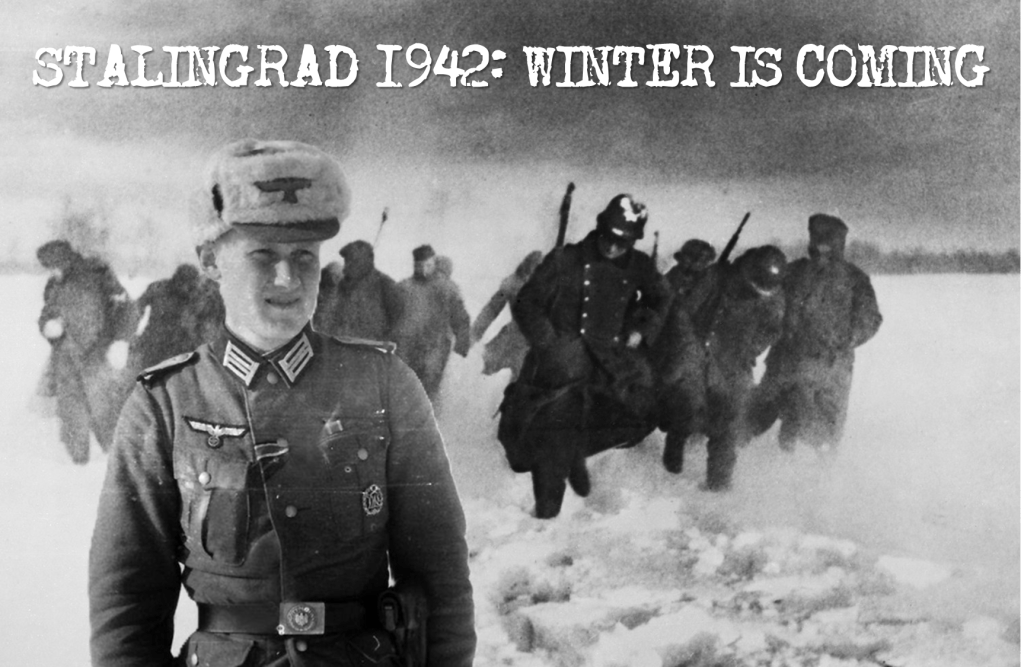
The occupiers fear the coming winter and, consequently, are experiencing primal fear. Stalingrad residents, for example, heard individual Germans saying that “winter will soon come, and the Russians will attack again.”
The following is our translation of the 9-page detailed report, which has never appeared before in English.

Top Secret
INTELLIGENCE REPORT No. 7
ON THE SITUATION IN ENEMY-OCCUPIED AREAS OF THE STALINGRAD AND ROSTOV OBLASTS, THE NORTH CAUCASUS, AND THE KALMYK ASSR
THE SITUATION IN STALINGRAD AND THE STALINGRAD OBLAST
In the occupied areas of Stalingrad, the Germans have established strict security. Walking about the streets is prohibited. The city center is heavily guarded; none of the city residents are permitted there. The remaining population in the city find themselves in an extremely difficult situation. All of the nooks and crannies are inhabited by children and the elderly; nobody steps out for days on end. Many are starving, and lice and diseases are beginning to spread.
The Germans have evacuated some of the residents to their rear, specifically to Kalach-na-Donu, and transport is provided only to those residents who have handed over valuables to the Germans.
All of the city’s able-bodied individuals have been forcibly mobilized to various jobs: restoring bridges, constructing defensive fortifications, and attending to the soldiers (laundry, cooking).
Very soon, per the residents, a death squad will enter the city in order to “restore order”.
The German Kommandatura [commandant’s headquarters] is located within the Third House of Soviets on the corner of Chapayevskaya and Ladozhskaya Ulitsa. The Kommandatura has begun by announcing a mobilization of the women to work in German hospitals and the population’s “surrender” of winter clothing and boots for the German Army.
In the city’s occupied regions, the Germans have begun forming local municipal administrations.
The former administrator of the surgical department at the railroad hospital, Doctor MAKUSHIN, 50-55 years old, was designated by the Germans as the warden – it has not yet been established whether this applies to one region or the entire occupied section of the city.
The occupation regimen in the rural areas of Stalingrad Oblast is just as strict as that in the city.
Orders published by the German command declare that the collective farms [kolkhoz], state farms [sovkhoz], and MTS [machine and tractor stations] are now the property of the Germany Army. Kolkhoz and state equipment and valuables are impartible. Collective farmers and state farm and MTS workers are essentially being turned into the workforce, working under the oversight and supervision of the German military authorities.
Thus, in the hamlet of Raskopino, in the Kletsky District, the German command gathered up the entire population on the premises of the MTS and ordered them to go off to harvest grain. Upon meeting strong resistance from the collective farmers, the German officers began flaying them with whips, thereby forcing them to get to work.
The Germans’ presence in the occupied territory is accompanied by terror and abuse of the civilian population.
In the hamlet of Proninskiy, in the Perelazovsky District, the Germans executed a 67-year-old member of the “Krasnyy Mak” kolkhoz management, Vasiliy Vasilyevich PRYAKHIN, along with his wife Anna Vasilyevna PRYAKHINA, in charge of the children’s playground.
A worker at the Proninskaya MTS, Sergey KRIVOV, 30 years old, a fighter from the extermination battalion, was captured while carrying out a battalion headquarters assignment, and was shot. Before dying, KRIVOV cried out: “I die for my homeland and for Stalin, you will be avenged for my death.”
The local population’s attitude toward the Germans can be described as hostile. Even those individual residents of hamlets and villages who previously had been friendly toward the Germans now no longer trust them, and often openly express their hostile attitude toward the occupiers.
A resident of the stud farm settlement No. 1 in the Dubovsky District of the Rostov Oblast, Anna Mikhaylovna GANZHINA, once anti-Soviet, stated in a conversation with our source that “the Soviet authorities are a thousand times better than these tyrant Germans.”
In late July and early August of this year, the Germans carried out an active campaign to select village leaders. In those areas where the Germans were unable to “select” the leaders, they designated them through representatives of the military units who were sent to the meetings, where “leaders” were selected.
In these situations, it only took one word from a German officer to identify who would be the village leader. Usually, these leaders were from among the kulaks and were anti-Soviet.
In the village of Nizhniy-Chir, Grigoriy Fedorovich POPOV was designated leader. POPOV, 43 years old, is a native from the Kalachyovskiy District in Staliningrad Oblast, and a former member of the White Guard. Before the war, he worked as a mechanic in the state-owned mill in Nizhniy-Chir and the Kaganovich Districts. He propagated pro-fascist propaganda among the local population, and urged the peasants to refuse to be evacuated to the Soviet rear, but instead await the arrival of the Germans.
In the hamlet of Lipovsky, Georgiy Potapovich POPOV is the elder. POPOV, 73 years old, was once a Cossack ataman, and is an active White Guardist [counter-revolutionary].
THE SITUATION IN THE CITY OF ROSTOV-NA-DONU
The first Germany army units – a group of Czechoslovak machine gunners – entered Rostov-na-Donu on 24 July at 10 o’clock in the morning.
On the morning of the 25th of July, the main German Army troops began arriving. Among these there were Hungarians [Malyars], Romanians, Czechoslovakians, Italians, and Spaniards.
These units did not linger in the city for long, moving as a huge mass to the south with a large amount of weapons.
On 26 and 27 July, SS units and the death squad arrived at Rostov, and on 28 July, the first German orders were already appearing, establishing the occupation regime in the city.
In the first order, the civilian population was warned that those individuals found assisting communists, partisans, and Red Army commanders and fighters remaining in the German rear will immediately be shot.
Jewish residents of Rostov have been kicked out of their homes, where the Germans and their lackeys have then taken up residence.
According to a special order, all Jews have been subject to registration at the German headquarters, where they were instructed to wear a white band with a star on their sleeve, a sign that would distinguish them from the Russian population.
Rostov has been seriously ravaged.
Along Engels Street, starting from the depot all the way to Voroshilov Prospekt, only one building was spared – the Pioneers Palace, near the VKP(b) Obkom [local Communist party] building. Along Budyonnyy Prospekt, from Engels Street to the Worker’s Settlement, the following were left undamaged: the Musical Comedy Theater building and the residential building ‘Gigant,’ which houses the German Komendatura.
The large Wehrmacht headquarters is located in the Gorky Theater building and the Voroshilov Railroad Management building.
German soldiers patrol throughout the city, but they are not strict when it comes to checking papers. Residents are free to leave the city.
Coming into the city is far more difficult than it is to leave. In order to enter, one must have the documentation that establishes your identity and permission from German authorities. Papers for entering the city are checked with great care. Even the slightest suspicion arouse by the documents will lead to your arrest.
During the Red Army’s retreat, some of the plant and factory equipment was removed, and some destroyed.
Regardless of this, the Germans were able to start up some of the workshops to the Rostselmash factory, where they are now repairing aircraft, and the Lenzavod, where they have established a base to repair tanks and automobiles.
Restoration of Rostselmash required the Germans to bring in specialists and machine tools from Germany. Prisoners of war are used as manpower at the restored facilities.
Civilians in the city were used to restore the power station and the water supply system. In the residences occupied by the Germans, the power and water have been restored and are operating as normal.
Private trade is authorized in the city, but up to now it has yet to be organized. There are no store, and prices in the market are extremely high. Only a handful of private hair salons are open from the community enterprises.
One of the German orders categorically prohibits their soldiers from looting, promising that anyone found guilty of violating the order will be subject to the harshest penalty, up to and including execution. Regardless of this, however, stealing from the civilians continues.
The SS performing door to door searches steal all of the provisions from the population, as well as warm clothes, boots, coats, and money. Plundering often takes place under the pretense of “gifts” supposedly being offered to the German soldiers by the civilians. It takes place as follows: outdoors, during the day, a Wehrmacht soldier stops any passerby, and if the passerby is carrying something that strikes the soldier’s fancy, he will ask him to give whatever caught his eye as a “gift”. If he encounters resistance, then the desired objects are taken by force.
The Nazis shoot completely innocent people under the guise of partisans or communists.
On Budyonnyy Prospect, near the building of the former SKVO [North Caucasus Military District] headquarters, a slain German officer was found. From buildings located not far from where the body was found, Germans shot some 40 men, women, and children.
Recently an ordered was issued in which the German military authorities warned the population that from now on, for any German killed, they would abduct and execute a number of civilians.
The mood among the Rostov residents is subdued and wary. Rumors are often being spread throughout the city that the Red Army is returning, that the Germans will be swept out of Rostov, and specific time frames for the Red Army’s return to the city are being called out.
REGARDING THE SITUATION IN THE TEMPORARILY OCCUPIED AREAS OF ORDZHONIKIDZE KRAI
SS and Gestapo units arrived in the captured cities and villages of Ordzhonikidze Krai immediately after the Wehrmacht’s arrival, and they immediately began establishing Nazi rule in the occupied territories.
The Gestapo and SS arrived at Kislovodsk on 18 September and took up residence in the Semashko and “10 Years of October” sanatoriums.
The German Commandant’s first order announced the registration of Red Army men and commanders that wound up surrounded or who remained for whatever reason (in most cases, this refers to deserters) in occupied territory after Red Army units had departed.
Over the course of several days, the Germans registered up to 10,000 Red Army soldiers, all of which were immediately send to the Mikoyan-Shakhar region for road construction.
Security is provided in the occupied city by mounted detachments made up of Red Army deserters, primarily Russians.
In the first days of the occupation, security in Kislovodsk consisted of a group of some 150 Karachays, but soon afterwards this group was replaced by Russians, as they were so discredited by their abuse of civilians, even the Germans were compelled to remove them and disperse them among the villages.
The Germans designated Madzhir Babulayevich KOCHKAROV (born 1907, by birth a resident of Daud, Karachevsky Oblast) as the mayor. Majzhir KOCHKAROV was one of the organizers of the anti-Soviet uprising in 1930, after which he went into hiding in the mountains of Dagestan and Checheno-Ingushetia. His father and grandfather were executed by Soviet authorities.
On 28 August, an order was announced in the city for the registration of Jews. All Jews were forced to appear at the depot, bringing their valuables with them. Upon arriving at the depot, the Jews were taken away into the mountainous area of [the village of] Belyy Ugol and executed. Their bodies were then buried under a rockslide caused by an explosion set off by the SS.
Over this short period of time, 1500 Jews were killed in Kislovodsk, and as many as 3000 in Pyatigorsk, including many children. Their belongings were confiscated and sent off to Germany.
After this “voluntary” surrender was completed, the Germans started searches. All provisions and livestock were taken away.
A special order was declared for the registration of all VKP(b) members and candidates. There have also recently been instances of Communists and Komsomol members being arrested.
In the settlement of Verkhnyy Akbay, Kabardino-Balkarian ASSR, on 23 September 1942, during the day a German officer executed a girl named Zoya simply because a Komsomol membership card was found on her person during a search.
In order to make the population believe in German “victories” and the inevitability of the “defeat” of the USSR, the Nazis are spreading false rumors that Turkey has seized all of Armenia and Georgia, that the Germans, masquerading as British troops, have pushed a million and a half-strong army into Baku via Iran, that Leningrad and Stalingrad have been captured, and that “in general, the Bolsheviks in the south have been defeated.”
On 22 September, the Germans announced by radio broadcast in Pyatigorsk that Nalchik and Groznyy have been taken.
But the Nazis often expose themselves. Many of them are less belligerently inclined and express completely opposite views.
For example, in Pyatigorsk and Cherkassk one German general, responding to residents’ queries, stated that war is protracted by nature, when it will end is unknown. Turkey, he said, is not fighting and has no intention of fighting. England and the United States are aiding the USSR and therefore, the General concluded, the population of occupied areas must work well, and harvest the grain in order to provide it to the German army and the population itself.
In accordance with an order from the German authorities, the mayor of Pyatigorsk ORLOV issued instructions for the mobilization of all able-bodied citizens to harvest; 60% of the harvested grain must be handed over to the German authorities, the rest of the grain, with the permission of the elders, to be divided by workday units, and leaving a specific amount for seed reserves.
The order stipulates that after the harvest, the land will be parceled, with parcel preference being afforded to those who worked hard during the harvest and were conscientious in carrying out the orders of the occupiers.
The land will be divided between farms, from 4 to 5 hectares per farm. Those desiring a larger plot of land can purchase an additional plot from the local government in addition to the existing plot.
All of the able-bodied citizens of the occupied areas have been ordered to a labor conscription, working to restore the railroads and motorways, building military fortifications, and so on.
Private trade has been declared in the cities, albeit far from organized. Local Armenians are serving the role as “merchants” for now, selling various trifles.
Soviet money is in circulation; one German mark is valued at 10 Soviet rubles.
Businesses are operating in the city of Pyatigorsk: the chemical plant, oil mill, power station, and engine factory [моторо-завод].
[Translator note: The Russian word for ‘engine factory’ was underlined in red, with a large red question mark written over it by an unknown recipient of the report.]
As of 15 September, an overall census and registration of passports has been declared in Pyatigorsk, Kislovodsk, and other settlements in Ordzhonikidze Krai.
For the registration, each person is given special forms to fill out, where they are to indicate: a) surname, given name, and patronymic; b) year and place of birth; c) how long the registrant has been living in their current residence; and d) if they arrived at their current residence during the war, when and from where did that arrival occur.
This step is directed at cleansing the towns of “undesirables”. Meanwhile, a redistribution of housing spaces has begun in the cities.
For this reason, the Pyatigorsk Echo newspaper, edited by a certain G.I. DASHANOV, wrote on 13 September:
“By instruction of the mayor, after a verification of the level of need, those previously oppressed by the Soviet authorities, as well as families of German descent who were earlier evicted from the cities, will be moving into available residences.
“There are many residences of fleeing Communists left in the city. These residences were handed over to various relatives and acquaintances immediately prior to the departure of those fleeing. These ‘heirs,’ taking advantage of the fact of residency, remained in the dwellings of their ‘distinguished relatives’.
“The city must quickly be cleansed of the remnants of these most heinous enemies of the new world order lurking in the crevices.”
It has been established that an office has been set up in Pyatigorsk to recruit Russian criminals and traitors into the German army.
They are taking individuals between 20 and 30 years of age into the military, primarily those possessing specific specialties such as mechanics, carpenters, etc.
Volunteers entering the ranks of the military are dressed in German uniforms, buit without distinguishing ranks or emblems.
The call for Germans to join the German military is met with very little positive response. There is almost nobody wanting to fight on the side of the fascists.
The German command has recently begun a mobilization into the German military.
The Germans are making national “volunteer” units from a number of prisoners of war. On 10 September a newly formed Georgian regiment was sent to the front line in the city of Prokhladny. Individuals of other nationalities – Armenians, Ossetians, and Azerbaijanis – are being sent to Rostov, supposedly to form other national units. A former Red Army Major, a Georgian named ABASHIDZE, who previously served in Gori, is the one carrying out the work to create the national units in the Georgiyevskiy prisoner of war camp.
A church has opened in Kislovodsk, where recently a divine service was held in honor of Hitler. The mayor and the German command attended.
There is information that some of the artists left behind in the occupied territory have begun working for the Germans. A Terek Cossack song and dance troupe, overseen by the Germans, is learning fascist hymns and songs, and will soon be making appearances with their new repertoire.
In Pyatigorsk, the “Illyuziy” theater and musical drama theater are performing with nearly complete casts.
The local population, for the most part, is anti-German. Open performances against the occupiers are taking place.
In Apollonovka, one resident burned down his home where Romanians had taken up quarters, and fled. On the Kislovodsk-Pyatigorsk railway line, Soviet patriots organized into partizan units have caused several train wrecks.
The Germans behave outrageously and terrorize the population.
For one German officer killed in Nadzornyy (Kuban), the Nazis rounded up all of the village’s residents and brought them to the Kuban River, where half of them were executed. The remaining residents were sent to a camp.
KALMYK ASSR
SITUATION IN ELISTA AND NOMAD CAMPS (УЛУСЫ)
On 5 September 1942, German military authorities announced the “election” of the head of the city Elista. They filled this role with the criminal Nikolay Pavlovich TRUBA, formerly the senior agronomist in the Elista city land department. V. MANUILOV and Kalmyk Bembe TSUGLYNOV, a “specialist” on the national question, were appointed as his deputies.
In both Elista and in the nomad camps, the local police is made up of former Kulaks, primarily Kalmyks. Chief of the city police is a man named D.P. TYRYSHKIN.
The most well known of the police are the following traitors who have sold out to the enemy: former sheepherder Dmitriy Moiseyevich KRIKUNOV, MALIVANNYY, and Urentsen TSEDENOV – assistant to the chief of the city’s horse-drawn transport.
The identification mark of the police is a black armband with the label “Elista Police”.
Death squads are conducting a brutal terror and abuse campaign against the local population. Every day throughout the city searches and arrests of openly active Party members and Soviets are carried out. The city’s detention facilities are packed to overflowing.
Travel into and out of the city are strictly monitored. The German Komendatura has announced a 1000 ruble reward for anyone participating in identifying Communists, partisans, political workers, and Chekists.
In rural settlements, the Germans have appointed elders who have been instructed to identify partisans, Communists, and Jews, and record them in special lists.
Everything that was taken by local residents from collective farms and state warehouses during the evacuation has been ordered to be handed over immediately. Those refusing to carry out this order face execution.
On 4 August in the village of Sharnuta, from the Sarpinskiy camp, German soldiers took two females prisoner. The females, members of the VNOS [Airborne Surveillance, Warning, and Communications Troops], were executed along with a 60-year-old Kalmyk named B. MUNYANOV, a resident of Naryn-Khuduk in the Chernozemelsky camp.
The shops and villages in this settlement were ransacked and completely looted. A similar outrage was carried out by the Germans in the settlement of Khorba in the Yustinsky camp. The Germans even distributed some of the plunder among the local residents, photographing the distribution of the goods and provisions.
One day in Elista, there was a gathering of women to whom the Germans promised to hand out bread. But those who appeared for the handout were merely photographed, then were broken up and sent off to their homes.
In the villages of Khulukhut and Keshyata, the Germans took everyone’s boots, gramophones, and other household items.
A slaughterhouse was opened in the city, and meat was being processed into canned goods, which were sent off to supply the German military.
In the collective farms, the Germans – using their puppet elders – set up grain threshing. All of the milled grain was sent off to Divnoye in Stalingrad Oblast.
In Elista there is a newspaper being published in Russian, the Free Earth, whose editor is the Deputy Mayor, MANDZHIYEV BOTA, who appeared in the newspaper’s first edition with his nationalist article “The Kalmyk loves the steppe.” MANDZHIYEV is the son of a zaisan from the Sarpinskiy nomad camp.
Some of the traitors and turncoats remaining with the Germans and who are actively assisting them:
The former director of the Elista cheese enterprise BELENKO. In 1932 he was arrested and sentenced to 10 years, per the 7 August Law. Speaking at a gathering, he stated, “We finally have achieved liberation from the Bolsheviks, and we will live by the conditions set by the Germans.” In his speech, he called on the population to assist the Germans.
G.M. DULENKO, a former member of the White Guard, former head of the local land department. It was DULENKO who ordered the return of the livestock from the kolkhoz in the Troitskiy Ulus, which had been herded toward Yenotayevsk during the evacuation.
Aleksandr Ivanovich TURENKO, former Communist Party organizer from the Voznesenovka settlement in the Troitskiy Ulus, being the manager of the horse farm evacuation, ordered the return of all of the horses and that they be handed over to the Germans. He voluntarily went over to the Nazis.
In the village of Voznesenovka, in the Troitskiy Ulus, the KALININ brothers – the sons of a priest: P.L. KALININ, a teacher, and M.D. KALININ, a former accountant at the “10 Years of October” collective farm – organized the theft of kolkhoz property. They are anti-Soviet. They made no efforts to hide their hostile attitude toward us, openly stating. “Earlier, Georgia never trusted anything, we weren’t sent off to the military, they didn’t trust weapons, and now we live freely.”
[Translator note: A recipient of the report underlined in red pencil the word ‘Georgia’ and drew a question mark over it.]
A Kalmyk squadron has been established to aid the Germans in Elista. The soldiers of the squadron are dressed in Red Army uniforms with armbands.
The German authorities are trying in every possible way to coax the locals to join their side. To this end, they are spreading various inflammatory rumors that Stalingrad, Baku, Astrakhan, and the entire Caucasus have already been captured by the Germans and now the German Army is fighting with British and American troops.
But in spite of this, the majority of the population is against the Germans. Shaya Berkovich GALAY, who escaped the blockade, says: “At first, some of the population greeted the Germans with pirogis, but once they got to know their ‘liberators’ better, their attitudes toward the Germans underwent a radical change. Residents of the Priyutinsky district are now asserting that they are ready to take up pitchforks, shovels, and scythes to thrash the Germans.”
THE MOOD OF ENEMY SOLDIERS IN THE SOUTH
An anti-war attitude and desertion have been noted among the German and Italian soldiers on the Stalingrad front. One German deserter, in a conversation with our source said, “There is no way that I will be fighting. My two brothers were killed, my sister died during a bombing attack, and my mother writes to tell me to save my life. Twice I tried to flee to the Russians, but fearing that my own people might kill me, I returned. Our soldiers don’t want to fight, many of them haven’t been home for 5 or 6 years. If the Russians advance, then the Germans will raise their arms [in surrender].”
German military deserters are encountered quite often behind enemy lines. The most severe anti-war attitude is held among the Italian soldiers. They tell the locals that they haven’t been home for 6 to 7 years, that the periods for which they were sent to Russia to fight had long since passed.
One Italian corporal allowed the owners of the house where he had taken up residence to listen to Moscow on a radio they had hidden away. Hearing the Moscow transmissions himself, he offered the following thoughts:
“Hitler lies constantly. The Soviets speak the truth. As for us, we never wanted to fight. Moreover, we’re now convinced that the Russian people are good. We were supposed to go to Italy in August, but on Mussolini’s orders, we’ve been left here until November 1st. The soldiers do not want to go to the front.”
Behind enemy lines, our source saw how the Germans drove into the rear a group of Italians who were shackled and bound with ropes. As it turned out, these were soldiers who had refused to go to the front.
Similar attitudes are shared by the Romanian army. Romanian soldiers taking part in harvesting with the collective farmers in Yevstratovsky, in the Kletsky District, told the farmers, “Hurry up and gather the grain while it’s still warm out; we’ll soon be evacuated to Rostov Oblast. The Russians are coming here.”
From conversations with Romanian, Italian, and Austrian soldiers, it’s clear that the Germans don’t trust them. Combat formations on the front line are put together in such a way that the Germans can keep an eye on their “allies”.
The German machine-gunners always stand behind the Romanians and Italians to let them know that falling back is not an option. Some of the soldiers say that, whether by Russian or German bullet, you’ll find your end on the Russian front.
The occupiers are afraid of the coming winter and, as a result, are experiencing blind panic. Stalingrad residents have been hearing from various Germans that “Winter will soon be here, and the Russians will be attacking again.”
CHIEF OF THE 4th DIRECTORATE OF THE USSR NKVD SUDOPLATOV
18 November 1942

Translation © 2026 by Michael Estes and TranslatingHistory.org
 Translating History