

On September 14, 1945, the head of the NKVD Operations Sector in Berlin, Major General Aleksey Sidnev, sent the Deputy People’s Commissar of Internal Affairs of the USSR, Colonel General Ivan Serov, a new special message on the progress of the investigation into the case of SA Gruppenführer Werner Wächter.
As revealed during interrogations, simultaneously with his position as Chief of Staff of the Main Directorate of Propaganda of the NSDAP, Wächter headed the General Directorate of Armaments and Construction in the same department.
During the investigation, Wächter testified about the development of new types of weapons by Nazi Germany and, in particular, about the German atomic bomb, as well as other classified weapon developments and the people who knew about them.
As can be seen from the materials of the criminal case, on October 10, 1945, Colonel General Serov personally participated in the interrogation of Wächter on Hitler’s classified weapon programs. The following is the translation of Wächter’s interrogation by Serov. Among Wächter’s revelations was the statement that Hitler felt his nuclear weapons program was sufficiently advanced to be used for a June 1945 strike on the Soviet Union. Hitler’s plans to use the atomic bomb against the USSR were never destined to come true. In May 1945, Nazi Germany surrendered.


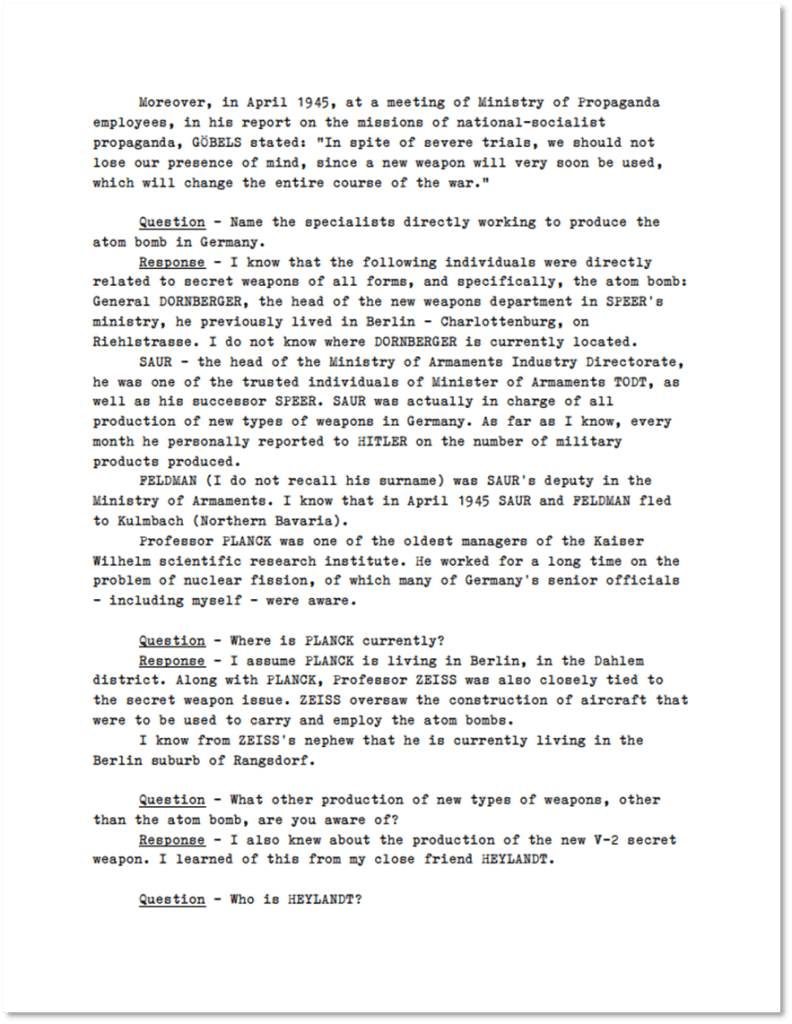

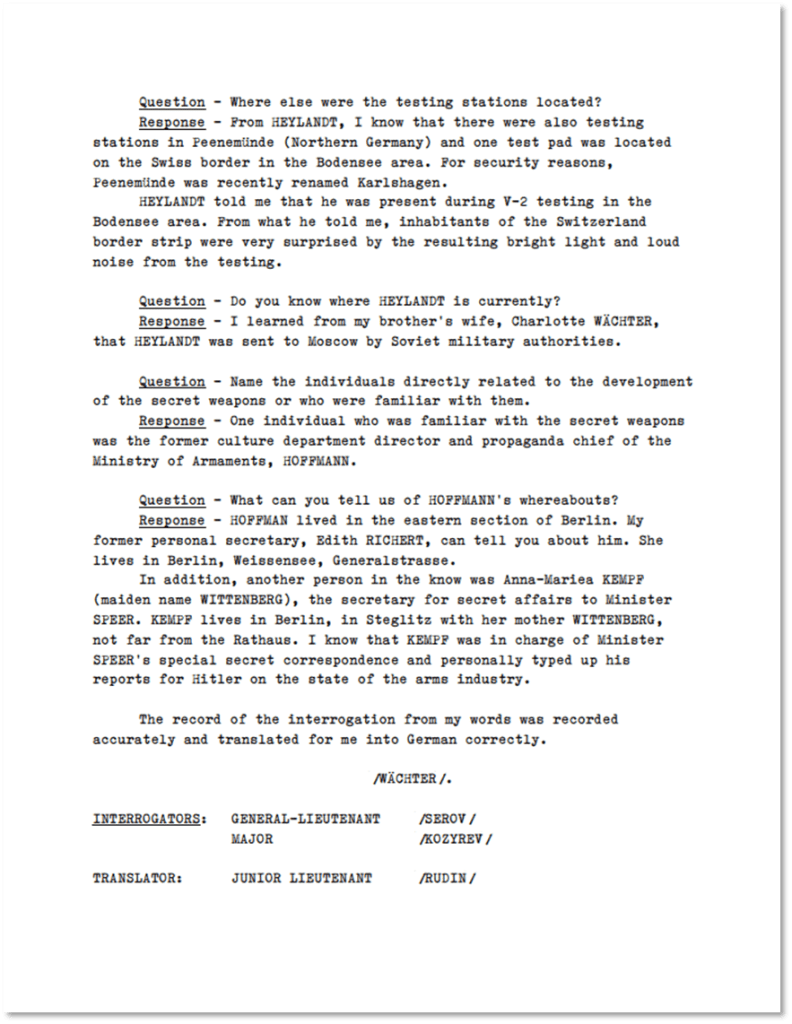
 Translating History
This is easily one of the most important documents that has ever been declassified since the end of the Second World War. I am fully convinced that Kremlin archives contain a goldmine of information about Axis nuclear weapons research and development. Are you actively working to find additional similar documents? And, by any chance, do you have any research contacts in Japan?
LikeLike
I’ve heard that there are fistfuls of similar reports floating around out there, hoping to uncover them soon. I’m pushing out perhaps three more of the post-war Berlin reports that I have my hands on, hope to revisit this topic in the coming weeks (taking a breather in late July). No research contacts in Japan as yet; a lot of my material comes from former Republics, but if you have any individual or organization specific in mind, I’m all ears.
LikeLike
all right I’m going to have to break these comments up, because this site just nuked a comment that I spent sometime composing.
if I understand you correctly, what you are doing is essentially working backwards from copies of, or references to, original wartime Soviet documents that you find in the archives of the former Soviet satellite nations. Of course it is extremely difficult if not impossible at the moment to do much if anything in Kremlin archives due to the war situation in ukraine. I don’t know if or when Kremlin archives will ever be open to Western researchers.
LikeLike
in terms of archives I would love to search regarding World War II Japanese nuclear weapons development and their cooperation with Germany and other Axis nations, it is my understanding at this time that World War II Britain maintained an intelligence hub in India during the conflict. I don’t know if the records from that agency, and I don’t recall its name just now, are still held somewhere in India or if they have been relocated back to the UK and thus presumably to Kew Gardens. As far as I am aware, the records of the British intelligence operation in India have never been searched diligently, either in general or much less for any references to Japanese work with nuclear weapons.
LikeLike
As for Asian sources, I don’t know how much is left of the wartime imperial Japanese military archives, but I can’t imagine it would be very much. Japan very diligently burned enormous amounts of paper at war’s end in 1945, doubtless including most of their own records of their nuclear projects. I know for a fact that Japanese researchers have been combing through American archives for years looking for traces of their own atomic program. So this would seem to indicate that there is not much to find in Japan proper, but given the intricacies of Japanese society, Japanese sources can’t be ruled out altogether. To my knowledge little or no archival digging has ever been done in Korean or Chinese archives for information about Japanese Weapons of Mass destruction. There are doubtless other places to dig, these are just some of the places I would desperately love to visit. Or find someone else who can.
LikeLike
by the way, I am wondering if you are familiar with the work of former MIT and US Navy nuclear physicist Dr Todd Rider?
LikeLike
I’m unfamiliar with Dr Rider’s work but will do some research there.
Some of my “sources” are also Russian SVR and FSB websites; from time to time, they’re happy to use the power of their agencies to push a political agenda, and are quick to declassify documents that show contemporary political adversaries in a negative light. Ukraine’s proven ability to withstand their invasion has embarrassed the Kremlin, and these two sites have published plenty of derogatory material against Ukraine, as well as her Allies.
I’ve seen some sporadic Russian intelligence reporting on Japan’s biological weapons program during WW2. I haven’t looked too deeply into it, but will also take a look at that. One thing I found interesting about the Japanese wartime nuclear program in a quick glance this morning is how rich in material the English-language Wikipedia site is, but the Russian site is only a fraction of that. I look forward to the challenge.
LikeLike
Looking up one of the sources on the Russian Wikipedia page for the Japanese Nuclear Program, I found a curious article from Argumenty i Fakty [Arguments and Facts] that claims on the morning of 25 March 1945, an unusual submarine surfaced at the German naval base in Wilhelmshaven, was loaded under cover of darkness, and departed. Then this:
“Only when the submarine was out at sea did Corvette Captain Haase announce to all the officers that the U-401 submarine was to deliver an extremely important cargo to distant Japan: the newest top secret Me262 jet fighter, which was disassembled in the ship’s hold, as well as boxes containing… uranium-235. At that time, few people knew what this substance was and why it was necessary to transport 56 kg of some kind of uranium to the ends of the earth.”
So far I can find no other information confirming this information, but while I have serious doubts about a submarine being fitted out with an Me262, the uranium is plausible, at least in theory. This might all be old news to you. The article references a Russian TASS reporter who unearthed the story, Vladimir Kikilo (I’ll chase his work down shortly), as well as an American nuclear arms expert, Charles Stone.
LikeLike
The article goes on to offer this:
“Japan had no uranium, but the Germans regularly exported this substance to the Land of the Rising Sun. When the military situation of Hitler’s Germany deteriorated sharply and they lost the ability to deliver uranium by sea on ships, Hitler decided to continue delivering uranium on submarine transport vessels. The departure to sea of the U-401 was the first (and last) such attempt. According to Stone, by that time the Japanese had already accumulated enough uranium to detonate their atomic bomb. This happened on August 12, 1945, i.e., shortly before the capitulation of Japan. According to him, the nuclear test was carried out in the Sea of Japan, not far from the northern coast of Korea, and had all the characteristic features: a fireball approximately 1,000 meters in diameter and a huge mushroom cloud. The power of the explosion was approximately the same as that of the American bombs dropped on Hiroshima and Nagasaki. This event was preceded by intensive research work by Japanese scientists, not so much in Japan, which was being subjected to fierce bombing, but in the huge Korean research and industrial complex at Hungnam, where the Japanese also built a secret factory. Here, according to Stone, the Japanese bomb was produced.”
The article also mentions author Theodore McNelly, a former US Army intelligence analyst (per the article). The article is written rather sensationally, and at the time (16 years before it was taken over by the Russian government), the newspaper was more or less similar to the early days of USA Today.
LikeLike
The Russian article you quoted here is mostly correct but there are a couple of inaccuracies. There were at least 10 known u-boats that attempted the journey from Germany to Japan at war’s end in europe, or at minimum were intended for that and might have gone rogue. In addition to the submarine you mention here, there was you 234 and you 864, among others. Earlier in the war there were a number of Japanese eye boats involved in the nuclear traffic between Germany and japan, as well as Italian submarines and some surface ships as you noted.
LikeLike
As I’m sure you gathered, I am using talk to text and that’s why it spelled out some things phonetically in the post immediately above. If I can log in from a desktop computer later today I will see if I can edit the post so it doesn’t have those typos in it, sorry about that.
there has been a great deal of inquiry and scholarship regarding one of those u-boats in particular, and that is U-234. I will return later today to post some of the best and most eye-opening research.
FYI I am part of a group of researchers that is digging deeply into the Axis nuclear weapons effort in World War II. As a matter of fact, I was initially thinking you might be one of those fellow researchers, but it looks like you are not. I don’t know if you have ever encountered Mathias Uhl in your travels, but he has done extensive digging in Kremlin archives. Or more accurately, he did before they kicked him out of the country after the Ukraine war got going in earnest. Anyway, the hub for our group of researchers is a subspace on quora.com called the Axis Nuclear Weapons Page. You would be most welcome to join us there.
LikeLike