
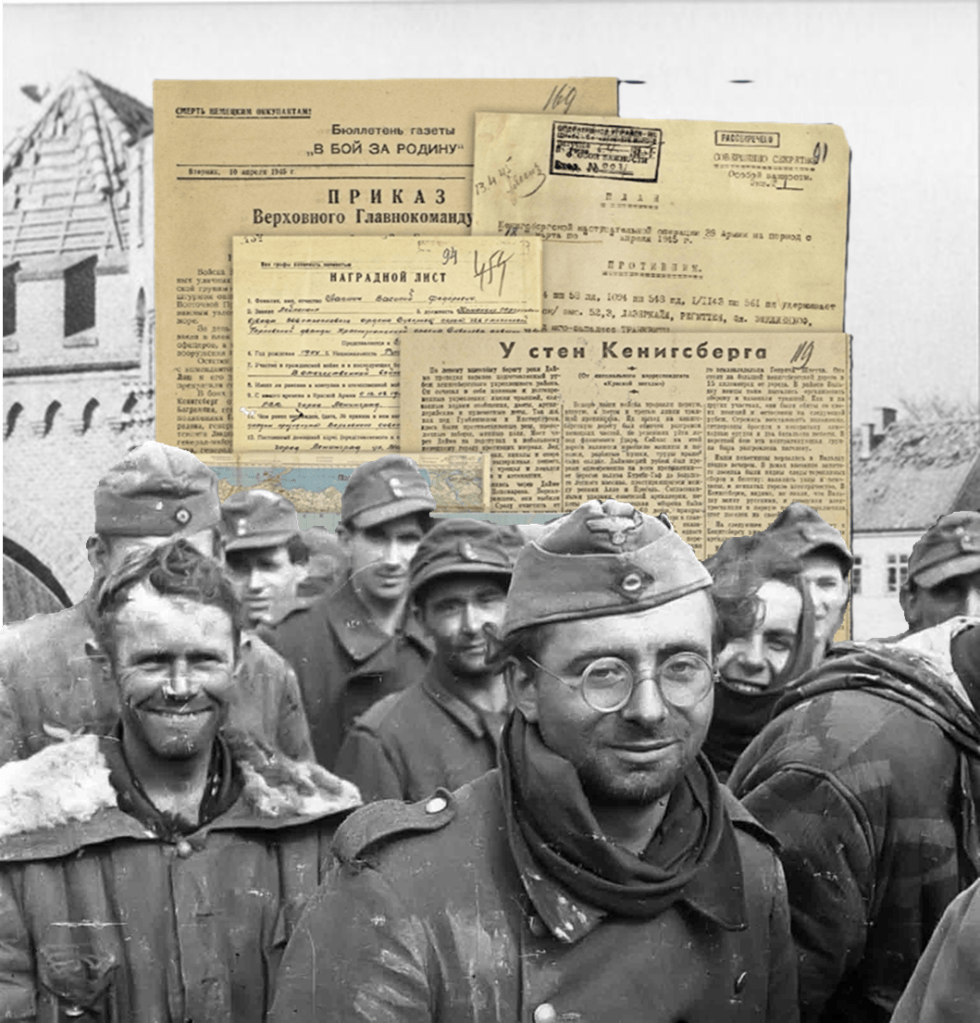
In late 1944 and early 1945, the Red Army’s combat operations shifted into German territory. During the East Prussian Offensive, the Red Army advanced upon the fortress city of Königsberg (today known as Kaliningrad). To breach the Königsberg Fortified Region, troops of the 3rd Belorussian Front, under the command of Marshal of the Soviet Union Aleksandr Vasilevsky, were deployed.
Even before Soviet troops approached the capital of East Prussia, the city had already suffered severe destruction. In August 1944, the British Royal Air Force virtually razed it to the ground, reducing the city’s architectural heritage to ruins.
On the night of August 26–27, 1944, the first massive air raid took place, involving 174 heavy four-engine Lancaster bombers. The eastern suburbs of Königsberg came under attack.
A second raid was carried out on the night of August 29–30 by a force of 189 bombers. During the attack, significant destruction was inflicted upon the city’s historic center. The strike involved the use of aerial bombs filled with napalm. The assault on the fortress city by Red Army troops began on April 6, 1945. The Königsberg garrison capitulated on April 9, 1945, on the orders of the city commandant, General of the Infantry Otto Lasch.
In January 1945, the positions of Plenipotentiaries of the NKVD [People’s Commissariat for Internal Affairs] of the USSR were established to coordinate the actions of NKVD bodies and the Front-level “Smersh” Counterintelligence Directorates (UKR). On April 18, 1945, Lieutenant General Pavel Zelenin — Chief of the Smersh Counterintelligence Directorate of the 3rd Belorussian Front (and concurrently the USSR NKVD Plenipotentiary for the 3rd Belorussian Front) — sent a Top Secret memorandum to the USSR People’s Commissar of Internal Affairs, General Commissar of State Security Lavrentiy Beria, regarding the situation in Königsberg.
The Top Secret memorandum, now declassified, details the fighting that took place in the last days that led to the Red Army forces taking the city, as well as the level of atrocities committed by the Germans in the two months preceding its fall.
We’ve translated the declassified report, along with a related record of the interrogation of the leader of a local Nazi Party cell, a Zellenleiter named Otto Mashon. Mashon details how he and his men were ordered to methodically go from camp to camp across Königsberg to summarily execute Soviet prisoners of war and detained civilians.
In response to the investigator’s question regarding what measures the NSDAP [National Socialist German Workers Party] party organization had undertaken for the defense of the city of Königsberg, Mashon explained:
“As the Red Army drew close to the city, our Party organization [NSDAP] carried out special assignments for the Political Department of the Prussian Administration — executing the remaining Soviet prisoners of war and the civilian population that were then being held in camps throughout the city […].”
Further in his testimony, Mashon recounted the reasons that prompted the local NSDAP leadership to carry out this heinous act:
“In the early days of this past February, August Rudat, the head of the local party organization, summoned me and the Blockleiter to his office […]; there, having characterized the situation in Königsberg, he explained to us that, due to the frequent bombings of the city, numerous weapons depots were exploding — with the result that fully serviceable weapons could fall into the hands of Soviet and Italian prisoners of war and be used against us.
“Moreover, the majority of [the prisoners], once in the hands of the Red Army, could reveal a great deal to the Soviet command regarding our activities, as well as join its ranks and fight against us.
“Thus, the Party ordered the execution of the prisoners of war remaining in the city, as well as the civilians brought in from the occupied regions of the Soviet Union.”
According to the testimony of O. Mashon, from early February to April 5, 1945, members of his party cell (Zelle) alone — acting jointly with a special squad of ten Volkssturm fighters — executed approximately 1,500 Soviet and Italian prisoners of war in the city, as well as civilians abducted by the Nazis from the occupied territories of the USSR, including women and children.
Our English translations of the two documents are provided below. In terms of exposing the brutality of war and atrocities committed, they speak for themselves.

Memorandum from Lieutenant General P. Zelenin, Chief of the Smersh Counterintelligence Directorate of the 3rd Belorussian Front, to Lavrentiy Beria, People’s Commissar of Internal Affairs of the USSR and General Commissar of State Security, regarding the situation in Königsberg. April 18, 1945.
TOP SECRET
3RD BELORUSSIAN FRONT
NKVD USSR
Comrade L.P. BERIA
Herewith my report on the situation in the city of Königsberg upon that city having been taken by units of the 3rd Belorussian Front:
After three days of air and artillery strikes, which involved the use of heavy artillery and rocket projectile launchers, the city of Königsberg has been reduced to rubble. Only handful of homes here and there in the southern and western outskirts of the city were left standing.
Both the city center and the city’s main quarters are still in flames. The streets are strewn with bricks, scrap metal, wood, furniture, and other refuse. Moving about the city is impossible, with the exception of a number of streets that have been cleared for the passage of troops and hardware.
An inspection of Königsberg and its outlying regions has revealed that the German command had no intention of surrendering the city. This is confirmed by the fact that the city and its outskirts in a 5-kilometer radius is encircled by two antitank ditches, four entrenchment lines, dragon’s teeth [antitank obstacles], and a large number of earth and timber strongpoints and reinforced concrete emplacements with steel covers. Existing old forts have been reinforced and refitted, for which the uppermost layer of earth at the forts was brought to a thickness of 3-4 meters. The forts were equipped with reinforced concrete and steel covers where guns and cannons were placed. On each of the city’s streets, barricades made from rock, bricks, sand, and metal bars were built where the guns and cannons stood.
In the city’s outskirts, all of the stone houses were turned into strongpoints. The rooms in the single-story stone houses were filled to the ceiling with earth, and windows in the basements were turned into gun-holes for the rifles and machine guns.
Minefields were established in front of the trenches, as well as along each trench, on the approaches to the city. Our sappers removed 186,000 antitank and antipersonnel mines in one day in just one of the city’s eastern outskirts.
According to statements from the prisoners of war, almost all of the city’s buildings were mined. For two days after our troops entered the city, some 13,000 mines and 850 delayed-action high-explosive charges were removed. For the most part, burning houses tend to explode. There are cases of delayed-action mines blowing up in houses that had otherwise escaped destruction.
According to preliminary data, the following elements of Königsberg’s industrial enterprises were spared: two cellulose plants on the eastern and western sides of the city along the Pregel [Pregolya] River which, according to the testimony of Germans who worked at the plants, were mothballed for the past three months due to the lack of raw materials. The shipyard, docks, seawall, and slip were left standing with minor damage. Three power plants remain completely intact, one was lightly damaged, and the other five power plants were destroyed. The meat processing plant was saved, as was the alcohol distillery, slaughterhouse, grain elevator, and cold storage. The gasworks and its power plant were lightly damaged. The sawmill and brickworks are undamaged. All of these facilities are located in the eastern and western outskirts of the city.
In the city center, only the first and second stories of the main post office are intact, where the telegraph and telephone exchange equipment are located. This equipment is completely intact.
The railway terminals are destroyed. All of the railway tracks and bridges were blown up by the Germans. The carriage repair works and locomotive and railway car sheds were also blown up. Almost all of the locomotives were blown up, and most of the railway cars went up in flames. The rail joints in many points along the main tracks were blown up. Restoring the rail bridges and depots will require a significant amount of time.
The Germans blew up the tram depots and rolling stock, and some of them burned from our own bombing raids.
According to our intelligence operatives and testimony from the prisoners of war, there were supposedly 50-60 thousand civilians living in Königsberg, mostly able-bodied men that the Germans left behind to defend the city. The women, children, and elderly were supposedly evacuated deep into Germany.
In order to detain the civilians departing the city and preventing them from circulating into those territories our troops now occupied, as well as to eliminate spies, saboteurs, terrorists, and other hostile elements, we blocked all roads around the city using three NKVD regiments and operations teams.
As soon as our troops begun occupying the city quarters, the civilians hiding in the cellars began to emerge from their concealment, trying to penetrate deep into our territory.
These were mostly women, children, and the elderly. There were hardly any able-bodied civilians on that first day.
According to initial data, as of this past 13 April, Königsberg’s population numbered 110,000, the significant number of which consisted of Poles, Russians, and French driven out by the Germans from countries they had previously occupied. The German population in the city numbered as many as 60,000, although the majority consisted of women, children, and the elderly.
As of 13 April, our operations teams detained 60,526 individuals: 32,573 Germans, 13,052 Soviet citizens, and 14,901 of other nationalities.
The citizens of the USSR are being sent to NKVD screening and filtration points, and other foreigners to garrison headquarters established by the Military Council of the front, where they will be screened by our elements.
The German population is amassing at specific points in the city where they will be under the greater scrutiny of military commandants and screened by our elements.
There were 1,710 individuals placed under arrest, which consists of:
- 152 German intelligence and counterintelligence agents, saboteurs, terrorists, and official operatives of these organs;
- 1,501 members of the Nazi Party and participants in fascist organizations;
- 57 traitors and accomplices to the German occupiers and other hostile elements.
By nationality:
- 1,621 Germans
- 43 Russians
- 20 Ukrainians
- 14 Poles
- 12 Belorussians
Among those arrested:
Kurt ZERNIK, b. 1886, German, Doctor of Juridical Science, previously the Königsberg City Court Judge, active Nazi Party member;
Otto ANDRIS [sic], b. 1892, German, commandant of the Königsberg prisoner of war camp, Nazi Party member;
Lukas MARKWARDT, German, chief of the gendarmerie for the town of Labiau [Polessk], member of the Nazi Party since 1932;
Wilhelm HOHMANN, German, chief of the gendarmerie for the Gołdap district, active Nazi Party member;
Eberhardt MEIER, b. 1883, German, public prosecutor for the Province of Pomerania, member of the Nazi Party since 1933. MEIER was simultaneously a member of the Consortium of Breweries of East and West Prussia;
Emil DIETZ, b. 1892, German, former Chief of the Augustów and Grodno City Police, Nazi Party member. While Chief of the Augustów and Grodno City Police, arrested and executed over 50 Communist and Soviet citizens who were fighting the Germans;
Fritz GUSS, b. 1911, German, assistant to the head of the Königsberg prisoner of war camp. While serving in that capacity, GUSS beat and tortured the POWs;
Willi SCHMYK, b. 1893, German, assistant to the burgomaster of Königsberg, Nazi Party member;
Kazimierz Franciszek MAKOWIECKI, b. 1900, Pole, commandant of the prisoner of war camp at the Königsberg port. While camp commandant, MAKOWIECKI beat and brutally tortured the POWs. At the same time, MAKOWIECKI, as Gestapo rezident, had a network of agents at his disposal, through whom he was able to identify individuals with anti-fascist leanings and those attempting to escape the camp.
As forward units seized the city of Königsberg, the rear echelons of the armies that had taken the city streamed toward that location, as well as some of the forces that had not participated in the operation to capture the city.
As a result of this, the city was quickly crowded with as many as 50,000 vehicles and wagons, along with a large number of troops and hardware, which caused traffic backups on the streets and river crossings.
Moreover, there were episodes of drunkenness and rampaging by a number of military men, most notably by naval officers and enlisted.
While there, I issued instructions to the operations teams to reestablish order in the city, and at my recommendation, on 9 April the Military Council of the front issued the order to withdraw the troops from the city, leaving two guards rifle divisions behind to assist our operations teams and KNVD troops in restoring order.
Troops were withdrawn from the city for two days, and proper order was restored.
I divided the city into eight sectors, and in each of these our operations team was to operate, along with NKVD troops assigned thereto. The operations teams were stationed next to the city’s area garrison headquarters.
In order to centralize the detainees, we occupied a former German POW camp rated for 25,000 prisoners in the suburb of Ponarth, and barracks in the suburban settlement of Quednau [Severnaya Gora] previously occupied by Volkssturm units, also rated to house 25,000 men.
Operations teams are currently conducting inspections of basements, attics, and other refuges that could serve as hideouts for saboteurs, terrorists, or other hostile elements.
When inspecting basements of demolished buildings on General-Litzmann-Straße and Zimitter Allee, we discovered wounded German soldiers and officers, and in two basements, 12 wounded Red Army soldiers.
In one basement, we found 8 bodies of German children and 14 females, all of whom ended up buried under the bricks of the collapsed building and suffocated there from lack of air.
From testimony by city residents, we have established that civilians of the German military are in the basements of collapsed buildings. Some of these individuals are unable to extract themselves, since the basements are buried under the debris, and others are hiding.
In order to uncover the collapsed basements and clean up the city, at our recommendation, the front headquarters has sent special sapper brigades and ambulance detachments, which are now carrying out this work.
At the same time, our operations teams are working to ferret out hostile elements and seize weapon and ammunition depots.
CHIEF OF THE SMERSH COUNTERINTELLIGENCE DIRECTORATE OF THE 3RD BELORUSSIAN FRONT GENERAL LIEUTENANT ZELENIN
18 APRIL 1945

Interrogation record of NSDAP Zellenleiter O. Mashon. May 14, 1945. Königsberg.
INTERROGATION RECORD
May 14 1945 Field Army
On this day I, Captain DYAKOV, using interpreter MAKARENKO, interrogated the detainee Otto MASHON, German, born 1893, native of the city of Wehlau. Eighth grade public school education. Lived in the city of Königsberg up to the arrival of Soviet forces.
Interpreter MAKARENKO has been advised of the consequences of false translation per Article 95 of the Criminal Code of the RSFSR.
QUESTION: What was your occupation prior to the arrival of the Soviet troops to Königsberg?
RESPONSE: Before the arrival of the Soviet troops, I worked as a decorator in the Schauspielhaus city theater.
Q: What parties were you a member of?
R: From the first days of Hitler’s arrival to power, I became a member of the National Socialist Party of Germany. In September 1939, I was nominated to the senior party position of Zellenleiter, and since that time, until the end, I managed all party operations of the five blocks of our party organization, “OTTO REINKE”.
Q: What activities did your party organization carry out in the defense of the city of Königsberg?
R: Because of Königsberg’s proximity to the front lines, our party organization began diligently preparing for the city’s defense. We built barricades, and many party members were sent over to the Volkssturm. Of those party members remaining, special party combat groups were formed for patrol services.
In addition, when the Red Army was approaching all the way up to the city itself, our party organization conducted special tasks for the political department of the Prussia command – the execution of remaining prisoners of war throughout the city and the civilian population held in the camps at that time.
Q: Did you participate in the executions of Soviet prisoners of war?
A: In order to provide a more comprehensive answer to this question, I would like to briefly pause on the events that preceded it. As the Red Army drew closer to Königsberg, masses of Soviet prisoners of war and civilians were herded into the city. The conditions under which these people were held were unbearable: the vast majority of them were kept out in the open; their rations deteriorated day by day, and during the final days, they received absolutely no food at all. The approaching front, the starvation, and the deaths of Soviet people in captivity posed a daily threat of an internal uprising in our rear. In early February of this year, the leader of the local party organization, August RUDAT, summoned me along with Blockleiter Paul NET, Erich REBERG, and Franz BASNER. After characterizing the situation in Königsberg, he explained to us that, due to the incessant bombing of the city, numerous weapons depots were exploding; consequently, fully serviceable weapons could fall into the hands of Soviet and Italian prisoners of war and be used against us. Furthermore, should the majority of them find themselves in the Red Army’s lines, they could reveal a great deal to the Soviet command regarding our activities, as well as join its ranks and fight against us. Therefore, the Party ordered that the prisoners of war remaining in the city — along with the civilian population brought in from the occupied regions of the Soviet Union — be executed.
To this end, special detachments have been formed from among the Volkssturm. One such detachment — consisting of 10 men under the command of Gruppenführer Scharrier — was dispatched to us; working in conjunction with us, they were to carry out these operations. In fulfillment of the Party’s orders, we executed the following individuals inside the camps:
1. Hauptbahnhof – 40 Soviet POWs executed.
2. Mitteltragheim /Eckewalstraße/ – 150 individuals, Soviet POWs and women and children.
3. Steindammerwall – 120 Soviet POWs executed.
4. Potengife – over 50 Russian and Ukrainian civilians executed.
5. Oberteich – we executed over 60 male and female civilians.
6. Nordbahnhof — 30 POWs were executed.
7. Bahnhofswallstraße — 80 POWs (Russians and Italians) were executed.
8. Tiergarten — 80 Russian POWs were executed.
9. Hintertragheim — 140 Soviet POWs and civilians were executed.
10. Messegelände — we executed 120 POWs.
11. Daimlerwerke — over 30 people — Russians and POWs — were executed.
12. General-Litzmann-Straße (from two camps) — we executed 100 POWs.
13. Stadthof — over 60 Italian POWs were executed.
14. Veilchenberg — over 60 Ukrainians — men, women, and children — were executed.
15. Juditten — 80 people — POWs and civilians, Russians and Ukrainians — were executed.
16. Altenbahnhof (Klapperwiese) — we executed more than 60 Ukrainians and Italians.
17. Neue Bleiche — 30 Soviet POWs were executed.
18. Groß Raum — 30 Soviet POWs were executed.
19. Hintertragheim (second time) — we executed 35 Soviet POWs.
Q: How much time was spent executing these individuals?
R: We carried out the executions methodically, from early February through 5 April.
Q: Where were the individuals you executed buried?
A: After each execution, we party members usually went home, and the corpses were buried by the Volkssturm. So I am unable to point to a specific burial site for those who were executed.
Q: What actions did the party take regarding the subsequent struggle behind Soviet lines after the fall of the city of Königsberg?
R: The city’s party organization was preparing for resistance work.
Q: And what specifically did the party organization carry out in this regard?
R: I first learned about the upcoming resistance effort that we were to execute behind Red Army lines in March 1945, during a meeting of party members. The meeting was attended by the heads of the party blocks, Zellenleiters, and Ortsgruppenleiters of four different party organizations: “OTTO REINKE,” “WRANGEL,” “STEINDAMM,” and “TRAGHEIM”. At the meeting, on behalf of deputy of Ernst KOCH-WAGNER, the deputy of our regional party August RUDAT made a speech, in which he announced that due to current circumstances and the possible fall of Königsberg, the party is ordering all regional party organizations to prepare for underground resistance behind enemy lines.
In accordance with this instruction, during the first days of this past April, a meeting was held among only our party organization’s active party members, in which RUDAT once again focused our attention toward the serious nature of our upcoming resistance effort, and decisions were arrived at for the fundamental organizational issues of the preparatory efforts. On 5 April, during a restricted meeting of party members and only in the presence of the Zellenleiters, August RUDAT read out the directive instructions of the party’s central leadership on the city’s party organizations going underground. After this, RUDAT stated “the enemy is at the city’s gates, and it is quite possible that the city will fall. So we have been tasked by the party to go deep underground and continue the fight behind enemy lines.”
The duty falls upon us to damage the railway lines, blow up railway bridges, blow up railway switches and tunnels, and destroy railway connections. We are to use grenades to bombard the city’s administrative institutions, the city commandant’s office, and other buildings where military authorities are housed, and all homes occupied by Soviet troops. Additionally, we are to attack individual Red Army soldiers and commanders, as well as small groups of soldiers. Using grenades, pistols, and rifles, we are to destroy men and beasts, destroy food warehouses, weapon depots, and sapper equipment. We are to attack at any and all times, wherever possible.
Added to everything else at this meeting, we were told that a very highly classified “Military Block,” consisting of the best and brightest of those reliable, would also be operating alongside all of the other underground organizations. At this point, we were warned about the consequences of betraying the party’s cause and alerting the enemy to these activities. Those individuals found revealing classified information will be punished in the harshest manner possible. The Military Block would hunt them down everywhere and anywhere, and most certainly kill them, no matter where, whether it’s in Germany or Siberia.
The party must survive any test no matter the cost, but still remain true to its ideals and sacrifice itself fighting in the enemy’s rear. All party leaders attending the meeting swore an oath of allegiance. Immediately following the declaration, the directive instruction on the underground resistance was burned. August RUDAT was entrusted with leadership of our organization’s underground efforts. He was to seek out an out-of-the-way secret hideout or cellar in which party members could secretly assemble and remain unobserved.
We arranged for all of the combat work for primary party groups of 3 to 8 members, which we referred to as combat groups. Complicated tasks would be assigned to stronger groups.
Each combat group was responsible for its own area of operations. Our underground organization, led by RUDAT, was to operate in the center of the city of Königsberg: Hintertragheim, Paradeplatz, Poststraße, Wagnerstraße, Volkegarten, Steindammeval [sic], and Wrangelstraße to Tragheim.
At the very end of the meeting, we were told that our organization’s underground headquarters would be located in the basements of the completely destroyed “KDF” house on “Franzchirze” square [sic]. After the meeting, via the Blockleiters, I notified all of the party members of our “Zelle” about the decisions made at the meeting.
On 7 April, what turned out to be the last meeting of the Zellenleiters was held, in which RUDAT informed us that the battle for the city was approaching the end, that the party was headed underground, and that the battle behind enemy lines would continue. Party affairs, as he put it, must remain a secret, and communications between party members must be established in any conditions. It was here that he pointed out that as soon as the primary forces of the Soviet troops have withdrawn, the armed struggle will begin, everywhere and anywhere.
Q: Name those who attended the meetings of the active party members.
R: As many as 75 individuals were present at the first two meetings, and I am unable to fully recall them to memory. There were eleven individuals at the restricted meeting.
1. August RUDAT, about 55 years old, the leader of our regional party organization, awarded the medal “For Distinguished Work.” On orders from Ernst Wagner, he oversaw the execution of Soviet prisoners of war and civilians throughout the city’s camps. He was the organizer of the underground resistance behind Soviet lines. Average height, sturdily built. Broad-shouldered with a full red face and a long straight nose. Blonde. Currently he must be in the hands of the Soviet troops in Königsberg.
2. GUDA – I don’t know his first name. He is about 50 years old, secretary of the Königsberg City Court. He was the propaganda chief of our regional party organization. Tall, lean, with a long, narrow face and a long straight nose. Blonde, but streaked with gray. He was awarded the Iron Cross. I do not know his whereabouts.
3. Wilhelm GERMAN, 60 years old, worked in the artillery section of the military complex. Zellenleiter, awarded the Iron Cross. Average height, stout, he has a wide face and fresh complexion. He has a long, wide nose, gray-haired. I do not know his whereabouts.
4. Fritz ZANDER, 62 years old, worked as a waiter; he’s been ill lately. A Zellenlieter, short in stature, lean; he has a long face, a short straight nose, brown hair with some gray. I don’t know where he currently is.
5. Emil TIERGARTH, about 59 years old, an employee at the city administration’s finance department. A Zellenleiter, awarded the medal “For Distinguished Work.” Tall and lean with a long, lean face; he limps on his right leg, and has a straight, long and narrow nose. He has blonde hair with streaks of gray. I do not know where he is currently located.
6. Doctor STEINER, about 62 years old, Chief Inspector of Justice for the court. Zellenleiter, average height, very lean. He wears glasses, and has a narrow face and small nose. He is balding. I do not know where he is located at present.
7. Franz ROSE, approximately 67 years old, the land planner for the City Administration. Zellenleiter, awarded the medal “For Distinguished Work,” average height, lean, with a narrow face and small, sharp nose. He has gray hair. I do not know his whereabouts.
8. Otto VOGEL, about 61 years old, worked as an investigator for the City Court. Zellenleiter, average height, full-bodied with a full round face and short wide nose. He has dark hair streaked with gray. I do not know his current whereabouts.
9. HORN – I don’t know his first name. He is about 60 years old, a merchant. Zellenleiter, of average height. He is lean and has a long, narrow face with a long, sharp nose. He limps on his right leg. I do not know his current whereabouts.
10. Max GABRIEL, about 56 years old, a self-employed photographer, Zellenleiter. He is tall, broad-shouldered, with a long, narrow face and a large nose. He has dark hair with streaks of gray. I do not know where he currently resides.
Q: Who were the members of the underground group you were in charge of?
R: As I have already testified, our entire party organization was split into combat detachments that, in turn, consisted of small groups of 3 to 8 people. At the behest of the party organization, I was charged with creating four underground groups in our Zelle. Because a large number of the party members departed for the front, I was forced to only come up with 3 underground groups, consisting of 21 individuals. The first group was made up of the following:
1. Paul NETT, 55 years old, worked in his tailor shop, Blockleiter, awarded the Iron Cross Second Class, head of the first underground group. He is currently being held in the camp along with me. He participated in executing the POWs.
2. Ernest SELL, 56 years old, merchant. A rank-and-file member of the party. Taller than average height, stout, with a full oval face and wide nose, blonde hair with streaks of gray. Current whereabouts unknown.
3. IPPACH, first name unknown, 56 years old, hairdresser, rank-and-file member of the party, taller than average height, lean, with a long, narrow face and a small, sharp nose. Blonde with a streak of gray, current residence unknown.
4. HEINRICH, first name unknown, 58 years old, merchant, rank-and-file member of the party, taller than average height with a normal build. He has a round face with fresh complexion and a small, sharp nose. He has thinning gray hair. I do not know where he is currently.
5. Otto FALK, an electrician at the Elektrozentral. He used to be a Zellenleiter, but because all of his party members went to the front, he was added as a rank-and-file member to the underground group. He is tall, of normal build and broad-shouldered. He has a long face and a long broad nose, and gray hair. I do not know his whereabouts.
6. Heinrich HOPPE, 57 years old, a tailor in his own tailor shop. He was in the Volkssturm and, by 1945, he was a Blockleiter. Afterwards, his block party members went into the military and I then added him to the underground group as a rank-and-file member. Above average height, stout, with a round face and large broad nose. He has gray hair. I do not know where he is at present.
7. Erich REHBERG, 37 years old, blacksmith at the forge at Schichau in Königsberg. A Blockleiter, he actively participated in the mass executions of Soviet prisoners of war in 1945. Taller than average, normal build, with a sickly appearance. He has a narrow face, is lean, and has a long nose and blonde hair. I do not know his whereabouts at present.
8. Franz WASNER, 27 years old, a shoemaker at the Grulvald [sic, poss. Grunwald] shop. A Blockleiter, he was attached as a rank-and-file member to an underground group because his party members departed for the front. Took active part in the mass executions of Soviet prisoners of war and civilians in the Königsberg camps. Above average height, his right leg is shorter than the left. He has a long face, is lean, and has a long nose. He appears weak. He has light hair. I do not know his current whereabouts.
Along with its other duties, this group was tasked first and foremost to take out communications. The second underground group was comprised of the following:
1. Willy SKRITIK [sic], about 45 years old, secretary of the finance department of the City Administration. A Blockleiter, he is the leader of the second underground group, is taller than average, and lean. He has a long, narrow face, a long sharp nose, and light hair. I do not know his whereabouts.
2. Hans RIEMLAND, about 30 years old. He was exempted from military service on the basis of his professional specialization, an architect. He is a rank-and-file member of the party, above average height, lean, with an oval face, a straight nose, and blonde hair. I do not know where he currently is.
3. Ernst SCHUTZHOLTER, 65 years old, a worker in the vulcanization department of the automobile manufacturer. He is a rank-and-file member of the party, of average height, lean, and has a long face, large nose, and gray hair. I do not know where he is currently located.
4. Erich TIECK, 45 years old, exempted from military service as the city’s water pumping station operator. He is a rank-and-file member of the party, of average height, lean, and has an oval face, a small but sharp nose, and blonde hair. I do not know where he is at present.
5. Franz THIEL, 45 years old, editorial typesetter for the newspaper ‘Preußische Zeitung’ (Prussian Gazette), rank-and-file member of the party, taller than average, lean, with a narrow face and long, sharp nose. Light hair with streaks of gray. I do not know where he is now.
6. Josef SCHELBERG, 62 years old, master electrician, rank-and-file member of the party, tall, very lean, with a narrow face and long, sharp nose, and with gray hair. Awarded the medal “For Distinguished Work.” I do not know where he is currently.
7. Wilhelm KRIPPOL, 55 years of age, secretary with the City Administration, rank-and-file member of the party. Above average in height, stout, with a full, round face, a broad nose, and sparse gray hair.
Along with its other assignments, this group was tasked with destroying the mobile workshops and damaging railroad tracks. The third group consisted of:
1. Werner BARDNIK, 55 years old, he worked as the lead inspector for the City Administration, Ortsgruppenleiter with the NFU. He was the leader of the third underground group. Average height, normal build, he had a round, pale face, and wears glasses. He has a short broad nose. I do not know his current whereabouts.
2. Paul KRUMM, 55 years old, he worked as an inspector for the City Administration. He is a rank-and-file member of the party, a former Zellenleiter, average height, brought-shouldered, full-bodied. He has a full, round face, a broad nose, and brown hair. He was awarded the medal “For Distinguished Work.” I do not know his current whereabouts.
3. Willy FUNKE, 57 years old, owned his own restaurant, rank-and-file member of the party. Average height, lean, with a narrow face, straight nose, and gray hair. I do not know where he is now.
4. Arnold SKRIBEL, 57 years old, worked as an inspector for the City Administration. He is tall and lean, has a long, pale face, a long, sharp nose, and dark graying hair. I do not know his current whereabouts.
5. Heinrich WOLF, 63 years old, worked as a carpenter for the City Administration. Above average height, normal build, broad-shouldered. He has a narrow face, a straight nose, and gray hair. I do not know where is currently is.
6. Hermann FRANK, 65 years of age, a carpenter for the City Administration, and party member. He’s tall, with a narrow, thin face, and a broad nose. I do not know his current whereabouts.
This group was also tasked with destroying the railroad track, and blowing up bridges and various mobile repair shops.
Q: What sort of weapons did your party organization have at its disposal?
R: Before the Soviet troops arrived, we all had French rifles. We were to receive other weapons from the head of the party organization, August RUDAT, before the onset of the battle.
I don’t know anything about secret weapon dumps, but I heard from RUDAT that there should be weapons located in the cellar of the destroyed Tragheimer Church and in the ruins of the Schloss Hof. When the Russians arrived, I tossed my rifle away in one of the city’s courtyards.
Q: What did you do in terms of underground resistance during the time you spend behind Soviet lines?
R: On the very day that the Soviet troops arrived, I was detained; therefore, I had no opportunity to carry out the Party’s directives regarding the resistance.

Translation © 2026 by Michael Estes and TranslatingHistory.org

