
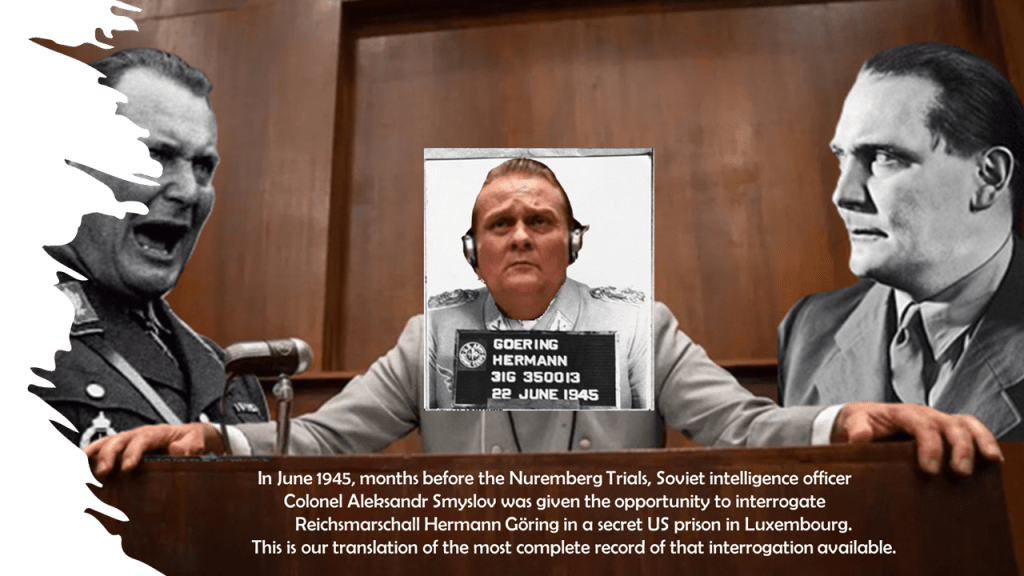
Immediately prior to or following Germany’s defeat in World War II, Reichsmarschall Hermann Göring surrendered to the U.S. 36th Infantry Division on May 6–9, 1945, near Radstadt, Austria, seeking to avoid capture by Soviet forces. After being stripped of power by Hitler for perceived treason, Göring offered his surrender to the Western Allies, expecting to be treated as a high-ranking diplomat but was immediately taken into custody as a prisoner of war. Weeks before this, General Eisenhower instructed that the Palace Hotel in Bad Mondorf, Luxembourg, be appropriated by American forces in order to convert the hotel into a prison in which surrendering and captured high-ranking members of Hitler’s government and military circles would be interned and interrogated. The ‘renovated’ hotel would come to be known by its codename ‘Ashcan‘.
By June, interrogations of a number of the prisoners were underway. By some accounts, the interrogations were more like interviews – there were very few instances noted of obvious lies being challenged by the interrogator, and the prisoner was sometimes allowed to wax rhapsodic on a number of subjects rather than provide a direct answer to the questions posed. For this, among other reasons, the products of the ‘Ashcan’ project were viewed by many as historical peculiarities, but hardly worthy of legal scrutiny in a court of law scoped to tackle the level of crimes against humanity perpetrated by the Nazi leadership.
The record of Göring’s questioning is only loosely dated as “June 1945”. In our translation, you will see how Göring, clearing knowing his life is at stake and hoping for a stalemate rather than a death sentence, answers factually where evidence already exists. However, when it comes to accusations and opinions unverified and untested in 1945, he plays it with slick aplomb. Downplaying everything from his role in the Nazi Party to the number of Jews killed throughout Hitler’s rule, but also boasting his importance to (failed) efforts in trying to bring the war to an end, he sometimes reaches for the pity brush in hopes of painting himself as a more sympathetic character than the public could ever know.
A brief note on the interrogating officer: Astrakhan-native Col Aleksandr Mikhaylovich Smyslov (1904-1970) was a former officer from the intelligence department of the Staff of the First Belorussian Front. He was a graduate from the M.V. Frunze Military Academy. In 1945, he participated in the group of
Soviet officers in interrogating high-ranking military prisoners at Bad Mandorf. Not long before his death, Smyslov turned over a number of documents that he had been holding for publication in the collection of documents and materials, “The End of Hitler’s Germany” [Конец гитлеровской Германии].
The translation of the interrogation record we are providing is based on the most complete Russian version available. Many copies of the interrogation record available for the public eye today do not carry the first two questions asked during the session; others have been found to inexplicably truncate a number of the answers. One concern raised during the translation of this record is that there is no apparent original German record against which we can compare the Russian. This is not unusual; the records of Soviet interrogations are often at the mercy of the interpreter present at the interrogation, although they often carry notices that the interpreter has been warned of incomplete and/or incorrect translations. Further, they come with signatures verifying the correctness of the final translation – signatures which often include that of the interrogated prisoner (it is rare, but not unheard of, for the interrogated to add a note indicating disagreements with sections of the text).

Record of Interrogation of Reichsmarschall H. Göring
June 1945
Mondorf Resort, Luxembourg
Göring, Hermann Wilhelm, 52 years old, Reichsmarschall, Commander-in-Chief of the German Air Force, member of the NSDAP since 1922.
Question: Do you speak Russian?
Answer: No, I only know one Russian word – ‘velikiy’ [великий / great].
Q: What makes this particular word stand out for you?
A: Near Velikiye Luki, we encountered great difficulties in the war against the Russians. It was then that I asked for an explanation of what the word ‘Velikiye’ meant.
Q: When did you learn about Hitler’s military plans against the Soviet Union?
A: I became aware of this a month and a half to two months before the start of the war.
Q: We have in our possession precise information that the order to prepare for war against the USSR was issued by Hitler in November 1940, and that this order was circulated to the Commanders-in-Chief of the Army, the Navy, and the Luftwaffe. As Reichsmarschall of the Luftwaffe, surely you must have received this order?
A: I cannot recall the exact dates when I first became aware of preparations for war against the USSR; however, reflecting upon the circumstances of the autumn of 1940, I am able to state the following:
1. At that time, an order for war preparations did indeed exist, but it had absolutely no bearing on Russia. It concerned the capture of Gibraltar, involving the passage of our troops through Spain. This operation was fully prepared, but, unfortunately, it was ultimately abandoned.
2. I spent Christmas in 1940 together with my wife and children in Romania, roughly 300 kilometers from the Russian border. Had I been aware of any contemplated military operations against the Soviet Union, I would hardly have ventured to take my entire family to Romania, where we were situated in such close proximity to the Soviet frontier.
These two circumstances lead me to doubt the existence — in the autumn of 1940 — of any order for war preparations against the Soviet Union. Under any circumstances, had such an order existed, I would have known of it no later than two weeks prior to it being signed.
Q: What was your attitude toward Germany’s attack on the Soviet Union?
A: I have always been opposed to a war with Russia. When I learned of Hitler’s military plans against the USSR, I was simply horrified. At that time, our entire Luftwaffe had been deployed to the West and was operating against the British. The objectives facing our Luftwaffe were still far from being achieved, yet — in the event of a war with Russia — I was expected to transfer a good half of our aircraft to the Eastern Front. I repeatedly attempted to dissuade the Führer from his intentions to wage war against the USSR; however, the Führer was obsessed with the idea of a war against Russia, and I was unable to change his mind. I considered a war against the USSR to be ill-advised.
Q: How does this point of view square with your numerous statements regarding your hatred for the Soviet Union, and your assertion that the Soviet Union would be crushed?
A: I would be very surprised if you could produce for me even a single speech of mine delivered in that vein. The issue at hand was not one of hatred or love for the Soviet Union, but rather the advisability of waging war against the USSR. I believed that waging war against the USSR was inadvisable; yet, at the same time, I was always an opponent of your worldview. However, it is one thing to oppose a war with the Soviet Union, and quite another to express a dissenting opinion on the matter in the press. Once the Führer initiated the war, it became my duty to do everything in my power to win it. I have always regarded Stalin as a formidable adversary.
Q: Have you yourself ever been on the Eastern Front?
A: I was in Russia for a very short time. I am acquainted with only one Russian city — Vinnytsia. I came to Vinnytsia not on military business, but because I was interested in the theater.
Q: At one time, did you swear that not a single bomb would fall on Berlin?
A: All of these are assertions from enemy propaganda. I simply stated that I would do everything in my power to ensure that not a single bomb fell on Berlin. Moreover, this was said at a time when we held complete air superiority.
Q: What weight did you carry within the party?
A: I served in the SA until 1928; I was abroad from 1923 to 1928. I returned to Germany in 1928, but I no longer held a position within the Party. That same year, 1928, I was elected as a Deputy to the Reichstag. During 1930–1931, my standing within the Party became more prominent. I played a significant role in the Reichstag. From late 1931 until 1933, I served as the Führer’s Political Plenipotentiary and played a major role in matters concerning negotiations with other organizations and with foreign entities. I played a decisive role in the formation of the government, as I maintained good relations with Hindenburg.
Q: In recent years, have state and party matters been coordinated with you?
A: State matters — yes; party matters — no. I held no official position within the Party, yet as the second-highest-ranking figure in the State, I played a significant role in resolving state-related issues. I did not interfere in the Party hierarchy, as I held six or seven state offices simultaneously, and I had more than enough work to handle as it was.
From the moment Bormann — my fiercest rival — assumed the post of Secretary of the Reich Chancellery, I ceased to involve myself in Party affairs altogether. I was completely cut off from Party life in 1943. Never — not even during the years of my greatest influence — did I wield as much sway over Hitler as Bormann did. We used to refer to Bormann as the little secretary, the great schemer, and the filthy pig. I would learn of Party decisions only after they had already been made. Since Bormann’s arrival, I delivered a report to the assembly of Gauleiters only once — specifically, regarding the air situation. My standing within the Party rested solely upon my personal authority and my status as Hitler’s designated successor.
Q: What was your relationship with Hitler?
A: My relations with the Führer were excellent until 1941. Over the course of the war, they steadily deteriorated until they reached a complete collapse.
Q: What do you mean by the collapse of your relationship with Hitler?
A: By this, I refer to the fact that Hitler relieved me of my duties, expelled me from the Party, and sentenced me to death. On April 22, Hitler declared that he would remain in Berlin and die there. That evening, for the first time, he spoke of the possibility of defeat. He was in a rage and asserted that his closest associates had betrayed him. One of the generals asked him whether the troops stationed on the Western Front should not be redeployed to defend Berlin against the Russians. Hitler replied: “Let the Reichsmarschall decide this matter.” The general said: “But it is possible that the Army will not wish to fight under Göring’s command.” Hitler replied: “Do you really intend to continue fighting? It is futile. We must seek a compromise, and Göring is better suited to do that than I am.” Hitler then ordered the majority of the military staff to fly to Southern Germany. Among them was the Chief of the Luftwaffe General Staff, Koller, who subsequently stopped by to see me and recounted these events.
After Koller’s visit, I telephoned Dr. Lammers and asked for his opinion as to whether, in light of the prevailing circumstances, I should assume power. It was decided that I should send a telegram to Berlin requesting instructions.
I dispatched a telegram to the following effect: “Since you have made the decision to remain in Berlin, I request that you inform me whether your testament — designating me as your successor — is now in force, and whether I am at liberty to exercise freedom of action in matters of domestic and foreign policy, as the interests of the State require. If I do not receive a reply by 10:00 p.m., I shall be compelled to assume that you are no longer free to make your own decisions, and I shall proceed to act independently.” Subsequently, I extended the deadline for a reply to midnight. My nemesis, Bormann, was in Berlin and evidently reported my telegram to Hitler in such a way as to suggest that I was supposedly plotting against him. At 18:00, I received a reply stating that the previous order was no longer valid and that I was not to be appointed as successor. At 20:00, a group of SS men arrived and announced that my family and I were under arrest. The following day, at 9:00 a.m., SS-Obersturmbannführer Dr. Frank, the SS commander in Obersalzberg, came to see me and read aloud the following telegram from Hitler: “Through your conduct and your actions, you have betrayed me and the cause of National Socialism. The penalty for this is death. However, in recognition of your great past services, and under the plausible pretext of severe illness, I hereby relieve you of your post as Commander-in-Chief of the Luftwaffe.”
The following day, it was announced over the radio that I had been relieved of my duties due to a severe illness. The public, naturally, laughed, as no one believed it.
The SS received the following order from Bormann: “When the crisis in Berlin reaches its climax, the Reichsmarschall and his entourage are to be executed by order of the Führer. SS men: you must fulfill this duty with honor. Martin Bormann.” However, the SS men had no intention of doing so, as they viewed this not as an order from the Führer, but merely as a personal favor on the part of “my friend” Bormann. It was a completely insane decision.
They had all gone mad down there in the bunker and were no longer masters of their own actions. On April 24, I was arrested by Bormann and his men. On May 4 or 5, pilots from air units flying over Mauterndorf, where my family and I were being held in custody, spotted us; they attacked the guards and freed me.
The deterioration of relations between the Führer and myself began in 1941. Disagreements arose between us regarding the deployment of air power on the Eastern Front. In connection with the military operations against the USSR, the Führer proposed that I divide our air forces into two separate contingents. I refused to agree, arguing that our air power was essential for the struggle against the British. Prior to this, the Führer had never interfered in Luftwaffe matters. Now, however, the gates were open. He would issue orders to transfer air units here and there, often without any apparent pressing need. I voiced my objections, insisting that I needed to know precisely what objectives were being assigned to these units in each specific operation.
When a critical situation developed for our troops at Stalingrad, the Führer summoned me to his presence. The critical question at hand was whether the army would remain where it was or if it would have to retreat. The Führer asked me whether it would be possible to ensure the delivery of 500 tons of supplies per day to the Stalingrad force, a figure he later reduced to 300 tons. I replied that this would be feasible only on the condition that flying weather prevailed continuously, and provided that our Stalingrad grouping managed to retain control of the airfields.
Hitler ordered that every available transport aircraft — even training planes — be thrown into the effort to deliver supplies to Stalingrad. Then, the very thing I had feared most came to pass: terribly severe atmospheric conditions — icing, blizzards, and snowstorms. Our Luftwaffe suffered heavy losses. At that point, the Führer ordered that our entire bomber fleet be diverted to transport weapons and ammunition. The bomber force was my brainchild; I had built it from scratch, and it represented the finest asset I possessed. I could not consign it to certain destruction. This marked the first serious rift between us. Hitler ordered Generalfeldarschall Milch to act independently, bypassing my authority entirely, and to utilize the air assets at his own discretion.
Q: What is your opinion of Hitler?
A: In my opinion, Hitler was a brilliant strategist; he possessed a peerless knowledge of the armies of every nation. However, he was unwilling to delve into the intricacies of aviation and aerial warfare; consequently, he made flawed decisions regarding the deployment of air power. Furthermore, Hitler could not tolerate failure — it drove him into a rage. His military and strategic plans were brilliant, and had his generals executed them faithfully on the Eastern Front, the Germans would have emerged victorious.
There were other disagreements between us as well. You may recall that, in the winter of 1942, the so-called “field air divisions” were formed. Suddenly, I received an order to transfer 200,000 airmen to these units. I insisted that these men, who had never fought on the ground, undergo the appropriate training, be equipped with artillery, and so forth. I was given assurances that this would be done; however, just a few days later, they were thrown into battle straight off the march, without any preparation whatsoever. They were all slaughtered, leaving me in an untenable position in the eyes of my own aircrews.
I had also formed an airborne division, a unit I deemed essential for specific operational objectives. I devoted a great deal of personal attention to this division, training its troops myself. I am aware that the Soviet authorities held this division in high regard. Then, abruptly, the division was plucked away from me for use in ground combat operations in the Smolensk region. For me, that was perhaps the most crushing blow of all.
Fundamental disagreements also emerged between us regarding the possibility of initiating negotiations with the Allies. I repeatedly proposed entering into talks with one of the Allied nations, as I had come to the conclusion that victory could no longer be achieved through military means alone. Hitler, however, categorically rejected my proposals. The mention of the word “negotiations” in my telegram to Hitler may well have played a decisive role, as it reminded him of all the disagreements that existed between us.
Relations between us deteriorated even further during as the Allied air raids intensified. Hitler interposed in the field of fighter aviation, proposing fantastical ideas, such as the necessity of mounting cannons on fighter aircraft, and appointing special envoys, among other measures.
Q: When did it become clear to you that Germany had lost the war?
A: I first felt my own doubts arise regarding the outcome of the war following the invasion by Allied armies in the West. The breakthrough by Russian forces on the Vistula, coupled with the simultaneous offensive by Allied troops in the West, served as the first serious warning sign for me. However, after the front in the West stabilized, I regained my hope. I hoped that, provided the Western Front remained stable and the Red Army’s advance on the Vistula could be stalled, we would succeed in accelerating the production of jet fighters — aircraft armed with 6 cannons and 24 rockets. This would have made it possible to put an end to the air raids on Germany. Under such circumstances, we would have been able to restore our lines of communication and industrial infrastructure, and ramped up the production of new weaponry.
Q: What can you tell us about the atmosphere at Hitler’s Headquarters immediately preceding the surrender?
A: I cannot really offer anything in this regard, for up until April 20, 1945, if anyone had even harbored the thought that victory was impossible, no one dared to voice such thoughts. Any mention of capitulation was strictly forbidden at Headquarters. Even prior to April 20, Hitler continued to speak of the possibility of a victorious conclusion to the war.
To understand this, you have to take into account the events of July 20, 1944.
As a result of the assassination attempt, Hitler suffered severe physical trauma. Alone among all the survivors, he did not seek hospitalization. That very evening, he received Mussolini, and on that same day, he delivered a radio address. Admittedly, five days later he took to his bed and remained there for two days. Following the assassination attempt, he changed profoundly: he lost his balance, developed tremors in his hands and legs, and lost his clarity of thought.
From that time onward, Hitler ceased leaving his bunker altogether; he no longer ventured out into the fresh air, as bright light caused him physical pain in his eyes. He became utterly ruthless, handing down death sentences without hesitation and placing his trust in no one.
Bormann was referred to as the Führer’s “Mephistopheles.” Whenever the military situation was being discussed, if Bormann merely placed a note on the Führer’s desk — one that cast aspersions upon this or that general — that alone was sufficient to cause that general to fall from grace.
Q: How can the rise in Himmler’s authority over recent years be explained?
A: As soon as my authority began to wane, the authority of the man who held the position immediately below me began to rise. I was regarded as a conservative. The more radical Hitler himself and his policies became, the greater his need grew for radical men. One cannot implement a radical policy without having people of a radical mindset.
When Himmler was entrusted with the command of Army Group Vistula, we thought the whole world had gone mad. The relationship between Himmler and me was as follows: he aspired to take my place. He professed his friendship to me, yet all the while he was covertly operating against me. I, too, told him that I held him in high regard, but in reality, I was constantly on the alert.
Q: What do you know about Himmler’s fate?
A: I only know what was in the newspapers. If he really died, then I have no doubt that in the next world he will be a demon rather than an angel.
Q: What role did Goebbels play in all of these intrigues?
A: Goebbels was very closely linked to Hitler. He was a highly intelligent man of great ability, and intensely ambitious. He was a political rival of Bormann, yet he possessed a remarkable knack for maneuvering. We used to call him the “ship’s lifeboat,” for he always knew whose wake to follow. My relations with him were cordial, though never intimate. He was a shrewd man and, as such, could hardly afford to treat Hitler’s designated successor with anything but respect.
When, a year or a year and a half ago, word got out regarding my strained relationship with the Führer, the Chief of the Reich Chancellery inquired of the Führer whether I remained, in fact, his designated successor. Hitler replied that were he compelled to appoint a successor at that very moment, he would not choose Göring; however, since he had already made that appointment once before, and the notion had taken root in the public consciousness, he would not reverse his decision.
Q: What can you tell us about the underground organizations established by the Hitler government to conduct subversive activities within Germany following its occupation by Allied forces?
A: The discussion likely concerned the occupied regions, rather than the entirety of Germany, as Hitler could not entertain the notion of total occupation. In late March of this year, the “Adolf Hitler Free Corps” was formed, comprising the party’s most active functionaries. I know that they were tasked with waging an armed struggle against the occupiers; however, I do not know what, if anything, they actually managed to accomplish.
Ley was appointed commander of the Corps. This appointment was tantamount to ensuring that nothing would come of the entire enterprise. Ley is an old fool — one need only read his newspaper articles to realize that. I do not know where Ley is now; but if he has died, his passing is certainly no great loss to the Allies.
I heard about the Werwolf organization only through radio broadcasts. A proclamation addressed to the people urged Germans to do everything within their power, by any means necessary. In my view — as well as theirs — this initiative was launched far too late. Such an organization should have been established before enemy troops crossed into our territory. Furthermore, the matter was not coordinated with the military, specifically regarding the supply of weapons to the organization’s members. It was a strictly amateurish undertaking; one simply cannot organize subversive operations behind enemy lines without maintaining direct liaison with the active combat forces.
One of the senior SS leaders was reportedly appointed head of the Werwolf organization, though I do not know whether he actually succeeded in accomplishing anything. I can only surmise that the initiative to create such an organization originated with either Himmler or Bormann. I personally considered such an organization to be absolutely essential — a view I had voiced as early as the time when the threat from both the West and the East first became a tangible reality. I presented my proposals at a staff meeting. The Führer was present as well; he expressed his agreement with me, yet nothing concrete was ever carried out. It was imperative to establish secret stockpiles of weapons and ammunition in the forests, and to leave behind detachments of troops — forces that would allow the enemy columns to pass them by, thereby remaining behind the enemy lines. I even offered to organize this work, but I did not receive consent.
Q: What do you know about Germany’s espionage operations against the USSR?
A: Until early 1944, all intelligence and counter-intelligence operations were under the control of Canaris. Subsequently, this responsibility was passed on to Himmler. SS-Gruppenführer Schellenberg directed the intelligence activities of the SS. I do not know how, in practical terms, these operations were carried out. I merely received the results of this work and oversaw the transport of agents by aircraft. As Commander-in-Chief of the Luftwaffe, I did not concern myself with minor details. I received only requests for aircraft to transport the agents; the flight routes were determined by the Abwehr. To facilitate these transfers, I assigned a special squadron which, acting upon requests from Canaris and Schellenberg, provided the necessary aircraft. I took no interest in the specific outcomes of individual missions. The pilots would occasionally tell me about the most noteworthy flights; as far as I recall, the longest of these missions was carried out in the vicinity of Lake Baikal.
Q: Do you know the location of the archives, and, in particular, the archives of the Ministry of Aviation?
A: The state archives were transported to Central Germany. In the second half of April, the Führer issued an order to burn all the archives of the Ministry of Aviation; however, I am unaware as to whether or not this was carried out.
Q: For a long time, Nazi propaganda disseminated rumors regarding a rift between us and the Allies. On what grounds was this done?
A: The propaganda reached massive proportions, yet there was no real basis for it. We — the military — believed that we faced a single, unified enemy. I surmise that this type of propaganda was conducted solely to bolster the people’s will to resist.
Q: What did the Hitler government hope for in continuing the war, when the actual situation must have been perfectly clear?
A: My God, the Führer was the Commander-in-Chief and personally directed the war. He adhered to an absolute principle: never surrender. Since he continued the war, we, too, were bound to do the same. On one occasion, he declared: “I cannot negotiate for peace. I will not negotiate; if it becomes inevitable, let Göring do it. He understands far more about such matters.”
Q: Did you, or anyone in your circle, have any connection to the plot of July 20, 1944?
A: No. Of the Luftwaffe personnel, only two were implicated in this affair; however, they had long since left the Luftwaffe and were serving in general-purpose units. As for myself, I personally would never have done such a thing, nor would I have raised a hand against Hitler.
Q: Is it not true that the conspirators did not pursue self-serving ends, but rather sought to overthrow the government in order to alleviate the plight of the German people?
A: That is not the case. They pursued only personal objectives, and had they come to power, total chaos would have ensued, as they represented an unprincipled bloc of three entirely disparate factions. At that time, Germany’s military situation was not hopeless, but merely critical. The General Staff of the Replacement Army played the most active role in this conspiracy.
Q: What do you know about the whereabouts of prominent Nazis hiding from the Allied authorities?
A: I know nothing about this; and even if I did, I still wouldn’t tell you anything about it.
Q: Reichsmarschall Göring’s statement strikes me as somewhat unclear.
A: The fact is, I truly do not know where they are. Regarding the Gauleiters, I know only the following: the Gauleiter of East Prussia suddenly became a sailor and sailed from Königsberg in an unknown direction. I would not be the least bit surprised to learn that he is currently taking on coal somewhere off the coast of Iceland. The Gauleiters of West Prussia, Pomerania, and Danzig are in British custody. The Gauleiter of Mecklenburg is in prison in Neumünster. The Gauleiter of Posen has gone to Bavaria. As for the whereabouts of the Gauleiter of Brandenburg — I do not know.
Q: How do you personally view Hitler’s racial theory, which he placed at the very center of his politics?
A: I never subscribed to this view in the harsh form in which Hitler propounded it. As for the Jewish question, within Party circles I was regarded as a friend to the Jews, as I provided assistance to many Jewish families. Because of this, I faced a great deal of trouble within the Party. This fact was known abroad. I never believed that we were demigods—for I am, personally, far too down-to-earth a human being.
Q: Do you know Colonel-General Kühl?
A: Yes, I know him. He was the commander of the air fleet in Norway.
Q: What is your opinion of him, and why was Kühl suspended from his post and forced to resign?
A: Kühl is a competent specialist who devoted considerable effort to personnel training. His resignation is attributable to his lack of sufficient combat experience, coupled with our desire to inject fresh blood into the Luftwaffe.
Q: When we spoke with him, Kühl said that he was forced to resign following a major discussion with you, during which he put forward a proposal that you disagreed with, flew into a rage, and threw him out.
A: An out-and-out lie. I never had such a conversation with him. I would like to have a face-to-face confrontation with him, just to hear what other lies he comes up with.
Q: What can you say regarding the Hitler government’s use of Russian White émigrés and traitors to the Motherland?
A: I cannot say anything definitive, as I never became involved, nor took any interest, in this matter. Rosenberg himself handled these issues; he was the one who concocted all manner of nationalist schemes. I have always held the view that if people fled their own country, it is likely because they were good for nothing there, either.
Q: Is it true that Hitler had doubles?
A: This is nothing but pure rumor. Here, too, people used to write that Stalin had doubles. However, I wouldn’t be the least bit surprised if Hitler actually did have a double. It wouldn’t have been difficult for him to find such a person. Now, if I wanted to have a double—that would be a significantly more difficult task.
Q: What secret state and party directives were issued regarding the fight against communism?
A: During the war, general police directives were issued to maintain order within the country. It is well known that even a democratic leader such as Churchill, during wartime, arrested members of parliament when circumstances required it. Legally speaking, the campaign against communism was limited to propaganda alone; in practice, however, direct action was also taken. Yet, such measures were executed through the SS apparatus rather than through the state—particularly during Bormann’s reign.
Q: What do you know about the measures undertaken by the Party and the military command to exterminate millions of Russians, Poles, Jews, and people of other nationalities in the occupied countries, and about the atrocities committed by German troops?
A: Good Lord, my God — talk of millions is utterly out of the question; it is pure propaganda fiction. Furthermore, believe me when I say that [our actions] were by no means directed against the Slavs, only against the Jews. If isolated atrocities were indeed committed by soldiers at the front or in occupied countries, I assure you that none of us — the state leaders — neither the General Staff, nor the government, nor the Party — sanctioned them.
I can cite a few examples: on one occasion, it came to light that in Russia, during the transport of prisoners, a trainload of captives suffered mass frostbite. I immediately made inquiries. It turned out that only a few individuals had frozen to death. Directives were subsequently issued to prevent such occurrences in the future. Mass killings took place only during the uprising in the Warsaw Ghetto.
We must bear in mind that all concentration camps were under Himmler’s command, and ever since the police force was taken out of my hands, I had no direct involvement in their operation. On the contrary, I was frequently approached with letters and various requests, all of which I invariably forwarded to the appropriate address: Himmler’s Chancellery. I even got into trouble over matters of this nature.
Q: What do you know about Thälmann‘s fate?
A: Thälmann was held in the Buchenwald concentration camp and perished during an Allied air raid on the camp. As is well known, Buchenwald housed armaments factories, which were the targets of the bombing. Personally, I did not believe that Thälmann had been deliberately killed, for at that time, the circumstances in no way necessitated such an act. Furthermore, I received the report regarding the bombing of Buchenwald through official Luftwaffe channels as well.
Q: Was Thälmann’s body handed over to his family?
A: I regard this matter with considerable skepticism. In all likelihood, the answer is no. I might add that during the initial period, when Thälmann was under my custody, I summoned him to my office and held a brief conversation with him. Thälmann laid out a number of requests regarding his living conditions. Subsequently, however, the entire police apparatus came under Himmler’s authority. In 1944, Thälmann’s wife wrote to me with a number of requests; however, I was obliged to forward that letter to Himmler as well.
Q: What was your role in the Reichstag fire?
A: Literally none whatsoever. It was entirely the work of the madman van der Lubbe. Of course, things did not unfold as described in the press; he did not have to run through the building brandishing a torch. Incendiary devices had been planted in advance, instantly igniting everything. How exactly he managed to do this is something I simply cannot fathom. It is clear that Torgler and the others played no part in this arson. However, there is no doubt that the Communist Party was indeed preparing a coup at that time. Neither the Party, nor I personally, had anything to do with the Reichstag fire. We had absolutely no need for it. The only thing I did during the fire was to rush to the scene immediately and attempt to enter the building; however, the chaos inside was so horrific that I was forced to make a hasty retreat. After all, my own life is more precious to me.
Q: Who were the members of your inner circle?
A: My primary connections extended to a circle of generals, as well as certain Gauleiters with whom I was bound by long-standing friendship. Among the generals were Lörzer, Kesselring, Sperrle, and Richthofen.
Of the Party officials, those closest to me were Körner, Bouhler, Terboven, and Sauckel. However, Bormann exerted every effort to diminish my influence within the Party and to isolate me from its leading officials.
Q: What do you know about Vlasov’s activities, and what role was intended for him and the so-called “Russian Liberation Army”?
A: Based on the factual evidence available to me, I am aware that Vlasov established a committee, similar to the Seydlitz Committee, and formed a single division, which, it appears, was subsequently committed to combat (though I cannot state the latter with absolute certainty). I do not know precisely who initiated the formation of the Vlasov units. Initially, Vlasov was handled by Ribbentrop, and subsequently by Himmler.
In 1945, Vlasov paid me a visit. He apprised me of the progress being made in the formation of his division and complained that he was being denied weaponry. Vlasov requested my support, hinting that he would be open to forming a Russian air squadron to operate under my patronage. I declined this proposal. Furthermore, our conversation touched upon a number of private matters. I questioned Vlasov at length regarding Stalin, as I was deeply interested in that remarkable figure.
The Führer harbored no expectations whatsoever regarding this entire undertaking and adamantly refused to receive Vlasov.
Interrogation conducted by Colonel SMYSLOV
GA RF F. 9401. Op. 2. D. 97. L. 394-414

Translation © 2026 by Michael Estes and TranslatingHistory.org

