
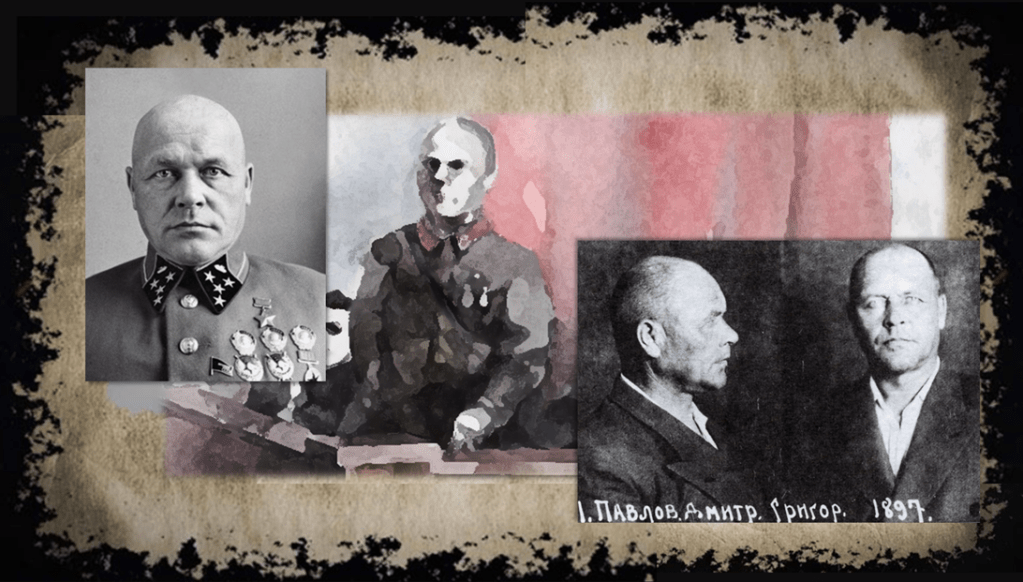
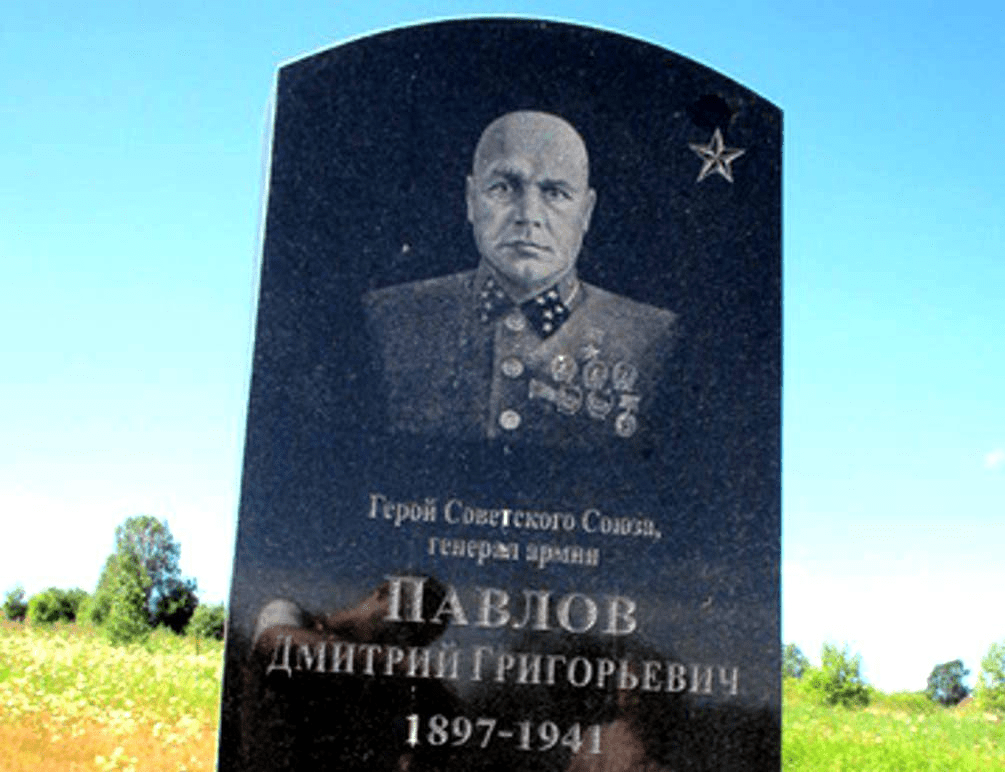
When discussing Nazi Germany’s opening volleys against the Soviet Union on 22 June 1941, and what Josef Stalin observed as a shameful withdrawal and defeat of Red Army forces in the Western Special Military District [ZapOVO], it is important to give pause and consider the tragic fate of ZapOVO Commander Dmitriy Grigoryevich Pavlov, at the time a decorated Hero of the Soviet Union.
Pavlov was born in 1897 into a peasant family in the village of Vonyukh, in the Kologrivsky District. In 1914, he volunteered for the army and went to the front. In 1916, he was wounded and taken prisoner. In 1919, following his return from captivity, he served in the Red Army. During the Civil War, he participated in battles on the Southern Front; he later took part in the resolution of the conflict on the Chinese Eastern Railway, in combat operations in Spain, and in the war against Finland.
From 1937, he served as a deputy to the Supreme Soviet of the USSR. At the 18th Congress of the All-Union Communist Party (Bolsheviks), he was elected as a candidate member of the Central Committee. From November 1937, he served as the Chief of the Red Army’s Automobile and Armored Directorate. From June 1940, he commanded the troops of the Western Special Military District. On June 4, 1940, he was awarded the rank of Colonel-General of Tank Troops. On February 22, 1941, he was awarded the rank of General of the Army. He was the driving force behind the creation and introduction into service of new tank models: the T-34 and the KV.
On June 21, 1941, he was appointed Commander of the Western Front. However, by July 22, 1941, pursuant to a verdict by the Military Collegium of the Supreme Court of the USSR, D.G. Pavlov was found guilty of displaying cowardice, inaction, and incompetence; of allowing the collapse of troop command and control; of permitting the surrender of weapons and ammunition to the enemy without a fight; and of allowing Front units to arbitrarily abandon their combat positions. By doing so, he was deemed to have disorganized the country’s defense and enabled the enemy to breach the Soviet front lines; consequently, he was sentenced to death, with the confiscation of his property and the stripping of his military rank. On that very same day, he was executed by firing squad and buried at an NKVD training ground near Moscow.
Less than a month later, members of General Pavlov’s family — his father, Grigory Vasilyevich; his mother, Yekaterina Stepanovna; his wife, Aleksandra Fedorovna; his son, Boris Dmitryevich; and his mother-in-law, Klavdia Mikhailovna Kuznetsova — were arrested. On October 1, 1941, pursuant to a verdict by the Military Tribunal of the NKVD Troops for the Gorky Region, they were stripped of their voting rights and exiled to the Krasnoyarsk Territory for a term of five years.
The fate of these “family members of a traitor to the Motherland” proved cruel: The General’s parents perished: his mother in 1943, his father in 1944, and his mother-in-law in 1947, worn down by the harsh living conditions and the soul-crushing burden of suspicion. The General’s son was convicted a second time on January 18, 1950, under Article 2 of the Decree dated June 4, 1947, and sentenced to 15 years of imprisonment. Pavlov’s wife made repeated, albeit unsuccessful, attempts to restore the family’s honor. It was not until December 16, 1954 — by ruling of the Military Tribunal of the Moscow Military District — that G.V. Pavlov, Ye.S. Pavlov, A.F. Pavlov, B.D. Pavlov, and K.M. Kuznetsova were officially rehabilitated.
Finally, by a ruling of the Military Collegium of the Supreme Court of the USSR dated July 31, 1957, the verdict issued against D.G. Pavlov on July 22, 1941, was overturned, and the criminal proceedings against him were terminated due to the absence of any criminal elements in his actions.
The following is the lengthy record of Pavlov’s 7 July 1941 interrogation, carried out three days after his arrest. His testimony is a riveting replay of the first 24 hours of Germany’s successful efforts to penetrate Red Army lines. It details the effect of the fog of war on undertrained and, at times, poorly-led troops trying to repel a force overwhelmingly superior in terms of weapons and personnel strength. He offers exhaustive blow-by-blow accounts of each of the units under his overall command and his need to rely on impromptu solutions based on the rapidly evolving battlefield across the entire front line. To the casual 21st century reader, it reflects Pavlov’s efforts as valiant in the face of impossible odds. However, his interrogators have the final word in the record, noting “…the deep breakthrough of German forces into Soviet territory can be attributed solely to your criminal actions as Front Commander…Along the entire length of the state border, it was only in the sector under your command that German troops drove deep into Soviet territory. I repeat: this is the result of treasonous actions on your part.”
They further attempt to solidify their case by stating that the investigating authorities “…established that you were a participant in a conspiracy as early as 1935, and that even then, you harbored the intention of betraying your country in a future war. Your current conduct at the front corroborates the findings of this investigation.”
There is a separate interrogation on record, dated 9 July, in which Pavlov, after having had some time on his own to reflect on his 7 July interrogation responses, freely admits his guilt in having committed the treasonous and conspiratorial behavior against the State for which he was accused. This record is widely considered to be a complete fiction to more easily justify his execution. Given that he was later rehabilitated and his verdict overturned, it is extremely doubtful that the 9 July 1941 interrogation ever took place.

RECORD OF THE INTERROGATION OF PRISONER DMITRY GRIGORYEVICH PAVLOV
7 July 1941
Question: Were you informed of the reason for your arrest?
Answer: I was arrested on the afternoon of July 4th of this year in Dovsk, where I was informed that I had been arrested by order of the Central Committee. Later, Mekhlis, the Deputy Chairman of the Council of People’s Commissars, spoke with me and announced that I had been arrested as a traitor.
Q: In that case, proceed with your testimony regarding your treacherous activities.
A: I am not a traitor. The troops I commanded were defeated due to reasons beyond my control.
Q: The investigation possesses evidence indicating that your actions over a period of years were treasonous, a fact that became particularly manifest during your command of the Western Front.
A: I am no traitor; there was no malicious intent in my actions as Front Commander. Nor am I to blame for the fact that the enemy managed to drive a deep wedge into our territory.
Q: Then how did it happen?
A: I shall begin by outlining the circumstances under which German military operations against the Red Army commenced.
At 1:00 a.m. on June 22 of this year, acting on orders from the People’s Commissar of Defense, I was summoned to Front Headquarters. Arriving there alongside me were a member of the Military Council — Corps Commissar Fominykh — and the Front Chief of Staff, General-Major Klimovskikh.
The very first question the People’s Commissar asked over the telephone was: “Well, how are things on your end? Is it quiet?” I replied that a massive movement of German troops was being observed on our right flank; according to a report from the 3rd Army Commander, Kuznetsov, German motorized and mechanized columns had been streaming continuously into the Suwałki salient for the past thirty-six hours. According to that same report, in the Augustów–Sapotskin sector, the Germans had removed their wire entanglements in a number of locations.
Regarding other sectors of the Front, I reported that I was particularly concerned about the grouping of forces in the Biała Podlaska area.
To my report, the People’s Commissar replied: “Calm down a bit, and do not panic. However, assemble your staff this morning just in case — something unpleasant might indeed occur — but mind you: do not rise to any provocations. If there are isolated provocations, give me a call.” The conversation ended there.
In accordance with the Commissar’s instructions, I immediately summoned all Army Commanders to the secure communications line, ordering them to report to their respective Army Headquarters accompanied by their Chiefs of Staff and the heads of their Operations Departments. I also instructed the Commanders to place their troops on combat alert and to occupy all defensive fortifications, including those constructed of reinforced concrete that were not yet fully completed.
In response to this order, Kuznetsov reported that, in accordance with instructions I had issued earlier, he had already distributed ammunition to his troops and was, at that very moment, proceeding to occupy the defensive fortifications. Golubev, Commander of the 10th Army, reported that his corps headquarters had remained, following a military exercise, at the locations prescribed by the plan for the command and control of their troops. I instructed Golubev to maintain his troops in a state of full combat readiness and to await my further orders.
Korobkov, 4th Army Commander, reported that his troops were ready for combat. He promised to verify the combat readiness of the Brest garrison. In response, I pointed out to Korobkov that the garrison must be positioned exactly where the plan stipulated, and I directed him to proceed with the immediate execution of my order.
Kopets, Commander of the District Air Force, and his deputy, Tayursky — who had reported to me at District Headquarters — reported that the air assets had been brought to a state of full combat readiness and dispersed across the airfields in accordance with the order issued by the People’s Commissariat of Defense.
This conversation with the army commanders took place at approximately 2:00 a.m.
At 3:30 a.m., the People’s Commissar of Defense called me again by telephone and asked: “Are there any new developments?” I replied that there was nothing new at the moment; my communication with the armies was established, and the appropriate instructions had been issued to the commanders.
At the same time, I reported to the Commissar that — contrary to the prohibition issued by Zhigarev, the Chief of the Air Force, regarding the fueling of aircraft with reserve gasoline and the replacement of engines using reserve stocks — I had issued orders to that effect to Kopets and Tayursky. The People’s Commissar approved this order of mine. I promised the People’s Commissar that I would report on the subsequent situation in my sector following a second round of discussions with the army commanders.
Over the next 15 minutes, I received the following information from the commanders:
From the Commander of the 10th Army: “All is quiet.” From the 4th Army: “Everything is quiet everywhere; the troops are carrying out the mission you assigned them.” In response to my question, “Is the 22nd Tank Division withdrawing from Brest?” I received the answer: “Yes, it is withdrawing, just like the other units.” The Commander of the 3rd Army replied that nothing new had occurred in his sector. Ivanov, the commander of the Fortified Region, stated that his troops were positioned within the fortifications; the 56th Rifle Division had been moved to its designated position in accordance with the plan; and the 27th Rifle Division was also in its assigned location; approximately one month prior to the outbreak of hostilities, I had transferred it from the Sapotskin–Grodno area to the Augustów–Grajewo–Sukhovoy sector. These positions had been approved by the General Staff. I set out to report the new situation to the People’s Commissar of Defense; however, before I could get through to Moscow, Kuznetsov called me by telephone and reported: “Along the entire front, there is an exchange of artillery, small-arms, and machine-gun fire. Over Grodno, some 50 to 60 aircraft are bombing the headquarters; I have been forced to take cover in the basement.” I instructed him over the phone to put “Grodno-41” into effect (this refers to the code word for the defense plan) and to act without hesitation, moving his headquarters to its designated position.
Immediately thereafter, I placed an urgent call to Belostok; Belostok replied: “At this moment, the front is quiet.”
At approximately 04:10–04:15, I spoke with Korobkov, who likewise replied: “Everything is quiet on our end.”
Some eight minutes later, Korobkov reported that “aircraft have launched a raid on Kobrin, and along the front, there is a tremendous volume of artillery fire.” I instructed Korobkov to put “Kobrin-41” into effect and ordered him to maintain firm control over his troops and to commence operations with unconditional responsibility.
I immediately and accurately relayed everything reported to me by the commanders to the People’s Commissar of Defense. The latter replied: “Act as the situation dictates.”
Q: How many minutes elapsed before you reported Kuznetsov’s message to the People’s Commissar of Defense, stating that the enemy had opened artillery, small-arms, and machine-gun fire in the area where his army was deployed?
A: I reported Kuznetsov’s message to the People’s Commissar about ten or twelve minutes later.
Q: Continue describing the situation at the front as it was unfolding.
A: Following my report to the People’s Commissar of Defense, I issued an order to the Staff to establish communications, in accordance with our plan, and specifically radio contact. A check of the high-frequency lines revealed that all such communication with the various armies had been severed. At approximately 05:00, Kuznetsov reported the situation to me via long-distance telephone, utilizing bypass lines. He reported that enemy forces were being held in check, but that the town of Sapotskin was engulfed in flames, having been subjected to particularly heavy artillery bombardment, and that the enemy had launched an offensive in that sector; for the moment, our troops were successfully repelling their attacks.
At approximately 07:00, Golubev sent a radiogram reporting that small-arms and machine-gun fire was raging across the entire front, and that all enemy attempts to penetrate deeper into our territory had been repulsed.
General Semenov, Deputy Chief of Staff of the Front, reported to me that the town of Lomzha had been captured by the enemy, but that a counterstrike by the 6th Cavalry Division had successfully driven the enemy out of Lomzha once again. From that point onward, radio communication with the Headquarters of the 10th Army became intermittent. In response to my request for a precise update on the disposition of our units, the 10th Army Headquarters transmitted a coded report detailing the current locations of its various divisions and the general operational situation; this report indicated that our units along the front were successfully repelling enemy attacks and inflicting heavy casualties upon the adversary. The forces engaging the 10th Army consisted primarily of enemy infantry, supported by a relatively small number of tanks; furthermore, a swift enemy thrust in the vicinity of Semyatichi resulted in the surprise encirclement of the 113th Division’s signal battalion. The enemy has deployed substantial mechanized forces to this sector, and our troops were currently engaged in fierce combat against them. In certain areas, our infantry — pressured by enemy tanks — was conducting a tactical withdrawal in the general direction of Bryansk. This same report stated that the commander of the 10th Army was committing the tank crews of the 13th Mechanized Corps, which comprised a total of only about 200 tanks, to the attack, engaging the entire corps in the general battle; furthermore, it noted that he planned to employ the 6th Mechanized Corps, also under his command, to deliver the strike.
Q: How did you assess this report from the Commander of the 10th Army?
A: I assessed that the enemy was pinning down the actions of the 10th Army with its infantry, supported by only a negligible number of tanks, along the front, while seeking to deliver a more powerful strike from the direction of Drogochin–Nagaynovka, or further north toward the corridor situated between the Belovezhskaya Pushcha and the Suprenevsky Forests.
Q: What instructions did you issue to the 10th Army Commander in light of this assessment?
A: The Commander of the 10th Army was instructed to immediately move the anti-tank brigade to its designated position and deploy it in the area west of Mikhalovo, along the line south of Białystok.
I also impressed upon Golubev that the commitment of the 6th Mechanized Corps into battle must be executed so as to deliver the most powerful strike possible; I advised him to thoroughly assess the situation and to act accordingly. In this same message, I informed him that my deputy, Boldin, was on his way to his location.
Q: Did you report the new situation to the People’s Commissar of Defense?
A: Reports addressed to the People’s Commissar of Defense were dispatched regular as clockwork, in accordance with the instructions of the General Staff.
Q: Did you receive any [additional] instructions from the People’s Commissar?
A: I duly received directive instructions from general headquarters, in accordance with the prevailing situation.
Q: How did events next unfold?
A: Upon receiving highly fragmentary reports from the 4th Army Headquarters —stating that the army intended to launch a counterstrike against the enemy in the vicinity of Zhabinka — I was left utterly perplexed by the message; I simply could not fathom how the 4th Army could have retreated 30 kilometers from Brest in such a short span of time. I queried Korobkov and received a reply stating that he had lost radio contact with both the 49th and 75th Rifle Divisions. He reported, however, that he knew the current location of the 75th Division and was maintaining contact with it via liaisons. Korobkov further reported that he was committing Oborin’s corps to a counterattack against very large enemy mechanized forces, and that he would report the outcome of the assault once it was concluded.
Subsequent reports revealed that Zhabinka had changed hands seven times over the course of that day; although our infantry had successfully dislodged the enemy’s foot soldiers at every turn, Korobkov nevertheless began to withdraw toward Kobrin under pressure from the enemy’s mechanized units.
I issued an order to transmit a radio-telegram to Korobkov, sternly instructing him to cease acting on his own initiative and to refrain from abandoning defensive lines so readily; instead, he was to hold and fight for every single defensive position until explicit authorization to withdraw was received from the Front Headquarters.
I dispatched a group of liaison officers to Korobkov with categorical instructions to demand, in the strongest possible terms, that the 4th Army Headquarters reassert proper command and control over its troops. They were further instructed to require the Army Commander and his Chief of Staff to submit joint, signed reports detailing the exact location and operational status of every unit under their command. Concurrently, I ordered the immediate deployment of the entire 113th Rifle Division to reinforce Korobkov; the division was placed under his operational command and directed toward Kartuz-Bereza. To expedite this transfer, an entire motor transport regiment — then stationed in Starye Dorogi — was assigned to assist in the movement of the division. Furthermore, Korobkov was instructed that the defensive line in the Kartuz–Bereza area was to be prepared for defense and for providing cover for the deployment of the 55th Division. All these measures were subsequently and promptly reported to the People’s Commissar of Defense.
In the afternoon, Kuznetsov reported that of the three radio stations at his disposal, two had been destroyed and the remaining one was damaged; he requested that a replacement radio station be sent to him. During this same period, he also reported that our units had abandoned Sapotskin; with a tremor in his voice, Kuznetsov declared that, in his opinion, nothing remained of the 56th Rifle Division but its name. I replied that he was panicking prematurely and unnecessarily, that the men would regroup. I then asked Kuznetsov what he was doing regarding the 85th Rifle Division. He replied that the 85th Division, having deployed along a line west of Grodno, had begun to withdraw to the south and southeast under pressure from heavy enemy tanks; however, he — Kuznetsov — was committing Steklov’s tank division to a counterattack in an attempt to restore the situation for the 85th Division. When I asked about the situation on his right flank, Kuznetsov replied that, in his view, the situation there was catastrophic: scattered units in the Koze area (north of Grodno) were barely managing to hold back the enemy’s onslaught, while a rifle regiment positioned between Koze and Druskininkai had been crushed by a rear-flank strike from very large enemy mechanized formations; nevertheless, he added, he was currently gathering all available resources at his disposal and committing them to the Koze area. Finally, Kuznetsov asked: “I have a feeling we will have to abandon Grodno; in that event, what should be done with the supply depots and the families of the officer corps — many of whom have already been left behind in enemy territory?” I replied that if any locations had to be abandoned, the depots, along with all supplies and equipment that could not be evacuated, were to be completely destroyed.
Kuznetsov handed the receiver to the Member of the Military Council, Biryukov, who asked once again: “But what are we to do about the families?” I replied: “Since battle has overtaken us, it is not the commanders’ business right now to worry about families, but rather to focus on how the fighting is being conducted.”
In its next report, the 3rd Army Headquarters stated that the enemy had reached the approaches to Grodno and that our units were withdrawing from the city. Acting on Kuznetsov’s orders, the supply depots were blown up; prior to their destruction, however, the army had managed to replenish its stock of artillery shells from these very depots.
On that same day, Golubev, perceiving the rapidly mounting enemy pressure from the direction of Siemiatycze toward the Bryansk–Bielsk axis, submitted a report without having fully clarified the actual situation, claiming that the enemy had already reached the approaches to Bielsk, whereas in reality, the enemy was still engaged in combat near Bryansk. Golubev thereupon made the decision to commit the Mechanized Corps to the battle.
Assessing the overall situation, I observed that the 3rd Army Headquarters had evacuated Grodno and relocated to Luno; however, the enemy was not exerting any significant pressure on or actively pursuing the 3rd Army. On the 10th Army’s left flank, the enemy, at the cost of immense effort, was exploiting its success and pushing back our units. In all other sectors of the 10th Army, every enemy attempt to launch an offensive had been repulsed. Within the 4th Army, the command appeared to be in a state of utter disarray; effective control over the troops had been lost, and the enemy was rapidly exploiting its success, advancing along the Bobruisk–Brest highway.
In light of this situation, I issued orders to the 6th Motorized-Mechanized Regiment to launch a strike against the enemy from its current staging area in the direction of Bryansk. Its objective was to defeat the enemy’s mechanized forces in the Bryansk area and, upon the successful completion of this mission, to concentrate all its assets in the vicinity of Volkovysk, placing them at my disposal. This order was subsequently relayed via airborne couriers and radio transmissions.
In the 3rd Army’s sector, we had lost control of the Augustów region. In the 10th Army’s sector, our units remained positioned exactly where they were designated to be according to the operational plan, with the exception of the left flank, where the enemy had seized Ciechanowiec and was approaching Bryansk.
Units of the 4th Army were engaged in combat for Zhabenko; however, I received intelligence indicating that while the units of the 42nd and 6th Rifle Divisions, along with the 22nd Tank Division, were withdrawing from Brest, they came under intense fire from a massive concentration of enemy artillery. The enemy had focused the entirety of its fire first and foremost on the housing quarters of our command staff, and secondly on the streets, roads, and vehicle depots. I am aware that this bombardment inflicted heavy material losses upon the artillery assets of the units withdrawing from Brest. This information was derived from reports submitted by the Corps Commander and the Commander of the Tank Division.
Q: What conclusions did you, as Front Commander, draw from the outcome of the first day of battle?
A: Based on the results of the first day of combat, I concluded that the forces engaging the center of the 10th Army consisted predominantly of infantry, and that our own infantry was successfully repelling all enemy attacks. On the right flank, facing Kuznetsov and in the direction of Sapotskin, the enemy had deployed heavy tanks, which were impervious to our 45mm artillery fire; furthermore, the enemy had committed infantry in the wake of these tanks, thereby breaching our defensive lines. On this same right flank, under Kuznetsov’s command, an entire regiment was routed by a large enemy mechanized formation that had advanced from the north, from Lithuania, comprising two to three mechanized divisions and two to three motorized divisions. This development gave me grave cause to fear that this mechanized force might pivot its strike in the general direction of Lida.
Q: What measures did you take, as commander, to prevent a breakthrough of the front?
A: On the right flank, I issued instructions to the 3rd Army: utilizing the attack of the 11th Mechanized Corps in the direction of Sapotskin, units of the 85th Division, belonging to that same army. were to occupy a second defensive line west of Grodno, at Sukhovolo, facing north. I ordered Kuznetsov to rally the battered units of the 56th Division, position them on the right bank of the Neman River, and defend Grodno as well as the approaches toward Lida.
Anticipating a strike from Lithuania, I ordered the commander of the 21st Rifle Corps (headquartered in Lida) to establish a defensive line: assigning an anti-tank brigade to the sector west of Lida, and the 17th Rifle Division to the sector northwest of it. The objective was to hold this line in order to gain time and enable the 37th and 24th Rifle Divisions to concentrate in the area northwest of Lida, thereby securing the right flank against a strike from Lithuania originating from the direction of Orany, while establishing contact with Lithuanian units. The commander of the 21st Rifle Corps duly executed these orders; however, no units whatsoever were found in the Orany area.
Q: Did you convey your decision to the Commander of the 21st Rifle Corps in the form of an order?
A: Yes. This same directive was also transmitted to the commander of the 3rd Army, instructing him that, effective from the moment of receipt of this order, the commander of the 21st Rifle Corps was to be incorporated into his command.
Regarding the left flank, I have already reported: the 55th Rifle Division was advancing from Slutsk in the direction of Kartuz-Bereza; it was being transported by motor vehicles with the mission of joining the 4th Army and securing the Slutsk sector. Furthermore, the 143rd Division, which had arrived in echeloned formations, was completing its concentration in the Obus–Lesno area, tasked with reinforcing units of the 4th Army in order to launch a counterstrike in the direction of either Kartuz-Bereza or Milovitsy, depending on the operational situation. Additionally, the 131st Division was positioned in this same area, having prepared defensive positions along the Shchara River and standing ready to launch a strike — depending on the situation — either toward Ruzhany or toward Pruzhany.
As for the 10th Army: following my directive to Boldin to launch a strike with his mechanized corps toward Bryansk, with the objective of destroying enemy mechanized units in that area and, upon completion of that mission, withdrawing to my reserve at Volkovysk, the Army subsequently received a directive from General Headquarters to launch a strike in a northerly direction using a mechanized cavalry group, with the objective of restoring the situation in the Grodno area. To oversee the execution of this new mission assigned to the 10th Army’s mechanized cavalry group, I appointed Lieutenant General Boldin, who arrived at the designated location in a timely manner.
At the same time, in order to direct the operations of the 3rd and 10th Armies and to supervise the strike by the mechanized cavalry group, Marshal Kulik departed on June 23rd and arrived at 10th Army Headquarters. Subsequently, we received a report regarding the 6th Mechanized Corps stating that it had failed to accomplish its initial objective; for reasons unknown to me, the Commander of the 10th Army, Golubev, had not committed it to the attack. The Corps shifted its concentration area, redeploying to a position east of Białystok, in the vicinity of Waliły. The 29th Motorized Division took up a defensive front at Sokółka and to the southwest thereof.
Q: And you felt that these measures were sufficiently comprehensive to restore the situation?
A: No, they were insufficient, but there was nothing else I could do, as no more units were available.
Q: Did you know the grouping of enemy forces deployed against you definitively?
A: Definitively? No. This information became more refined as the battle progressed, aided by aerial reconnaissance. By the first day of combat, it became clear that large enemy mechanized formations were present in the Brest, Siemiatycze, and Zhabinka areas, as well as in Lithuania, in the region west of Orany. Up to four or five rifle divisions were advancing against the 10th Army, while up to three rifle divisions, supported by heavy tanks, were advancing in the direction of Sapotskin and Grodno.
Q: Did you take all measures possible to provide the army with radio stations?
A: Yes, I took all necessary measures in this regard. When, on the first day of the battle, Kuznetsov called me and requested that I send a radio station — as the three he had were destroyed — I requisitioned them from Moscow by aircraft. Moscow did not respond at first; however, following my repeated requests, they replied that they had dispatched 18 radio stations. However, up to the day of my arrest, these radio stations had still not been received.
Q: How do you explain, then, that the Germans ultimately managed to break through the front and push deep into our territory?
A: On the Brest axis, three mechanized corps descended simultaneously upon the 6th and 42nd Divisions, thereby establishing enemy superiority in terms of both troop numbers and the quality of their equipment. The Commander of the 4th Army, Korobkov, having lost control and, by all appearances, having become disoriented, failed to adequately secure this primary axis with his available forces, even by the simple expedient of redeploying the 49th Division to the sector. On this very same Brest axis, the enemy unleashed a massive force of bomber aircraft against the 6th and 42nd Divisions. According to Korobkov’s report, these aircraft systematically and meticulously pounded our infantry positions, while enemy dive-bombers knocked our artillery pieces out of action, one after another. The enemy enjoyed total air supremacy, a situation exacerbated by the fact that our own fighter force had been largely wiped out on the very first day, following a simultaneous enemy strike launched against all our airfields at precisely 04:00, before our aircraft could even get off the ground. In total, up to 300 aircraft of all types, including trainers, were destroyed that day. All of this occurred because it was still dark, and our aircraft were unable to take off. I was physically unable to personally verify how our aircraft were dispersed across the airfields; yet, the Commander of the Air Force, Kolets, along with his deputy Tayursky, his deputy for political affairs Listrov, and the Air Force Chief of Staff, Taranenko, had all reported to me that they had fully complied with the People’s Commissar of Defense’s order regarding the concentrated deployment of our air assets.
Q: Did you not receive a report that enemy aircraft had appeared at the border?
A: I received this report simultaneously with the onset of the bombing. The Minsk Central VNOS Post received word that enemy aircraft had crossed the state border four minutes later; the border airfields, however, had received this report significantly earlier but were unable to take to the skies, as they had not yet mastered night flight operations with their new equipment.
Q: Tell us how events on the front unfolded next.
A: On June 23, the Front Headquarters received a telegram from Boldin, also addressed to the 10th Army, stating that the 6th Mechanized Corps possessed only one-quarter of a full fuel load. Given the critical need for fuel, the OSG (Fuel Supply Department) had, as early as the first day of combat, dispatched the entire fuel stock available within the District — specifically, 300 tons — to Baranovichi for the 3rd Mechanized Corps. According to the General Staff’s plan, the remainder of the District’s fuel reserves was located in Maikop. However, the fuel shipments were unable to advance beyond Baranovichi due to the enemy air force’s incessant destruction of railway tracks and stations.
On to the 4th Army Front. For the second consecutive day, the enemy, employing exclusively aircraft, tank units, and motorized infantry, advanced toward Kobrin. Our units, poorly commanded by the 4th Army Commander, Korobkov, were forced to abandon Kobrin under pressure from superior enemy forces. I felt that the abandonment of Kobrin exposed of the 10th Army’s left flank and directly threatened its encirclement. I dispatched my assistant for military educational institutions, Khabarov, to the Army with my strictest orders: to execute as many personnel as necessary, but foremost, to halt the 4th Army’s retreat and ensure that the Army Headquarters regained effective control of its forces. Simultaneously, orders were issued to reinforce the 4th Army by deploying the 121st Rifle Division in the direction of Rozhany and by accelerating the transport of the 55th Division to the Kartuz-Bereza defensive line. The 155th Division, which was firmly holding the Slonim defensive line, was ordered to remain in readiness to pivot from the Volkovysk Highway toward Rozhany, thereby also moving to the aid of the 4th Army. This order was delivered to division commanders and to Korobkov by couriers traveling via Baranovichi, as well as by aircraft.
Concurrently, in order to secure the Baranovichi sector, the 17th Mechanized Corps (devoid of its combat materiel) was ordered to cover the Baranovichi junction from the direction of Obus–Lesna, a task which the 17th Corps executed with great diligence, even under conditions where it was completely encircled.
On the second day of operations, enemy aircraft conducted continuous raids throughout the day against the airfields housing the fighter regiment of the 43rd Aviation Division, subjecting the airfield to bombardment on twelve separate occasions.
Due to the fact that the Losinets airfield had been bombed, and all aircraft, both training and civilian, that were incapable of flight had been rendered completely inoperable, the Air Force command redeployed the regiment to the Slepianka airfield. Simultaneously, on this second day, the enemy inflicted damage upon the railway junctions at Orsha, Borisov, Bobruisk, and Osipovichi, and completely destroyed the artillery depot at Gaynovka.
On this day, enemy aviation lost 27 aircraft.
On the second day, the units of the 10th Army, with the exception of the Army Headquarters, remained in their positions. The Army Headquarters relocated its command post, withdrawing east of Białystok to the Vapila area. Units of the 4th Army, under ceaseless pressure from enemy mechanized forces and aircraft, continued their withdrawal toward the Pruzhany–Bereza-Kartuska line.
Over the course of the second day, the 3rd Army advanced 13 to 17 kilometers in the direction of Grodno.
I possessed no information regarding personnel or materiel losses for either the first or the second day, save for a general report from Kuznetsov; on the first day, he had reported that the 56th Rifle Division had ceased to exist—yet, in reality, the division had lost only about 25 percent of its personnel. By the end of the first day and the morning of the second, the division had re-emerged: one portion appeared on the left bank of the Neman River, and the other on the right bank.
The 85th Division of the 3rd Army, though it had sustained losses, remained fully combat-capable.
The 27th Division of the 3rd Army successfully disengaged and established a firm defensive line along the Sukhovoy–Genions sector, where it linked up with a division of the 10th Army.
Conclusions drawn from the third day: the enemy was advancing rapidly from the Brest axis, employing large mechanized forces supported by very powerful air assets that were systematically pounding our infantry and artillery.
Q: What steps did you take to try bringing about a turning point on the front?
A: In order to counter the rapid pace of the enemy’s offensive, my first measure, which I took on the 23rd, was to commit all available bomber aircraft exclusively to striking the advancing enemy in the Kobrin area; at the same time, the pace of moving the 55th Division from Slutsk to the Bereza-Kartuzskaya area was stepped up so that this sector could be secured by a cohesive, organized formation. The 121st and 143rd Divisions were placed at the disposal of the Commander of the 4th Army. The latter division continued to offload and concentrate in the Obus–Lesna area.
Q: What results did the measures you carried out yield?
A: The result was that we managed to halt the enemy for a single day in the Bereza–Kartuzka area.
Subsequent events unfolded as follows: after we reported to General Headquarters regarding the dire situation in the Brest sector, and specifically reported that enemy mechanized units were launching a heavy strike along the Belsk–Gorodok axis, apparently with the objective of cutting off units of the 10th Army, an order was received to rapidly withdraw all units to the line of the Shchara River. This order was delivered to the 10th Army, transmitted twice by radio (with receipt acknowledged), and duplicated for all armies via aircraft and paratroopers. Special liaisons were dispatched to each army to monitor the execution of this order. This same group of officers was instructed to locate Marshal of the Soviet Union Kulik within the 10th Army’s operational area. The units received the order and proceeded to carry it out.
At the same time, to ensure the orderly withdrawal of units to the Shchara River line, defensive positions were already being fully prepared by units of the 155th, 121st, and 143rd Divisions, and these units subsequently occupied that line.
The 55th Division, operating in the Brest sector, came under attack by at least three tank divisions — supported by a large number of bombers — immediately upon reaching its designated line. The division was cut in two and driven back into the woods on both sides of the roadway. Thus, simultaneous with the occupation of the Shchara River front, a new breakthrough developed on the left flank. The enemy surged toward Slutsk.
I personally assigned Chief of Staff Sandapov the following tasks: to occupy and defend the Slutsk Fortified Region with the UR [Fortified Region] troops; to personally accompany the army commander to the 55th Rifle Division, impose strict order, and force it to defend the former state border; and to launch a counterattack southward with units of the 143rd Division, with the goal of cutting the highway in the Kartuz-Bereza area.
I was unable to determine how this order was carried out. I only learned that units of the 55th Division were attacked that day on the right flank, from Baranovichi, by no fewer than 60 tanks.
The enemy attack was repelled by both artillery and troops, but these actions alone showed me that some of the enemy had broken through to Baranovichi, thereby reaching the rear of the second group – that is, the 121st, 155th, and 143rd Divisions. However, thanks to the measures taken by the commander of the 17th Mechanized Corps, General Petrov, up to 45-50 enemy tanks that had broken through to Baranovichi were destroyed, and the rest retreated south.
I knew that on the 24th, units of the 3rd Army had begun a retreat to the line designated by Headquarters — the Shchara River. I just didn’t know where the 6th Mechanized Corps was being directed by the 10th Army headquarters. According to my orders, it was to advance rapidly ahead of the infantry and take up a position in the Slonim area, ready to cut off a possible enemy counterattack aimed at encircling the 10th Army from the south. I dispatched this order to Headquarters, and it was approved.
On the 25th, the enemy, according to those fleeing from Lithuania, routed the 5th Mechanized Division in the Vilnius area. The Lithuanian National Division scattered, and enemy mechanized units appeared on the right flank of the 21st Rifle Corps, which further accelerated the movement of the 50th Division toward Vileika and the 24th Division to join the 21st Rifle Corps.
North of Lida, the 24th Division was attacked by at least one enemy tank division, inflicting heavy losses, and halted at the line it had occupied, facing northwest.
The 37th Division, having repelled a tank and motorized mechanized attack with heavy losses, counterbalanced the front, joining the 24th and 17th Rifle Divisions. The enemy rushed toward Molodechno, outflanking units of the 21st Rifle Corps, encountering no resistance, as there were no troops in that area and nowhere to get them from. Having simultaneously hit the 50th Division in the Vileika area, the enemy occupied Molodechno and thereby cut off the 50th Division’s connection with the 21st Rifle Corps.
The commander of the 50th Division made a completely correct and sound decision to withdraw and occupy the Pleschanitsa [sic] area in order to establish a strong defense of the Minsk–Borisov axis.
Following the enemy’s capture of Slutsk and Molodechno, the troops of the Fortified Regions — specifically the Minsk and Slutsk Fortified Regions — were placed on full combat alert; to reinforce these regions, the 64th, 108th, and 100th Divisions were advanced forward — the latter being tasked with defending the northern sector of Minsk — while the 161st Division was held in reserve south of the city. By this time, these divisions, with the exception of the 100th, were only just completing their deployment.
The retreating headquarters of the 13th Army was ordered to establish the Minsk Front, roughly along the line extending from Pleshchanitsy to the Minsk and Slutsk Fortified Regions. The army’s composition included the 2nd and 44th Rifle Corps, as well as the 20th Mechanized Corps (which, however, lacked its material assets). Thus, a front covering Minsk was being established, and forces were being massed for a potential counterstrike, should it become necessary to extricate the Minsk-Novogrudok and Baranovichi groupings from encirclement.
On the 25th, the Front Headquarters received a telegram from the headquarters of the 10th Army: “Our units have reached the Zelvyanka River; all river crossings are occupied by the enemy. Request support from the Baranovichi sector.”
I issued orders to the 10th Army to either seize the crossings or seek alternative routes of withdrawal — either across the Neman River or further south through the forested terrain, depending on the prevailing situation. The troops were ordered to report their exact locations with greater precision and to specify their intended course of action. At the same time, to ensure the proper coordination of the troops already positioned along the Shchara River line, I dispatched my assistant for military educational institutions, Khabarov, along with a group of liaison officers, to Petrov’s headquarters. Their mandate was to oversee the efforts of this grouping in facilitating the withdrawal of the 10th Army’s units; subsequently, they were instructed as to where, and in which direction, these combined groupings were to withdraw.
By this time, following successful engagements in the vicinity of Slonim, the enemy’s forward tank units had been defeated. Furthermore, a map was recovered from the body of a slain enemy officer; this map precisely delineated the entire attacking enemy force, spanning the entire front from the Bug River all the way to Baranovichi (inclusive). This map reveals that the enemy was conducting an offensive with a force of three mechanized corps, and that, along the axis of the main thrust, this entire grouping bore down initially upon the front of two rifle divisions, and subsequently upon that of a single rifle division.
Judging by the course of events, it could be determined that in the vicinity of Slonim, as well as in the vicinity of Volkovysk, the enemy had apparently committed a mechanized division belonging to their left-flank corps.
During the fighting within the Minsk Fortified Region, the headquarters of a German corps was completely routed, and all of its documentation was captured. These documents establish that two mechanized corps, reinforced by three motorized divisions, were operating in this sector.
Regarding the 13th Army, the Army Commander issued an order based on a personal directive from the People’s Commissar of Defense, relayed through Marshal Shaposhnikov, to “fight for Minsk with absolute tenacity, and to continue fighting even in the event of encirclement.” This order was disseminated to all troops; this explains the tenacity with which the units fought against the enemy’s numerous mechanized formations. Once their armor-piercing shells were exhausted, the units resorted to using ordinary bottles and canteens filled with gasoline to set fire to the German tanks. By this method alone, the 100th Division destroyed no fewer than 100 tanks. I had, in fact, instructed all troops in the use of this method back in the winter of this year, drawing upon the combat experience gained at Khalkhin Gol. However, the enemy’s mechanized units bypassed the Minsk Fortified Region; after dropping parachute assault groups in the vicinity of Smilovichi, they linked up with these airborne troops and cut the Minsk–Borisov highway.
The only remaining supply routes for our units were the Minsk–Osipovichi highway and the Mogilev highway.
On the left flank, by the time I departed for the front, the enemy was approaching Starye Dorogi, encountering no organized resistance whatsoever. Furthermore, according to a report from the commander of the Urechye depot, an enemy force consisting of at least a tank regiment was closing in on Urechye that very day; this compelled the depot commander to set fire to and blow up the facility before withdrawing. There were no longer any troops available to cover this sector.
On the spot, I issued orders to form platoons, companies, and battalions from personnel of various divisions withdrawing from the rear, and to deploy them along the Starye Dorogi line. Simultaneously, the Bobruisk [Military] Tractor School was mobilized and took up defensive positions near Bobruisk. All bridges spanning the Berezina River were mined and prepared for demolition. The remnants of the 42nd Division — albeit severely depleted — along with the 21st Reserve Regiment, established defensive positions on the left bank of the Berezina.
Regarding the demolition of the bridges, I assigned a specific mission to the commander of the 42nd Division, Lazarenko: in the event of the appearance of enemy tanks or a threat to the river crossings, he was to blow up all the bridges — an order General Lazarenko duly executed during the withdrawal of our units.
Around 03:00 on the night of June 27 or 28, the Chief of Staff of the 13th Aviation Division received a direct order from me to evacuate the airfield at the very first glimmer of dawn in order to avoid total destruction. The air units executed this maneuver with great timeliness; indeed, by dawn, the airfield had already been occupied by enemy tank units. Throughout this period, the enemy continued its relentless efforts to locate crossings over the Berezina River in the vicinity of Ptatkovo and Domanovo.
To support the placement of these river crossings, the enemy employed massive air raids involving dive-bombers, as well as an overwhelming volume of mortar fire. For two consecutive days, the primary mission assigned to our own air force was to conduct bombing strikes against the enemy forces concentrated around Bobruisk.
To facilitate telephone communications with the Commander of the Air Force, I devised the following code system: “Northern Group” designated the area around Smilovichi; “Northern-2” designated the area around Pleshchenitsy; and “Southern” designated Bobruisk. This code was established to ensure that all aviation assets, depending on the operational situation, could be concentrated on any one of these sectors by means of a simple directive.
From the 25th through the 28th, there was no radio communication with either the 3rd or the 10th Army. Attempts to dispatch liaisons by aircraft ended in failure, as the planes were shot down.
A large number of liaisons were dispatched via circuitous routes using automobiles. I do not know whether or not these liaisons succeeded in reaching the headquarters of the 10th and 3rd Armies.
Individuals emerging from the 3rd and 10th Armies brought back intelligence regarding the locations of those armies’ headquarters or specific units — information that was typically two days out of date. From the 10th Army, the 1st Anti-Tank Brigade managed to disengage from the Zelvyanka River line and break through. It broke through without a single artillery shell to its name; however, it was halted at the Berezina River and immediately resupplied with ammunition in order to defend the river crossing.
Afterwards, the primary objective became to locate the whereabouts of our units, by any and all means and at any cost. Paratroopers were dropped into the area where our units were presumed to be located, tasked with delivering an encrypted telegram or verbally conveying the designated withdrawal route.
Marshal of the Soviet Union Kulik remained with the 10th Army continuously, right up until my departure; his ultimate fate remains unknown to me to this day.
On the eve of my arrest, I learned at Front Headquarters that a cavalry corps — and, reportedly, the 113th Division — were breaking out of encirclement. Measures taken to delay the enemy’s advance on Minsk from the Slutsk area succeeded in keeping open a corridor for our units to exit south of Minsk, extending as far as Shatsk (inclusive); it was toward this area that all units of the 155th, 121st, 143rd, and 55th Divisions, as well as the 21st Rifle Corps, were directed, with the exception of the 50th Division, which had been ordered to establish defensive positions along the left bank of the Berezina River, north of Borisov.
As I withdrew our units toward the Berezina River, I took the precaution of organizing covering detachments, drawn from various composite groups and training schools, to secure the river crossings in the vicinity of Borisov, Berezino, and the Svisloch River. The mission of these detachments was to ensure the safe passage of all our units across the Berezina; once across, the units that had taken up positions on the left bank of the Berezina were tasked with holding that bank and preventing any enemy crossings.
The 47th Rifle Corps and the 20th Mechanized Corps were earmarked for use in a counterstrike along the general Mogilev–Bobruisk axis, with the aim of completely cutting off the enemy tank forces that had broken through toward Rogachev.
These measures, however, could not be implemented, as a new Front Commander arrived on the scene. As of the day of my departure, I am unable to report with precision on the status of the units comprising the 3rd and 10th Armies; however, judging by the condition of the troops, I knew that they would offer very long and stubborn resistance and take every measure to break out of their encirclement.
Throughout the entire period of combat operations, the Front Headquarters operated under extreme strain; we were forced to gather intelligence by every conceivable means, as wire communications had entirely ceased to function. These lines were being severed in the western regions by local anti-Soviet elements and by saboteurs — individuals who had been parachuted in.
The degree of physical exhaustion suffered by the Chief of Staff, General Klimovskikh, was so severe that I personally had to transcribe the orders being issued into my own notebook, or personally verify their execution myself, or dispatch special personnel, chosen from among the political officers, to conduct such verification.
I consider the primary cause of all our misfortunes to be the enemy’s overwhelming superiority in tanks and fresh materiel, as well as the enemy’s immense superiority in air power.
Q: Can you cite the personnel and material losses sustained by the Western Front during your command?
A: Up until the day of my arrest, I had no information in terms of losses, neither personnel nor materiel. Parts of the 3rd and 10th Armies remained encircled; their fate is unknown to me. The remaining units were successfully extricated from the encirclement through the measures taken and remained under effective command.
Q: Who is to blame for the breakthrough on the Western Front?
A: As I have already testified, the primary reason for the rapid advance of German troops into our territory was the enemy’s clear superiority in aircraft and tanks. Furthermore, Kuznetsov (Baltic Military District) had deployed Lithuanian units to the left flank — units that had no desire to fight. Following the initial pressure exerted upon the Baltic forces’ left wing, the Lithuanian units shot their commanders and dispersed. This enabled German armored units to launch an attack against me from the Vilnius area. Concurrently, the 4th Army Headquarters’ loss of command and control over their units, under Korobkov and Sandalov, facilitated the enemy’s rapid advance toward Bobruisk; moreover, the failure of the 10th Army Commander, General Golubev, to execute my order — specifically, to launch a strike toward Bryansk using the 6th Mechanized Corps in order to defeat the enemy’s mechanized grouping, and thereafter to place himself under my command in the vicinity of Volkovysk — deprived me of the ability to field a proper strike force.
Q: Were there treasonous actions on the part of your subordinates?
A: No, there were not. Some of the men experienced a certain sense of bewilderment amidst the rapidly changing situation.
Q: And what do you take responsibility for in Germany’s penetration of the front?
A: I took every measure to prevent a breakthrough by the foreign troops. I do not consider myself responsible for the situation that developed at the front.
Q: How long did you command the Western Special Military District?
A: One year.
Q: Were the District’s units prepared for military operations?
A: The District units were prepared for combat operations, with the exception of the newly formed 17th, 20th, 13th, and 11th Mechanized Corps. Moreover, within the 13th and 11th Corps, only one division in each was prepared for action; the remaining divisions, having received their intake of recruits, possessed only training-grade equipment, and even that was not available everywhere. The 14th Mechanized Corps possessed only a single, poorly trained motorized division, along with its tank divisions’ rifle regiments.
Q: If the District’s main units were prepared for combat operations, and you received the order to advance in a timely manner, then the deep breakthrough of German forces into Soviet territory can be attributed solely to your criminal actions as Front Commander.
A: I categorically deny this accusation. I have committed no acts of treason or betrayal.
Q: Along the entire length of the state border, it was only in the sector under your command that German troops drove deep into Soviet territory. I repeat: this is the result of treasonous actions on your part.
A: The breakthrough on my front occurred because I did not possess the new equipment — at least not in the quantities — that, for instance, the Kiev Military District had.
Q: You attempt in vain to attribute the defeat to causes beyond your control. The investigation has established that you were a participant in a conspiracy as early as 1935, and that even then, you harbored the intention of betraying your country in a future war. Your current conduct at the front corroborates the findings of this investigation.
A: I have never been involved in any conspiracies whatsoever, nor have I ever associated with any conspirators. I find this accusation profoundly grievous. It is false from beginning to end. If there is any testimony against me, it constitutes nothing but sheer, blatant lies fabricated by individuals seeking to cast aspersions upon honest people by any means necessary, thereby inflicting harm upon the State.
End of interrogation: 16:10.
I have read and verify that my words have been rendered accurately.
D. Pavlov
Interrogators:
Acting Deputy Chief of the Investigative Section of the 3rd Directorate NKO, USSR, Senior Battalion Commissar Pavlovskiy
Investigator, 3rd Directorate, NKO, Junior Lieutenant of State Security Komarov
Taken from the FSB Central Archive. Investigative Case No. R-24000, pp. 23–53. Manuscript, original.

Translation © 2026 by Michael Estes and TranslatingHistory.org

