
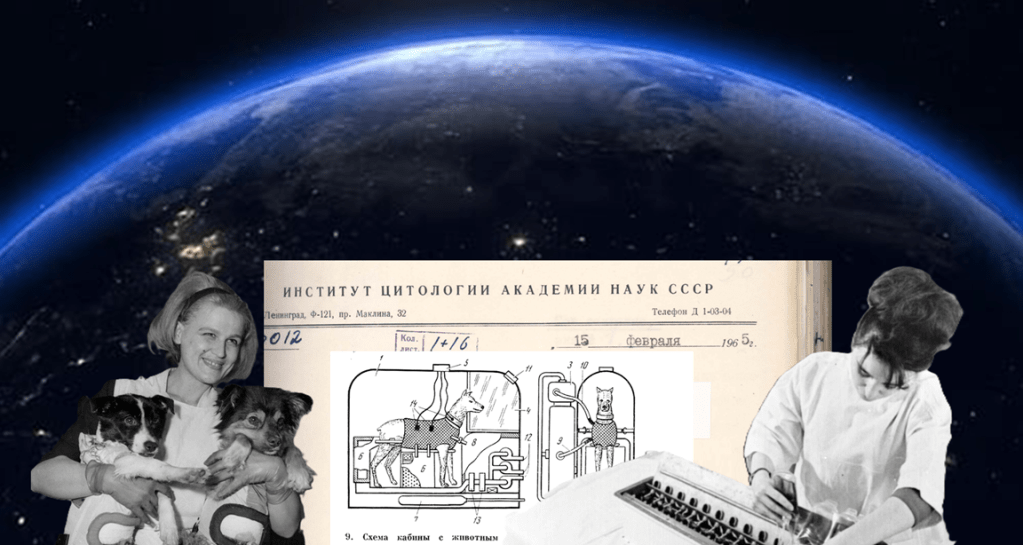
Today’s document is actually a packet of documents, written 60 years ago on the cusp of a Soviet space experiment to study the effects of long-term radiation exposure of one-cell organisms and “biochemically and biologically important matter.” The experiment would take place as part of the Cosmos 110 flight program, to be launched approximately one year after this packet was to be delivered.
The Cosmos-110 flight program included research into the impact of a three-week flight in orbit through the Earth’s inner radiation belt on biological organisms, as well as testing of the life support system for future long-term manned expeditions. The biological package aboard the orbiting spacecraft was a pair of dogs named Veterok and Ugolyok. These two dogs were selected from a hundred mongrel “candidates”. The “passengers” were placed in sealed containers with a specific gas environment, and they were tucked into “outfits” which connected sensors to the animals and kept their bodies from excessive movement. Feeding was carried out through a special fistula, which allowed liquid food to be automatically fed directly into the stomach. In addition to dogs, there were other biological objects of research on board (bacteria, plant seeds, yeast, etc.).
The launch took place on February 22, 1966 at 23:09 (Moscow time). The mission, involving constant flights through radiation belts, lasted 21 days 18 hours 51 minutes, and became a record for the duration of living beings in space at that time. Ugoltok and Veterok, who returned to Earth, were examined in the laboratory of the Institute of Biomedical Problems (IMBP). The space journey had weakened the dogs greatly: they looked thin and lethargic, tired quickly, preferred to lie down, and were constantly thirsty. As a result of exposure to space radiation, their fur thinned and fell out in clumps. However, after three days they began to revive, and after several weeks they had fully recovered. The mongrels lived a full life as inhabitants of the IMBP animal quarters and left behind healthy offspring.
The lengthy document package sent on 15 February 1965 by A.S. Troshin, Director of the Institute of Cytology of the USSR Academy of Sciences, to G.A. Skuridin, the Scientific Secretary of the Interdepartmental Scientific Technical Council for Space Research (MSTCSpoKI) at the USSR Academy of Sciences, contains a flight assignment for experiments on the Vostok and Voskhod type orbital spacecraft, including four documents entitled as follows:
1. The limits of life in conditions of increased solar ultraviolet radiation and using this data to predict the possibility of life on other planets;
2. The influence of weightlessness and changing gravity during long-term space flight on the reproduction of some unicellular organisms;
3. Complex effects of ionizing cosmic radiation on biochemically important matter;
4. Complex effects of space radiation and temperature on biologically important matter.
As this is the first of the declassified documents relating to Cosmos 110, there are no references yet to placing complex life forms (dogs) in orbit.
The translations follow:

15 February 1965
Top Secret
Copy 1
TO THE INTERDEPARTMENTAL SCIENTIFIC TECHNICAL COUNCIL FOR SPACE RESEARCH AT THE USSR ACADEMY OF SCIENCES
P/box 2287
to Science Secretary G.A. SKURIDIN
Herein we are sending you the flight assignment on the agreed topic. The primary task of this package is the study of the effects of a range of factors, specifically, ultraviolet, visible, ionized radiation, and other elements of the outer space environment on organic, biological matter and living objects, the response of which was studied in the space biology laboratory of the Institute of Cytology of the USSR Academy of Sciences.
Attachment: flight assignments 0056, 0057, 0058, and 0059, 4 pages each, for a total of 16 pages.
Director of the Institute of Cytology of the USSR Academy of Sciences
Associate Member A.S. Troshin

The limits of life in conditions of increased solar ultraviolet radiation and using this data to predict the possibility of life on other planets
Flight assignment on Vostok and Voskhod-type orbital spacecraft.
I. Goal and objectives
a) The primary goal of the study is the discovery of the impact of the complete solar spectrum (ultraviolet and visible fields) on the reproduction of protozoa.
b) Determination of whether it is possible for organisms unadapted to the complete ultraviolet spectrum to have a complete or partial photoreactivation under the simultaneous effects of two factors (the UV and visible fields of light).
II. Overview of previously conducted research. Russian and foreign.
Previously conducted biological studies used a powerful ultraviolet beam, primarily using the monochromatic or UV line spectrum (in acute experiments).
After being subjected to ultraviolet influence, the objects were exposed to visible light. As a rule, the researchers did not use protracted UV exposure. The available data in our instruction suggest that during the combined actions of the complete UV spectrum and the visible field of light can produce both a stimulating effect on a cell and suppress several of its functions.
III. Overview of study methods, Justification of experiment duration. Output data.
The work will utilize the following study methods:
1) determination of the rate of division and several other functions;
2) determination of resistance to respiratory and glycolytic inhibitors;
3) cytophotometric determination of the DNA and RNA in the nucleus and cytoplasm;
4) electron microscope studies of the nucleus and cytoplasm;
5) luminescent microscopy.
The performance of this type of cytological analysis will make it possible to determine the functional deterioration in the cell in prolonged space flight conditions. Space flight duration – 10-15 days.
IV. Justification for orbit requirement.
The flight must take place below the radiation belts, and last up to 15 days.
V. Content of scientific equipment.
On the Vostok and Voskhod type orbital spacecraft, near the quartz viewing port there are housed several quartz vials containing Paramecium caudatum, Colpoda spp., and Euglena gracilis Klebs. The biocapsule consists of quartz vials and a stand. The dimensions of the vials and the stand are based on that of the viewing port. A screen is installed behind the stand that does not allow UV rays into the ship.
Each vial is filled with a Lozina-Lozinsky medium, approximately 10m3 and weighing no more than 10.5 grams.
It would be best to place 6-8 of the quartz vials, each vial and its solution weighing 20-30 grams. The total weight will be no greater than 300 grams. The weight of the stand and shield together is no more than 150 grams.
VI. No power supply required.
VII. For the flight experiment to be conducted successfully, it is absolutely critical that E.I. Zaar, member of the Institute of Cytology of the AN USSR, junior research fellow, install the container with the living objects directly into the spacecraft. This will make it possible to conduct the experiment in a methodically correct manner and to reduce the amount of time the living objects spend travelling, and also to retrieve them at the spacecraft touchdown site.
We request your assistance in placing the order to manufacture the quartz vials and capsule at the Leningrad-based Lomonosov porcelain factory and at the Biofizpribor [laboratory equipment supplier].
[signed]
Director of the Institute of Cytology of the USSR Academy of Sciences A.S. Troshin
Head of the Space Biology Laboratory L.K. Lozina-Lozinsky
Junior scientific fellow E.I. Zaar

APPROVED: APPROVED:
Commander, v/ch 64688 Director of the Institute of Cytology of the AN USSR
Yu.M. Valynkin A.S. Troshin
Copy: Interagency Scientific and Technical Council for Space Research of the USSR Academy of Sciences
The impact of weightlessness and changing forces of gravity under prolonged space flight conditions on the reproduction of a number of single-cell organisms Paramecium caudatum, Colpoda spp., and Euglena gracilis Klebs.
Between v/ch (military unit number) 64688 [State Aviation and Space Medicine Research and Development Institute] and the space biology laboratory of the Institute of Cytology of the USSR Academy of Sciences, an agreement in principle has been reached on the conduct of a joint flight experiment under prolonged space flight conditions (up to 20 days) to understand the impact of weightlessness and the effect of low gravitation on a number of single-cell organisms.
The experiment is to be carried out on a test device designed under the supervision of Doctor of Medical Science A.A. Gyurdzhian.
I. Goal of the experiment.
The primary goal of the experiment is to determine the impact of the conditions of prolonged weightlessness on the functional state and reproduction of single-cell organisms, with subsequent cytological analysis.
The experiment will make it possible to answer the following questions: how a cell or single-cell organisms respond under prolonged weightlessness, and how they are impacted by in-flight artificial gravity.
II. Setup of the flight experiment
a) The preparatory part of the experiment is conducted in the space biology laboratory of the Institute of Cytology of the AN USSR to select the best conditions for culturing single-cell organisms in vacuum-sealed tubes.
b) Together with v/ch 64688 employees, developed construction of the container and vials for the flight experiment.
c) Placement of 4-6 containers with vials in the orbital spacecraft, in the instrument developed under the supervision of Doctor of Medical Science A.A. Gyurdzhian. Two containers under conditions of low acceleration, approximately 0.5 G, and in weightlessness.
Simultaneous to the flight with the containers on the orbital spacecraft, vials with one-cell organisms will be placed in the Space Biology Laboratory in a special thermostat in the same temperature conditions that match that of the spacecraft.
The dimensions and weight of the container with the vials are determined by Doctor of Medical Science A.A. Gyurdzhian and junior research fellow E.I. Zaar. Based on preliminary data, it is necessary to place 8 of the vials under artificial gravitation conditions and 6-8 in weightlessness. In each of the vials, the total weight of the medium is 160-200 grams.
d) After the orbital spacecraft returns to Earth, the Space Biology Laboratory of the Institute of Cytology of the AN USSR will perform a cytological analysis of organisms under space-flight conditions.
The following analyses will be conducted:
1) determination of the rate of division and several other functions;
2) determination of resistance to respiratory and glycolytic inhibitors;
3) cytophotometric determination of the DNA and RNA in the nucleus and cytoplasm;
4) electron microscope studies of the nucleus and cytoplasm;
5) luminescent microscopy.
The performance of this cytological analysis will make it possible to determine the functional deterioration in the cell in prolonged space flight conditions.
For the flight experiment to be conducted successfully, it is absolutely critical that E.I. Zaar, member of the Institute of Cytology of the AN USSR, junior research fellow, install the container with the living objects directly into the spacecraft. This will make it possible to conduct the experiment in a methodically correct manner and to reduce the amount of time the living objects spend traveling, and also to retrieve them at the spacecraft touchdown site.
Responsible parties:
[signed]
Candidate of Medical Science A.A. Gyurdzhian
Head of the Space Biology Laboratory L.K. Lozina-Lozinsky Junior scientific fellow E.I. Zaar

The combined effect of ionized space radiation on biochemically important matter
Flight assignments on two-way orbital spacecraft.
1. Goal and objectives
Because we are unable to put into force the impact of the simultaneous effect of composite radiation on radiated substances in terrestrial conditions, such an effort was undertaken in the proposed experiment. The objective of this study is the understanding at the molecular level, in t° of outer space, of the patterns and influence of composite space radiation (ionized radiation, ultraviolet rays, etc.) on biologically important matter. Performance of like research will make it possible to more closely approach an understanding of the radiation and chemical processes that take place in organic matter for a comparatively prolonged time in space.
II. Overview of previously conducted research. Russian and foreign.
The results we obtained in laboratory conditions in t° -78 on the effect of γ-rays Co60 on deoxynucleoprotein (DNP) indicated significant physical and chemical changes to the DNP when exposed to the combined effect of deep freezing and radiation. Both Russian and foreign publications contain no data relative to the systematic study of the photochemical and radiation, and cryolysis on biologically important matter under space conditions.
III. Overview of study methods. Validation of experiment duration. Processing results.
The following study methods will be used in the work.
1. Chromatography. 2. Colorimetry. 3. Chemical analysis. 4. Electro-paramagnetic resonance. 5. Spectrophotometry. 6. Physical and chemical methods. 7. Light scattering.
Because of the fact that solutions and dry matter will be subjected to radiation, the flight experiment duration should last 20-30 days or longer.
It is presumed that data will be obtained that will make it possible to draw a conclusion regarding the stability of various chemical linkages (biochemically important matter) to the effect of radiation and change of the physical and chemical properties of biomacromolecules.
IV. Validation of orbit requirement
Radiation belts – to receive a large dose of radiation, it is desirous that the objects of study spend a prolonged period of time in the inner and outer radiation belts.
Flight time – from 15 to 30 days (preferably even longer, up to 90 days).
V. Content of scientific equipment
Plexiglass capsule with windows, 150×100 mm. Weight of the 24 vials is approximately 300 grams. Total weight of the capsule is approximately 800 grams. The following preparations have been sent:
1. adenine
2. adenosine
3. adenylic acid
4. phenylalanine
5. phenyl-leucine.
Dry preparations, as well as solutions of these substances in various concentrations.
VI. No power supply required.
VII. During the flight the capsule with the quartz vials must be exposed to the outside. During the return to Earth, the capsule must be returned into the spacecraft. The vials in the capsule are fixed in the stand.
VIII. Expected results of the experiment.
The research results to a certain extent will make it possible to draw a conclusion on the radiation and chemical processes to which biochemically important matter can be subjected, experiencing the combined effect of the physical factors of space. This question, as is well known, is of great scientific interest, both for space biology and for the understanding of the radiation and chemical developments that take place in space.
Special conditions
Conducting the experiments will require allowing E.I. Zaar, representative of the Institute of Cytology of the AN USSR to install the container with the preparations into the spacecraft, which will make it possible to technically record the experiment correctly and deliver the material to the laboratory as quickly as possible.
We request your assistance in placing the order to manufacture the quartz vials and capsule at the Leningrad-based porcelain factory and at the Biofizpribor plant.
Director of the Institute of Cytology of the USSR Academy of Sciences A.S. Troshin
Head of the Space Biology Laboratory, Doctor of Biological Sciences L.K. Lozina-Lozinsky
Senior research scientist, Candidate of Chemical Sciences, Doctor of Biological Sciences M.Z. Khenokh Junior scientific fellow E.I. Zaar

Top Secret
Copy No. 2
The combined effect of space radiation and temperature on biochemically important matter
Flight assignments on two-way orbital spacecraft.
1. Goal and objectives
Because we are unable to study the simultaneous effect of composite radiation on radiated substances in terrestrial conditions, such an effort was undertaken in the proposed experiment. The objective of this study is the understanding at the molecular level, in t° of outer space, of the patterns and influence of composite space radiation (ionized radiation, ultraviolet rays, etc.) on biologically important matter. Performance of like research will make it possible to more closely approach an understanding of the radiation and chemical processes that take place in organic matter for a comparatively prolonged time in space.
II. Overview of previously conducted research. Russian and foreign.
The results we obtained in laboratory conditions in t° -78° on the effect of γ-rays Co60 on deoxynucleoprotein (DNP) indicated significant physical and chemical changes to the DNP when exposed to the combined effect of deep freezing and radiation. Both Russian and foreign publications contain no data relative to the systematic study of the photochemical and radiation, and cryolysis on biologically important matter under space conditions.
III. Overview of study methods. Validation of experiment duration. Processing results.
The following study methods will be used in the work.
1. Chromatography. 2. Colorimetry. 3. Chemical analysis. 4. Electro-paramagnetic resonance. 5. Spectrophotometry. 6. Physical and chemical methods. 7. Light scattering.
Because of the fact that solutions and dry matter will be subjected to radiation, the flight experiment duration should last 20-30 days or longer.
It is presumed that data will be obtained that will make it possible to draw a conclusion regarding the stability of various chemical linkages (biochemically important matter) to the effect of radiation and change of the physical and chemical properties of biomacromolecules.
IV. Validation of orbit requirement
Radiation belts – to receive a large dose of radiation, it is desirous that the objects of study spend a prolonged period of time in the inner and outer radiation belts.
Flight time – from 15 to 30 days (preferably even longer, up to 90 days).
V. Content of scientific equipment
Plexiglass capsule with windows, 150×100 mm. Weight of the 24 vials is approximately 300 grams. Total weight of the capsule is approximately 800 grams. The following preparations have been sent:
1. adenine
2. adenosine
3. adenylic acid
4. phenylalanine
5. phenyl-leucine.
Dry preparations, as well as solutions of these substances in various concentrations.
VI. No power supply required.
VII. During the flight the capsule with the quartz vials must be exposed to the outside. During the return to Earth, the capsule must be returned into the spacecraft. The vials in the capsule are fixed in the stand.
Special conditions
Conducting the experiments will require allowing E.I. Zaar, representative of the Institute of Cytology of the AN USSR to install the container with the preparations into the spacecraft, which will make it possible to technically record the experiment correctly and deliver the material to the laboratory as quickly as possible.
We request your assistance in placing the order to manufacture the quartz vials and capsule at the Leningrad-based porcelain factory and at the Biofizpribor plant.
VIII. Expected results of the experiment.
The research results to a certain extent will make it possible to draw a conclusion on the radiation and chemical processes to which biochemically important matter can be subjected, experiencing the combined effect of the physical factors of space. This question, as is well known, is of great scientific interest, both for space biology and for the understanding of the radiation and chemical developments that take place in space.
Director of the Institute of Cytology of the USSR Academy of Sciences A.S. Troshin
Head of the Space Biology Laboratory, Doctor of Biological Sciences L.K. Lozina-Lozinsky
Senior research scientist, Candidate of Chemical Sciences, Doctor of Biological Sciences M.Z. Khenokh Junior scientific fellow E.I. Zaar

