
In 1942, the situation for the Soviet Union in the war against Nazi Germany took a dramatic turn for the worse. Soviet troops suffered defeats in Crimea and near Kharkov. German forces began a rapid advance westward, moving toward the shores of the Caspian Sea and the Caucasus region. Given the situation, the USSR began pressing its allies to open a Second Front in 1942 in order to draw off some German divisions from the Eastern Front.
To this end, in the spring of 1942, Vyacheslav Molotov, acting on Stalin’s orders, carried out a secret trip to Britain and subsequently to the United States to negotiate agreements on wartime cooperation against Germany and the opening of a Second Front.
The primary objectives of Molotov’s Soviet delegation were to coordinate a unified coalition strategy — specifically, discussing the vital issue of opening a Second Front in 1942 and strengthening the anti-fascist coalition.
During the talks, a treaty was concluded between the USSR and Great Britain in London on May 26, 1942, concerning an “alliance in the war against Nazi Germany and its associates in Europe, and collaboration and mutual assistance thereafter.”
The parties pledged to provide each other with mutual assistance in the war. The articles of the treaty dealing with the post-war period provided for cooperation between the USSR and Great Britain in maintaining security and economic prosperity in Europe, as well as for mutual assistance in the event of an attack by Germany or a country allied with it.
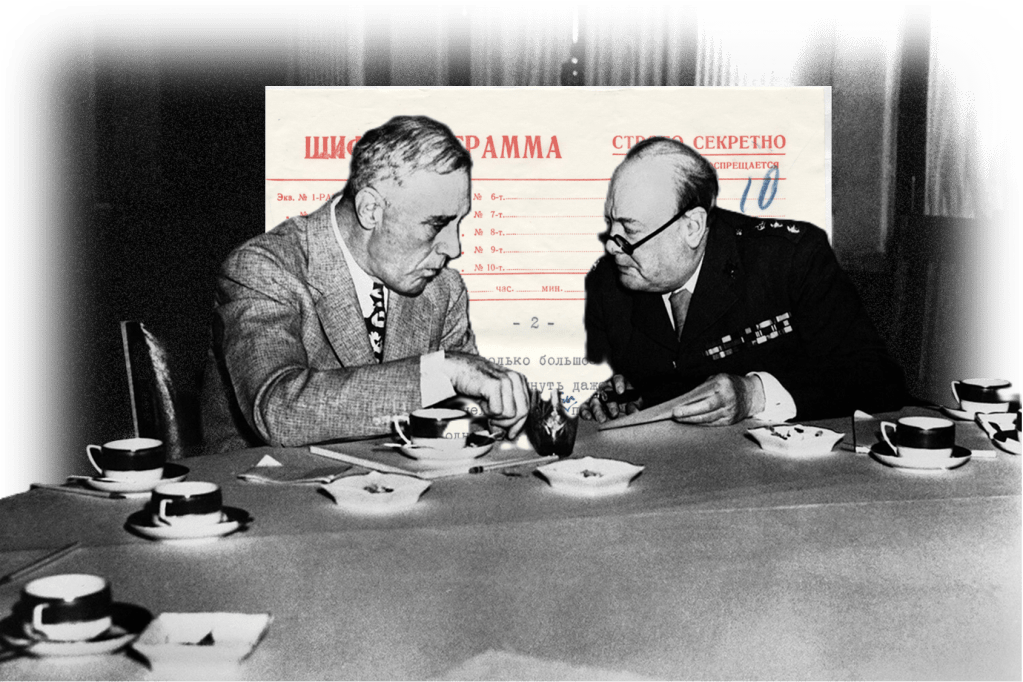
Because of the high level of interest in the negotiations in London and Washington, Molotov was instructed to report back on how events were playing out, particularly with Churchill and Roosevelt. Molotov’s enciphered telegrams to Moscow (addressed to Stalin and Beria, among others) proved to be quite revealing in the attitudes of the two leaders, and also offered an insight on a source of friction between the two: the timeline for opening the Second Front, and (as it turns out) what appears to be a casual aside by Roosevelt on the cost in human lives that he was willing to accept. As you’ll read, during Molotov’s stopover in England while returning to Moscow, Churchill found his American partner’s attitude (referring to it as a “second Dunkirk”) more than just a bit disconcerting. One can imagine words on the topic were exchanged between the two leaders after Molotov’s aircraft cleared British airspace.
Or were there words? There is some doubt that the cavalier statement by Roosevelt was ever uttered. There is no mention of it in any records of the meeting other than those of Molotov. Was this a less-than-subtle effort to try to sow seeds of doubt in Churchill’s mind in regards to Roosevelt’s conduct of the war? Or was the “second Dunkirk” message verbalized, but not captured in the official US version of the meeting because of potentially explosive fallout in the eyes of history? We’d love to hear your thoughts.
The following are translations of three sets of Molotov’s Top Secret telegrams. The reader will note that, because of the amount of information to be passed, the messages sent for each leg of the journey often had to be split into several telegrams.

Message 1:
ENCIPHERED TELEGRAM
TOP SECRET
From LONDON No. 4553, 4554, 4555, 4556
Received 03:10 22 May 1942
PRIORITY
To: Stalin, Molotov, Beria, Dekanozov
Comrade STALIN:
1. Two meetings took place today — one in the morning and one in the afternoon; both lasted approximately two hours. The morning meeting was attended, on the British side, by Churchill, Eden, Attlee, Cadogan, and Sargent (Cadogan’s assistant), as well as Foulds as interpreter; on our side — by myself, Maisky, and Pavlov as interpreter. The afternoon meeting was attended, on the British side, by Eden, Cadogan, Sargent, and Foulds; on our side — by myself, Maisky, Sobolev, and Pavlov.
2. At the morning meeting with Churchill, I outlined the purpose of my visit: to discuss — and, if possible, resolve — the issues regarding treaties and the Second Front, while open to the possibility of considering other matters as well. In doing so, I emphasized the particular importance and urgency of the Second Front issue, citing Roosevelt’s initiative in extending the invitation for me to visit the United States specifically to address this matter. Churchill raised no objections, but added that the British government, too, might perhaps find certain “other matters” to bring up for consideration. I agreed.
3. In the morning, Churchill, in a few rather general statements, spoke primarily to the first issue — remarks that differed in no essential respect from what Eden had previously told Maisky. Churchill emphasized the importance of keeping in lock-step with the United States and expressed a reluctance to violate the Atlantic Charter, citing the difficulties that would arise within British parliamentary circles regarding the recognition of our draft treaties. Churchill further stated that the objective of the British government was to ensure friendship and trust among the three powers — the USSR, Britain, and the USA — for upon the shoulders of these nations would rest the leadership of world affairs following the victory. If such friendship were established, he argued, everything else would fall into place. Therefore, he suggested, no obstacles should be created regarding the conclusion of treaties.
4. To this end, I replied that we consider it essential, first and foremost, to reach an agreement with England, an agreement in which, naturally, the parties would take into account the views of the United States as well as the undesirability of violating the Charter. However, I emphasized that our proposals regarding the treaties are predicated precisely on this premise; indeed, they align more closely with what was discussed with Eden in Moscow than the British proposals do. For this reason, we have limited ourselves to minimum conditions, conditions without which Soviet public opinion would neither understand nor accept any treaties, particularly in light of all the sacrifices that have been made and the hardships currently being endured. For us, this minimum entails the restoration of what was violated by Hitler, plus additional minimum security guarantees, primarily along the northwestern and southwestern borders of the USSR. If the British government believes that an agreement on this basis is currently unfeasible, then it would be better to defer the question of the treaties until a more favorable time in the future. At the conclusion of the discussion, Churchill suggested that I meet with Eden and attempt to reach an agreement with him regarding the text of the treaties.
5. Regarding the question of the Second Front, Churchill made a brief statement during the morning session, the gist of which is that the British and American governments have, in principle, decided to establish such a front in Europe, employing the maximum forces available to them and within the shortest possible timeframe, and are vigorously preparing to do so.
TO BE CONTINUED
ENCIPHERED TELEGRAM
TOP SECRET
From LONDON No. 4558, 4559, 4560, 4561
Received 06:00 22 May 1942
PRIORITY
To: Stalin, Molotov, Beria, Dekanozov
Comrade STALIN:
FINAL TO No. 4553.
However, Churchill steered clear from any refinements of this general wording, yet made it a point to mention the significant technical challenges associated with the establishment of a Second Front. To discuss this issue, Churchill suggested the morning of the 22nd to set up a special meeting [crossed out, replaced with hand-written “discussion” ], with the participation of the British Chiefs of Staff, as well as Isayev. I replied that any method was agreeable to me, but I stressed that, for all the importance of discussing the military aspects of the matter, I feel this is not simply a military issue, but first and foremost a political issue and, as such, carries great urgency.
6. The afternoon meeting with Eden involved a conversation of the draft agreements. The draft agreement on mutual military aid was approved with ease. The introductory passage and articles 1 and 2 were agreed upon with minor corrections. In article 3, Eden proposed dropping the mention of the return to England of its enemy-occupied territories in Europe since, in this context, the discussion only concerns a few small islands in the English Channel, but keeping in place the entire section that concerns our borders. Moreover, Eden also proposed to drop the mention of “Europe” in the section of the article that speaks of refraining from territorial acquisition and non-interference in the internal affairs of other peoples, so as to avoid giving rise to misinterpretations, as if, by renouncing such actions in Europe, we were tacitly allowing for the possibility of undertaking them in other territories. I accepted these proposals. There was quite a lengthy discussion regarding the issue of Poland. In this case, I argued that, out of a desire to meet England halfway, we were proposing a compromise in which we would make a major concession — namely, by not currently demanding England’s assent to the restoration of the Soviet-Polish border of 1941, and by promising to settle this issue amicably directly with Poland — while asking England to make a lesser concession: specifically, not to reaffirm its declaration of July 30, 1941. Eden insisted that England could not decline to reaffirm this declaration, but agreed not to introduce anything into the treaty, and promised to draft a letter by tomorrow in response to the letter I am to send him simultaneously with the signing of the treaty. In response to Eden’s question, I explained that we had excluded from our draft any mention of European federations, in light of attempts to turn some of these federations against the USSR. Eden stated that he too is absolutely against this, and that he will look for the appropriate wording, to which I agreed. Discussion of subsequent articles will take place during the next meeting.
7. On 22 May, in addition to the meeting regarding the Second Front, a breakfast with Churchill is scheduled, as well as an audience with the King, who expressed a desire to see me.
8. Churchill once again attempted to raise the issue of making my presence public, but in light of my objections, he abandoned this desire.
21 May 1942 MOLOTOV
Message 2:
ENCIPHERED TELEGRAM
TOP SECRET
From 5004 [sic] No. 5005
Received 18:55 04 June 1942
PRIORITY
To: Stalin, Molotov, Beria, Malenkov, Vyshinsky, Dekanozov, 10th Department
Comrade STALIN:
From my conversations with Roosevelt, I feel it imperative to highlight the following points:
1. Regarding the Second Front: Roosevelt stated that preparations for a Second Front are currently underway. The invasion of Europe is to be launched from England. Consequently, the first American troops have been dispatched to Ireland, and the deployment of further contingents from the United States will continue. Furthermore, provisions must be made to facilitate amphibious landings from England across the Channel. The logistical challenge posed by the Second Front is immense. Along the French coast, there are three or four ports that have been heavily fortified by the Germans. These ports are essential for the unloading of tanks and other weaponry; such operations cannot be conducted elsewhere, as the coastal waters are too shallow. Personnel, even for a force of 30 divisions, could, however, be landed at various points other than these ports. To support all these amphibious operations, vessels of three distinct types and sizes are currently being constructed. All preparations are unlikely to be completed before 1943; consequently, the full-scale invasion of Europe could realistically be executed only in 1943. Nevertheless, Roosevelt is urging American military planners to accept the risk and proceed with the landing of 6 to 10 divisions in France. It is possible that a “Dunkirk-like” scenario might ensue, resulting in the loss of 100,000 to 120,000 troops; however, such sacrifices must be made in order to provide assistance to the USSR in 1942 and to deal a severe blow to German morale.
To Roosevelt’s question on my thoughts regarding a landing assault of 6 to 10 divisions, I said it was not sufficient, since it would take at least 40 divisions to pull off a Second Front. I did, however, acknowledge that this operation, too, would deal a significant blow to morale in Germany — thinking to myself, meanwhile, that the Anglo-Americans must avoid getting bogged down in some amphibious operations.
Hopkins came up to me separately and also asserted that what’s important isn’t the number of assault landing divisions for the first period, but that these operations get underway as soon as possible.
General Marshall, during the discussion relating to the challenges of a Second Front, tried to find a difference between his and my points of view on this issue. Molotov, he says, is keen to push as many divisions as possible into the Second Front, whereas he, Marshall, sees the main objective as drawing as many Luftwaffe aircraft into battle as possible to put down a [handwritten: not very large] assault landing, only to have the Luftwaffe crushed by US and British air assets, after which the large assault landing can be carried out. I explained that I agreed with the role Marshall designated for the air forces. Roosevelt emphasized that the distinction that Marshall pointed to does not exist, that it is merely two stages of the invasion of the continent. I confirmed this was the case.
TO BE CONTINUED
ENCIPHERED TELEGRAM
TOP SECRET
From WASHINGTON No. 4997
Received 14:30 04 June 1942
PRIORITY
To: Stalin, Molotov, Beria, Malenkov, Vyshinsky, Dekanozov, 10th Department
Comrade STALIN:
CONTINUATION
2. On the creation of a police force from three to four nations to preserve the peace after the war. While speaking on this topic, Roosevelt referred to his 1937 Quarantine Speech in Chicago. If, he said, a country that has been disarmed after the war (Germany, for example) begins to re-arm itself, it would have to be isolated, and should this measure be unsatisfactory, the “four police forces” would have to bomb that country. Naturally, we are unable to announce this before the war is over, but we should come to an agreement on this issue ahead of time.
Roosevelt also stated that, when meeting with Churchill in Newfoundland (to discuss the Atlantic Charter), Churchill had no answer in terms of how to guarantee that the goals set out in the Charter, which were unanimously accepted by them, would be achieved. Churchill elaborated on the notion of creating something akin to the League of Nations, although that organization turned out to not be viable. To Roosevelt’s proposal, Churchill accepted the point on disarmament in the Charter, but argued that disarmament alone is not enough. A four-nation police force to preserve the peace after the war is all very well, but would have to be in place for 10, 20, even 30 years at the very least. Roosevelt believes that Churchill will have to accept this proposal if the US and USSR insist on it.
CONCLUSION FOLLOWS
ENCIPHERED TELEGRAM
TOP SECRET
From WASHINGTON No. 5006
Received 19:15 04 June 1942
PRIORITY
To: Stalin, Molotov, Beria, Malenkov, Vyshinsky, Dekanozov, 10th Department
CONCLUSION
To my question, Roosevelt responded that the Chinese government had not been informed about this project. China’s participation in the proposed agreement, Roosevelt asserted, is in question, since it is not clear, he said, whether or not China could form a centralized government and become a police force with respect to Japan.
Roosevelt admits that other nations, too, will eventually come to understand the necessity for the peace to be secured by a force of three or four states, and will join them. He envisions that France and other nations will then join the general agreement of these police-force countries.
3) On two occasions, albeit seemingly in passing, Roosevelt said: “Can American bombers taking off from Syrian territory bomb Romania?” I replied that yes, they could, that they could also do so from Soviet territory.
Hopkins advised that a squadron of American aircraft be dispatched to the Soviet-German front, which would help dispel distrust toward the USSR by American generals. I confirmed that this would be quite possible, citing the work of the British airmen in Murmansk.
4 June 1942 MOLOTOV
Message 3:
ENCIPHERED TELEGRAM
TOP SECRET
From LONDON No. 5286, 5287, 5288
Received 15:40 10 June 1942
PRIORITY
To: Stalin, Molotov, Beria, Malenkov, Vyshinsky, Dekanozov, 10th Department
Comrade STALIN:
This morning, June 9, the first meeting with the British took place following my return from the USA. Present on behalf of the British government were Churchill, Eden, Attlee, and Cadogan; on our side were myself, Maisky, and Sobolev. The meeting lasted approximately two hours.
At the request of the British, I informed them of the results of my visit to Washington.
1) I said that Roosevelt viewed the treaty favorably, and in particular the absence of any mention of borders therein.
2) Next, I dwelled in greater detail on setting forth Roosevelt’s position regarding the question of the Second Front, casually noting Roosevelt’s agreement with the view I had expressed — namely, that establishing a Second Front in 1943 might prove more difficult than in 1942, in light of the possibility of serious complications on our own front.
I emphasized the particular importance of establishing a second front specifically in 1942 and, referring to considerations of President Roosevelt with which you are familiar, added that, if the realization of this objective this year requires a certain reduction in the shipping tonnage utilized for delivering supplies to the USSR, the Soviet government is prepared to accept such a reduction. Finally, I mentioned that the President attaches such great importance to a second front in 1942 that he is prepared to risk even a new Dunkirk, and the loss of 100,000 to 120,000 men, solely to initiate the second front; I added, however, on my own behalf, that I consider the deployment to the Continent of the 6 to 10 divisions envisioned by Roosevelt completely inadequate to create a second front and insufficient for purposes of diverting 40 German divisions from our front.
At this point, Churchill, highly agitated, interrupted me and declared that he would under no circumstances agree to a new Dunkirk, nor to the futile sacrifice of hundreds of thousands of lives, no matter who might recommend such a course of action. To my reply that I was merely conveying Roosevelt’s opinion, Churchill added: “I shall express my own opinion on this matter to him personally.”
3) I then proceeded to outline Roosevelt’s post-war proposals. The President’s concept, that all powers, with the exception of the United States, Britain, the USSR, and perhaps China, should be disarmed, met with a negative reaction from Churchill (who was supported in this by Eden). In this context, he cited France, Norway, Poland, Turkey, and other states, asking: were they all, then, to be left without an armed force? That, he argued, was simply unfeasible. As for Roosevelt’s idea of establishing an international police force to maintain peace, Churchill viewed it with a degree of sympathy, albeit with the proviso that all democratic nations must participate in the creation of such a force. He also reacted with extreme disapproval to Roosevelt’s proposal that three or four major powers assume trusteeship over the islands of the Dutch East Indies, the Japanese islands in the Pacific, and similar territories (I did not mention Malaya in this connection, though I did name Indochina). Churchill declared that, were such a project to become public knowledge, it would be met with fierce hostility by public opinion and would inevitably end in failure.
4) Finally, I reported on the Anglo-American supply protocol I had received from Roosevelt and expressed my surprise that it stipulated that Britain’s deliveries to us would continue at the same level as before July 1 — this, despite the fact that Beaverbrook, in a letter to Maisky, had confirmed that, on behalf of the British government, he had undertaken an obligation in Moscow to increase deliveries of aircraft and tanks by 50% effective July 1, 1942, and by a further 50% effective January 1, 1943. I insisted on the fulfillment of Beaverbrook’s promise.
5) Following this, Churchill presented his views. He stated that Roosevelt’s post-war proposals served as yet another demonstration of the necessity to defer all such questions until the peace conference. First, victory must be secured; only then should the spoils be divided. Churchill intends to write to the President to this effect. The Prime Minister then addressed the issue of supplies, declaring that while he acknowledged the commitments made by Beaverbrook, he wished to draw attention to a specific proviso within the Moscow Protocol regarding “changed circumstances,” a condition under which the supply quotas stipulated in the Protocol could be subject to revision. In this context, he cited the Japanese attack. Furthermore, the United States had begun building up its own army and air force, and was also providing assistance to Australia; as a result, American military shipments to Britain had been drastically impacted. For instance, under an agreement concluded between the two governments in January 1942, the United States had pledged to deliver five thousand fighter aircraft to the British government by [handwritten: April] 1943; however, they had quite recently informed Britain that they would be able to supply only one thousand fighters. Churchill intends to continue fighting for those thousands of aircraft, though he remains uncertain of the outcome. In light of these circumstances, the British government cannot, after July 1st, undertake commitments exceeding those it has been fulfilling over the past nine months.
6) Finally, Churchill turned to the “most important question” (as he put it), the question of the Second Front. He does not wish to mislead us; he wants us to know precisely what we can count on in this regard. Roosevelt has stated that he sent Churchill his plan for the Second Front, but the plan has not yet been received; consequently, Churchill refrains from expressing any opinion on the matter at this time. For his part, he can state only one thing: over the coming months, the British government is preparing to land six divisions on the Continent, in the hope that, given the right conditions, they will be able to gain and maintain a foothold on the European shore. However, Churchill cannot say in advance whether this operation will actually take place, much less precisely when. That will depend on the circumstances prevailing closer to the actual moment of the operation. Incidentally, Churchill remarked that Roosevelt’s assertion that establishing a Second Front would necessitate a reduction in the flow of supplies to the USSR is incorrect. The limiting factor in such an operation is not the large vessels used for convoys, but rather the flat-bottomed landing craft.
7) Churchill also mentioned that he is exploring the possibility of a northern operation (Petsamo, etc.), and that, should we be interested in this project, he is prepared to dispatch six squadrons of fighter aircraft to Murmansk, as well as provide assistance at sea and, perhaps, through other means. The Prime Minister would like to discuss the technical aspects of this operation with our experts.
8) In conclusion, Churchill stated that everything outlined constituted preliminary plans in terms of 1942. Regrettably, he could offer nothing further for that year. As for 1943, Great Britain and the United States intend to land 40 to 50 divisions on the European continent during that year, possibly at five or six separate points simultaneously, for which purpose the Americans will dispatch up to one million soldiers. Intensive preparations for these future operations are currently underway.
9) Churchill invited Maisky and me to an intimate evening meal, attended by Churchill, Attlee, and Eden. After the meal, for three hours, he endeavored to convince us that, due to a lack of the necessary landing craft tonnage, it would be impossible to open a Second Front this year; that, perhaps, a landing of six divisions in France might be feasible in August or September; and that preparations for this operation, as well as for the Second Front in the coming year, are being pursued with great intensity. He proposed that our specialists verify the calculations made by their specialists through painstaking collaborative work, a task that would require them to sit down together and devote weeks to the undertaking.
I insisted on the opening of a Second Front this year, arguing that they were underestimating their own strength and capabilities even now, and that the year 1943 might prove more difficult for such a front. I promised to report back regarding the participation of our specialists in verifying their calculations, but emphasized that the British government must verify these calculations itself; in any case, I argued, at this stage the British government should not rule out a Second Front this year, but should instead expand the preparations for the six-division operation into preparations for a full-scale Second Front operation. Churchill agreed with these latter points of mine, but added that he did not wish to deceive us, his allies, or to raise false hopes.
10) In conclusion, therefore, the British government is not assuming any obligation to establish a Second Front this year; rather, and even then with reservations, it states that it is preparing what amounts to an experimental amphibious operation.
I will report the rest in Moscow.
10 June 1942 MOLOTOV

Translation © 2026 by Michael Estes and TranslatingHistory.org

