
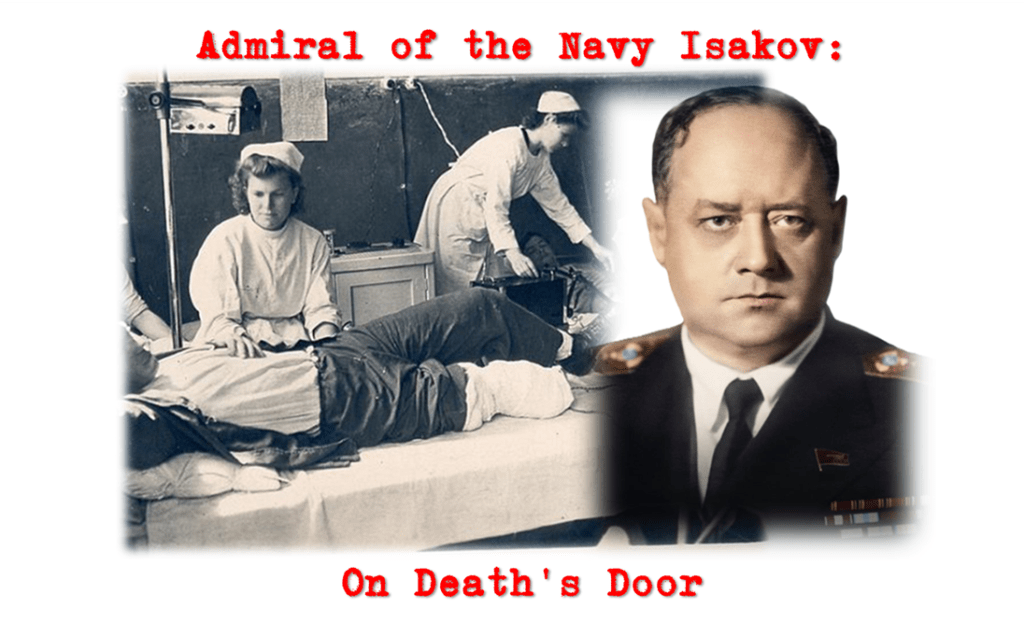
Much has been written across the years about the much-decorated Chief of the Naval Staff, Ivan Stepanovich Isakov. Almost all of the biographies, papers, and mere anecdotes dedicated to the Hero of the Soviet Union’s World War Two exploits make glancing, even joking, references to the fact that Isakov had a leg amputated after he was struck during a Luftwaffe air attack near Tuapse. Stalin publicly made note of Isakov’s missing leg on more than a few occasions, sometimes peppered with respect. But few outside of Soviet upper echelons were aware of how close Isakov came to dying from his wounds, both before and after his above-the-knee amputation.
Isakov underwent the amputation of his left leg in October 1942 after having sustained his severe injury during the Battle of the Caucasus. Due to the difficult situation, he was not transported to a hospital until two days later. By that time, gangrene had set in, and to save the commander’s life, doctors had to amputate his leg above the knee. Despite the major surgery, Isakov underwent a lengthy course of treatment and was unable to return to full active duty until May 1943.
The following is our translation of a 15 December letter from Fedor Andreyev, the Chief of the Navy Medical and Health Directorate, to the Deputy People’s Commissar of the Navy regarding the amputation of Admiral Isakov’s leg and Isakov’s transfer to Tbilisi for further treatment. The six-page letter starkly details the serious challenges that faced the surgical team in Isakov’s amputation and post-operation recovery, as well as efforts to simply deliver him to a hospital capable of tackling the complex medical attention his wounds demanded. This, while trying to guarantee some level of stealth to protect the lives of all involved in treacherous military conditions. Isakov’s body clearly struggled mightily against the challenges posed by the trauma it was subjected to; on a number of occasions, no pulse could be detected. As Andreyev notes in his letter, Isakov was clearly at death’s door as long as one month after the amputation.

15 December 1942
I hereby report that this past 10 October, at your direction, on a Douglas aircraft, together with the Navy’s chief surgeon, division medical officer Professor I.I. Dzhanelidze and the Navy’s chief physician, brigade medical officer Professor A.L. Myasnikov, I arrived at Sochi in order to set up medical treatment for the injured Admiral I.S. Isakov.
That same day, at 12:30, we came in for a landing at Kuybyshev airfield, and our group was joined by Admiral Isakov’s wife, Olga Vasilyevna. By the end of 10 October, the aircraft reached Guryev, and at 17:30 on 11 October, after refueling at Baku and Tbilisi, the aircraft landed near Sukhumi. From the Kutaisi area the flight was protected by three fighters, which provided escort to our final airfield.
For utmost security for our further travel, Black Sea Fleet headquarters provided two torpedo cutters, which delivered our group from Sukhumi to the pier at Sochi in one hour and forty minutes.
Back in Sukhumi, the flag lieutenant commander Captain Petrov spoke about the Admiral’s grave condition and voiced his doubts that we would find him alive.
We were met at the pier in Sochi by the Chief of the Medical and Health Directorate of the Black Sea Fleet, brigade medical officer A.M. Zotov and Commander Andreus. When I inquired as to the admiral’s condition, Comrade Zotov responded, “Half an hour ago when we left the hospital, he was alive. But as for right now, I don’t know.”
We arrived at the Tuapse Naval Hospital’s Sochi branch at 20:20.
Black Sea Fleet surgeon, Military Doctor 1st Rank, assistant professor Comrade B.A. Petrov and Chief of the Surgical Unit, Military Doctor 2nd Rank Comrade Belinskiy reported that the admiral was faring quite poorly and lying “without a pulse” since the morning. A blood transfusion, infusion of a saline solution, and cardiac medications yield almost no effect.
Professor Dzhanelidze, Professor Myasnikov, and I immediately entered the ward and saw Comrade Isakov, who was extremely pale and breathing heavily and rapidly, although he was fully conscious despite his extreme weakness. His extremities were cold to the touch and coated in a cold sweat, and his pulse was barely detectable.
So as not to deplete the patient’s remaining strength. the examination was limited that day to general impressions, although a detailed report was given on the course of the illness.
It was established from this information that on 4 October, Admiral Isakov, together with General of the Army Comrade Tulenev, General-Lieutenant Bodin, and others, were traveling in a vehicle column along the highway between Tuapse and Maykop, and near Tuapse they were attacked by enemy aircraft. All of the passengers left their vehicles and dispersed near the road. Several bombs were dropped on the road, and during the detonation of one of these bombs, Comrade Isakov was wounded. After the aircraft had departed, the admiral was placed on a truck and delivered to the nearest field hospital, where his left thigh underwent an initial wound debridement. During this, it was discovered that there was a significant loss of soft tissue on the rear surface of the thigh and substantial damage to the integrity of the sciatic nerve. Following removal of the non-viable tissue fragments, sponges were placed in the wound and a dressing was applied; the limb was immobilized, and a serum against tetanus was administered. Because of the patient’s critical condition, a blood transfusion was performed and opiates and cardiac medicine were administered.
By the morning of 6 October, the patient was brought to the Sochi branch of the Tuapse Naval Hospital where, by special request, Black Sea Fleet Surgeon Military Doctor 1st Rank Petrov had arrived.
During an examination of the patient that day, a severe general condition was noted, along with the presence of clear signs of blood poisoning (sepsis) and distinct signs of emphysematous gangrene on the left lower limb. The latter appeared significantly expanded, the skin was bronze in color, and palpation revealed a fine crunching sound (crepitus). Pulse was recorded at 150, barely perceptible.
Considering the overall severe clinical picture, Black Sea Fleet surgeon Petrov made the absolutely correct decision – the need to perform an immediate high-level amputation of the left thigh in order to save the patient’s life. Comrade Petrov performed the operation that very day, together with Military Surgeon 2nd Rank Belinskiy. The wound was left completely open.
Despite the early amputation, excellently managed care, and repeated use of all possible supportive therapeutic measures (anti-gangrene serum, blood transfusion, sulfonamide drugs, glucose solution, cardiac medications, etc.), the patient’s condition remained critical and his strength was finally exhausted by the struggle against infection and the threatening disruption of the basic vital (vegetative) functions, otherwise known as shock.
It was in this phase of the post-trauma period that our medical group found Admiral Isakov. Taking into account how ineffective the therapeutic agents were that had been used prior to our arrival, at the medical consultation the decision was made to utilize one of the oldest tools used to fight infection and shock – alcohol.
Throughout the night, the patient was given 200.0 (ml) of cognac to drink, and all other prescribed medicines were temporarily halted.
By the morning of 12 October, the admiral began to feel better, his pulse had become completely satisfactory, and his weakness was diminishing but his temperature remained high, while septic manifestations persisted at the same level. The alcohol therapy was maintained throughout the entire day.
October 13 was noted as a day when the admiral’s health improvement became even more pronounced, and on the 14th, administrative steps were being taken to move Comrade Isakov from Sochi to the rear, with an eye toward Tbilisi.
This decision was forced upon the group by the fact that Sochi was falling under enemy air attacks, and falling bombs were not uncommon. These also were taking place at the time when we arrived in the city.
Because the admiral’s arrival at the hospital was widely known to the civilian population, there were concerns that this information could be leaked to enemy headquarters.
However, an air evacuation proved to be too high a risk, and road transport by vehicle was ruled out completely due to the severity of the patient’s condition. Thus the only possible option was evacuation by sea. Travel by sea made it possible to carefully deliver the patient to Sukhumi, although it carried the danger of meeting with the sea- or airborne enemy.
Taking these concerns into account, the decision was made to move the admiral by night using a high-speed minesweeper that was to be assigned as an escort for two “small submarine hunters.” In order to prevent drawing attention to the operation, a large minesweeper that had arrived at Sochi from Tuapse at 14:00 on 15 October was sent back to sea, only to return by 19:00, with the onset of darkness.
At 23:30, the wounded admiral was placed on a stretcher. At midnight, he was brought on board the ship and settled into the chart room on the forecastle deck. At 00:35, the ship put out to sea, with one “small hunter” further out to sea, and the second in the minesweeper’s wake.
After 30-40 minutes, the ship’s captain reported that the “small hunters” could not keep up with the us, and were lagging behind. I issued instructions to not reduce speed, since I felt it was more important to arrive at our destination before dawn.
The hunter boats fell behind, and we reached the Sukhumi harbor at dawn (6:00, 16 October). The wounded admiral got through this part of the journey quite satisfactorily.
The admiral was met at the pier by Division Commissar Kulakov (who had just arrived), Division Commissar Azarov, and Rear Admiral Yeliseyev. There was an ambulance to transport the wounded admiral to the depot, where a special train awaited, along with a number of accompanying vehicles for the armed guards with automatic weapons and medical and senior officers who were there to meet him.
In spite of the most hazardous yet peaceful ride of the ambulance, the wounded admiral began to experience such strong pain in the amputated extremity that initially, he had to make several stops to rest, then pick up the stretcher and carry it for the last kilometer. The train ride from Sukhumi to Tbilisi passed relatively easily, although a number of times the admiral requested unexpected stops because of the pain. Narcotic medications (pantopon and morphine) were used throughout the entire route. His pulse remained of adequate volume throughout, and his consciousness was relatively clear.
Upon arriving at Tbilisi (21:00 on 16 October), the admiral was brought by ambulance to the NKZ [People’s Commissariat of Health] hospital No. 2454, which was operationally subordinate to the Health and Medical Directorate of the Navy. A special single-story house was prepared for Comrade Isakov. The house had 7 rooms and was situated at the back of the hospital courtyard. Next to the house, a guard post was set up. The designated premises made it possible to set up a ward for the wounded man, a room for technical resources (storage and preparation of bandage and medications, preparation for medication administration procedures), a separate kitchen, a room for the duty adjutant, and premises for attending professors. Food for Comrade Isakov was prepared separately, based exclusively on medical protocols and the patient’s wishes. A duty nurse was posted in the ward on a permanent basis, and an attending physician in the house itself.
On the day he arrived at Tbilisi, the admiral’s state of health was relatively satisfactory. Signs of general sepsis appeared quite pronounced, but his day-to-day cardiac activity, respiratory function, and blood condition continued improving, which raised hopes for a favorable outcome of the disease. These hopes were further reinforced by the good condition of the wound, the absence of any local signs of inflammation, and the successful process of tissue granulation and the onset of epithelialization.
The daily improvements continued gradually up to 30 October, and then the overall health of the patient once again began to worsen. His temperature began to fluctuate severely, there was deterioration of cardiac activity, racing pulse, poor blood accumulation, fading in and out of consciousness, at times delusional. No appetite. Mild inflammatory changes were detected in the lungs. The patient’s condition continued to deteriorate. There were moments when there were real concerns about the possibility of recovery.
5 November and 12 November – these were especially difficult days, as they were accompanied by signs of a sharp decline in cardiac activity, and the patient was at death’s door.
The council of attending physicians (Andreyev, Dzhanelidze, Myasnikov, and Petrov) feel that the reasons for such a significant decline in Comrade Isakov’s health can be found in the rise of inflammatory pulmonary manifestations. The clinical picture was obscured by the presence of tubercular changes resulting from an affliction suffered in earlier years.
The nature and severity of the case necessitated the involvement of a broader range of pulmonary specialists and radiologists. Thus, the following were brought in for consultation: Professors A.N. Kipshidze, G.V. Mestiashvili, and G.P. Nazareshvili from the Tbilisi Medical Institute, and Professor V.L. Eynis, who was called in from Moscow.
The entire period, from 30 October to 20 November, was characterized by the extremely severe course of the disease. Subsequently, however, the disease began to take a favorable turn. Septic and inflammatory events in the lungs began to subside, his temperature gradually began to normalize, the patient’s strength quickly began to increase, and his appetite and sleep returned to normal. Cardiac activity stabilized, and blood tests indicated a vigorous recovery of the patient’s strength and the disappearance of signs of inflammation.
By 26 November it became evident that the body had coped with the complication that had taken place.
By 4 December, the patient’s condition had stabilized and become quite good. His temperature had settled in the normal range. Cardiac activity returned to normal. The wound’s appearance gave no cause for concern. The size of the wound decreased two- to threefold. The surface of the wound was clean and incarnant. Epithelization was clearly evident on the edges of the wound.
Further patient management is to be assigned to Black Sea Fleet Surgeon Military Doctor 1st Rank Petrov.
Chief of the Navy Medical and Health Directorate Division Physician ANDREYEV
Source: TsVMA [Navy Central Archive] Department, f. 243, d. 37341, pp. 139-141.

Translation © 2026 by Michael Estes and TranslatingHistory.org

