
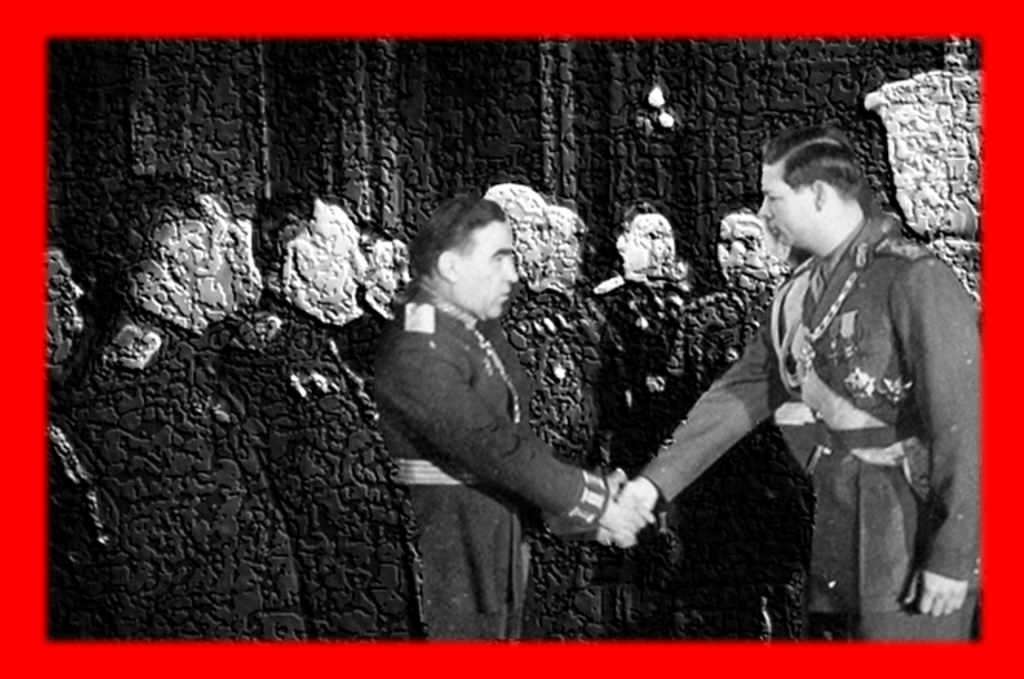
In late August 1944, World War II was clearly coming to a swift close for Romania. Having sided with Nazi Germany under the government of Ion Antonescu, Romania observed the Red Army’s August 1944 Jassy-Kishinev offensive crush the Axis front in northeastern Romania. With no realistic chance of survival, the Romanian Army declared a unilateral ceasefire with the Soviets on the Moldavian front.
Plans were afoot as early as mid-June 1944 between Romania’s Communist Party and King Michael I to overthrow and depose Antonescu. The two met on 23 August 1944 to discuss the situation on the front line. King Michael suggested that Antonescu sign an armistice with the Allies and the Soviets. Antonescu replied that this would be a fool’s errand, as any such armistice would be nullified by Germany. This triggered a coup, backed by the military, in what would be called the Actul de la 23 august.
Remaining Romanian forces were ordered to defend Romania against any German attacks. Meanwhile, the king negotiated with the Soviet Union to place the remnants of his military on the side of the Allies.
The USSR briefed the Western Allies about the Romanian proposals shortly after the August 23, 1944 coup, prompting Washington and London to exchange urgent diplomatic correspondence to agree upon unified armistice terms. Formal Allied recognition of Romania’s decision to switch sides in the war came on 12 September 1944. Prior to this, in spite of a de facto armistice between the Soviets and Romania, there was the unanswered question of war reparations. As a result, although now allied, Red Army troops began moving into Romania, taking approximately 140,000 Romanian prisoners of war. A striking majority of the Romanian POWs were sent to the Soviet Union, where many perished in the camps.
In communications with the British and Americans, the Soviet side presented the case that the USSR would take control of the situation and the country of Romania, thus leaving the remaining Allied Powers free to continue with their own advances in the war. Churchill and Roosevelt agreed, and Stalin enjoyed a “90% share of influence” in Romania.
The following is a translation of a declassified five-page account, dated 31 August 1944, from Vyacheslav Molotov’s diary, which details a conversation between the Romanians and Soviets at a reception of representatives of the Romanian Government delegation, held in Moscow, regarding the armistice. One can feel the Romanians’ frustration when being told that, until the question of war reparations could be settled, no armistice was in place.

Moscow 31 August 1944 22:05
SECRET
Soviet representatives: V.M. Molotov, A.Ya. Vyshinsky, translator Podtserob
Romanian representatives: Pătrășcanu, Vișoianu, General Dămăceanu
After exchanging greetings and getting acquainted with one another, Molotov asks the delegates if they have been comfortably accommodated in Moscow.
Pătrășcanu states that the delegates traveled well and have been well accommodated in Moscow, for which they thank the Soviet Government.
Molotov asks whether the entire delegation is assembled, or if part of the delegation is still en route.
Pătrășcanu replies that the entire delegation is currently assembled.
Molotov states that information was received today regarding a group of Romanian representatives who have arrived in Odessa. Are these representatives also members of the delegation?
Pătrășcanu says that these are not political representatives, but the technical staff of the delegation.
Molotov asks whether the delegates are aware that the upcoming negotiations will take place with the participation of representatives from the United States and England.
Pătrășcanu answers in the affirmative.
Molotov asks which of the delegates is authorized by the Romanian government to sign the armistice agreement.
Molotov notes that today, a Romanian note, received in Ankara by Ambassador [Sergei] Vinogradov from [Alexandru] Cretzianu, was handed to the delegates.
[Translator note: This likely refers to the diplomatic note regarding Romania’s intention to sign an immediate armistice and participate in the struggle against Germany.]
Molotov asks whether this note is still relevant.
Pătrășcanu replies that the delegation is empowered to discuss an armistice and a convention regarding the implementation of the armistice, as well as all matters pertaining to the armistice between Romania and the Allies. The delegation comprises members of the Government, as well as representatives arriving from Cairo, who are likewise authorized to negotiate and sign the armistice.
Molotov states that he intends to present the Romanians with a draft armistice agreement in about two days. These terms draw on the framework of Soviet proposals dated April 13, which is already known to Romania.
[Translator note: The date above was spoken in error or entered incorrectly on the diary entry; the proposals were actually dated April 12 1944.]
Pătrășcanu confirms that this framework is, indeed, know to the Romanians.
Molotov asks whether the delegates arriving from Cairo are familiar with the latest telegram from the Soviet Government, of which they should have learned from Ambassador Novikov.
Vișoianu responds that the latest telegram received by him and [Barbu] Știrbey from Novikov reported that the Soviet Government agreed to an armistice on the basis of the April terms and accepted the three additional points put forward by the Romanian Ministry of Foreign Affairs.
[Translator note: Based on available documents from Russian archives, it is not possible to corroborate Vișoianu’s information regarding the Soviet government’s acceptance of additional conditions set by the Romanian side.]
Molotov states that this was the penultimate telegram, while the final telegram, which did not reach Vișoianu or Știrbey in Cairo, stated that the Soviet peace terms had received the approval of the Governments of Great Britain and the United States, but that a number of unresolved issues remained, which would be clarified during the negotiations in Moscow.
Vișoianu confirms that this telegram was not received prior to his and Știrbey’s departure from Cairo.
Molotov states that he would like to clarify precisely which points, in his view, require elaboration during the negotiations. For instance, the first point of the April terms referred to a rift between Romania and the Germans, and to a joint struggle against Germany. At present, such a general phrase is insufficient; a precise formulation is required regarding the number of Romanian troops that will participate in military operations on the Romanian side.
Pătrășcanu states that General Dămăceanu, as a member of the delegation, is authorized to participate in the discussion of military matters.
Furthermore, Pătrășcanu declares that the primary objective of the new Romanian government is the struggle against Germany. Pătrășcanu states that he wishes to stress this point. Six hours after the King’s address — specifically at 4:00 a.m. on August 24 — Romanian troops received and began to carry out orders not to fight against the Russians, but rather to fight against the Germans. On August 25, Romania issued an official declaration of war against Germany.
Molotov states that the additional armistice conditions proposed by the Romanian government referred to the allocation of a district or zone for the Romanian government. At present, this issue is no longer relevant. Of greater urgency is the question of relations between Soviet troops and the Romanian authorities. Furthermore, Molotov notes that the April conditions stipulated Romania’s obligation to compensate the Soviet Union for damages. The amount of compensation due to the Soviet Union must be determined.
Pătrășcanu replies that he wishes to make several observations regarding Molotov’s statement. The Romanian delegates were under the impression that the Armistice Act and the Convention on the Implementation of the Armistice would be signed in Moscow. In the Romanians’ view, the issues Molotov has just addressed pertain more to the Convention than to the Armistice Act itself. The question of incorporating these specific points into the Armistice Act is a new one for the Romanian delegation. While the delegates have arrived here prepared to discuss any issues that may arise, he, Pătrășcanu, nevertheless considers it his duty to point out that they had anticipated such matters would be covered within the Convention on the Application of the Armistice Act.
Molotov replies that the armistice agreement covers the quintessential issues. Detailed matters can be resolved through the signing of separate protocols and conventions. However, all other issues must be included in the armistice act.
Pătrășcanu goes on to state that there is another matter of great significance and urgency. As of August 24, Romania has been, both legally and de facto, in a state of armistice with the Soviet Union. However, subsequent to that date, specifically on the 28th, when the delegates were departing from Bucharest, Romanian divisions were being disarmed by Red Army troops. The Romanian army had received orders to fight against the Germans; nevertheless, it is being disarmed, and thus weakened. Romanian regiments are being intermingled, and the soldiers — even if not technically prisoners of war — find themselves in a situation akin to that of prisoners of war. Pătrășcanu believes that this matter requires clarification. He adds that the Romanian delegation includes a general and a colonel who are able to clarify all military issues and specify the number of forces that Romania is prepared to field in the fight against Germany.
Molotov replies that the armistice will enter into force the moment it is signed. Naturally, it would be desirable for the armistice to be signed sooner; however, matters are currently being delayed. The terms of the armistice must be established, and the parties participating in the negotiations must reach an agreement regarding these terms. As for the position of the Soviet side, it will adhere to the statements it has previously made.
Pătrășcanu states that the Romanian Government intends to immediately dispatch its troops to Transylvania to fight against the Germans. Therefore, the priority now is not merely to refrain from disarming Romanian divisions, but rather to return weapons to those divisions that have already been disarmed. The Romanian General Staff has drawn up a precise plan for combating the Germans in Transylvania. However, this plan cannot currently be implemented, as the army units upon which the Government relied when formulating the plan are presently disarmed and unable to participate in operations.
Molotov states that he wishes to remind everyone that the war has been going on for three years, and now a few weeks are required to transition to new conditions. The Soviet Government will be guided by military considerations; and inasmuch as the Romanian government participates in the struggle against the Germans, all issues such as those raised by Pătrășcanu will be resolved.
Pătrășcanu states that General Dămăceanu is prepared to provide, should the need arise, all necessary information regarding military matters, and that these military matters will be entrusted to him. As for the question of zones and territories, the delegation prefers to express its views only after reviewing the written draft. However, he, Pătrășcanu, believes it would be beneficial to commence the work of the military experts as early as tomorrow, and proposes establishing contact between General Dămăceanu and the Red Army experts in order to prepare the military agenda in advance.
Molotov replies that, in his opinion, it would be better to begin with the terms of the armistice, from which all other issues—including military ones—would follow.
Pătrășcanu states that the delegates have no further questions for the Soviet side and that they will await receipt of the Soviet draft.
Molotov states that the fundamental principles of the draft have been agreed upon among the three Allied governments, but the finalization of the text will still require one or two days of correspondence between Moscow, Washington, and London.
The conversation lasted one hour. Recorded by Podtserob.
AVP RF F. 06. Op. 6. P. 43. D. 580. L. 1-5. Original text.

Translation © 2026 by Michael Estes and TranslatingHistory.org

