
Issue No. 1 (2026) of Military Thought [Voyennaya Mysl / Военная Мысль], the official magazine of the Russian Federation Ministry of Defense, features a noteworthy article titled “Tactics for the Employment of Long-Range Air-to-Air Missiles in the Special Military Operation.” The article is authored by Colonel A. Yu. Stepkin, Lieutenant Colonel A.A. Gvozdenko, and Yu.G. Kravtsov, all holders of advanced degrees in military science. The piece explores the specific characteristics of the air war over Ukraine during the Special Military Operation, an environment dominated by long-range aerial combat, and highlights the limitations of such warfare that have come to light. The article details the tactics employed by the Ukrainian Air Force which, in conjunction with the use of air defense systems, have led to a significant reduction in the effectiveness of Russia’s employment of R-37M long-range air-to-air missiles. Additionally, the article acknowledges a significant lag in the intelligence and information support capabilities of the Russian Aerospace Forces (VKS) compared to those of the United States and NATO.
One of the primary characteristics of the ongoing Special Military Operation is the predominance of combined-arms warfare. During the SMO, Russian fighter aviation is employed to execute air defense missions — specifically, the destruction of airborne targets such as enemy aircraft, helicopters, cruise missiles, and unmanned aerial vehicles — while providing air cover for troop formations and critical facilities against air strikes.
In the execution of this task, the primary form of fighter employment, just as it was many decades ago, remains aerial combat: an armed confrontation in the air involving aviation units, subunits, and the aircrews of individual aircraft.
Maximizing the advantages inherent in each type of fighter aircraft during aerial combat is possible only through the skillful application of sound tactics. These tactics enable the surreptitious entry into weapon engagement range and the destruction of aerial targets using a minimum number of air-to-air missiles, while simultaneously ensuring the timely evasion of incoming enemy missiles in the event of potential retaliatory countermeasures. Prior to the commencement of the Special Military Operation, military experts held the view that the fundamental challenge of aerial combat could be defined as follows: to be the first to detect the adversary, to close in covertly, and to deliver a preemptive strike.
The successful execution of this task under any conditions is facilitated by the coordinated actions of command posts and flight crews, as well as by the more advanced targeting systems of VKS fighter aircraft and the employment of more modern air-to-air guided missiles.
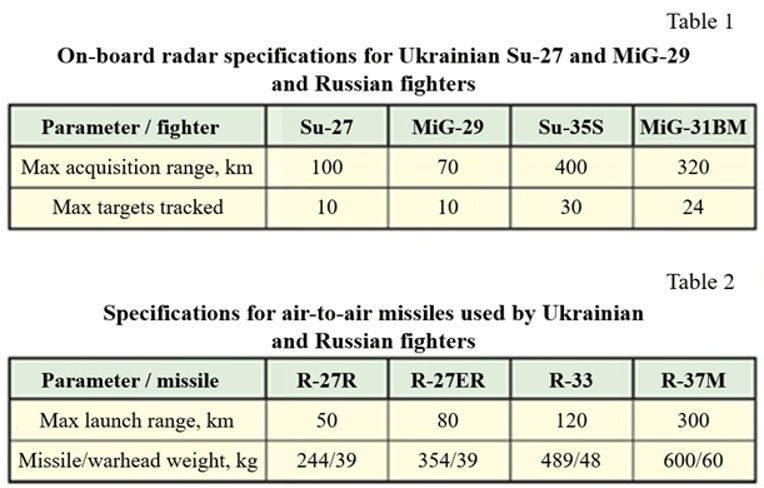
A comparison of the key tactical performance specifications of the onboard radar systems of Russian Aerospace Forces fighters versus those of Ukrainian Armed Forces fighters (Table 1), as well as the same for the air-to-air missiles employed by them (Table 2), leads to the conclusion that Russian fighters possess an advantage over the Ukrainian aircraft.
However, this distinct advantage could have led to victory only in a one-on-one situation and in the absence of outside assistance, but true combat operations are not fought according to the rules of a dueling code.
Over the many decades preceding the commencement of the Special Military Operation, the tactics of various generations of jet fighters were refined across numerous military conflicts. However, the repertoire of tactical maneuvers for both medium-range and close-in aerial combat, which had been employed in the regional wars of the relatively recent past, remained unexploited within the operational environment of the SMO.
During the Special Military Operation, factors that hindered Russian aviation and diminished its effectiveness have become clearly evident: large-scale military assistance from NATO and EU nations; the operation of Soviet and foreign air defense systems by the Ukraine military; the efficacy of multi-discipline reconnaissance assets employed by the United States and NATO countries; and gaps in the intelligence and information support provided to the Russian Aerospace Forces.
Under these circumstances, the need to employ long-range air-to-air missiles — the only means of engagement capable of destroying airborne adversaries while operating from “ground alert” status or from airborne patrol over Russian territory (i.e., without crossing the line of mutual contact) — became particularly acute. As a direct consequence of this situation, MiG-31BM fighter interceptors, equipped with long-range R-33 air-to-air missiles, have been deployed to carry out missions in the Special Military Operation since the autumn of 2022.
The employment of R-33 missiles against aerial targets located beyond the line of mutual contact initially met with some success. However, over time, the inherent limitations of these missiles became apparent; they had been developed as part of the MiG-31-33 [sic] aircraft missile system, designed primarily to intercept non-maneuvering U.S. strategic bombers, specifically before they reached their cruise missile launch points, as well as to destroy cruise missiles in flight. Ukraine’s fleet of aging Soviet-built aircraft significantly outperforms the B-52, as well as other aircraft of similar operational purpose, in terms of maneuverability. With the assistance of their Western allies, Ukrainian Air Force pilots devised and implemented a comprehensive set of countermeasures that contributed to a reduction in the effectiveness of R-33 missile employment by MiG-31BM crews.
The next step involved MiG-31BM fighters adopting the more advanced R-37M long-range air-to-air missile. This missile features an active radar seeker capable of locking onto airborne targets at ranges of several tens of kilometers, and boasts a maximum launch range at high altitudes of up to 300 km when engaging a target in a forward hemisphere aspect.
At present, in addition to the MiG-31BM, the R-37M air-to-air missile is also employed by Su-35S fighter pilots. The primary reason for the preferential use of the Su-35S fighter as a launch platform for the R-37M missile is its superiority over the MiG-31BM in terms of airborne endurance, as well as its airborne target detection range.
Since the beginning of the Special Military Operation in Ukraine, Russian fighter aircraft engaged in aerial combat, utilizing long-range air-to-air guided missiles, have employed various tactical maneuvers; however, the authors are not authorized to disclose in open publications the names and nature of these maneuvers, nor the makeup of the fighter packages or their operational procedures during the execution of combat missions.
A key advantage of the tactical maneuvers developed and successfully employed in combat is the element of surprise achieved by strike fighters when attacking airborne targets; this is accomplished through the unexpected launch of air-to-air missiles, combined with the prior execution of a comprehensive set of diversionary and deception measures. The employment of long-range R-37M air-to-air missiles by Russian fighters, unexpected by the adversary, has resulted in increased losses for Ukrainian aviation assets and has compelled the enemy to seek countermeasures to address the new development.
The employment of advanced long-range air-to-air missiles by Russian Su-35S fighters prompted yet another shift in the operational tactics of the Ukrainian Air Force. These changes were made possible exclusively through the use of NATO’s high-tech, multi-discipline intelligence collection capabilities. The Western intelligence agencies not only immediately relayed all available operational data regarding Russian fighters operating over their territory but were also capable of detecting the launch of air-to-air missiles by our fighters against targets situated at a considerable distance from the line of mutual contact. Naturally, information regarding such launches was instantly transmitted to the Ukrainians, whose pilots were afforded ample time to execute effective countermeasures, combining aggressive evasive maneuvering designed to break missile lock-on with the deployment of active electronic jamming.
The maneuvering of enemy aircraft consisted of executing a vigorous, sustained 180-degree turn at a significant angular velocity, or a high-G turn involving a reduction in airspeed and turn radius. Effectively, this shifted the direction of the attack on the aerial target from forward hemisphere to rear hemisphere aspects, a change that inevitably reduces the maximum launch range of all types of air-to-air guided missiles by at least half. Given the fixed guided flight time of an R-37M missile launched at maximum range against a target in the forward hemisphere, but which, following the enemy’s maneuver, is effectively engaging that same target in the rear hemisphere, the probability of destroying the airborne target drops sharply due to the reduced closing speed between the missile and the target compared to a forward hemisphere (head-on) attack.
In short, Ukrainian Air Force standard operating procedures, developed with the assistance of its NATO mentors, comprise the following elements:
• a strike typically involving two pairs of Su-25 (or MiG-29) aircraft at two-minute intervals (at a distance of approximately 30 km), with an initial flight altitude of 600 to 1,200 meters while approaching the line of contact, escorted by a Su-27 fighter for cover;
• one pair executes a dynamic “S-turn” maneuver [змейка] at a distance of 60–70 km from the line of engagement, involving a turn of 45–60° and a descent to 150–200 m, in order to evade acquisition and lock-on;
• continued flight toward the line of engagement, accelerating to 800–1000 km/h, followed by the pair banking dynamically at a distance of 30–35 km from the line of engagement;
• upon receiving information regarding our airspace control fighter breaking away from the line of engagement, the pair of strike aircraft immediately executes an aggressive maneuver, accelerating to maximum speed, to reach weapons employment range, deliver a strike, and egress at maximum speed along the return route.
The adversary’s implementation of these measures, combined with actions undertaken to restore impaired combat capabilities and reinforce air defense packages, have allowed it to stabilize its situation to a certain extent. This was facilitated by the rapid restoration and return to service of Ukrainian Armed Forces air defense assets repaired at Ukrainian facilities following combat damage inflicted by Russian artillery and aviation, as well as the continuous replenishment of Ukrainian air defense units through the supply of air defense systems of both NATO and Soviet manufacture provided by NATO countries. Furthermore, significant changes also occurred in the operational tactics employed by the adversary’s air defense units.
The essence of these changes lay in a shift from fixed, site-based air defense to covert, mobile, and ambush-style operations. In practical terms, this constituted a transition from defensive actions aimed at safeguarding specific sites to offensive/defensive operations designed to maximize the disruption of our aviation units as they executed their assigned missions.
To a certain extent, the measures undertaken by the adversary contributed to some short-term success at the tactical level. The primary factor behind this success was the robust intelligence support provided by a diverse array of high-tech collection assets from Western nations, which promptly supplied the command structures of Ukraine’s Armed Forces with a comprehensive set of data regarding the operations of our aerospace assets. Furthermore, on our side as well, there were certain isolated instances of patterned behavior, manifested in the repetitive use of the same airfields for takeoff and landing, the same flight routes and profiles to and from combat mission areas, the same airborne patrol zones, as well as other specific identifiable operational elements.
It is also important to take into account that the current performance potentials of our intelligence system clearly do not exceed the combined capabilities of the intelligence systems of the opposing European and North American nations. Consequently, this does not yet allow us to fully ensure adequate monitoring of the current locations and transit routes of Ukrainian Armed Forces’ ground-based air defense assets within the territories immediately adjacent to the operational zones of Russian fighter aircraft.
A defining characteristic of the tactics employed by Russian fighter aircraft during the Special Military Operation — specifically regarding the use of long-range air-to-air missiles, regardless of the tactics chosen by the adversary — boils down to a single critical factor. To successfully accomplish the mission, whether by destroying enemy strike groups or forcing them to abort their assigned objective, the Russian fighter must maintain a combat heading toward the target from the moment the enemy aircraft enters its attack run until it reaches the line of engagement. It is only under these specific circumstances that the adversary will either abandon the mission entirely or attempt a desperate dash to complete it; in doing so, while continuing its flight toward the launch envelope of its own air-launched munitions, the enemy aircraft enters the engagement zone of our air defense systems, where it faces a high probability of being destroyed.
It is difficult to provide a definitive answer to the question regarding the optimal launch range for our air-to-air missiles, such as the R-37M or similar missiles, under the current conditions of the Special Military Operation. The missile launch range must be sufficient to ensure target engagement while simultaneously eliminating the risk of our fighter aircraft being struck by enemy air defense systems over our own territory. The air defense network established by the adversary, under the guidance of their Western advisors, has had an adverse effect on the extent to which Russian fighter aircraft can fully realize their combat potential. The engagement buffer zone for the enemy’s surface-to-air missile (SAM) systems ranges from 1.5 to several tens of kilometers, depending on the specific line of operations; however, along the primary axes of our forces’ operations, the average extent of this zone is 50 kilometers or greater. This significantly complicates the work of Russian fighter aircrews in adhering to all the necessary operational parameters for employing air-launched munitions against airborne targets. Approaching the engagement buffer zones of Ukraine’s SAM systems can lead to negative consequences for Russian fighters; nevertheless, operational experience during the Special Military Operation has also yielded an instance of a successful mission completion by a Su-35S fighter that had sustained damage from a Ukrainian SAM. Colonel Maksim Stefanov successfully landed his fighter at an airfield, where a post-flight inspection by aircraft maintenance specialists revealed 28 distinct perforations.
Operational experience with long-range air-to-air missiles clearly demonstrates the imperative need to continue efforts aimed at both further refining domestic aviation technology and optimizing the command, control, and combat support of the Russia’s fighter aviation assets. It is suggested that the primary avenues for such improvement should include: increasing the acquisition range of the missile’s active radar seeker; enhancing the seeker’s resistance to electronic countermeasures; reducing the missile’s radar cross-section; implementing modes for dynamically retasking the missile from one target to another; and enabling the transfer of missile control from one launch platform to another.
A necessary prerequisite for enhancing the effectiveness of long-range air-to-air missiles is the improvement of the fighter aviation command and control system, specifically by increasing the operational speed with which flight crews are issued the decision to launch air-to-air guided missiles against a target during combat operations.
Reviewing examples of the actions of our fighter pilots during the Special Military Operation, in lectures and seminars conducted at military academies for both advanced students and cadets during the study of operational-tactical or military-technical disciplines, not only stimulates the students’ cognitive interest but also contributes to the achievement of the educational objectives of these academic sessions.
It is essential to instill in all trainees the conviction that analyzing combat experience gained during the Special Military Operation is of priority importance in the decision-making process. Experience demonstrates that, without properly drawn lessons, it is impossible to formulate well-founded proposals and recommendations that can contribute to the enhancement of the effectiveness of troop (force) employment.
Thus, comparing the combat capabilities of opposing air packages solely on the basis of juxtaposing the specific tactical performance specifications of one’s own fighters against those of the adversary cannot adequately reflect the actual objective situation. Even a highly significant superiority of a particular fighter type in terms of specific criteria, such as maximum air-target acquisition range or maximum air-to-air missile launch range, does not guarantee success. In a large-scale combat engagement, the side with the superior level of command and control management, more accurate intelligence, better-coordinated interoperability, and more reliable logistical support will have the greater chance of achieving its military objectives.

Translation © 2026 by Michael Estes and TranslatingHistory.org

