
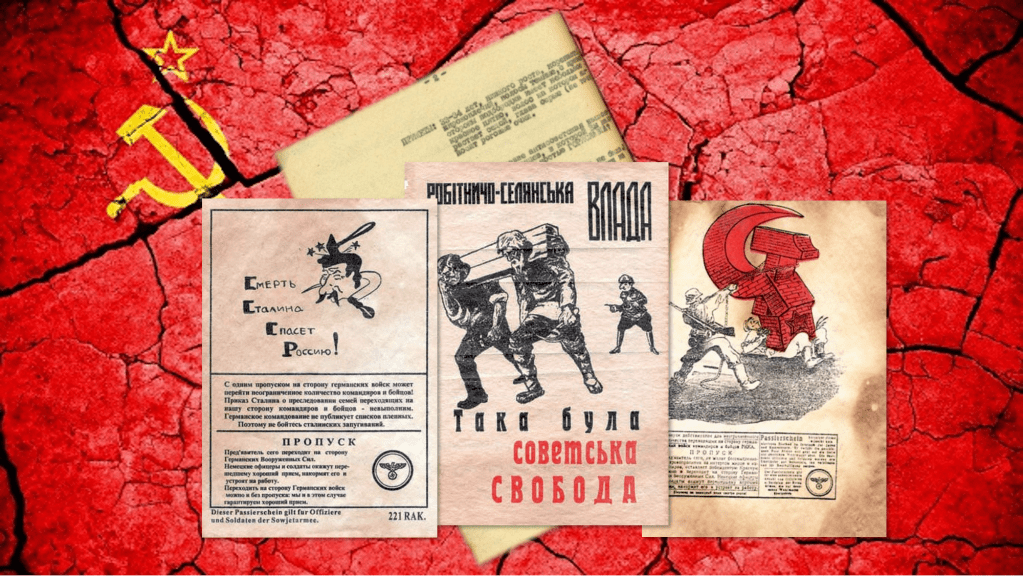
In recent days, the FSB archives for the so-called Donetsk People’s Republic have declassified excerpts of documents which shed light on the operations of Nazi propaganda schools for Soviet prisoners of war. Among the papers are interrogation transcripts from 1944–1947, in which former trainees describe in detail how they were taught to hate the Soviet Union and to “create an independent Ukraine in alliance with Germany.”
In early 1942, a school for propagandists — also known as “Sonderlager” — began operations under Germany’s “Eastern Ministry.” It was located in the settlement of Wustrow, Germany.
According to the declassified documents, the school was divided into three major blocks:
- Russian (6 groups of Russians and 4 groups of Belorussians),
- Ukrainian (9 groups),
- Caucasian (North Caucasian, Georgian, Armenian, Tatar, and Uzbek groups).
Each group consisted of 16 to 20 trainees. The training period lasted 3 to 4 months.
Who was selected? Primarily prisoners of war and Soviet citizens who had been deported to Germany—specifically those “disaffected with Soviet rule.” The educational requirement was a secondary education or higher. A personal dossier, complete with a photograph, was opened for each trainee. The trainees were outfitted in the uniform of the ROA (General Vlasov’s Russian Liberation Army).
The following are excerpts from five declassified interrogation records. The excerpts are translated in full, but some details (in particular, names) have been redacted from the declassification process.

Translation 1. This is the first two pages of an interrogation record of unknown length.
EXTRACT from an interrogation record from 3 July 1947
On this date, I, the counterintelligence department head for the MGB of the 12th Guards Tank Division Major ███████████, interrogated as a witness –
S███████ D██████ T██████████, born in 1910, native of the village of Shlyakhovaya in the Kigichevskiy [Kehychivka] region of Kharkiv Oblast, of peasant origin, Ukrainian, worker, higher education, citizen of the USSR, former member of the VKP/b/ [All-Union Communist Party (Bolsheviks)], and by his own statement, resided in a German prison from 1941 to 1945.
S███████ has been advised of his responsibility to provide honest testimony per Article 95 of the Penal Code of the RSFSR.
QUESTION: Tell us about the circumstances behind your recruitment into the school of propaganda agents of Germany’s “Eastern Ministry,” located in Wustrow.
ANSWER: While held captive by German troops, I was held in a prisoner of war camp for officers in the city of Vladimir-Volynsk [Volodymyr] where I worked since September 1942 as a policeman for the camp law enforcement. In late 1942, I was transferred by the “Eastern Ministry” commission and send to train in the German “Eastern Ministry” school for propaganda agents located in Wustrow.
Q: Describe for us this Wustrow school of propaganda agents.
A: The school for propaganda agents, or as they referred to it, the Sonderlager (special camp) under the German Eastern Ministry, located in Wustrow (Germany), was established in early 1942 by the Eastern Ministry. The school operated in three units: Russian, Ukrainian, and Caucasian. In turn, each of the units was broken down into groups.
The Russian unit consisted of 6 groups of Russian nationality and 4 groups of Belorussian nationality. In the Ukrainian unit, there were 9 groups of Ukrainian nationality, and in the Caucasian unit, there were a number of groups: North Caucasus, Georgian, Armenian, Tatar, and Uzbek. Each group consisted of 16 to 20 individuals.
Other than these groups, there was another group that trained the instructor staff of all of the nationalities. The training period ran from 3 to 4 months.
Q: What sort of people were selected into the propaganda agent school?
A: They primarily selected individuals of all of the nationalities of the Soviet Union who were dissatisfied with Soviet authority. Along with prisoners of war and citizens who were brought into German for labor, they also took all others who expressed a desire to come. The education level of incoming students was to be no lower than secondary. For each person being processed for the school, a questionnaire was filled out and photos were taken. All of the propaganda agents admitted to the school were outfitted in ROA [Russian Liberation Army] uniforms.
Q: What subjects were taught in the school?
A: I’m unable to fully reconstruct the training program in the German Eastern Ministry school for propaganda agents. I don’t recall the students being taught the following subjects:
Critique of Marxism-Leninism, German Philosophy, History of Ukraine, History of Germany, Nationalism and Internationalism, Germany’s War with the USSR and Reasons for Defeating the Red Army, Oratory and Propaganda Methods, The Jewish Question, and other anti-Soviet topics which involved the professors discrediting the Soviet Government and Soviet Legitimacy. Propaganda-agents, as the ideological fighters for implementing Nazi Germany’s plans, were taught to hate the Soviet regime.
The teaching staff was selected from a number of Russian White émigrés, as well as instructors and traitors to the homeland that came to Germany during the war.

Translation 2. This is Page 2 of an incomplete document; this is the only page provided from this specific document.
DESCRIPTION: 33-34 years old, short, stocky build, broad-shouldered, with dark hair, has a small red spot on the right side of his chin from which grey hair is growing; eyes are almost fully grey. Wears horn-rimmed glasses.
QUESTION: Is it true that the anti-Soviet nationalist indoctrination of the Ukrainian group, of which you were a part, was limited only to the activities of GORISLAVETS?
ANSWER: No, it was not limited in that way. In October, I can’t remember the precise date, we were all split up into 4 groups.
The first and second group were for those with a higher education, and the third and fourth were for those with secondary education or who had not completed their higher education.
Newly arrived leaders were assigned to each of these groups. The leader of the first group, to which I belonged, was Ivan Zakharovich KURGANSKIY, a former educator at the Teachers’ Institute in Artemovsk. Once the fourth group was created and its leader was assigned, we began receiving regular classes. These classes were chiefly conducted using lectures. Moreover, a system was put into practice for assignments to deliver lectures and reports by the group students.
The subjects of these lectures and reports varied. The following are the lectures that we attended in this camp that I can recall:
1. Why were the Bolsheviks victorious in October 1917?
2. LENIN’s letter to the Central Committee of the VKP/b/ before his passing
3. Reasons for collectivization
4. Soviet industry
5. The history of the Stakhanovite movement
6. The nature of Soviet patriotism
7. Reasons for the famine in Ukraine in 1932-33
8. Ukraine’s future
9. How the German National-Socialist Party united the worker with the business owner

Translation 3. This is Page 2 of an incomplete document; this is the only page provided from this specific document.
The lesson plan and the lesson topics were always approved by the head of all of the camps in Wustrow – Oberleutnant Frenzel.
All of the issued addressed in these lectures and reports were undoubtedly interpreted as anti-Soviet and nationalist in nature.
The objective of these classes involved propaganda ideas for creating an independent and self-sufficient Ukraine, allied with Germany against bolshevism.
The need to fight for an independent Ukraine and its alliance with Germany was stressed on a daily basis, and not just in these classes, but also in private conversations and in everyday activities.
To this end, for example, it was recommended to us that, upon meeting each other, a senior, or a group of individuals, instead of the standard greeting, we were to raise our right hand upward and say, “Glory to Ukraine!”
When speaking with us, GORISLAVETS would repeatedly assert that, if Finland – with its population of 3 million, is an independent state, then Ukraine with its population of 30 million and highly developed agriculture and industry, has even more of a right to be independent.
We were also systematically provided with various brochures and the magazine Golos, which contained various justifications for the need to fight for an independent Ukraine in an alliance with Germany.
QUESTION: So it can be stated that you in essence were not in a camp, but in a school to train Ukrainian propaganda-nationalists.
ANSWER: Yes, of course, it was exactly that: a school used for training Ukrainian propaganda-nationalists that just so happened to be in a camp in Wustrow.
Q: And consequently, upon graduation of this school, you – as a Ukrainian propaganda-nationalist – were to carry out a propaganda campaign for the creation of an independent Ukraine in an alliance with Germany.

Translation 4. This is Page 3 of an incomplete document; this is the only page provided from this specific document.
QUESTION: Where were the propaganda-agents dispatched upon graduating from the school?
ANSWER: We were sent into occupied areas of the Soviet Union, to prisoner of war camps and those holding Soviet citizens, as well as to carry out propaganda activities in the ROA, where we carried out anti-Soviet agitation work, and in so doing, singing praise to the “Russian liberation movement” and Nazi Germany.
Q: What do you currently know regarding the whereabouts of the official teaching staff and the propaganda-agents from the Wustrow school?
A: I know that, as the Soviet Army units approached, the entire teaching staff of the Wustrow school fled to western Germany. A significant number of the propaganda-agents and teaching staff are currently in hiding in German western zones of occupation, in the so-called Camps for Depatriated Persons near Hamburg and Herford (Westphalia). As I testified above, a number of the propaganda-agents were returned home in 1945 by way of repatriation.
Interrogated by: CHIEF OF THE COUNTERINTELLIGENCE DEPARTMENT OF THE 12 GUARDS TANK DIVISION MAJOR ███████████

Translation 5. This is the only page available for this document; it carried no page marking.
EXCERPT from the record of the interrogation of P██████ V██████ G██████████,dated 23 March 1944.
QUESTION: How did you occupy yourself when you were at the camp in Wustrow?
ANSWER: At first, on my arrival at the camp, we were used in various intra-camp work. In September 1942, a man came to us in the barracks, calling himself GORISLAVETS. Having called us all together, he began to inquire as to the circumstances of our having been taken prisoner and when, what the situation was in Ukraine, how the population live, are they not experiencing famine, is the land in the area near the front being cultivated, etc.
After this conversation, GORISLAVETS began visiting us almost every day. He brought brochures with him that any of a number of us present would read, accompanied by GORISLAVETS’s explanations. I do not recall the exact name of all of the brochures, but they were reports and speeches by Hitler at Nazi Party rallies, reports and speeches by GOERING, ROSENBERG, and so on, which stressed the advantages of the fascist system of government, not on the theory of class struggle, but on the solidarity and unity of the nation. In short, the purpose of GORISLAVETS’s explanations for the brochures boiled down to the fact that, having exterminated all of the Jews and having implemented the National-Socialist program, in a short amount of time, Germany has eliminated unemployment and improved the well-being of all segments of its population. All of GORISLAVETS’s readings and comments were directed at the pro-fascist and nationalist manipulation of this group of Ukrainians, which I was a part of.
Q: Who is this GORISLAVETS? Describe him for us.
A: Ivan Anufriyevich GORISLAVETS. As he told us, before the war he was a professor at the Dnepropetrovsk University in the Chemistry Department. His family is supposedly living in Nikopol. He was taken prisoner in 1941, but I do not know where he served or in what capacity.
Translation © 2026 by Michael Estes and TranslatingHistory.org

