
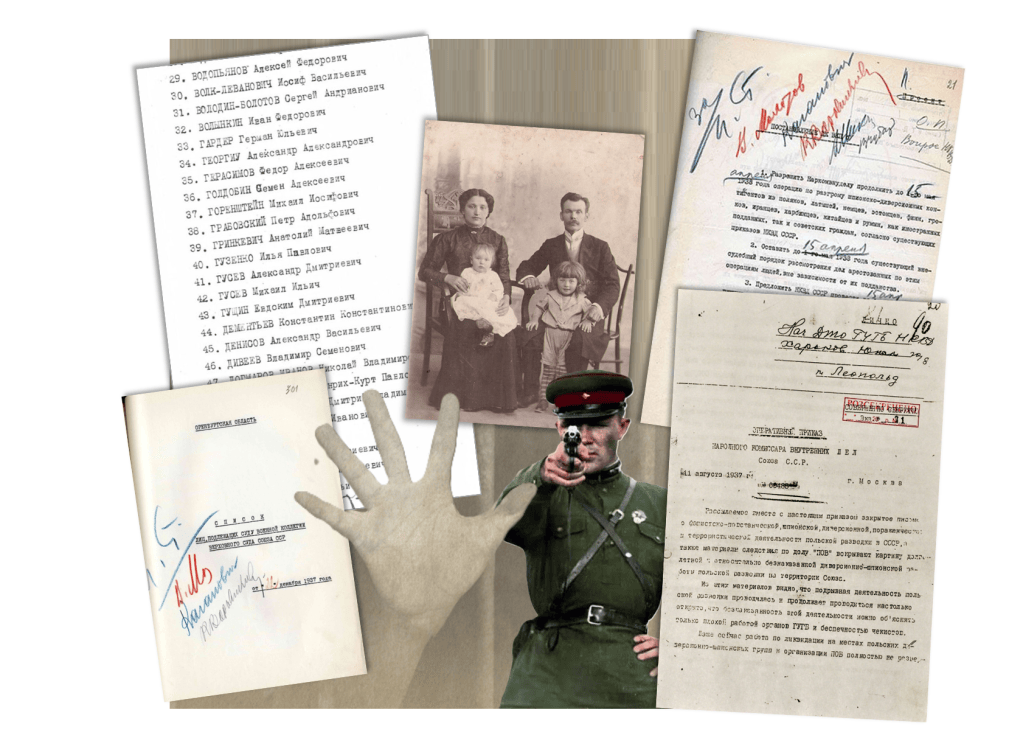
On August 20, 1937, the NKVD’s “Polish Operation” began.
It was one of many “national operations” carried out during the Great Terror, targeting ethnic Poles who were Soviet citizens, as well as anyone else who might have had some connection to Poland. It was initiated by Secret NKVD Order No. 00485, dated August 9, 1937, and a Secret letter dated August 11 regarding the “fascist-insurgent, espionage, sabotage, defeatist, and terrorist activities of Polish intelligence in the USSR.”
The operation lasted 15 months, concluding on November 17, 1938. During this period, 143,850 people were arrested; of these, 111,071 were executed by shooting, and over 28,000 were sent to labor camps.
Secret documents justified the operation by citing the need to dismantle a network of “sabotage and insurgent cells” allegedly established within the USSR’s Polish population by the so-called Polish Military Organization (Polska Organizacja Wojskowa, or POW)—an organization that had actually existed but had been disbanded back on November 11, 1918. In practice, the operation amounted to mass arrests and executions of anyone in the USSR whose surname even remotely resembled a Polish name.
There are thousands of copies of declassified being stored in the various archives of the former Soviet republics, many of which have seen the light of day over the past decade. We’ve translated a representative sample of some of the documents recently released by the Belarus-based website Kobylaki, which is a public initiative commemorating the victims of Soviet state repressions and mass executions specific to the Orsha region of Belarus. The site features a Russian-language searchable database containing names, execution dates, nationalities, and backgrounds for thousands of individuals repressed or executed in the region; a visual map of the region identifying the specific locations of executions and the home villages of the victims; and a catalog of personal testimonials, documents, and historical family records provided by descendants. It is an outstanding resource.

Document 1:
On the results of the Polish operation as of September 1, 1937
Top Secret
To Comrades STALIN, MOLOTOV, VOROSHILOV, and KAGANOVICH
In accordance with the USSR NKVD order regarding the swift elimination of Polish intelligence personnel, arrests began on August 20 targeting Polish defectors, political émigrés, prisoners of war, consular contacts, and other groups suspected of involvement in Polish espionage.
In total, as of August 30, 15,218 Poles have been arrested, including 5,410 in the Ukrainian SSR, 3,697 in the Byelorussian SSR, 776 in the Western Oblast, 1,293 in Leningrad, 615 in Moscow, 820 in the West Siberian Oblast, 450 in the Sverdlovsk Oblast, and 1,311 on the railway networks.
Preliminary operational results indicate significant achievements, both regarding the seizure of physical evidence during arrests and the exposure of spy-saboteurs and their activities.
BSSR
Initial interrogations of individuals arrested in Orsha led to the exposure of a Polish espionage and sabotage group led by A.I. Kamensky, whose two brothers are officers in the Second Department of the Polish General Staff. Kamensky identified 13 recruited saboteurs, including one at the Gorlovka power station, which he had targeted for demolition.
In the territory of the (now-dissolved) Dzerzhinsky District, 153 Poles were arrested, including 19 district officials, 8 NKVD personnel, and 24 employees of district organizations. Searches yielded several sets of weapons, explosive charges, bacteriological agents, documents incriminating the suspects in espionage, and large sums of foreign currency.
In the Smolevichi District, an 18-member sabotage group was uncovered; it had been organized by the district veterinarian, a Polish defector named Tur. Tur’s testimony revealed links to Polish intelligence agencies involving Pasmannik, a member of the Rightist organization and former head of the Veterinary Directorate of the BSSR People’s Commissariat of Agriculture (who has since been arrested), who had orchestrated the spread of mass infectious diseases among livestock on orders from Polish intelligence.
During an operation targeting Poles in Osveya, a six-person spy ring led by Cheresnets was uncovered and dismantled; the investigation established that the group had been operating on orders from German intelligence. There, the arrested Krasovsky confessed to espionage activities on behalf of Poland and named 15 spies linked to him, including an NKVD border guard officer.
In Gomel, Peyev — a member of a Polish sabotage and insurgent organization — confessed and named 10 accomplices.
The arrested Dauksha, who worked at the editorial office of the Polish newspaper Orka, confessed to membership in the POW [Polish Military Organization] since 1916; he testified regarding the involvement of the arrested former People’s Commissar of Agriculture of the BSSR, Benek, in the Mogilev-based POW network in 1918, and named a number of POW members in the central districts.
In Polotsk, the arrested Pole Voytsekhovich confessed to being a member of the White émigré “Russian All-Military Union.”
The results of the operation’s first few days — which are still far from complete, given that a significant portion of those arrested have not yet been fully interrogated or exposed — already demonstrate the class-based nature of the Polish intelligence service’s recruitment of agents. They also reveal the service’s specific targeting not only of border regions but also of various industrial centers and major enterprises, where numerous deeply clandestine, well-trained sabotage groups have been uncovered during the operation.
By September 1 of this year, 930 Polish agents had been convicted and shot.
PEOPLE’S COMMISSAR FOR INTERNAL AFFAIRS OF THE USSR
COMMISSAR GENERAL OF STATE SECURITY
September 1937

Document 2:
Special report from N.I. Yezhov to I.V. Stalin on the progress of the Polish operation
September 14, 1937
No. 60020
Secret
To the Secretary of the Central Committee of the All-Union Communist Party (Bolsheviks), Comrade STALIN
As a result of the ongoing operation to eliminate Polish intelligence networks, as of September 10 of this year, a total of 23,216 people have been arrested across the USSR from among Polish defectors, political émigrés, prisoners of war, consular contacts, and other groups suspected of involvement in Polish espionage.
This figure includes:
- Ukrainian SSR: 7,651 (of whom 1,138 confessed)
- Leningrad: 1,832 (of whom 673 confessed)
- Moscow Region: 1,070 (of whom 216 confessed)
- Byelorussian SSR: 4,124
- Western Region: 837
- Western Siberia: 1,325
- Railway transport: 2,943
Alongside the expansion of investigations into the cases described in the initial report, the results of further operational measures in specific republics and regions are as follows:
Belarus
Confessions obtained from the arrested Poles Anton Dudorchik and his son Mikhail have exposed a Polish intelligence sabotage organization at the Minsk power station, as well as long-standing preparations for sabotage activities there.
A.I. Apoznanskaya, arrested in Minsk, confessed that she had been recruited by the Polish consulate in Moscow. Acting on instructions from Polish intelligence, she gained the trust of military families and stole various military documents kept in the apartments of commanding officers. Some of the stolen documents were discovered in her apartment.
M.S. Oshker, a Polish spy arrested in Orsha, identified during interrogation members of the Polish intelligence network operating in factories near Moscow — specifically at Aircraft Plant No. 22.
In the Smilovichi district, a local POW sabotage and insurgent cell known as “Piłsudski’s Bullet”, comprising 15 members, was eliminated. The organization was led by S.K. Skorobogaty, who maintained operational ties with agents Bulgak and Vrublevsky, operatives of the 2nd Department of the Polish General Staff who had illegally entered USSR territory.
In addition to sabotage and espionage, the organization’s members were preparing terrorist acts against local Soviet and Party officials.
Seven Polish defectors—all ethnic Belarusians—were detained in the sector of the 18th Border Guard Detachment. Investigations established that the entire group had been sent by Polish intelligence agencies with orders to settle within the territory of the Byelorussian SSR.
Testimony provided by Polish agent Drozdovich revealed a large-scale operation in which he smuggled anti-Soviet individuals into Poland for processing and recruitment by Polish intelligence, followed by their return to the USSR. Drozdovich named dozens of Polish spies whom he had facilitated into the country over an 11-year period and who had settled deep within the Soviet interior.
In total, based on testimony from those arrested during this operation, 26 Polish spies operating in other cities across the Soviet Union were identified and exposed.
WESTERN OBLAST
The arrested Polish defector M.A. Mikhnyuk, an assistant locomotive engineer at the Unecha depot of the Belarusian Railway, confessed that in 1930 he had been recruited by E. Yanus, assistant chief of the Mikoshevichi political police, and illegally infiltrated into the USSR. Once there, acting as a resident agent, Mikhnyuk established contact with a number of Polish spies sent in by Polish intelligence — specifically, those working on the Belarusian Railway.
In total, by September 10 of this year, 1,251 Polish agents had been convicted and shot.
People’s Commissar for Internal Affairs Commissar General of State Security Yezhov
AP RF. F. 3. Op. 58. D. 254. Ll. 173–188. Original. Typescript.

Document 3:
Special report from Yezhov to Stalin and Molotov, enclosing a copy of a telegram from the Assistant People’s Commissar of Internal Affairs of the BSSR regarding the results of the investigation into the “Polish line” during the first two five-day periods of September
September 14, 1937
Top Secret
To Comrades STALIN and MOLOTOV
I am forwarding a copy of telegram No. 714/NS from the Assistant People’s Commissar of Internal Affairs of the BSSR, Comrade Khorkhorin.
People’s Commissar of Internal Affairs of the USSR
(YEZHOV)
September 14, 1937
<No. 60039>
Top Secret
Telegram No. 2763.
To the People’s Commissar of Internal Affairs of the USSR, Comrade YEZHOV
From Minsk, dated September 14, 1937
As a result of the investigation into the “Polish line” during the first two five-day periods, 63 Polish spies, saboteurs, and members of the POW have been exposed. The testimony of these arrested individuals, who have confessed, implicates 239 [sic] people — members of espionage-sabotage networks, insurgent organizations, and the POW — including 23 individuals in Moscow, 9 in Leningrad, and 8 in other locations across the Union.
Thus, at its very outset, the investigation is uncovering an extensive underground network that had been built up in Belarus by Polish intelligence over the course of years. Of particular importance is the testimony provided by the arrested individuals: KAVTSEVICH (linked to the POW center in Belarus); SHATKOVSKY (linked to the Moscow POW group, specifically to former police officer VAITYGO); DROZDOVICH (revealing a network of key Polish intelligence agents infiltrated into Belarus over several years); DUDARCHIK (revealing Polish sabotage activities at the Minsk power plant); TUR (revealing Polish intelligence sabotage techniques targeting horse breeding and livestock farming in the BelSSR); DAUKSHA (revealing the activities of the Mogilev POW organization); and LOPAREVICH (revealing a sabotage and insurgency network established by Polish intelligence using former members of political bandit groups).
All materials, including details on relevant individuals, particularly those located in Moscow and Leningrad, were set out in full in two special bulletins (covering the period up to September 1st and the first five-day period of September) sent to you on September 5 and 9 of this year under Nos. 82257 and 82284.
Regarding the city of Minsk, the following additional information covers the second five-day period of September of this year:
1) IVASHKEVICH, Iosif Antonovich — confessed to being recruited in 1920 by Lieutenant Pytlyasinsky of the Second Department of the Polish General Staff; he was sent to Minsk that same year with intelligence and sabotage assignments. In 1921–1922, he stole and handed over to Polish intelligence the deployment plan for military units in the Minsk district; this document had been in the possession of Iosif Lukyanchik, the former head of the Operations Department (OPEROD) of the NKVD of the Byelarus SSR, whom we had previously arrested and sent to Moscow. Ivashkevich had been hired for the Minsk district military headquarters staff by Lukyanchik, who was aware of his desertion from the Red Army, his service in the Polish gendarmerie, his illegal crossing into Poland, and his subsequent return to the USSR. He recruited four individuals for espionage work and formed a sabotage group consisting of another four individuals. We are currently identifying all of them for arrest. He transmitted espionage materials via Polish consulate agents in Minsk: the priest Ussas (expelled to Poland in a 1925 exchange) and Kovalsky, who lived in Minsk posing as a newspaper vendor. The newspaper trade served as a cover for clandestine handovers. Kovalsky is currently in Gomel and is being arrested.
In addition, Ivashkevich was contacted by Iosif Botyanovsky, an intelligence agent who had arrived from Poland (we are currently locating him for arrest). According to Ivashkevich’s testimony, Botyanovsky had been infiltrated into the USSR with the assistance of Novitsky, who served in the Zaslavl border detachment in 1925 (Novitsky’s whereabouts are currently being determined). Botyanovsky gave Ivashkevich a detailed account of the assignments for which he had been sent into the USSR.
2) SHATKOVSKY, Frants Iosifovich — additionally testified that he was sent from Moscow to Minsk by his sister, SHATKOVSKAYA (also known as Stanislava Ivanovna BEKMAN), with instructions to report to PRINTS, a member of the Belarusian Center of the POW. PRINTS was arrested by us earlier; while implicated by a number of indirect testimonies, he has not confessed. SHATKOVSKY provides a detailed account of reporting to PRINTS using an agreed-upon password and of his subsequent work for the POW under PRINTS’s direction. We are using SHATKOVSKY’s testimony to compel PRINTS to tell the truth.
3) MOGILNITSKAYA, Evgeniya Fedorovna — testified regarding the existence of several major clandestine transit channels in Minsk linked to Polish intelligence. The primary channel is headed by the itinerant musician Pyotr Vladimirovich LUKOMSKY and Ekaterina Genrikhovna VRONSKAYA, who lives in Minsk illegally. LUKOMSKY is linked to a spy den run by Varvara Pavlovna MELKAMINOVICH, a woman with no fixed occupation. Eighteen individuals are implicated by the testimony, including long-distance train attendant DUBOVIK and telegraph workers, and we are carrying out arrests.
4) DUDARIK, Mikhail Antonovich — having confessed to being recruited by Polish intelligence and taking a job at the Minsk power station to carry out sabotage missions assigned by Polish intelligence, he additionally identified the Polish intelligence resident in Minsk, former director of the Minsk radio hub DOBRIAN, as the person directly supervising the sabotage operations. DOBRIAN is being arrested.
5) DOVNAR, Kazimir Alexandrovich — confessed to being recruited in 1929 by the Stolptsy intelligence post of Polish intelligence. Subsequently, he made systematic illegal visits to Soviet territory, meeting with intelligence representatives and transmitting military intelligence materials. In 1931, he was given a contact point to meet a Polish intelligence resident at Negoreloye station: the Polish railway representative BORODOVSKY (whom we expelled in 1936). DOVNAR maintained contact with BORODOVSKY both directly and through a Polish intelligence liaison, Boleslav Konstantinovich TUMILOVICH, who worked as a switchman at Negoreloye station. TUMILOVICH is being arrested.
6) BARTKEVICH, Zenon Semenovich — confessed to being recruited in 1934 by a key Polish intelligence resident, Anton DOVNAR. BARTKEVICH provided information on a number of individuals who had contact with Anton DOVNAR during the latter’s visits to our territory; these statements exposed a spy network established by Anton DOVNAR across several village councils in the former Dzerzhinsky District.
Most of the participants were arrested by us previously; the remaining ones are currently being arrested.
No. 714/N.S.
September 14, 1937. KHORKHORIN.
TsA FSB. F. 3. Op. 1. D. 105. Ll. 244–249.

Document 4:
Special report from N.I. Yezhov to I.V. Stalin, enclosing a copy of a memo from M.D. Berman regarding the Polish Military Organization
September 17, 1937
No. 60147 | Top Secret
To the Secretary of the Central Committee of the All-Union Communist Party (Bolsheviks), Comrade STALIN
I am forwarding a copy of the direct-line memo No. 718/SN from the People’s Commissar of Internal Affairs of the BSSR, Comrade Berman.
People’s Commissar of Internal Affairs of the USSR Commissar General of State Security YEZHOV
To the People’s Commissar of Internal Affairs, Comrade YEZHOV
The investigation into the Polish operation in Vitebsk has uncovered the “POW” — an organization that was conducting active espionage and sabotage, stockpiling poisons (seized during searches) and weapons (partially seized) for sabotage purposes, and preparing a major terrorist act. The leaders of the organization are: Anton Vatslavovich VRUBLEVSKY, a mathematics and radio engineering teacher, a member of the POW since 1919, recruited in Kyiv by the Polish consul; Aleksandr Aleksandrovich SNARSKY, an engineer, a member of the POV since 1918, recruited by the Polish consul in Leningrad; Frants Romualdovich DIAKEVICH, an electrical technician, a member of the POV since 1932, recruited in Vitebsk; Georgy Ivanovich MAKOSEVSKY, a mathematics teacher, a member of the POW since 1931, recruited in Vitebsk; Mikhail VANIDOVSKY, a technician, a member of the POW since 1925, recruited in Vitebsk. Testimony from the arrested individuals who confessed has exposed a campaign of sabotage carried out over an extended period at several enterprises in Vitebsk. The most significant acts of sabotage included repeated incidents (over 50 in total) causing breakdowns at the Belelektroenergo substation in Vitebsk and the arson of a furniture factory. The organization took its direction primarily from the Polish mission in Moscow through the sister of the aforementioned Vrublevsky — Maria Vatslavovna Vrublevskaya, who lived in Moscow and was married to the chemical engineer Mikhail Bogdanov (also a Polish agent). Testimony from the detainees identified 44 members of the organization, including Lev Isayevich Kokhanov, Maria Vrublevskaya’s first husband, who resided in Moscow. During his time in Leningrad between 1920 and 1924, Antoni Vatslavovich Vrublevsky served as an intelligence courier. Aleksandr Aleksandrovich Snarsky (aged 28, a civil engineer residing in Astrakhan) is the son of Aleksandr Aleksandrovich Snarsky (who was arrested in Vitebsk); a second son, Georgy Aleksandrovich Snarsky (aged 23), is a graduate of the Kharkov Institute of State Trade and resides in Kharkov. Also identified were Ivan Mikhailovich Orlov, Antonina Tikhonovna Orlova, and Evgeniya Ananyevna Nikolskaya; these individuals resided in Leningrad and were linked via intelligence activities to Snarsky, who was based in Astrakhan. Levandovsky, a teacher at a Polish school in Vitebsk who relocated to Moscow (identifying details are being ascertained), and Romuald Malinovsky, a former Polish Army officer and defector who moved from Vitebsk to Moscow in 1934. The Snarsky family members are linked to the organization’s terrorist activities. In 1934, they met with Mikhail Nikolayevich Snarsky, a member of a foreign terrorist organization who had arrived from Poland using forged documents under the name “Berdik.” All identified members of the organization located in Belarus are being arrested. In Polotsk, Adam Kazimirovich Nemiro, a district collective farm accountant arrested in connection with Polish intelligence activities, confessed to having been recruited and sent to the USSR by Polish intelligence agencies in 1924. He maintained contact through his cousin, Florian Nemiro, a Polish intelligence agent who made illegal visits to Soviet territory. In 1927, acting on Polish intelligence orders, Adam Kazimirovich Nemiro traveled to the Donbas region, where he was contacted by Polish intelligence resident Isaak Yefimovich Altman; together, they recruited two individuals for sabotage operations: Aleksandr Vorostyansky, a ventilation foreman at the Karl Marx Mine in the Yenakiyevo district, and Georgy Timofeyevich Gutnikov, a timber yard foreman at the same mine. These men subsequently orchestrated an explosion at the Karl Marx Mine in 1929 and a collapse at Mine No. 2. In July 1932, NEMIRO returned to Belorussia, where he established contact with a Polish intelligence courier named SEREDEVSKY; NEMIRO subsequently passed on espionage materials regarding military construction to him.
BERMAN
AP RF. F. 3. Op. 58. D. 254. Ll. 196–199. Copy. Typescript.

Document 5:
Telegram from the People’s Commissar of Internal Affairs of the BSSR to the People’s Commissar of Internal Affairs of the USSR regarding the results of the Polish operation for September 10–15, 1937.
September 17, 1937
Telegram No. 2793
From Minsk
Moscow, NKVD, to Yezhov.
September 17, 1937
During the five-day period of September 10–15, 23 individuals confessed regarding the “Polish line.” A further 207 people were arrested, including: 55 Polish defectors; 1 political émigré; 66 individuals who assisted the “White Poles” during the occupation; 27 members of the counter-revolutionary core within Polish colonies; 36 individuals with relatives in Poland linked to intelligence agencies; 8 participants in espionage networks; and 14 participants in “White Polish” gangs.
A search in Vitebsk uncovered toxic substances (potassium cyanide, Paris green, cyan-chloramine, and others) intended for acts of sabotage, as well as a rifle and a revolver with ammunition, all hidden beneath the floorboards.
The investigation has received indications regarding the existence of an arms cache; a search is underway. The investigation has been concluded, and summary reports on 198 individuals have been prepared and are being forwarded to you for review today.
No. 719 BERMAN
TsA FSB. F. 3. Op. 4. D. 107. L. 235. Copy.

Translation © 2026 by Michael Estes and TranslatingHistory.org

