
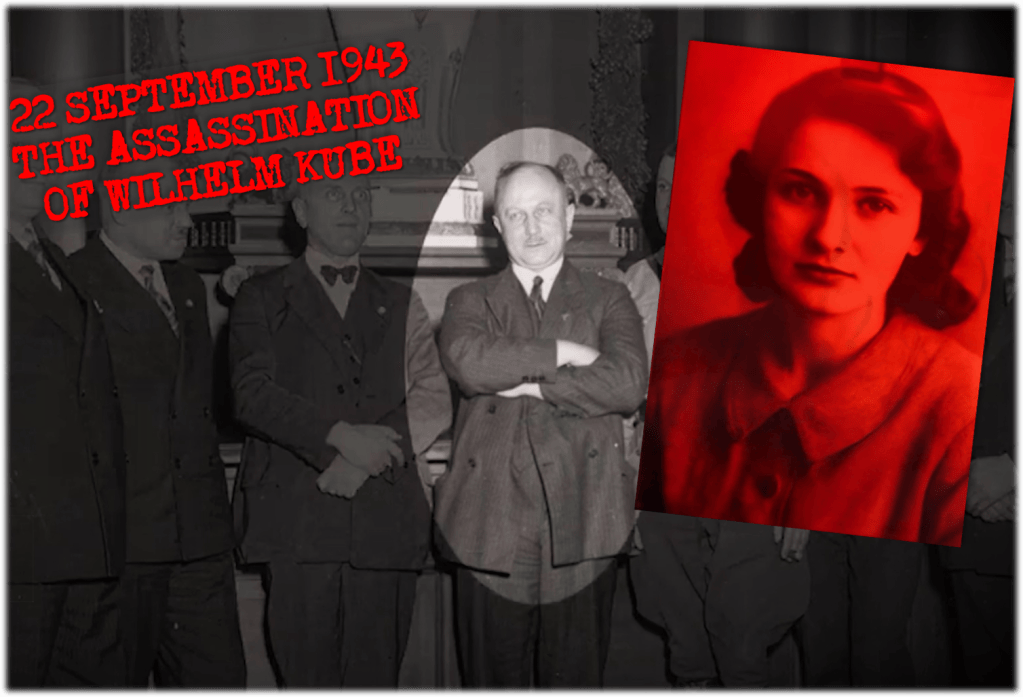
Wilhelm Kube was not a nice man, but the same could be said of so many others before and after him who donned the swastika armband. He is the author of the infamous quote, “What plague and syphilis are to humanity, are Jews to the white race.” That should be proof enough of the sort of man we’ll be talking about in today’s article.
A bit of background, courtesy of the primary Belarus news website. Then, into the translations.
In September 1933, the theater in the town of Schneidemühl premiered a play by Wilhelm Richard Paul Kube titled “Totila, King of the Goths.” It was a work with a distinct Nazi slant, bombastic and ideologically aligned with the regime. Party officials pinned their hopes on the production and promoted it across the country. The Schneidemühl stage was a special case; the town was the capital of a border province, and its theater served as a tool to bolster the German spirit along the eastern frontiers of the Third Reich.
Following the premiere at the borderland theater, not only was the national spirit bolstered, but the author’s own standing on the home front was strengthened. Kube was a graduate of the University of Berlin, where he had studied history and law. He sought to make his mark in literature, political commentary, and journalism, serving as the editor of two conservative newspapers and as a member of the Reichstag.
“Hitler held Kube in high regard. For one thing, he was extremely active in building up the party. Indeed, thanks to Kube’s involvement in organizational efforts, NSDAP membership numbers would surge in the regions where he was active—something Hitler greatly valued. Furthermore, many overlook the fact that he was one of the most educated Nazis and a theorist of National Socialism,” noted Igor Marzalyuk, a deputy of the House of Representatives of the National Assembly of Belarus, Doctor of Historical Sciences, and professor.
From the outbreak of the Great Patriotic War and the occupation of Belarus until the end of the summer of 1941, authority in the Nazi-occupied territories rested with the military — specifically, the Wehrmacht. It was the Wehrmacht that was responsible for establishing the first camps and ghettos and carrying out the initial mass exterminations.
The Wehrmacht laid the foundations of the occupation regime, a system that required maintenance and reinforcement. In July 1941, Hitler issued an order to transfer authority in the occupied territories from the military to a civil administration. With the order issued, candidates had to be selected to serve in the occupied regions. On July 17, the Führer held a meeting with the Reich’s top leadership; it was there that Kube’s name came up.
Kube arrived in the General District of Belarus on September 1, 1941. A dedicated “man of the system” and loyal to Hitler, he never forgot that he had secured the post of General Commissioner [Generalkommissar] through the Führer’s patronage; consequently, he was prepared to do his utmost to live up to that trust.
On September 9, Kube issued his first order requiring the population to surrender their weapons. Failure to comply was punishable by execution. Execution also awaited anyone who knew who possessed weapons or where they were hidden but failed to report it. Kube’s arrival also marked the beginning of the extermination of the mentally ill; more than 500 people were killed.
“He held specific views on the extermination of people. I would call him an ‘aesthetic executioner’ because he wanted the process to unfold — well, let’s just say ‘more aesthetically’. He wanted to avoid excessive bloodshed and ensure that as few people as possible knew about it,” said Natalia Yatskevich, a department head at the Belarusian State Museum of the History of the Great Patriotic War.
Upon his arrival in Minsk, a separate residence for the General Commissar had not yet been secured, so Kube was allocated five rooms within the General Commissariat building itself. Later, he traded these five-room quarters for a three-story, 18-room mansion on what is now Engels Street. The building no longer stands, but it was located on the grounds of the present-day 2nd Hospital.
Kube’s workday followed a very steady routine. He would rise at 9:00 a.m., have breakfast, and leave for work at 10:00. At 1:30 p.m., he would return for lunch and a rest, sometimes taking a stroll in the garden. At 4:00 p.m., the General Commissar would head back to work, though only for a short time. He would return at 5:30 p.m. for coffee and relax again until the evening.
Kube was a fervent Nazi and an active implementer of the policy of genocide, zealously carrying out the program for the total extermination of the Jewish population. He frequently repeated the phrase that “what the plague and syphilis are to humanity, the Jews are to the white race.” It was he who issued the order to all Germans in the occupied territory of Belarus to exterminate 40,000 Jews.
The Nazis carried out the first mass pogrom in the Minsk Ghetto on November 7, 1941. Gestapo agents surrounded several blocks of the ghetto; they lined up the people they had rounded up into a column, handed them a red banner, and took their photograph. It looked as though preparations for a demonstration were underway. Once the photography session ended, the Gestapo ordered those who worked for German institutions to step out of the column; these individuals were taken to the area of the bread factory on Rakovskaya Street. The Germans transported the remaining several thousand Soviet citizens by truck to the outskirts of the city, to the Tuchinka district, where they were all shot and subsequently burned.
In March 1943, German executioners arrived at the orphanage. They slaughtered virtually all the children there. The next day, they finished off the survivors with daggers. The operation was carried out to the accompaniment of an accordion to drown out the children’s screams. Kube himself decided to verify the extermination of the 300 children; he arrived at the execution site. Ghetto prisoners were lined up near the pit filled with the children’s bodies to greet Kube. He did not arrive empty-handed; he handed out lollipops to the survivors.
“There are some accounts, perhaps contradictory ones, yet they reached the Soviet command, suggesting that some of the children who had been shot were still alive in the pit. Kube personally walked over and tossed handfuls of candy to the children,” recounted Aleksander Kislitsky.
Ghetto pogroms and mass exterminations, the gassing of hospital patients, the establishment of concentration and death camps, and the execution of punitive operations (during which villages were burned down by the dozen and civilians shot) all served as the trigger for the elimination of Kube.
More than a dozen special groups and units received orders via various channels to eliminate the Generalkommissar of Belarus. Each group devised its own assassination plan. Kube was referred to by the code names “Kaban” [Bear], “Sova” [Owl], and “Dramaturg” [Playwright].
The Loshitsa Manor was one of Kube’s residences; it served as his summer estate. The General Commissioner visited frequently and enjoyed strolling through the park. Yet, history holds a curious twist: in the 1930s, a secret training facility operated at the estate, training undercover intelligence agents to fight against the Polish occupation. One of the school’s graduates was future Hero of the Soviet Union, Kirill Orlovsky. He was the very man who, in February 1943, attempted to assassinate Kube in the woods near Baranovichi as the Nazi leadership was returning from a hunt; however, Kube had skipped that particular winter outing.
Several assassination attempts were made against Kube — in an officers’ mess, at the theater, and at a harvest festival in Smolevichi (an operation involving Nadezhda Troyan) — but none succeeded.
Preparations for a historic operation began on September 1, 1943. The exact starting point is known from a report by Nikolai Fedorov, commander of a Red Army General Staff reconnaissance party. He wrote: “The sabotage was carried out by people working under me: ‘Chernaya’ — Maria Osipova, ‘Galya’ — Yelena Mazanik, and ‘Olya’ — Valentina Shutskaya.”
Fedorov’s report also reveals that several sabotage groups had attempted to recruit “Galya.” It is also possible that Gestapo agents were sent to infiltrate her circle.
The initial plan was to poison the General Commissar, but that idea was abandoned in favor of using an explosive device. Mazanik, who worked on the third floor of the General Commissar’s residence and had no access to the second-floor bedroom, nevertheless managed to plant a bomb under the mattress of Kube’s bed.
The bomb was planted at 11:00 a.m. At 11:30 a.m., Yelena and her sister were at the designated spot, ready to leave the city. They were traveling by car from Minsk to reach the partisan detachment. They brought with them baby swaddling blankets and shirts with them to use as a cover story in case they encountered a police patrol; their pretext was that they were on their way to a christening. The driver took them as far as the village of Vishnevka; from there, they walked about 15 kilometers to the village of Vyacha, where a horse-drawn cart was waiting to take them to the village of Yanushkovichi in the Logoysk district. There, they were met by Nikolai Fedorov, the deputy commander for intelligence operations of the “Dima” partisan detachment — the very unit from which Nadezhda Osipova had obtained the bombs.
The explosion rocked the building shortly after midnight on September 22. The blast tore away the left side of the General Commissioner’s chest and severed his left arm, proving fatal. A team responding to the alarm pulled his charred remains from the burning bedroom. His wife, who had been lying beside him, survived the incident but suffered severe nervous shock.
Wilhelm Kube became the highest-ranking Nazi official in the occupied territories to fall to assassination. At the same time, the event marked a failure for the Third Reich’s security services. Hitler declared a period of mourning in Germany, only the second and final time he would do so during the Great Patriotic War. The first instance had followed the defeat of German forces at Stalingrad.
Kube’s body was transported to Berlin, where an elaborate funeral with full military honors was held. Hitler posthumously awarded him the Knight’s Cross with Swords.
On the night of October 11–12, 1943, Yelena Mazanik, Maria Osipova, and Nadezhda Troyan flew to Moscow from a partisan airfield in Begoml. On October 29, a decree by the Presidium of the Supreme Soviet of the USSR conferred upon them the title of Hero of the Soviet Union. The awards were presented in the Kremlin on November 3. However, neither the decree nor the ceremony itself was reported in the press; this marked the first time the title of Hero was awarded in secret. The women’s heroic feat only became public knowledge after the war. Years later, declassified documents revealed the codename for the operation to eliminate Kube: “Dramaturg.”

We are able to present a series of interesting documents and snippets of documents that we translated over the past few days. The first is an extract of the original order calling for Kube’s liquidation. The second is a first-hand account of Kube’s assassination, courtesy of an interview (shortly after the act) by Yelena Mazanik herself. The third is the German report on the results of the investigation into Kube’s death, intercepted by Soviet operatives in Germany and translated into Russian. Because the documents have been presented to us in fragments, they don’t paint the entire picture, but the picture presented is still vivid enough. Enjoy.

Document 1: Order for the disposal of Wilhelm Kube. Origin unknown, although it is highly likely to have been written and disseminated by the NKVD.
The group “Novvye” [New] is instructed to carry out the following missions:
1. Dispose of HITLER’s appointee, the representative for Belarus Wilhelm Kube [handwritten].
2. Conduct military-political intelligence collection, and report all information acquired to the NKVD of the USSR.
At the same time, shed light on the situation of the population in the temporarily-occupied territory
In order to carry these missions out, the group will establish contact with agent assets and the necessary trusted individuals.
Document 2: The interview of Yelena Mazanik – exact date and agency performing the interview is unknown.
QUESTION: Are you able to recount the layout of the rooms in KUBE’s house?
ANSWER: The first floor housed the kitchen, laundry and other services, and that’s also where the house’s cleaning staff lived. The second floor had KUBE’s bedchamber, the dining room, the bathroom, and the three children’s rooms. On the third floor, you would find KUBE’s office, his wife’s room, a guest room, two rooms for his aide WILDENSTEIN,and two rooms for overnight guests.
Each of the cleaning girls had their own floor as their work area.
Q: What floor did you work on?
A: I cleaned the third floor. Galina, the younger one, cleaned the rooms on the second floor. It was categorically forbidden for us to go to rooms that were not on our floor. For example, I was not allowed to go to second floor rooms, and young Galina could not be on the third floor. We were also prohibited from meeting or speaking with each other.
Cleaning personnel were expected to not only clean the rooms of the house, but also stoke the stoves, and even had to carry firewood up to the second and third floors.
Q: How much were you paid for this work?
A: Each of us received 22 Marks per month from the general commissariat.
Q: Tell us about your daily work schedule.
<break>
A: Since I actually worked on the third floor, all day long I would consider the challenge of how to get to the second floor and carry out what I was setting out to do. Knowing that, if I were to succeed, I would have to depart immediately, I came up with the following scenario in advance: from first thing in the morning I would complain to WIDENSTEIN and KUBE’s wife that I had a very bad toothache, and that I would have to get to the dentist straight away. Having secured their permission to leave the premises and not return to work for the remainder of the day, I began to look for ways to plant the bomb under the bed.
Q: How were you able to manage that?
A: At ten that morning, KUBE departed for work. By that time, WILDENSTEIN was also no longer present in the house. KUBE’s two older children had been sent off to school. Thus, the only people left in the house were KUBE’s wife with the baby, Galina, and Yanina.
At the time, KUBE’s storeroom and pantry were depleted, so KUBE’s wife, together with the baby and Galina, left to do the shopping. Here was a favorable situation to get to the second floor. I decided not to waste the opportunity, and carried out what I set out to do.
Q: Weren’t you afraid that Yanina, who was still in the house, could be a problem?
<break>
A: [Missing text indicates this answer is joined in progress] Carrying the loaded bomb, I grabbed the baby’s knickers in case anyone suddenly came into the room, to make it appear as though I was looking for thread to darn the knickers.
Having quickly gone through all of the rooms on the second floor and seeing that nobody was around, I dashed into the bedroom, planted the bomb under the mattress springs, and then sat down on the bed to make sure that the bomb wouldn’t fall out under the weight. Everything was in order, and I started to leave the room. Just then, I bumped into Yanina, whom I told I just couldn’t seem to find the right type of thread to darn the knickers.
Next, mentioning that I had received permission from the lady of the house, I told Yanina that I was off to the dentist, and it was possible that I wouldn’t be at work the next day.
By this time, by prior arrangement, Maria had set it up with the chauffeur that all of us – my sister Valya, Maria, and I – would be brought to the team’s location.
The immediate preparations for killing KUBE were conducted by both me and Maria, but Valya and the team commander FEDOROV knew of it. She – Maria – is the one who brought the bomb to me.
Q: When was this?
A: 20 September 1943. Maria explained to me how the bomb could be set up while in my apartment, and practically since that time, I’d been making preparations to carry out the conceived plan that only my sister Maria knew of.
Q: Where did she work?
A: She was a cook for a German judge. Valya and I charged the bomb the night before 21 September, since its clockwork mechanism was designed to run for 24 hours. We planned it so that the bomb would explode at night while KUBE slept.
Q: Maria brought you one bomb?
A: Yes. We decided to plant one bomb. That night, when the bomb was charged, Valya and I hardly slept. At about half past six the next morning, I placed the bomb, wrapped in a handkerchief, into my handbag and set off for work.
Q: Weren’t you concerned that you could be searched and the bomb found?
A: Of course there were concerns, but I was walking with firm resolve. Sometimes, when service staff entered the house [page cuts off]…
Document 3: German report on the results of the investigation into Kube’s assassination
Copy Translated from German
SECRET!
30 September 1943
RESULTS of the investigation into the murder of General Commissar of Belarus Wilhelm Kube the night of 22 September 1943 //Secret report, Copy No. 410/42, Secret//
At 0040 on 22 September 1943, a bomb detonated in the bedchamber of the General Commissar of Belarus and Gauleiter Wilhelm Kube. The blast resulted in the left side of the General Commissar’s chest being torn from his body, along with his left arm. The impact of the explosion, without a doubt, proved fatal. His partially-burnt corpse was pulled from the burning bedchamber by a team summoned to action. Kube’s eight-month-pregnant wife Anita (nee Lindenhall), who was lying at his side at the time, remained unharmed and suffered nothing more than nervous shock. The three young children, who were sleeping in a separate room on the other side of the bathroom, were also unharmed.
The bedchamber was almost completely destroyed by the blast. Residential building No. 27 on Teatralnaya Ulitsa, directly adjoining the General Commissariat’s domicile, remained outwardly undamaged.
A “large special committee” was immediately put together, consisting of SS Sturmbannführer and criminal advisor Wendorf as the lead, and specialists from the criminal sector headed by SS Obersturmbannführer and criminal commissar Wreyer, as well as Staatspolizei representative SS Obersturmbannführer and criminal police commissar Heiß. During the committee’s investigation, while sifting through ash and debris, a piece of material was found, which Obersturmbannführer Wreyer (based on previous investigations conducted in connection with bomb-related sabotage in a number of German institutions) identified that, in this case, they were dealing with the remains of a magnetic delayed-action mine fuze, of English manufacture, with an indefinite delay. As the investigation showed, the detonated bomb was presumably set for 12 hours and attached to the inside of Kube’s mattress, on the mattress spring, where it exploded. The impact of the explosion was limited by the mattress and Kube’s body. This explains why Kube’s wife did not also succumb to the blast.
Since the Gauleiter’s home was guarded day and night by his 12-man personal security, the question immediately arose regarding the domestic staff and those individuals who had access to the Gauleiter’s chambers. The investigation began with the immediate establishment of the list of individuals who had visited the Gauleiter’s home in the days leading up to the assassination. At the scene of the crime, four girls from the Gauleiter’s service staff were arrested and jailed. An initial examination of the four in the early stages revealed no correlation with the assassination. However, early in the morning of 22 September 1943 it was discovered that the only member of the service staff who lived outside of the Gauleiter’s home (because of lack of space), Yelena Mazanik, date of birth 4 April 1918, was not found at her apartment (Number 48 Teatralnaya Ulitsa, Apartment 10, Minsk). Since no small amount of suspicion already existed under the circumstances described, her apartment was forced open. The apartment turned out to be nearly empty. The sister who lived with her, Valentina Shutskaya, also known as Valya (year of birth 1918), was also determined not to be home. Inquiries made at Shutskaya’s place of employment (a casino belonging to a German judge living in Minsk) indicated that Shutskaya, supposedly because of varicose veins, left work at 1030 on 21 September 1943. So that she wouldn’t be searched for that day, before departing she asked to move her day off to 21 September 1943. During the course of a thorough interrogation, the assets that had communicated… [document cuts off].

Translation © 2026 by Michael Estes and TranslatingHistory.org

